

Official Selina Concise Textbook Solutions for Class 8 History Civics
Access the official Selina Concise textbook solutions for Class 8 History Civics, updated for the 2026-27 academic year. This digital resource is structured to help students build strong conceptual clarity and prepare effectively for school examinations.
Read and Download Chapter 03 The Judiciary Solutions
Access the complete PDF for Chapter 03 The Judiciary below. This focused excerpt allows students to isolate specific topics for thorough review and uninterrupted reading, complementing standard ICSE textbooks.
I. Fill in the blanks:
Question 1. The ________ is the highest court of appeal in India.
Answer: Supreme Court
In simple words: The Supreme Court is the highest and final court where people can make an appeal in India.
Exam Tip: Remember that the Supreme Court is the final court of appeal, meaning its decisions cannot be challenged in any other court.
Question 2. The Supreme Court of India consists of a Chief Justice and ________ other judges.
Answer: 30
In simple words: The Supreme Court has one Chief Justice and thirty other judges.
Exam Tip: Note that the Parliament has the authority to change the number of judges from time to time.
Question 3. The judges of the High Court retire at the age of ________ years.
Answer: 62
In simple words: High Court judges can work until they reach sixty-two years of age.
Exam Tip: Be careful not to confuse the retirement age of High Court judges (62 years) with Supreme Court judges (65 years).
Question 4. The courts at the district level and below it are known as the ________.
Answer: subordinate courts
In simple words: Local district-level courts and those below them are called subordinate courts.
Exam Tip: Always write the plural term "subordinate courts" to get full marks.
Question 5. The Chief Justice of India is ________.
Answer: J.S. Khehar
In simple words: J.S. Khehar served as the Chief Justice of India.
Exam Tip: This question refers to the historical Chief Justice from the textbook, so write J.S. Khehar.
II. Match the contents of Column A with those of Column B:
| Column A | Column B |
|---|---|
| 1. Parliament | (a) village courts. |
| 2. Supreme Court | (b) hears criminal cases. |
| 3. A District Judge | (c) hears civil cases. |
| 4. A Sessions Judge | (d) decides the number of judges in the Supreme Court. |
| 5. Nyaya Panchayats | (e) is the highest court of appeal in India. |
Question. Match the items correctly.
Answer:
1. Parliament - (d) decides the number of judges in the Supreme Court.
2. Supreme Court - (e) is the highest court of appeal in India.
3. A District Judge - (c) hears civil cases.
4. A Sessions Judge - (b) hears criminal cases.
5. Nyaya Panchayats - (a) village courts.
In simple words: Match the words on the left with their correct meanings on the right. For example, Nyaya Panchayats are village courts, and the Parliament decides how many judges are in the Supreme Court.
Exam Tip: Remember that when a District Judge handles criminal matters, they are called a Sessions Judge.
III. Tick mark (✓) the correct statements and cross mark (X) the wrong ones:
Question 1. The judges of the Supreme Court retire at the age of 60.
Answer: Incorrect (X)
In simple words: Supreme Court judges do not retire at 60. They actually retire at 65.
Exam Tip: High Court judges retire at 62, while Supreme Court judges retire at 65.
Question 2. The President of India is free to remove the judges of the Supreme Court.
Answer: Incorrect (X)
In simple words: The President cannot remove a Supreme Court judge on their own. There is a special process called impeachment.
Exam Tip: Removing a Supreme Court judge is highly difficult and requires an impeachment motion passed by both houses of Parliament.
Question 3. The Chief Justice of the High Court is appointed by the President of India.
Answer: Correct (✓)
In simple words: The President of India is the one who appoints the Chief Justice of a High Court.
Exam Tip: Although it is a state court, the Chief Justice of a High Court is appointed by the President, not the Governor.
Question 4. The highest criminal court in the district is the munsif court.
Answer: Incorrect (X)
In simple words: The munsif court deals with small civil cases, not criminal ones. The Sessions Court is the highest criminal court in a district.
Exam Tip: Remember that the Munsif Court is a lower civil court, while the Sessions Court handles major criminal matters at the district level.
IV. Answer the following questions:
Question 1. Why is the Judiciary important?
Answer: The judiciary is very important because it punishes people who break the law. It helps to explain what laws mean and applies them to different cases. It also resolves disagreements between people or groups. Without courts, we would not be able to solve these legal problems.
In simple words: The judiciary keeps us safe by punishing lawbreakers and solving fights. It also makes sure everyone follows the rules.
Exam Tip: Mention key functions like interpreting laws, settling legal disputes, and punishing offenders to score full marks.
Question 2. What is the composition of the Supreme Court?
Answer: The Supreme Court has one Chief Justice and up to thirty other judges. The Parliament of India decides the exact number of these judges whenever needed.
In simple words: The Supreme Court has one main head judge and thirty other judges. Our Parliament decides if this number needs to change.
Exam Tip: State clearly that the Supreme Court consists of the Chief Justice and other judges, and that Parliament has the power to change this number.
Question 3. Who appoints the judges? What are the qualifications of a Supreme Court judge?
Answer: The Chief Justice and the remaining judges receive their appointments directly from the President of India. To become a judge of the Supreme Court, a candidate must fulfill these conditions:
1. They must be an Indian citizen.
2. They should be a well-known legal expert.
OR
3. They must have been a judge in a High Court for five years or more.
OR
4. They must have worked as an advocate in a High Court for ten years or more.
In simple words: The President of India chooses the judges. A person must be an Indian citizen with many years of experience as a judge or lawyer to qualify.
Exam Tip: Be sure to write 'OR' between the qualification options (jurist, judge, or advocate) because a candidate only needs to meet one of those three criteria.
Question 4. Describe the powers and functions of the High Court of India. What type of cases come before the High Courts in India?
Answer: The High Court of India has several roles that are both judicial and administrative in nature.
1. Original Jurisdiction: People can take cases about fundamental rights, marriage, divorce, and wills straight to the High Court.
2. Appellate Jurisdiction: The High Court hears appeals against decisions made by lower courts in both civil and criminal matters.
Additionally, the High Court oversees how all lower courts in the state work. It has the power to move a case from one lower court to another, or even to itself, and can check their legal records.
In simple words: The High Court handles cases about basic rights and marriage directly. It also listens to appeals from lower courts and supervises them.
Exam Tip: Remember to list both 'Original' and 'Appellate' jurisdictions, and mention the High Court's power of supervision over subordinate courts.
Question 5. What are the functions of a district judge?
Answer: Subordinate courts include those at the district level and below. Legal justice is divided into civil and criminal courts. Civil courts handle disputes about money, contracts, and marriage. A District Judge leads the entire judicial system in a district, and their rulings are final. When this same judge presides over criminal matters, they are called a Sessions Judge.
In simple words: The District Judge is the head of all courts in a district. This judge resolves civil disputes and handles criminal cases as a Sessions Judge.
Exam Tip: Make sure to explain that the same District Judge is referred to as a Sessions Judge when dealing with criminal cases.
Question 6. Distinguish between civil and criminal cases.
Answer: Civil matters deal with disagreements over property, business agreements, marriages, and divorces. On the other hand, criminal cases involve actual crimes like theft and murder.
In simple words: Civil cases are about personal fights like property or marriage. Criminal cases are about bad crimes like stealing or hurting someone.
Exam Tip: Give clear examples for both civil (like property or contracts) and criminal (like theft or murder) cases in your answer.
Question 7. Explain various types of writs. When are they issued?
Answer: The Supreme Court and High Courts safeguard our basic rights by issuing special legal orders called writs. These writs include:
1. Habeas Corpus: This order helps free any individual who has been unlawfully detained.
2. Prohibition: A higher court sends this order to a lower court to halt legal action if the lower court is going beyond its official powers.
3. Certiorari: This writ is sent by a higher court to cancel or quash a decision already made by a lower court or authority. Unlike Prohibition, which stops an ongoing case, Certiorari is used after a decision is finalized.
4. Mandamus: Meaning 'we command', this order forces a lower court or public official to perform their legal duties if they refuse to do so.
5. Quo Warranto: This writ is used to ask a public official by what legal authority they hold their position, removing them if their claim is invalid.
In simple words: Writs are special commands from top courts to protect people's rights. They can free people who are locked up, stop lower courts from crossing limits, or force officials to do their work.
Exam Tip: Memorize the literal meanings of the Latin terms (e.g., Mandamus means 'we command') as these are very common in multiple-choice and short-answer questions.
Additional Questions
A. Fill in the blanks:
Question 1. In India there is a ________ unified system of courts for the Indian Union and the states.
Answer: single
In simple words: India has one single court system that works for the whole country and all states.
Exam Tip: Remember that a 'single unified system' means that laws and court structures are linked from the local level all the way to the Supreme Court.
Question 2. The Supreme Court of India is located in ________.
Answer: New Delhi
In simple words: The main Supreme Court of India is in the capital city, New Delhi.
Exam Tip: This is a factual question; ensure you spell 'New Delhi' correctly with proper capitalization.
Question 3. To qualify for the post of a judge in the Supreme Court, a person must either be an advocate of a High Court for at least ________ years or a judge of a High Court for ________ years’ standing.
Answer: ten, five
In simple words: To become a Supreme Court judge, a person must be a High Court lawyer for ten years or a High Court judge for five years.
Exam Tip: Be sure to match the respective years with the correct roles: ten years for an advocate, and five years for a judge.
Question 4. The High Court ________ and ________ the functioning of subordinate courts.
Answer: controls, supervises
In simple words: The High Court looks after and guides how the lower courts do their work.
Exam Tip: The key administrative functions of the High Court over lower courts are control and supervision.
Question 5. The records of the High Court serve as ________ for ________ courts in future cases.
Answer: references, lower
In simple words: Rulings made by the High Court are used as examples for lower courts to follow later.
Exam Tip: This is why the High Court is known as a 'court of record', as its judgements are kept for future reference.
B. Match the following:
| Column A | Column B |
|---|---|
| 1. Supreme Court | (a) can have two more states under its jurisdiction. |
| 2. High Court | (b) village level courts |
| 3. Nyaya Panchayats | (c) affordable and speedy justice |
| 4. Lok Adalats | (d) free legal aid and service |
| 5. Legal Aid Scheme | (e) the apex court of India |
Question. Match the items correctly.
Answer:
1. Supreme Court - (e) the apex court of India
2. High Court - (a) can have two more states under its jurisdiction.
3. Nyaya Panchayats - (b) village level courts
4. Lok Adalats - (c) affordable and speedy justice
5. Legal Aid Scheme - (d) free legal aid and service
In simple words: Match the items in Column A to their descriptions in Column B. For example, Lok Adalats give fast and cheap justice, and the Supreme Court is India's top court.
Exam Tip: Be aware that a single High Court can serve more than one state (for example, the Punjab and Haryana High Court serves both states and Chandigarh).
C. Choose the correct answer:
Question 1. Disputes between the union government and the state government fall under which jurisdiction of the Supreme Court?
(a) Original Jurisdiction
(b) Advisory Jurisdiction
(c) Appellate Jurisdiction
(d) None of the options
Answer: (a) Original Jurisdiction
In simple words: When there is a fight between the national government and a state government, they must go directly to the Supreme Court. This is called original jurisdiction.
Exam Tip: Direct disputes between the central government and state governments can only be heard by the Supreme Court, not by any lower court.
Question 2. Which court has the power of judicial review?
(a) District Court
(b) Nyaya Panchayats
(c) Supreme Court
(d) None of the options
Answer: (c) Supreme Court
In simple words: The Supreme Court has the special power to check and cancel any laws that go against our Constitution.
Exam Tip: Judicial review is a key feature of the Indian judiciary, giving the Supreme Court the authority to declare any law unconstitutional if it violates the basic structure.
Question 3. The High Court is the highest court of justice in a:
(a) village
(b) district
(c) state
(d) nation
Answer: (c) state
In simple words: Each state in India has a High Court, which is the most powerful court within that state.
Exam Tip: Do not confuse High Courts with District Courts. A High Court is at the state level, while a District Court is at the lower district level.
Question 4. Judges of the High Court can serve till they are:
(a) 60 years old
(b) 62 years old
(c) 65 years old
(d) 70 years old
Answer: (b) 62 years old
In simple words: High Court judges can continue working until they turn sixty-two years of age.
Exam Tip: Be precise about these retirement ages: 62 for High Court judges and 65 for Supreme Court judges.
Question 5. Which of the following was set up to provide quicker and cheaper judicial services?
(a) Nyaya Panchayats
(b) Lok Adalats
(c) District Courts
(d) None of the options
Answer: (b) Lok Adalats
In simple words: Lok Adalats are public courts that help solve disputes quickly and without costing much money.
Exam Tip: 'Lok Adalats' literally means 'People's Courts' and they are designed to reduce the burden of pending cases on standard courts.
D. State whether the following are true or false:
Question 1. The Chief Justice of the Supreme Court is appointed by the Prime Minister of India.
Answer: False
In simple words: The President of India is the one who appoints the Chief Justice, not the Prime Minister.
Exam Tip: All Supreme Court judges are officially appointed by the President, although they are selected through a collegium system.
Question 2. No cases can be brought directly to the Supreme Court for the first time.
Answer: False
In simple words: Certain cases, like fights between state governments or basic rights violations, can go straight to the Supreme Court first.
Exam Tip: This ability of the Supreme Court to hear cases directly for the first time is known as its Original Jurisdiction.
Question 3. A High Court is not a court of record.
Answer: False
In simple words: A High Court is a court of record. This means its rulings are saved to guide lower courts later.
Exam Tip: Both the Supreme Court and High Courts act as courts of record, meaning their judgements have evidentiary value and cannot be questioned in subordinate courts.
Question 4. A Nyaya Panchayat can impose a fine upto Rs. 10,000.
Answer: False
In simple words: Nyaya Panchayats can only charge very small fines, up to Rs. 100, not large amounts.
Exam Tip: Nyaya Panchayats deal with very minor local issues at the village level and have limited financial powers to impose fines.
Question 5. The process of obtaining justice through law courts is a long-drawn-out and expensive process in our country.
Answer: True
In simple words: Getting justice in regular courts can take a lot of time and cost a lot of money.
Exam Tip: This slow and expensive process is why alternative methods like Lok Adalats have been created to offer fast and cheap justice.
E. Answer the following questions in one or two words/ sentences:
Question 1. On what grounds can Supreme Court judges be removed from office?
Answer: A Supreme Court judge can be dismissed from their post only if there is proven bad behavior or if they are unable to work, which is done through an impeachment vote.
In simple words: A Supreme Court judge can only be removed if they do something wrong or cannot do their job, using a process called impeachment.
Exam Tip: The key terms to mention are 'proven misbehaviour', 'incapacity', and the process of 'impeachment'.
Question 2. Mention any two kinds of disputes that can be brought directly before the Supreme Court.
Answer: The following disputes can go straight to the Supreme Court:
1. Disagreements between the central government and one or more state governments.
2. Legal actions involving any breach of the Constitution by a person or the government.
In simple words: The Supreme Court directly resolves conflicts between the central and state governments, and cases where the Constitution is violated.
Exam Tip: These categories represent the 'Original Jurisdiction' of the Supreme Court, so make sure to describe them clearly.
Question 3. What is the Advisory Jurisdiction of the Supreme Court?
Answer: The Supreme Court has the power to offer guidance to the President on constitutional or legal matters if asked. However, the President is not forced to follow this guidance.
In simple words: If the President asks, the Supreme Court can give advice on complex legal matters, but the President does not have to follow it.
Exam Tip: Emphasize that this advice is not legally binding on the President.
Question 4. Why are the records of the cases and judgement of the Supreme Court important?
Answer: These documents are kept so that lower courts can use them as guides for future legal battles.
In simple words: The judgements of the Supreme Court are written down to serve as examples for future legal matters.
Exam Tip: These records are legally binding on all subordinate courts, which is why the Supreme Court is called a 'court of record'.
Question 5. Who appoints the Chief Justice of the High Courts?
Answer: The President of India chooses the Chief Justice and other High Court judges. This is done by consulting with the state Governor and the Chief Justice of India.
In simple words: The President appoints High Court judges after talking with the Governor of that state and the Chief Justice of India.
Exam Tip: Remember that even though the High Court operates within a state, its Chief Justice is appointed by the President, not the Governor.
Question 6. What are writs ?
Answer: A writ is an official written order issued by a court directing an individual to take or avoid a specific action. Examples include Habeas Corpus, Mandamus, Certiorari, Prohibition, and Quo Warranto.
In simple words: A writ is a legal command written by a court telling someone they must or must not do something.
Exam Tip: Always name at least three common writs (like Mandamus or Habeas Corpus) to demonstrate complete knowledge of the topic.
Question 7. What is a Nyaya Panchayat?
Answer: A Nyaya Panchayat is a minor local court operating at the village level. It handles small civil and criminal disputes, including minor thefts, personal fights, and trespassing.
In simple words: A Nyaya Panchayat is a small village court that solves minor local fights and small thefts.
Exam Tip: Be sure to clarify that Nyaya Panchayats handle minor matters of both a civil and criminal nature.
Question 8. Why have Lok Adalats been set up?
Answer: Lok Adalats were established to offer fast and low-cost legal resolutions to the public.
In simple words: Lok Adalats were started to help people get faster and cheaper justice.
Exam Tip: Lok Adalats help clear the huge backlog of pending cases in regular courts by settling disputes through mutual agreement.
Question 9. Why are Lok Adalats becoming popular?
Answer: The popularity of Lok Adalats is rising because they deliver fast and inexpensive legal remedies.
In simple words: People like Lok Adalats because they solve problems quickly and do not cost much money.
Exam Tip: Highlight the benefits of speed and affordability, which are the main reasons for their growing popularity.
Question 10. What is the objective of the Legal Aid Scheme?
Answer: The main goal of the Legal Aid Scheme is to deliver free legal support and representation to disadvantaged and economically weak groups in society.
In simple words: The Legal Aid Scheme helps poor people get free lawyer support so they can also get justice.
Exam Tip: Remember to specify that this scheme targets the poorer and weaker segments of society who cannot afford legal fees.
F. Answer the following questions briefly:
Question 1. The Supreme Court is the highest judicial body in the country. In this context, explain: (a) Its original Jurisdiction (b) Its Appellate Jurisdiction. (c) Why it is called the guardian of the Constitution.
Answer:
(a) Original Jurisdiction: This refers to cases that can be taken straight to the Supreme Court without going through lower courts first. This happens in the following situations:
1. Conflict between the central government and one or more state governments.
2. Conflicts occurring between two or more different state governments.
3. Incidents where the national government or a person breaks constitutional rules.
4. Situations where a citizen's basic fundamental rights are violated.
(b) Appellate Jurisdiction: This means the Supreme Court has the power to review and alter judgements passed by High Courts. As India's ultimate appellate court, it can review and overturn any decisions made at lower levels.
(c) Guardian of the Constitution: The Supreme Court protects the Constitution using two main powers:
1. It can nullify any law or government order that goes against constitutional rules.
2. It can issue special orders, or writs, to defend and enforce the fundamental rights of citizens.
In simple words: The Supreme Court resolves direct government fights and checks appeals from High Courts. It acts as a guardian by canceling unconstitutional laws and issuing writs to protect our rights.
Exam Tip: Be precise about original and appellate jurisdictions, and state both ways the Supreme Court guards the Constitution: judicial review (canceling laws) and issuing writs.
Question 2. With reference to the powers of the High Court, discuss its: (a) Original Jurisdiction (b) Appellate Jurisdiction. (c) Review and Revisory Jurisdiction
Answer:
(a) Original Jurisdiction: This is the power to hear disputes brought directly to the High Court for the first time. It usually deals with cases about fundamental rights or disputes over election petitions.
(b) Appellate Jurisdiction: The High Court has the power to accept and hear appeals against the decisions of lower district courts. It can review, confirm, or modify these judgements.
(c) Review and Revisory Jurisdiction: The High Court can review and revise verdicts issued by subordinate courts. It has the authority to move a lawsuit from one local court to another, and it controls and monitors how lower courts operate.
In simple words: The High Court handles key rights cases first, listens to appeals from lower courts, and reviews their work to correct any errors.
Exam Tip: Clearly distinguish between these three jurisdictions by giving examples for each, such as election petitions for original jurisdiction and subordinate court appeals for appellate jurisdiction.
Question 3. In the context of the judicial system in India, answer the following questions: (a) What are the main features of a Nyaya Panchayat? (b) Why are Lok Adalats are becoming popular in India? (c) Mention the sections of society which receive free legal services under the Legal Aid Scheme.
Answer:
(a) A Nyaya Panchayat resolves minor civil and criminal disputes at the village level. It cannot lock anyone up and can only levy minor fines up to Rs. 100. If people are unhappy with its decision, they can file an appeal in a higher court.
(b) Lok Adalats have gained broad appeal because they settle disputes quickly and without charging heavy legal fees.
(c) The groups that get free legal support under the Legal Aid Scheme include:
1. Individuals belonging to Scheduled Castes, Scheduled Tribes, and other backward classes.
2. People suffering from mental illness or disabilities.
3. Women and children.
In simple words: Nyaya Panchayats resolve tiny village disputes, Lok Adalats offer fast and cheap justice, and the Legal Aid Scheme offers free lawyers to poor, disabled, or backward groups.
Exam Tip: For part (a), mention the specific limit of Rs. 100 for fines. For part (c), clearly list all beneficiary groups like backward classes, women, children, and disabled individuals.
G. Picture Study
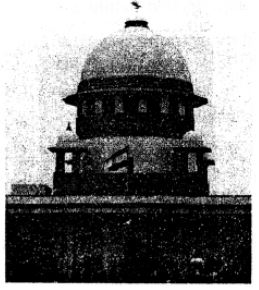
Question. Look at the picture of the apex Indian court and answer the following questions: 1. Identify it. 2. What is the composition of this court? 3. Who appoints the judges? 4. Explain its role as the guardian of the Constitution.
Answer:
1. The building shown is the Supreme Court of India.
2. The court consists of one Chief Justice and other judges. In the textbook's context, the total number of judges including the Chief Justice is capped at twenty-five.
3. The judges of this court are appointed by the President of India, following advice from the Chief Justice of India and the Council of Ministers.
4. It serves as the protector of the Constitution in two main ways:
- It has the power to strike down any legislative law or government order that violates constitutional provisions.
- It can issue writs to secure and enforce the fundamental rights of Indian citizens.
In simple words: This is the Supreme Court of India. Its judges are appointed by the President, and it protects our constitutional rights by canceling illegal laws and issuing writs.
Exam Tip: Be ready to identify this famous building (Supreme Court of India) and describe its composition and its crucial role in defending the Constitution.
Free study material for History Civics
ICSE Textbook Solutions for Class 8 History Civics Chapter 03 The Judiciary
About ICSE Solutions for Class 8 History Civics Chapter 03 The Judiciary
Access structured ICSE solutions for Class 8 History Civics Chapter 03 The Judiciary designed to match CISCE curriculum standards. These verified answers help clarify complex numericals and support daily homework revision.
Step-by-Step Explanations and Breakdown
Tackle complex theorems and numerical problems easily by cross-referencing your working steps with our structured solution guides.
More Study Resources for Class 8 History Civics
Pair your solution review with additional practice papers to test your execution speed and ensure total preparedness for school exams.
FAQs
You can download the verified Selina Concise solutions for Chapter 03 The Judiciary on StudiesToday.com. Our teachers have prepared answers for Class 8 History Civics as per 2026-27 ICSE academic session.
Yes, our solutions for Chapter 03 The Judiciary are designed as per new 2026 ICSE standards. 40% competency-based questions required for Class 8, are included to help students understand application-based logic behind every History Civics answer.
Yes, every exercise in Chapter 03 The Judiciary from the Selina Concise textbook has been solved step-by-step. Class 8 students will learn History Civics conceots before their ICSE exams.
Yes, follow structured format of these Selina Concise solutions for Chapter 03 The Judiciary to get full 20% internal assessment marks and use Class 8 History Civics projects and viva preparation as per ICSE 2026 guidelines.