

Download BITSAT MCQs for BITSAT Physics: Thermodynamics
Access targeted multiple-choice questions for Thermodynamics designed to align with the latest BITSAT academic syllabus for BITSAT Physics. These objective practice sets help students evaluate their conceptual understanding and improve exam readiness.
Chapter-wise Objective Questions: Thermodynamics
Navigate directly to the 50 objective questions for Thermodynamics using the digital viewer below. Each practice set includes verified answer keys, allowing students to instantly cross-check their work and identify areas requiring further revision.
Question: A cyclic process ABCD is shown in the figure PV diagram. Which of the following curves represent the same process?
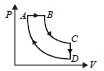
- a)

- b)

- c)

- d)

Answer:
Question: One mole of an ideal gas is taken from state A to state B by three different processes, (i) ACB (ii) ADB (iii) AEB as shown in the P-V diagram. The heat absorbed by the gas is

- a) Greater in process (ii) than in (i)
- b) The least in process (ii)
- c) The same in (i) and (iii)
- d) Less in (iii) than in (ii)
Answer: Less in (iii) than in (ii)
Question: Figure below shows two paths that may be taken by a gas to go from a state A to a state (c)
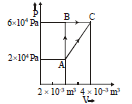
In process AB, 400 J of heat is added to the system and in process BC, 100 J of heat is added to the system. The heat absorbed by the system in the process AC will be
- a) 500 J
- b) 460 J
- c) 300 J
- d) 380 J
Answer: 460 J
Question: 0.5 mole of an ideal gas at constant temperature 27°C kept inside a cylinder of length L and crosssection area A closed by a massless piston. 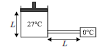 The cylinder is attached with a conducting rod of length L, cross-section area (1/9) m2 and thermal conductivity k, whose other end is maintained at 0°C. If piston is moved such that rate of heat flow through the conducing rod is constant then velocity of piston when it is at height L/2 from the bottom of cylinder is : [Neglect any kind of heat loss from system]
- a)

- b)

- c)

- d)

Answer:
Question: One mole of O2 gas having a volume equal to 22.4 Litres at 0°C and 1 atmospheric pressure in compressed isothermally so that its volume reduces to 11.2 litres. The work done in this process is-
- a) 1672.5 J
- b) 1728 J
- c) –1728 J
- d) –1572.5 J
Answer: –1572.5 J
Question: A Carnot’s heat engine works between the temperatures 427°C and 27°C. What amount of heat should it consume per second to deliver mechanical work at the rate of 1.0 kW ?
- a) 0.417 kcal/s
- b) 4.17 kcal/s
- c) 41.7 kcal/s
- d) 0.212 kcal/s
Answer: 0.417 kcal/s
Question: Which of the following process is possible according to the first law of thermodynamics –
- a) W > 0, Q < 0 and dU = 0
- b) W > 0, Q < 0 and dU > 0
- c) W > 0, Q < 0 and dU < 0
- d) W < 0, Q > 0 and dU < 0
Answer: W > 0, Q < 0 and dU < 0
Question: For an isothermal expansion of a perfect gas, the value of  is equal to
- a)

- b)

- c)

- d)

Answer:
Question: Figure shows the variation of internal energy (U) with the pressure (P) of 2.0 mole gas in cyclic process abcda. The temperature of gas at c and d are 300 K and 500 K. Calculate the heat absorbed by the gas during the process.
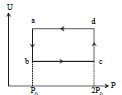
- a) 400 R ln 2
- b) 200 R ln 2
- c) 100 R ln 2
- d) 300 R ln 2
Answer: 400 R ln 2
Question: In the equation PVg = constant, the value of γ is unity. Then the process is
- a) Isothermal
- b) Adiabatic
- c) Isobaric
- d) Irreversible
Answer: Isothermal
Question: An ideal refrigerator has a freezer at a temperature of 13ºC. The coefficient of performance of the engine is 5. The temperature of the air (to which heat is rejected) is
- a) 320ºC
- b) 39ºC
- c) 325 K
- d) 325ºC
Answer: 39ºC
Question: A sample of gas expands from volume V1 to V2. The amount of work done by the gas is greatest when the expansion is
- a) Isothermal
- b) Isobaric
- c) Adiabatic
- d) Equal in all cases
Answer: Isothermal
Question: A cyclic process is shown in the p-T diagram. Which of the curves show the same process on a P-V diagram ?

- a)

- b)

- c)

- d)

Answer:
Question: The slopes of isothermal and adiabatic curves are related as
- a) Isothermal curve slope = adiabatic curve slope
- b) Isothermal curve slope = g × adiabatic curve slope
- c) Adiabatic curve slope = g × isothermal curve slope
- d) adiabatic curve slope
 sothermal curve slope
Answer: Adiabatic curve slope = g × isothermal curve slope
Question: A Carnot engine works first between 200°C and 0°C and then between 0°C and –200°C. The ratio of its efficiency in the two cases is
- a) 1.0
- b) 0.577
- c) 0.34
- d) 0.68
Answer: 1.0
Question: An ideal gas with adiabatic exponent (γ = 1.5) undergoes a process in which work done by the gas is same as increase in internal energy of the gas. The molar heat capacity of gas for the process is –
- a) C = 4R
- b) C = 0
- c) C = 2R
- d) C = R
Answer: C = 4R
Question: A cylinder with a movable piston contains 3 moles of hydrogen at standard temperature and pressure. The walls of the cylinder are made of a heat insulator, and the piston is insulated by having a pile of sand on it. By what factor does the pressure of the gas increases if the gas is compressed to half its original volume ?
- a) (2)7/5
- b) (2)1/5
- c) (5)7/5
- d) (2)1/5
Answer: (2)7/5
Question: The first operation involved in a carnot cycle is
- a) Isothermal expansion
- b) Adiabatic expansion
- c) Isothermal compression
- d) Adiabatic compression
Answer: Isothermal expansion
Question: Which of the following process is possible according to the first law of thermodynamics –
- a) W > 0, Q < 0 and dU = 0
- b) W > 0, Q < 0 and dU > 0
- c) W > 0, Q < 0 and dU < 0
- d) W < 0, Q > 0 and dU < 0
Answer: W > 0, Q < 0 and dU < 0
Question: A Carnot’s heat engine works between the temperatures 427°C and 27°C. What amount of heat should it consume per second to deliver mechanical work at the rate of 1.0 kW ?
- a) 0.417 kcal/s
- b) 4.17 kcal/s
- c) 41.7 kcal/s
- d) 0.212 kcal/s
Answer: 0.417 kcal/s
Free study material for Physics
Practice MCQs for BITSAT Physics Thermodynamics
Download Multiple Choice Questions: Thermodynamics (BITSAT Physics)
Test your conceptual understanding of Thermodynamics with these targeted multiple-choice questions. Designed in alignment with the latest BITSAT curriculum for BITSAT Physics, these problem sets build accuracy and prepare students for objective exams.
Concept Clarification for Thermodynamics
Each question includes structured solution keys mapped directly to standard BITSAT textbooks, helping students evaluate their reasoning and correct mistakes early in their revision.
Additional Study Resources for BITSAT Physics
Follow up your worksheet practice by attempting the interactive online Physics MCQ test for this chapter to evaluate your execution speed. All platform resources are free to access.
FAQs
You can get most exhaustive BITSAT Physics Thermodynamics MCQs for free on StudiesToday.com. These MCQs for BITSAT Physics are updated for the 2026-27 academic session as per BITSAT examination standards.
Yes, our BITSAT Physics Thermodynamics MCQs include the latest type of questions, such as Assertion-Reasoning and Case-based MCQs. 50% of the BITSAT paper is now competency-based.
By solving our BITSAT Physics Thermodynamics MCQs, BITSAT students can improve their accuracy and speed which is important as objective questions provide a chance to secure 100% marks in the Physics.
Yes, Physics MCQs for BITSAT have answer key and brief explanations to help students understand logic behind the correct option as its important for 2026 competency-focused BITSAT exams.
Yes, you can also access online interactive tests for BITSAT Physics Thermodynamics MCQs on StudiesToday.com as they provide instant answers and score to help you track your progress in Physics.