

Practice MCQs for BITSAT Physics Moving Charges and Magnetism
Access targeted multiple-choice questions for Moving Charges and Magnetism designed to align with the latest BITSAT academic syllabus for BITSAT Physics. These objective practice sets help students evaluate their conceptual understanding and improve exam readiness.
Access Moving Charges and Magnetism Questions and Solutions
View or download the dedicated Moving Charges and Magnetism MCQ resource below. Practicing these 50 objective questions regularly builds familiarity with standard exam patterns and helps secure higher marks in final Physics evaluations.
Question: Two very long, straight, parallel wires carry steady currents I and -I respectively. The distance between the wires is d. At a certain instant of time, a point charge q is at a point equidistant from the two wires, in the plane of the wires. Its instantaneous velocity v is perpendicular to this plane. The magnitude of the force due to the magnetic field acting on the charge at this instant is
- a)

- b)

- c)

- d) 0
Answer: 0
Question: A charged particle moves through a magnetic field perpendicular to its direction. Then
- a) Kinetic energy changes but the momentum is constant
- b) The momentum changes but the kinetic energy is constant
- c) Both momentum and kinetic energy of the particle are not constant
- d) Both momentum and kinetic energy of the particle are constant
Answer: The momentum changes but the kinetic energy is constant
Question: A wire carrying current I has the shape as shown in adjoining figure. Linear parts of the wire are very long and parallel to X-axis while semicircular portion of radius R is lying in Y-Z plane. Magnetic field at point O is :
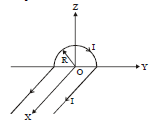
- a)

- b)

- c)

- d)

Answer:
Question: A deuteron of kinetic energy 50 keV is describing a circular orbit of radius 0.5 metre in a plane perpendicular to the magnetic field B. The kinetic energy of the proton that describes a circular orbit of radius 0.5 metre in the same plane with the same B is
- a) 25 keV
- b) 50 keV
- c) 200 keV
- d) 100 keV
Answer: 100 keV
Question: A long straight wire along the Z-axis carries a current I in the negative Z-direction. The magnetic vector field B r at a point having coordinates (x, y) in the Z = 0 plane is
- a)

- b)

- c)

- d)

Answer:
Question: A charged particle with velocity 2 × 10³ m/s passes undeflected through electric and magnetic field. Magnetic field is 1.5 tesla. The electric field intensity would be
- a) 2 × 10³ N/C
- b) 1.5 × 10³ N/C
- c) 3 × 10³ N/C
- d) 4/3 × 10–3 N/C
Answer: 3 × 10³ N/C
Question: A small current element of length dl and carryingcurrent is placed at (1, 1, 0) and is carrying current in ‘+z’ direction. If magnetic field at origin be  and at point (2, 2, 0) be
  then
then
- a)
 =
=
- b)
|
 | = |2
 |
| - c)
 = -
= -
- d)
 = -2
= -2
Answer:
= -
Question: Field inside a solenoid is
- a) Directly proportional to its length
- b) Directly proportional to current
- c) Inversely proportional to number of turns
- d) Inversely proportional to current
Answer: Directly proportional to current
Question: A uniform electric field and uniform magnetic field are acting along the same direction in a certain region. If an electron is projected in the region such that its velocity is pointed along the direction of fields, then the electron
- a) Will turn towards right of direction of motion
- b) Speed will decrease
- c) Speed will increase
- d) Will turn towards left direction of motion
Answer: Speed will decrease
Question: A horizontal overhead powerline is at height of 4m from the ground and carries a current of 100A from east to west. The magnetic field directly below it on the ground is (μ0 = 4π × 10–7 Tm A–1)
- a) 2.5×10⁻⁷ T southward
- b) 5 × 10⁻⁶ T northward
- c) 5 × 10⁻⁶ T southward
- d) 2.5 × 10⁻⁷ T northward
Answer: 5 × 10⁻⁶ T southward
Question: If m is magnetic moment and B is the magnetic field, then the torque is given by
- a)

- b)

- c)

- d)

Answer:
Question: A steady current is set up in a cubic network composed of wires of equal resistance and length d as shown in figure. What is the magnetic field at the centre P due to the cubic network

- a)

- b)

- c) 0
- d)

Answer: 0
Question: The magnetic field at the origin due to the current flowing in the wire is –

- a)

- b)

- c)

- d)

Answer:
Question: A conducting circular loop of radius r carries a constant current i. It is placed in a uniform magnetic field such that
that  is perpendicular to the plane of the loop. The magnetic force acting on the loop is
- a)

- b)

- c) zero
- d)

Answer: zero
Question: An ammeter reads upto 1 ampere. Its internal resistance is 0.81ohm. To increase the range to 10 A the value of the required shunt is
- a) 0.03Ω
- b) 0.3Ω
- c) 0.9Ω
- d) 0.09Ω
Answer: 0.09Ω
Question: Two parallel wires carrying currents in the same direction attract each other because of
- a) Mutual inductance between them
- b) Potential difference between them
- c) Electric forces between them
- d) Magnetic forces between them
Answer: Magnetic forces between them
Question: Calculate the magnetic field at the centre of a coil in the form of a square of side 2a carrying a current I.
- a)

- b)

- c)

- d)

Answer:
Question: The work done by a magnetic field, on a moving charge is
- a) zero because
 acts parallel to
- b) Positive because
 acts perpendicular to
- c) Zero because
 acts perpendicular to
- d) Negative because
 acts parallel to
Answer: Zero because acts perpendicular to
Question: A circular loop of radius 0.3 cm lies parallel to a much bigger circular loop of radius 20 cm. The centre of the smaller loop is on the axis of the bigger loop. The distance between their centres is 15 cm. If a current of 2.0 A flows through the smaller loop, then the flux linked with bigger loop
- a) 9.1 × 10⁻¹¹ weber
- b) 6 × 10–11 weber
- c) 3.3 × 10⁻¹¹ weber
- d) 6.6 × 10⁻⁹ weber
Answer: 9.1 × 10⁻¹¹ weber
Question: A particle is moving with velocity  and it produces an electric field at a point given by
  . It will produce magnetic field at that point equal to (all quantities are in SI units) [
- a)

- b)

- c) zero
- d) cannot be determined from the given data
Answer:
Free study material for Physics
Moving Charges and Magnetism Objective Questions & Solutions for BITSAT Physics
About Moving Charges and Magnetism MCQs for BITSAT Physics
Review structured objective questions for BITSAT Physics Moving Charges and Magnetism. Built according to official BITSAT guidelines, these MCQ sets support daily revision and core concept reinforcement.
How to Verify Your MCQ Answers
Each question includes structured solution keys mapped directly to standard BITSAT textbooks, helping students evaluate their reasoning and correct mistakes early in their revision.
Enhance Speed with Online MCQ Tests
Follow up your worksheet practice by attempting the interactive online Physics MCQ test for this chapter to evaluate your execution speed. All platform resources are free to access.
FAQs
You can get most exhaustive BITSAT Physics Moving Charges and Magnetism MCQs for free on StudiesToday.com. These MCQs for BITSAT Physics are updated for the 2026-27 academic session as per BITSAT examination standards.
Yes, our BITSAT Physics Moving Charges and Magnetism MCQs include the latest type of questions, such as Assertion-Reasoning and Case-based MCQs. 50% of the BITSAT paper is now competency-based.
By solving our BITSAT Physics Moving Charges and Magnetism MCQs, BITSAT students can improve their accuracy and speed which is important as objective questions provide a chance to secure 100% marks in the Physics.
Yes, Physics MCQs for BITSAT have answer key and brief explanations to help students understand logic behind the correct option as its important for 2026 competency-focused BITSAT exams.
Yes, you can also access online interactive tests for BITSAT Physics Moving Charges and Magnetism MCQs on StudiesToday.com as they provide instant answers and score to help you track your progress in Physics.