

Practice MCQs for BITSAT Physics Electric Charges and Fields
Explore reliable objective questions for Electric Charges and Fields tailored for BITSAT learners. Utilizing these Physics multiple-choice formats ensures thorough preparation and strengthens problem-solving speed for upcoming school assessments.
Access Electric Charges and Fields Questions and Solutions
View or download the dedicated Electric Charges and Fields MCQ resource below. Practicing these 50 objective questions regularly builds familiarity with standard exam patterns and helps secure higher marks in final Physics evaluations.
Question: A disk of radius a/4 having a uniformly distributed charge 6 C is placed in the x - y plane with its centre at (–a/2, 0, 0). A rod of length a carrying a uniformly distributed charge 8 C is placed on the x-axis from x = a /4 to x = 5a/4. Two point charges – 7 C and 3 C are placed at (a/4, – a/4, 0) and (– 3a/4, 3a/4, 0), respectively. Consider a cubical surface formed by six surfaces x = ± a/2, y = ± a/2, z = ± a/2. The electric flux through this cubical surface is

- a)

- b)

- c)

- d)

Answer:
Question: Two concentric conducting thin spherical shells A, and B having radii rA and rB ((rB > rA) are charged to QA and –QB (|QB| > |QA|). The electric field along a line passing through the centre is
- a)

- b)

- c)

- d)

Answer:
Question: Two identical charged spheres suspended from a common point by two massless strings of lengths l, are initially at a distance d (d << l) apart because of their mutual repulsion. The charges begin to leak from both the spheres at a constant rate. As a result, the spheres approach each other with a velocity v. Then v varies as a function of the distance x between the spheres, as :
- a)

- b)

- c)

- d)

Answer:
Question: The surface charge density of a thin charged disc of radius R is σ. The value of the electric field at the centre of the disc is  With respect to the field at the centre, the electric field along the axis at a distance R from the centre of the disc
- a) Reduces by 70.7%
- b) Reduces by 29.3%
- c) Reduces by 9.7%
- d) Reduces by 14.6%
Answer: Reduces by 70.7%
Question: At the corners of an equilateral triangle of side a (1 metre), three point charges are placed (each of 0.1 C). If this system is supplied energy at the rate of 1 kw, then calculate the time required to move one of the mid-point of the line joining the other two.
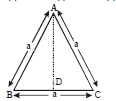
- a) 50 h
- b) 60 h
- c) 48 h
- d) 54 h
Answer: 50 h
Question: A solid sphere of radius R has a charge Q distributed in its volume with a charge density r = kra, where k and a are constants and r is the distance from its centre. If the electric field at r =

times that at r = R, the value of a is
- a) 3
- b) 5
- c) 2
- d) 7
Answer: 2
Question: Two point dipoles  are located at (0, 0, 0) and (1m, 0, 2m) respectively. The resultant electric field due to the two dipoles at the point (1m, 0, 0) is
- a)

- b)

- c)

- d) None of these
Answer:
Question: Three equal charges (q) are placed at corners of an equilateral triangle. The force on any charge is
- a) zero
- b)

- c)

- d)

Answer:
Question: In a region of space having a uniform electric field E, a hemispherical bowl of radius r is placed. The electric flux Φthrough the bowl is
- a) 2πRE
- b) 4πR2E
- c) 2πR2E
- d) πR2E
Answer: 4πR2E
Question: The electric field intensity just sufficient to balance the earth’s gravitational attraction on an electron will be: (given mass and charge of an electron respectively are 9.1 × 10⁻³¹ kg and 1.6 × 10⁻¹⁹ C.)
- a) –5.6 × 10⁻¹¹ N/C
- b) –4.8 × 10⁻¹⁵ N / C
- c) –1.6 × 10⁻¹⁹ N/C
- d) –3.2 × 10⁻¹⁹ N / C
Answer: –5.6 × 10⁻¹¹ N/C
Question: In an uniformly charged sphere of total charge Q and radius R, the electric field E is plotted as function of distance from the centre. The graph which would correspond to the above will be
- a)

- b)

- c)

- d)

Answer:
Question: A charge Q1 exerts some force on a second charge Q2. If a 3rd charge Q3 is brought near, then the force of Q1 exerted on Q2 –
- a) Will increase
- b) Will decrease
- c) Will remain unchanged
- d) will increase if Q3 is of the same sign as Q1 and will decrease if Q3 is of opposite sign
Answer: Will remain unchanged
Question: A charge +q is at a distance L/2 above a square of side L. Then what is the flux linked with the surface?
- a)

- b)

- c)

- d)

Answer:
Question: Two metallic spheres of radii 1 cm and 3 cm are given charges of –1 × 10⁻² C and 5×10⁻² C, respectively. If these are connected by a conducting wire, the final charge on the bigger sphere is
- a) 2 × 10⁻² C
- b) 3 × 10⁻² C
- c) 4 × 10⁻² C
- d) 1 × 10⁻² C
Answer: 3 × 10⁻² C
Question: If an electron has an initial velocity in a direction different from that of an electric field, the path of the electron is
- a) A straight line
- b) A circle
- c) An ellipse
- d) A parabola
Answer: A parabola
Question: The ratio of magnitudes of electric field due to an electric dipole on the axis and on the equatorial line at equal distances will be
- a) 4 : 1
- b) 1 : 2
- c) 2 : 1
- d) 1 : 1
Answer: 2 : 1
Question: A square surface of side L meter in the plane of the paper is placed in a uniform electric field E (volt/m) acting along the same plane at an angle θ with the horizontal side of the square as shown in Figure. The electric flux linked to the surface, in units of volt m, is

- a) EL2
- b) EL2 cos θ
- c) EL2 sin θ
- d) zero
Answer: zero
Question: Charge Q is distributed to two different metallic spheres having radii R and 2R such that both spheres have equal surface charge density, then charge on large sphere is
- a)

- b)

- c)

- d)

Answer:
Question: A charge q is placed at the centre of the open end of a cylindrical vessel. The flux of the electric field through the surface of the vessel is
- a) zero
- b) (q/ε0)
- c) (q/2ε0)
- d) (2q/ε0)
Answer: (q/2ε0)
Question: A solid spherical conductor of radius R has a spherical cavity of radius a (a < R) at its centre. A charge + Q is kept at the centre. The cahrge at the inner surface, outer and at a position r (a < r < R) are respectively
- a) + Q, – Q, 0
- b) – Q, + Q, 0
- c) 0, – Q, 0
- d) + Q , 0, 0
Answer: 0, – Q, 0
Free study material for Physics
Practice MCQs for BITSAT Physics Electric Charges and Fields
BITSAT Physics Electric Charges and Fields Objective Test Questions
Explore reliable practice questions for Electric Charges and Fields tailored for BITSAT Physics learners. Use these multiple-choice formats to evaluate preparedness and strengthen problem-solving skills.
NCERT-Aligned Objective Questions and Solutions
Cross-reference your completed choices with comprehensive NCERT solutions for BITSAT Physics to ensure absolute clarity across all sub-topics in this chapter.
Next Steps in Your Exam Preparation
Explore our broader library of printable assignments, chapter notes, and mock tests designed to support continuous revision and secure higher marks in BITSAT assessments.
FAQs
You can get most exhaustive BITSAT Physics Electric Charges and Fields MCQs for free on StudiesToday.com. These MCQs for BITSAT Physics are updated for the 2026-27 academic session as per BITSAT examination standards.
Yes, our BITSAT Physics Electric Charges and Fields MCQs include the latest type of questions, such as Assertion-Reasoning and Case-based MCQs. 50% of the BITSAT paper is now competency-based.
By solving our BITSAT Physics Electric Charges and Fields MCQs, BITSAT students can improve their accuracy and speed which is important as objective questions provide a chance to secure 100% marks in the Physics.
Yes, Physics MCQs for BITSAT have answer key and brief explanations to help students understand logic behind the correct option as its important for 2026 competency-focused BITSAT exams.
Yes, you can also access online interactive tests for BITSAT Physics Electric Charges and Fields MCQs on StudiesToday.com as they provide instant answers and score to help you track your progress in Physics.