

Physics Objective Questions and Answers: Current Electricity
Explore reliable objective questions for Current Electricity tailored for BITSAT learners. Utilizing these Physics multiple-choice formats ensures thorough preparation and strengthens problem-solving speed for upcoming school assessments.
Download Current Electricity MCQs with Answers
View or download the dedicated Current Electricity MCQ resource below. Practicing these 50 objective questions regularly builds familiarity with standard exam patterns and helps secure higher marks in final Physics evaluations.
Question: A wire is connected to a battery between the point M and N as shown in the figure (1). The same wire is bent in the form of a square and then connected to the battery between the points M and N as shown in the figure (2). Which of the following quantities increases?
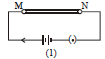

- a) Heat produced in the wire and resistance offered by the wire
- b) Resistance offered by the wire and current through the wire
- c) Heat produced in the wire, resistance offered by the wire and current through the wire.
- d) Heat produced in the wire and current through the wire
Answer: Heat produced in the wire and current through the wire
Question: In the circuit shown in figure the current through
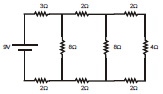
- a) The 3 Ω resistor is 0.50 A
- b) The 3 Ω resistor is 0.25 A
- c) The 4 Ω resistor is 0.50 A
- d) The 4 Ω resistor is 0.25 A
Answer: The 4 Ω resistor is 0.25 A
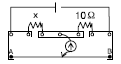
Question: A meter bridge is set up as shown, to determine an unknown resistance ‘X’ using a standard 10 ohm resistor. The galvanometer shows null point when tapping-key is at 52 cm mark. The endcorrections are 1 cm and 2 cm respectively for the ends A and B. The determined value of ‘X’ is
- a) 10.2 Ω
- b) 10.6 Ω
- c) 10.8 Ω
- d) 11.1 Ω
Answer: 10.6 Ω
Question: Two resistances at 0° C with temperature coefficient of resistance α1 and α2 joined in series act as a single resistance in a circuit. The temperature coefficient of their single resistance will be
- a) α1 + α2
- b)

- c)

- d)

Answer:
Question: The drift velocity of electrons in silver wire with cross-sectional area 3.14 × 10⁻⁶ m2 carrying a current of 20 A is. Given atomic weight of Ag = 108, density of silver = 10.5 × 10³ kg/m3.
- a) 2.798 × 10⁻⁴ m/sec.
- b) 67.98 × 10⁻⁴ m/sec.
- c) 0.67 × 10⁻⁴ m/sec.
- d) 6.798 × 10⁻⁴ m/sec
Answer: 6.798 × 10⁻⁴ m/sec
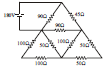
Question: In the circuit shown in the figure, find the current in 45 Ω
- a) 4 A
- b) 2.5A
- c) 2 A
- d) 3.5 A
Answer: 2 A
Question: A constant voltage is applied between the two ends of a uniform metallic wire. Some heat is developed in it. The heat developed is doubled if
- a) Both the length and the radius of the wire are halved.
- b) Both the length and the radius of the wire are doubled.
- c) The radius of the wire is doubled
- d) The length of the wire is doubled.
Answer: Both the length and the radius of the wire are doubled.
Question: The resistance of a wire is R. It is bent at the middle by 180° and both the ends are twisted together to make a shorter wire. The resistance of the new wire is
- a) 2 R
- b) R/2
- c) R/4
- d) R/8
Answer: R/4
Question: Two long coaxial and conducting cylinders of radius a and b are separated by a material of conductivity σ and a constant potential difference V is maintained between them, by a battery. Then the current, per unit length of the cylinder flowing from one cylinder to the other is –
- a)

- b)

- c)

- d)

Answer:
Question: A wire X is half the diameter and half the length of a wire Y of similar material. The ratio of resistance of X to that of Y is
- a) 8 : 1
- b) 4 : 1
- c) 2 : 1
- d) 1 : 1
Answer: 2 : 1
Question: What should be the characteristic of fuse wire?
- a) High melting point, high specific resistance
- b) Low melting point, low specific resistance
- c) High melting point, low specific resistance
- d) Low melting point, high specific resistance
Answer: Low melting point, high specific resistance
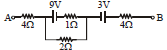
Question: In the circuit shown in figure potential difference between points A and B is 16 V. the current passing through 2Ω resistance will be
- a) 2.5 A
- b) 3.5 A
- c) 4.0 A
- d) zero
Answer: 3.5 A
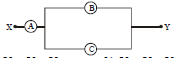
Question: Three voltmeters A, B and C having resistances R, 1.5 R and 3R, respectively, are connected as shown. When some potential difference is applied between X and Y, the voltmeter readings are VA, VB and VC respectively. Then –
- a) VA ≠ VB = VC
- b) VA = VB ≠ VC
- c) VA ≠ VB ≠ VC
- d) VA = VB = VC
Answer: VA = VB = VC
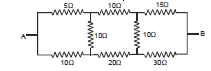
Question: Calculate the effective resistance between A and B in following network.
- a) 5 Ω
- b) 10 Ω
- c) 20 Ω
- d) 30Ω
Answer: 20 Ω
Question: The power dissipated in the circuit shown in the figure is 30 Watts. The value of R is

- a) 20 Ω
- b) 15 Ω
- c) 10 Ω
- d) 30 Ω
Answer: 10 Ω
Question: Which of the following quantities do not change when a resistor connected to a battery is heated due to the current?
- a) Drift speed
- b) Resistivity
- c) Resistance
- d) Number of free electrons
Answer: Number of free electrons
Question: The length of a potentiometer wire is l. A cell of emf E is balanced at a length l/3 from the positive end of the wire. If the length of the wire is increased by l/2. At what distance will be the same cell give a balance point.
- a) 2l/3
- b) l/2
- c) l/6
- d) 4l/3
Answer: l/2
Question: In a Wheatstone bridge all the four arms have equal resistance R. If the resistance of galvanometer arm is also R, the equivalent resistance of combination is
- a) 2R
- b) R/4
- c) R/2
- d) R
Answer: R
Question: Potentiometer measures potential more accurately because
- a) It measures potential in open circuit
- b) It uses sensitive galvanometer for null deflection
- c) It uses high resistance potentiometer wire
- d) It measures potential in closed circuit
Answer: It measures potential in open circuit
Question: A cell of internal resistance r is connected across an external resistance nr. Then the ratio of the terminal voltage to the emf of the cell is
- a)

- b)

- c)

- d)

Answer:
Question: In the circuit shown, when the switch is closed, the capacitor charges with a time constant

- a) RC
- b) 2RC
- c) (1/2) RC
- d) RC ln 2
Answer: RC
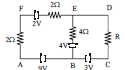
Question: In the electric network shown, when no current flows through the 4W resistor in the arm EB, the potential difference between the points A and D will be :
- a) 6 V
- b) 3 V
- c) 5 V
- d) 4 V
Answer: 5 V
Question: When a current I is set up in a wire of radius r, the drift velocity is vd. If the same current is set up through a wire of radius 2 r, the drift velocity will be
- a) 4 vd
- b) 2 vd
- c) vd / 2
- d) vd/4
Answer: vd/4
Question: The effective resistance between points P and Q of the electrical circuit shown in the figure is –
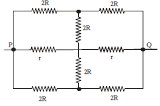
- a)

- b)

- c) 2r + 4R
- d)

Answer:
Question: What should be the characteristic of fuse wire?
- a) High melting point, high specific resistance
- b) Low melting point, low specific resistance
- c) High melting point, low specific resistance
- d) Low melting point, high specific resistance
Answer: Low melting point, high specific resistance
Free study material for Physics
Current Electricity Objective Questions & Solutions for BITSAT Physics
Chapter MCQs with Answers for BITSAT Physics
Explore reliable practice questions for Current Electricity tailored for BITSAT Physics learners. Use these multiple-choice formats to evaluate preparedness and strengthen problem-solving skills.
Expert Practice Material for BITSAT Physics
Each question includes structured solution keys mapped directly to standard BITSAT textbooks, helping students evaluate their reasoning and correct mistakes early in their revision.
Complete Your Chapter Revision
Explore our broader library of printable assignments, chapter notes, and mock tests designed to support continuous revision and secure higher marks in BITSAT assessments.
FAQs
You can get most exhaustive BITSAT Physics Current Electricity MCQs for free on StudiesToday.com. These MCQs for BITSAT Physics are updated for the 2026-27 academic session as per BITSAT examination standards.
Yes, our BITSAT Physics Current Electricity MCQs include the latest type of questions, such as Assertion-Reasoning and Case-based MCQs. 50% of the BITSAT paper is now competency-based.
By solving our BITSAT Physics Current Electricity MCQs, BITSAT students can improve their accuracy and speed which is important as objective questions provide a chance to secure 100% marks in the Physics.
Yes, Physics MCQs for BITSAT have answer key and brief explanations to help students understand logic behind the correct option as its important for 2026 competency-focused BITSAT exams.
Yes, you can also access online interactive tests for BITSAT Physics Current Electricity MCQs on StudiesToday.com as they provide instant answers and score to help you track your progress in Physics.