

Multiple Choice Questions (MCQs) for BITSAT Physics: Alternating Current
Review structured MCQ sets for BITSAT Physics Alternating Current. Built according to official BITSAT guidelines, these downloadable questions support daily revision and core concept reinforcement.
Practice Alternating Current MCQs for BITSAT Physics
View or download the dedicated Alternating Current MCQ resource below. Practicing these 50 objective questions regularly builds familiarity with standard exam patterns and helps secure higher marks in final Physics evaluations.
Question: An inductor of inductance L = 400 mH and resistors of resistance R1 = 2Ω and R2 = 2Ω are connected to a battery of emf 12 V as shown in the figure. The internal resistance of the battery is negligible. The switch S is closed at t = 0. The potential drop across L as a function of time is
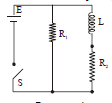
- a)

- b)

- c) 12e–5t V
- d) 6e–5t V
Answer: 12e–5t V
Question: A resistor of resistance R, capacitor of capacitance C and inductor of inductance L are connected in parallel to AC power source of voltage ε0 sin ωt. The maximum current through the resistance is half of the maximum current through the power source. Then value of R is
- a)

- b)

- c)

- d) None of these
Answer:
Question: A direct current of 5A is superposed on an alternating current I = 10 sin wt flowing through the wire. The effective value of the resulting current will be
- a) (15/2)A
- b) 5 √3A
- c) 5 √5A
- d) 15 A
Answer: 5 √3A
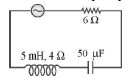
Question: In the circuit shown below, the ac source has voltage V = 20 cos(ωt) volt with ω = 2000 rad/s. The amplitude of the current will be nearest to
- a) 2A
- b) 3.3A
- c) 2 / √5A
- d) 5A
Answer: 2A
Question: An inductor 20 × 10–3 henry, a capacitor 100μF and a resistor 50Ω are connected in series across a source of EMF V = 10 sin 314t. If resistance is removed from the circuit and the value of inductance is doubled, then the variation of current with time in the new circuit is –
- a) 0.52 cos 314 t
- b) 0.52 sin 314 t
- c) 0.52 sin (314 t + π/3)
- d) None of these
Answer: 0.52 cos 314 t
Question: A sinusoidal voltage of peak value 283 V and frequency 50 Hz is applied to a series LCR circuit in which R = 3Ω, L = 25.48 mH, and C = 796 μF. Find the impedance of the circuit
- a) 5 Ω
- b) 12 Ω
- c) 18 Ω
- d) 22 Ω
Answer: 5 Ω
Question: In an LCR circuit, the voltages across the components are VL, VC and VR respectively. The voltage of source will be
- a) [VR + VL + VC]
- b) [VR 2 + VL 2 + VC 2]1/2
- c) [VR 2 + (VL + VC)2]1/2
- d) [VR 2 + (VL – VC)2]1/2
Answer: [VR 2 + (VL – VC)2]1/2
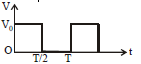
Question: The r.m.s. value of potential difference V shown in the figure is
- a) V0
- b) V0 /√2
- c) V0/2
- d) V0 √3
Answer: V0 /√2
Question: Which one of the following curves represents the variation of impedance (Z) with frequency f in series LCR circuit?
- a)

- b)

- c)

- d)

Answer:
Question: An alternating voltage V = V0 sin wt is applied across a circuit. As a result, a current I = I0 sin (ωt – π/2) flows in it. The power consumed per cycle is
- a) zero
- b) 0.5 V0I0
- c) 0.707 V0I0
- d) 1.414 V0I0
Answer: zero
Question: A resistance R and inductance L and a capacitor C all are connected in series with an AC supply. The resistance of R is 16 ohm and for a given frequency, the inductive reactance of L is 24 ohm and capacitive reactance of C is 12 ohm. If the current in the circuit is 5 amp., find the potential difference across R, L and C.
- a) 30, 20, 50 volt
- b) 40, 100, 60 volt
- c) 70, 110, 60 volt
- d) 80, 120, 60 volt
Answer: 80, 120, 60 volt
Question: The instantaneous current from an a.c. source is I = 6 sin 314 t. What is the rms value of the current ?
- a) 3 √2 amp
- b) 2 √2 amp
- c) √2 amp
- d) 2 amp
Answer: 3 √2 amp
Question: A coil has resistance 30 ohm and inductive reactance 20 ohm at 50 Hz frequency. If an ac source, of 200 volt, 100 Hz, is connected across the coil, the current in the coil will be
- a) 4.0 A
- b) 8.0 A
- c) 7.2 A
- d) 2.0 A
Answer: 4.0 A
Question: The primary winding of a transformer has 100 turns and its secondary winding has 200 turns. The primary is connected to an A.C. supply of 120 V and the current flowing in it is 10 A. The voltage and the current in the secondary are
- a) 240 V, 5 A
- b) 240 V, 10 A
- c) 60 V, 20 A
- d) 120 V, 20 A
Answer: 240 V, 5 A
Question: A resistance of 400Ω is connected in series with an inductor of (3/π) H and this combination is connected across an A.C. source as shown in figure
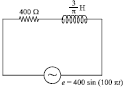
- a) In the circuit, peak value of current is
 A
A - b) In the circuit, potential difference across resistance is in same phase with the current
- c) In the circuit, potential difference across inductor is 53º leading with current
- d) In the circuit, potential difference across inductor is 37º leading with current
Answer: In the circuit, potential difference across resistance is in same phase with the current
Question: Which of the following curves correctly represents the variation of capacitive reactance (Xc) with frequency n –
- a)

- b)

- c)

- d)

Answer:
Question: If I = I0 sin (ωt – π/2), and E = E0 sinwt then the power loss is
- a)

- b)

- c)

- d) Zero
Answer: Zero
Question: A resistance R and inductance L and a capacitor C all are connected in series with an AC supply. The resistance of R is 16 ohm and for a given frequency, the inductive reactance of L is 24 ohm and capacitive reactance of C is 12 ohm. If the current in the circuit is 5 amp., find the potential difference across R, L and C.
- a) 30, 20, 50 volt
- b) 40, 100, 60 volt
- c) 70, 110, 60 volt
- d) 80, 120, 60 volt
Answer: 80, 120, 60 volt
Question: The primary winding of a transformer has 100 turns and its secondary winding has 200 turns. The primary is connected to an A.C. supply of 120 V and the current flowing in it is 10 A. The voltage and the current in the secondary are
- a) 240 V, 5 A
- b) 240 V, 10 A
- c) 60 V, 20 A
- d) 120 V, 20 A
Answer: 240 V, 5 A
Question: A coil has resistance 30 ohm and inductive reactance 20 ohm at 50 Hz frequency. If an ac source, of 200 volt, 100 Hz, is connected across the coil, the current in the coil will be
- a) 4.0 A
- b) 8.0 A
- c) 7.2 A
- d) 2.0 A
Answer: 4.0 A
Free study material for Physics
Practice MCQs for BITSAT Physics Alternating Current
Chapter MCQs with Answers for BITSAT Physics
Test your conceptual understanding of Alternating Current with these targeted multiple-choice questions. Designed in alignment with the latest BITSAT curriculum for BITSAT Physics, these problem sets build accuracy and prepare students for objective exams.
Expert Practice Material for BITSAT Physics
Built using the official NCERT book for BITSAT, these Physics objective sets provide reliable academic guidance. Pair your practice with our recommended NCERT solutions to master optimal problem-solving approaches.
Complete Your Chapter Revision
Wrap up your chapter revision by testing your knowledge against standard question formats. Everything on our platform is provided free of charge.
FAQs
You can get most exhaustive BITSAT Physics Alternating Current MCQs for free on StudiesToday.com. These MCQs for BITSAT Physics are updated for the 2026-27 academic session as per BITSAT examination standards.
Yes, our BITSAT Physics Alternating Current MCQs include the latest type of questions, such as Assertion-Reasoning and Case-based MCQs. 50% of the BITSAT paper is now competency-based.
By solving our BITSAT Physics Alternating Current MCQs, BITSAT students can improve their accuracy and speed which is important as objective questions provide a chance to secure 100% marks in the Physics.
Yes, Physics MCQs for BITSAT have answer key and brief explanations to help students understand logic behind the correct option as its important for 2026 competency-focused BITSAT exams.
Yes, you can also access online interactive tests for BITSAT Physics Alternating Current MCQs on StudiesToday.com as they provide instant answers and score to help you track your progress in Physics.