

Chemistry Objective Questions and Answers: Thermodynamics
Access targeted multiple-choice questions for Thermodynamics designed to align with the latest BITSAT academic syllabus for BITSAT Chemistry. These objective practice sets help students evaluate their conceptual understanding and improve exam readiness.
Download Thermodynamics MCQs with Answers
Navigate directly to the 50 objective questions for Thermodynamics using the digital viewer below. Each practice set includes verified answer keys, allowing students to instantly cross-check their work and identify areas requiring further revision.
Question: For the reaction 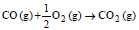 Which one of the statement is correct at constant T and P ?
a) ΔH=ΔE
b) ΔH< ΔE
c) ΔH>ΔE
d) ΔH is independent of physical state of the reactants
Answer: ΔH< ΔE
Question: For a given reaction, ΔH = 35.5 kJ mol-1 and ΔS = 83.6 JK-1 mol-1 1. The reaction is spontaneous at : (Assume that ΔH and ΔS do not vary with tempearature)
a) T > 425 K
b) All temperatures
c) T > 298 K
d) T < 425 K
Answer: T > 425 K
Question: For a particular reversible reaction at temperature T, ΔH and ΔS were found to be both +ve. If Te is the temperature at equilibrium, the reaction would be spontaneous when
a) Te > T
b) T > Te
c) Te is 5 times T
d) T = Te
Answer: T > Te
Question: Given
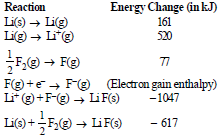
Based on data provided, the value of electron gain enthalpy of fluorine would be :
a) – 300 kJ mol–1
b) – 350 kJ mol–1
c) – 328 kJ mol–1
d) – 228 kJ mol–1
Answer: – 328 kJ mol–1
Question: Which law of the thermodynamics helps in calculating the absolute entropies of various substances at different temperatures?
a) First law
b) Second law
c) Third law
d) Zeroth law
Answer: Third law
Question: A spontaneous reaction is impossible if
a) Both ΔH and ΔS are negative
b) Both ΔH and ΔS are positive
c) ΔH is negative and ΔS is positive
d) ΔH is positive and ΔS is negative
Answer: ΔH is positive and ΔS is negative
Question: If the enthalpy of vaporization of water is 186.5 kJmol–1, the entropy if its vaporization will be :
a) 0.5 JK–1mol–1
b) 1.0 JK–1mol–1
c) 1.5 JK–1mol–1
d) 2.0 JK–1mol–1
Answer: 0.5 JK–1mol–1
Question: The heats of neutralisation of CH3COOH, HCOOH, HCN and H2S are – 13.2, – 13.4, – 2.9 and – 3.8 kCal per equivalent respectively. Arrange the acids in increasing order of acidic strength.
a) HCOOH > CH3COOH > H2S > HCN
b) CH3COOH > HCOOH > H2S > HCN
c) H2S > HCOOH > CH3COOH > HCN
d) HCOOH > H2S > CH3COOH > HCN
Answer: HCOOH > CH3COOH > H2S > HCN
Question: For determining the spontaneity of a process which of the following is considered ?
a) ΔS system
b) ΔS surroundings
c) ΔS system + ΔS surroundings
d) ΔS system – ΔS surroundings
Answer: ΔS system + ΔS surroundings
Question: The enthalpy of combustion of 2 moles of benzene at 27°C differs from the value determined in bomb calorimeter by
a) – 2.494 kJ
b) 2.494 kJ
c) – 7.483 kJ
d) 7.483 kJ
Answer: – 7.483 kJ
Question: In which of the following reactions, standard entropy change (ΔS°) is positive and standard Gibb’s energy change (ΔG°) decreases sharply with increasing temperature ?
a)

b)

c)
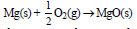
d)
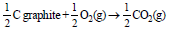
Answer:
Question: Bond enthalpies of H2 , X2 and HX are in the ratio 2 : 1 : 2. If enthalpy of formation of HX is – 50 kJ mol–1, the bond enthalpy of X2 is
a) 100 kJ mol–1
b) 300 kJ mol–1
c) 200 kJ mol–1
d) 400 kJ mol–1
Answer: 100 kJ mol–1
Question: What is the free energy change, ΔG , when 1.0 mole of water at 100º C and 1 atm pressure is converted into steam at 100°C and 1 atm. pressure?
a) 540 cal
b) –9800 cal
c) 9800 cal
d) 0 cal
Answer: 0 cal
Question: For the reaction :  Which one of the following is correct regarding ΔH
a) ΔH = ΔE + 2RT
b) ΔH = ΔE – 2RT
c) ΔH = ΔE + RT
d) ΔH = ΔE – RT
Answer: ΔH = ΔE – 2RT
Question: One mole of an ideal gas at 300 K is expanded isothermally from an initial volume of 1L to 10 L. The ΔE for this process is (R = 2 cal mol–1 K–1)
a) 163.7 cal
b) zero
c) 1381.1 cal
d) 9 lit atom
Answer: zero
Question: At 25°C and 1 bar which of the following has a non-zero ΔH°f ?
a) Br2(l)
b) C (graphite)
c) O3(g)
d) I2(s)
Answer: O3(g)
Question: For which of the process, ΔS is negative?
a) H2 (g)→ 2H(g)
b) N2 (g )(1atm)→ N2 (g)(8atm)
c) 2SO3 (g)→ 2SO2 (g) +O2 (g)
d) C(diamond) → C(graphite)
Answer: N2 (g )(1atm)→ N2 (g)(8atm)
Question: Ka for CH3COOH at 25°C is 1.754 × 10⁻⁵ . At50°C Ka is 1.633 × 10⁻⁵. What are ΔH° and ΔS° for the ionisation of CH3COOH ?
a) – 1.55 kJmol-1, – 96.44 Jmol -1K-1
b) – 2.55 kJmol-1, – 106.44 Jmol -1K-1
c) 1.55 kJmol-1, 96.44 Jmol -1K-1
d) – 1.55 kJmol-1, 96.44 Jmol -1K-1
Answer: – 1.55 kJmol-1, – 96.44 Jmol -1K-1
Question: Temperature of 5 moles of a gas is decreased by 2K at constant pressure. Indicate the correct statement
a) Work done by gas is = 5 R
b) Work done over the gas is = 10 R
c) Work done by the gas = 10 R
d) Work done = 0
Answer: Work done over the gas is = 10 R
Question: Compounds with high heat of formation are less stable because
a) It is difficult to synthesize them
b) Energy rich state leads to instability
c) High temperature is required to synthesize them
d) Molecules of such compunds are distorted
Answer: Energy rich state leads to instability
Question: The energy that opposes dissolution of a solvent is
a) Hydration energy
b) Lattice energy
c) Internal energy
d) Bond energy
Answer: Lattice energy
Question: The energy that opposes dissolution of a solvent is
a) Hydration energy
b) Lattice energy
c) Internal energy
d) Bond energy
Answer: Lattice energy
Question: In the reaction  ΔH = 40 kJ; ΔH represents :
a) Heat of formation
b) Heat of combustion
c) Heat of neutralisation
d) Heat of reaction
Answer: Heat of reaction
Question: The energy that opposes dissolution of a solvent is
a) Hydration energy
b) Lattice energy
c) Internal energy
d) Bond energy
Answer: Lattice energy
Question: Which law of the thermodynamics helps in calculating the absolute entropies of various substances at different temperatures?
a) First law
b) Second law
c) Third law
d) Zeroth law
Answer: Third law
Free study material for Chemistry
Thermodynamics Objective Questions & Solutions for BITSAT Chemistry
Chapter MCQs with Answers for BITSAT Chemistry
Test your conceptual understanding of Thermodynamics with these targeted multiple-choice questions. Designed in alignment with the latest BITSAT curriculum for BITSAT Chemistry, these problem sets build accuracy and prepare students for objective exams.
Expert Practice Material for BITSAT Chemistry
Built using the official NCERT book for BITSAT, these Chemistry objective sets provide reliable academic guidance. Pair your practice with our recommended NCERT solutions to master optimal problem-solving approaches.
Complete Your Chapter Revision
Wrap up your chapter revision by testing your knowledge against standard question formats. Everything on our platform is provided free of charge.
FAQs
You can get most exhaustive BITSAT Chemistry Thermodynamics MCQs for free on StudiesToday.com. These MCQs for BITSAT Chemistry are updated for the 2026-27 academic session as per BITSAT examination standards.
Yes, our BITSAT Chemistry Thermodynamics MCQs include the latest type of questions, such as Assertion-Reasoning and Case-based MCQs. 50% of the BITSAT paper is now competency-based.
By solving our BITSAT Chemistry Thermodynamics MCQs, BITSAT students can improve their accuracy and speed which is important as objective questions provide a chance to secure 100% marks in the Chemistry.
Yes, Chemistry MCQs for BITSAT have answer key and brief explanations to help students understand logic behind the correct option as its important for 2026 competency-focused BITSAT exams.
Yes, you can also access online interactive tests for BITSAT Chemistry Thermodynamics MCQs on StudiesToday.com as they provide instant answers and score to help you track your progress in Chemistry.