

Multiple Choice Questions (MCQs) for BITSAT Chemistry: Atomic Structure
Explore reliable objective questions for Atomic Structure tailored for BITSAT learners. Utilizing these Chemistry multiple-choice formats ensures thorough preparation and strengthens problem-solving speed for upcoming school assessments.
Practice Atomic Structure MCQs for BITSAT Chemistry
Access the complete set of multiple-choice questions for Atomic Structure below. This focused format allows students to isolate specific topics for thorough review and uninterrupted practice alongside official BITSAT textbooks.
Question: The energy of an electron in second Bohr orbit of hydrogen atom is :
a) –5.44 × 10⁻¹⁹ eV
b) –5.44 × 10⁻¹⁹ cal
c) –5.44 × 10⁻¹⁹ kJ
d) –5.44 × 10⁻¹⁹ J
Answer: –5.44 × 10⁻¹⁹ J
Question: The number of radial nodes of 3s and 2p orbitals are respectively
a) 2, 0
b) 0, 2
c) 1, 2
d) 2, 2
Answer: 2, 0
Question: The first emission line in the atomic spectrum of hydrogen in the Balmer series appears at
a)

b)

c)

d)

Answer:
Question: An e– has magnetic quantum number as –3, what is its principal quantum number?
a) 1
b) 2
c) 3
d) 4
Answer: 4
Question: For azimuthal quantum number l = 3, the maximum number of electrons will be
a) 2
b) 6
c) 0
d) 14
Answer: 14
Question: The Bohr orbit radius for the hydrogen atom (n = 1) is approximately 0.530 Å. The radius for the first excited state (n = 2) orbit is (in Å)
a) 0.13
b) 1.06
c) 4.77
d) 2.12
Answer: 2.12
Question: Which of the following is not permissible arrangement of electrons in an atom?
a) n = 5, l = 3, m = 0, s = + 1/2
b) n = 3, l = 2, m = – 3, s = – 1/2
c) n = 3, l = 2, m = – 2, s = – 1/2
d) n = 4, l = 0, m = 0, s = – 1/2
Answer: n = 3, l = 2, m = – 3, s = – 1/2
Question: The measurement of the electron position if associated with an uncertainty in momentum, which is equal to 1 × 10–18 g cm s– 1 . The uncertainty in electron velocity is, [2007] (mass of an electron is 9 × 10– 28 g)
a) 1 × 109 cm s–1
b) 1 × 106 cm s–1
c) 1 × 105 cm s–1
d) 1 × 1011 cm s–1
Answer: 1 × 109 cm s–1
Question: For azimuthal quantum number l = 3, the maximum number of electrons will be
a) 2
b) 6
c) 0
d) 14
Answer: 14
Question: An e– has magnetic quantum number as –3, what is its principal quantum number?
a) 1
b) 2
c) 3
d) 4
Answer: 4
Question. In the above problem, the maximum value of magnetic field will be:
a. 2.09 10-5 T
b. 2.09 10-6 T
c. 2.09 10-7 T
d. 2.09 10-8 T
Answer : C
Question. A narrow electron beam passes undeviated through an electric field E = 3×10⁴ volt /m and an overlapping magnetic field B = 2 x 10⁻³ Weber / m2 . If electric field and magnetic field are mutually perpendicular. The speed of the electrons is:
a. 60 m/s
b. 10.3 × 10⁻⁷ m/ s
c. 1.5 × 10⁷ m/ s
d. 0.67 x 10⁻⁷ m/ s
Answer : C
Question. When electron beam passes through an electric field, they gain kinetic energy. If the same beam passes through magnetic field, then:
a. Their energy increases
b. Their momentum increases
c. Their potential energy increases
d. Energy and momentum both remains unchanged
Answer : D
Question. The mass of the electron varies with:
a. The size of the cathode ray tube
b. The variation of ‘g’
c. Velocity
d. Size of the electron
Answer : C
Question. An electron is accelerated through a potential difference of 1000 volts. Its velocity is nearly:
a. 3.8×10⁷ m/ s
b. 1.9×10⁶ m/ s
c. 1.9×10⁷ m/ s
d. 5.7×10⁷ m/ s
Answer : C
Question. Cathode rays and canal rays produced in a certain discharge tube are deflected in the same direction if:
a. A magnetic field is applied normally
b. An electric field is applied normally
c. An electric field is applied tangentially
d. A magnetic field is applied tangentially
Answer : A
Question. In a Thomson set-up for the determination of e/m, electrons accelerated by 2.5 kV enter the region of crossed electric and magnetic fields of strengths 3.6 x 10⁴ Vm−1 and 1.2 10-3 T respectively and go through undeflected.
The measured value of e/m of the electron is equal to:
a. 1.0 × 10¹¹ C-kg-1
b. 1.76 × 10¹¹ C-kg-1
c. 1.80 × 10¹¹ C-kg-1
d. 1.85 × 10¹¹ C-kg-1
Answer : C
Question. If in nature there may not be an element for which the principal quantum number n > 4, then the total possible number of elements will be:
a. 60
b. 32
c. 4
d. 64
Answer : A
vEnergy levels A, B, C of a certain atom corresponding to increasing values of energy i.e. EA < EB < EC . If λ1 ,λ2 ,λ3 are the wavelengths of radiations corresponding to the transitions C to B, B to A and C to A respectively, which of the following statements is correct:
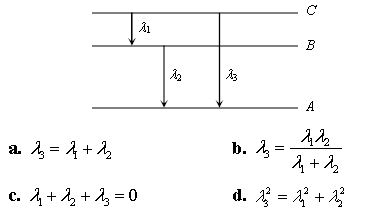
Answer : B
Question. The ionisation potential of hydrogen atom is 13.6 volt.
The energy required to remove an electron in the n = 2 state of the hydrogen atom is:
a. 27.2 eV
b. 13.6 eV
c. 6.8 eV
d. 3.4 eV
Answer : D
Question. The following diagram indicates the energy levels of a certain atom when the system moves from 2E level to E, a photon of wavelength λ is emitted. The wavelength of photon produced during its transition from 4E/3 level to E is:
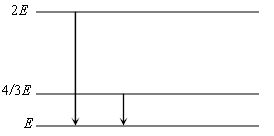
a.λ/3
b. λ/4
c. 4λ/3
d. 3λ
Answer : D
Question. If m is mass of electron, v its velocity, r the radius of stationary circular orbit around a nucleus with charge Ze, then from Bohr's first postulate, the kinetic energy K = (1/2) mv2 of the electron in C.G.S. system is equal to:
a. 1/2 Ze2/r
b. 1/2 Ze2/r2
c. Ze2/r
d. Ze/r2
Answer : A
Question. Figure shows the energy levels P, Q, R, S and G of an atom where G is the ground state. A red line in the emission spectrum of the atom can be obtained by an energy level change from Q to S. A blue line can be obtained by following energy level change
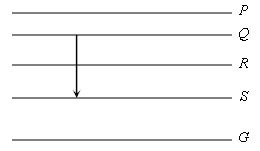
a. P to Q
b. Q to R
c. R to S
d. R to G
Answer : D
Question. In Thomson experiment of finding e/m for electrons, beam of electron is replaced by that of muons (particle with same charge as of electrons but mass 208 times that of electrons). No deflection condition in this case satisfied if:
a. B is increased 208 times
b. E is increased 208 times
c. B is increased 14.4 times
d. None of these
Answer : C
Question. An electron is accelerated through a potential difference of 200 volts. If e /m for the electron be 1.6×10¹¹ coulomb/kg, the velocity acquired by the electron will be:
a. 8×10⁶ m/ s
b. 8×10⁵ m/ s
c. 5.9×10⁶ m/ s
d. 5.9×10⁵ m/ s
Answer : A
Question. In Bainbridge mass spectrograph a potential difference of 1000 V is applied between two plates distant 1 cm apart and magnetic field in B = 1T. The velocity of undeflected positive ions in m/s from the velocity selector is:
a. 107 m/s
b. 104 m/s
c. 105 m/s
d. 102 m/s
Answer : C
Question. The ratio of momenta of an electron and an α − particle which are accelerated from rest by a potential difference of 100 V is:
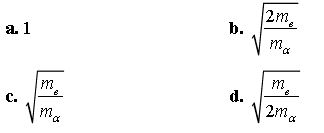
Answer : D
Question. In Millikan oil drop experiment, a charged drop of mass 1.8 x 10 kg−14 is stationary between its plates. The distance between its plates is 0.90 cm and potential difference is 2.0 kilo volts. The number of electrons on the drop is:
a. 500
b. 50
c. 5
d. 0
Answer : C
Question. The ratio of specific charge of an α -particle to that of a proton is:
a. 2 : 1
b. 1 : 1
c. 1 : 2
d. 1 : 3
Answer : C
Question. The speed of an electron having a wavelength of 10-10 m is:
a. 7.25×10⁸ m/s
b. 6.26×10⁸ m/ s
c. 5.25×10⁸ m/ s
d. 4.24×10⁸ m/ s
Answer : A
Question. The ratio of the wavelengths for 2 → 1 transition in Li++, He+ and H is:
a. 1 : 2 : 3
b. 1 : 4 : 9
c. 4 : 9 : 36
d. 3 : 2 : 1
Answer : C
Question. If scattering particles are 56 for 90° angle then this will be at 60° angle:
a. 224
b. 256
c. 98
d. 108
Answer : A
Question. When an electron in hydrogen atom is excited, from its 4th to5th stationary orbit, the change in angular momentum of electron is: (Planck’s constant: h = 6.6×10⁻³⁴ J–s)
a. 4.1 10-34 J -s
b. 3.32 10-34 J -s
c. 1.05 10-34 J -s
d. 2.08 10-34 J -s
Answer : C
Question. In hydrogen atom, if the difference in the energy of the electron in n = 2 and n = 3 orbits is E, the ionization energy of hydrogen atom is:
a. 13.2 E
b. 7.2 E
c. 5.6 E
d. 3.2 E
Answer : B
Question. In Bohr model of hydrogen atom, the ratio of periods of revolution of an electron in n = 2 and n = 1 orbits is:
a. 2 : 1
b. 4 : 1
c. 8 : 1
d. 16 : 1
Answer : C
Question. Hydrogen atom emits blue light when it changes from n = 4 energy level to n = 2 level. Which colour of light would the atom emit when it changes from n = 5 level to n = 2 level:
a. Red
b. Yellow
c. Green
d. Violet
Answer : D
Question. A single electron orbits a stationary nucleus of charge +Ze, where Z is a constant. It requires 47.2 eV to excited electron from second Bohr orbit to third Bohr orbit. Find the value of Z:
a. 2
b. 5
c. 3
d. 4
Answer : B
Question. The first member of the Paschen series in hydrogen spectrum is of wavelength 18,800 Å. The short wavelength limit of Paschen series is:
a. 1215 Å
b. 6560 Å
c. 8225 Å
d. 12850 Å
Answer : C
Question. Hydrogen atom in its ground state is excited by radiation of wavelength 975 Å. How many lines will be there in the emission spectrum?
a. 2
b. 4
c. 6
d. 8
Answer : C
Question. A photon of energy 12.4 eV is completely absorbed by a hydrogen atom initially in the ground state so that it is excited. The quantum number of the excited state is:
a. n =1
b. n = 3
c. n = 4
d. n = ∞
Answer : C
Question. An electron makes a transition from orbit n = 4 to the orbit n = 2 of a hydrogen atom. The wave number of the emitted radiations (R = Rydberg's constant) will be:
a. 16/3R
b. 2R/16
c. 3R/16
d. 4R/16
Answer : C
Question. If an electron jumps from 1st orbital to 3rd orbital, then it will:
a. Absorb energy
b. Release energy
c. No gain of energy
d. None of these
Answer : A
Question. Which of the transitions in hydrogen atom emits a photon of lowest frequency (n = quantum number?)
a. n = 2 to n = 1
b. n = 4 to n = 3
c. n = 3 to n = 1
d. n = 4 to n = 2
Answer : B
Question. The minimum energy required to excite a hydrogen atom from its ground state is:
a. 13.6 eV
b. −13.6 eV
c. 3.4 eV
d. 10.2 eV
Answer : D
Question. Energy of the electron in nth orbit of hydrogen atom is given by En = 13.6/n2 eV. The amount of energy needed to transfer electron from first orbit to third orbit is:
a. 13.6 eV
b. 3.4 eV
c. 12.09 eV
d. 1.51 eV
Answer : C
Question. If the binding energy of the electron in a hydrogen atom is 13.6 eV, the energy required to remove the electron from the first excited state of Li++ is:
a. 122.4 eV
b. 30.6 eV
c. 13.6 eV
d. 3.4 eV
Answer : B
Question. The minimum wavelength of the X-rays produced by electrons accelerated through a potential difference of V volts is directly proportional to:
a. √V
b. V2
c. 1/√V
d. 1/V
Answer : D
Question. In X-ray tube when the accelerating voltage V is halved, the difference between the wavelength of Kα line and minimum wavelength of continuous X-ray spectrum:
a. Remains constant
b. Becomes more than two times
c. Becomes half
d. Becomes less than two times
Answer : C
Question. If the potential difference applied across X-ray tube is V volts, then approximately minimum wavelength of the emitted X-rays will be:
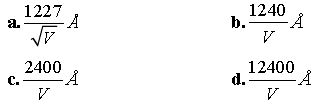
Answer : D
Question. Which of the following is accompanied by the characteristic X-ray Emission?
a. α − particle emission
b. Electron emission
c. Positron emission
d. K–electron capture
Answer : D
Question. Penetrating power of X-rays can be increased by:
a. Increasing the potential difference between anode and cathode
b. Decreasing the potential difference between anode and cathode
c. Increasing the cathode filament current
d. Decreasing the cathode filament current
Answer : A
Question. What kV potential is to be applied on X-ray tube so that minimum wavelength of emitted X-rays may be 1Å: (h 6.625 10−34 J-sec)
a. 12.42kV
b. 12.84kV
c. 11.98kV
d. 10.78kV
Answer : A
Question. The energy of a photon of characteristic X-rays from a Coolidge tube comes from:
a. The kinetic energy of the striking electron
b. The kinetic energy of the free electrons of the target
c. The kinetic energy of the ions of the target
d. An electronic transition of the target atom
Answer : D
Question. The wave number of the energy emitted when electron comes from fourth orbit to second orbit in hydrogen is 20,397 cm–1. The wave number of the energy for the same transition in He+ is:
a. 5,099 cm–1
b. 20,497 cm–1
c. 40,994 cm–1
d. 81,998 cm–1
Answer : D
Question. The wavelength of Kα line for an element of atomic number 43 is λ. Then the wavelength of Kα line for an element of atomic number 29 is:
a. (43/29)λ
b. (42/28)λ
c. (9/4)λ
d. (4/9)λ
Answer : C
Question. The shortest wavelength of X-rays emitted from an X-ray tube depends on the:
a. Current in the tube
b. Voltage applied to the tube
c. Nature of gas in the tube
d. Atomic number of target material
Answer : B
Question. When radiation of wavelength λ is incident on a metallic surface the stopping potential is 4.8 volts. If the same surface is illuminated with radiation of double the wavelength, then the stopping potential becomes 1.6 volts.
Then the threshold wavelength for the surface is:
a. 2λ
b. 4λ
c. 6λ
d. 8λ
Answer : B
Question. In an atom, the two electrons move round the nucleus in circular orbits of radii R and 4R. the ratio of the time taken by them to complete one revolution is:
a. 1/4
b. 4/1
c. 8/1
d. 1/8
Answer : D
Question. The voltage applied across an X-rays tube is nearly:
a. 10 V
b. 100 V
c. 10000 V
d. 106 V
Answer : C
Question. Mosley's law relates the frequencies of line X-rays with the following characteristics of the target element:
a. Its density
b. Its atomic weight
c. Its atomic number
d. Interplaner spacing of the atomic planes
Answer : C
Question. The continuous X-rays spectrum produced by an X-ray machine at constant voltage has:
a. A maximum wavelength
b. A minimum wavelength
c. A single wavelength
d. A minimum frequency
Answer : B
Question. An X-ray tube with a copper target emits Cu Kα line of wavelength 1.50 Å. What should be the minimum voltage through which electrons are to be accelerated to produce this wavelength of X rays: (h 6.63 x 10⁻³⁴ J-sec, c = 3×10³ m/ s)
a. 8280 V
b. 828 V
c. 82800 V
d. 8.28 V
Answer : A
Question. The cut off wavelength of continuous X-ray from two coolidge tubes operating at 30 kV but using different target materials (molybdenum Z = 42 and tungsten Z = 74) are:
a. 1Å, 3Å
b. 0.3 Å, 0.2 Å
c. 0.414 Å, 0.8 Å
d. 0.414 Å, 0.414 Å
Answer : D
Free study material for Chemistry
Practice MCQs for BITSAT Chemistry Atomic Structure
Download Multiple Choice Questions: Atomic Structure (BITSAT Chemistry)
Test your conceptual understanding of Atomic Structure with these targeted multiple-choice questions. Designed in alignment with the latest BITSAT curriculum for BITSAT Chemistry, these problem sets build accuracy and prepare students for objective exams.
Concept Clarification for Atomic Structure
Cross-reference your completed choices with comprehensive NCERT solutions for BITSAT Chemistry to ensure absolute clarity across all sub-topics in this chapter.
Additional Study Resources for BITSAT Chemistry
Wrap up your chapter revision by testing your knowledge against standard question formats. Everything on our platform is provided free of charge.
FAQs
You can get most exhaustive BITSAT Chemistry Atomic Structure MCQs for free on StudiesToday.com. These MCQs for BITSAT Chemistry are updated for the 2026-27 academic session as per BITSAT examination standards.
Yes, our BITSAT Chemistry Atomic Structure MCQs include the latest type of questions, such as Assertion-Reasoning and Case-based MCQs. 50% of the BITSAT paper is now competency-based.
By solving our BITSAT Chemistry Atomic Structure MCQs, BITSAT students can improve their accuracy and speed which is important as objective questions provide a chance to secure 100% marks in the Chemistry.
Yes, Chemistry MCQs for BITSAT have answer key and brief explanations to help students understand logic behind the correct option as its important for 2026 competency-focused BITSAT exams.
Yes, you can also access online interactive tests for BITSAT Chemistry Atomic Structure MCQs on StudiesToday.com as they provide instant answers and score to help you track your progress in Chemistry.