

Official Oxford Textbook Solutions for Class 8 History Civics
Review the Oxford Solutions for ICSE Class 8 History Civics Chapter 19 The United Nations designed for Class 8 History Civics students. Published under the latest ICSE guidelines for 2026-27, these chapter-wise solutions provide the foundational knowledge required for exam success.
Read and Download Chapter 19 The United Nations Solutions
View or download the dedicated Chapter 19 The United Nations resource below. This chapter-by-chapter structuring ensures easy navigation for daily study routines and immediate access to core academic concepts.
A. Fill in the blanks:
Question 1. The __________ was formed in 1920 after the end of the First World War.
Answer: League of Nations
In simple words: The League of Nations was a group started in 1920 to keep peace after the first major world war.
Exam Tip: Make sure to spell "League of Nations" correctly, as this was the first global peace organization before the UN.
Question 2. Each member state of the UN can send up to __________ representatives to the General Assembly.
Answer: Five
In simple words: Every country in the UN can send five people to the main meeting, but they still only get one vote.
Exam Tip: Note that while up to five representatives can be sent, each nation gets only a single vote in the General Assembly.
Question 3. The __________ is often referred to as the ‘Enforcement Wing’ of the UN.
Answer: Security Council
In simple words: The Security Council is the powerful group that makes sure countries follow UN rules and stay peaceful.
Exam Tip: The Security Council is called the "Enforcement Wing" because it has the power to use force or sanctions to keep peace.
Question 4. The five permanent members of the Security Council are USA, UK, France, __________ and the __________.
Answer: People's Republic of China, Russian Federation
In simple words: The five countries that are always in the Security Council are the USA, UK, France, China, and Russia.
Exam Tip: Learn the official names of these five permanent members: USA, UK, France, People's Republic of China, and Russian Federation.
Question 5. The objective of the ECOSOC is to free the world from __________.
Answer: want
In simple words: ECOSOC wants to help poor countries so that no one has to suffer from a lack of food, money, or help.
Exam Tip: In this context, the word "want" refers to poverty, hunger, and other basic needs of people.
Question 6. The WHO is a __________ agency of the UN.
Answer: specialized
In simple words: The World Health Organization is a special group in the UN that focuses just on keeping people healthy.
Exam Tip: "Specialized agencies" like the WHO work on specific areas such as health, education, or labor under the UN.
Question B. Match the following:
| Column A | Column B |
|---|---|
| 1. San Francisco Conference | (a) organ of the UN |
| 2. UN headquarters | (b) 15 |
| 3. Security Council | (c) five |
| 4. Permanent members of the Security Council | (d) New York City |
| 5. Number of judges at the International Court of Justice | (e) 1945 |
Answer:
| Column A | Column B (Matched) |
|---|---|
| 1. San Francisco Conference | (e) 1945 |
| 2. UN headquarters | (d) New York City |
| 3. Security Council | (a) organ of the UN |
| 4. Permanent members of the Security Council | (c) five |
| 5. Number of judges at the International Court of Justice | (b) 15 |
In simple words: This section links key UN places, dates, and groups together correctly, like matching the year 1945 with the conference where the UN charter was signed.Exam Tip: Double-check dates and headquarters locations, as these are frequently asked in short-answer questions.
C. Choose the correct answer:
Question 1. 24 October/22 March/21 June is celebrated as United Nations Day.
(a) 24 October
(b) 22 March
(c) 21 June
Answer: (a) We celebrate United Nations Day on 24 October every year.
In simple words: The UN was officially started on October 24, so we remember this special day every year.
Exam Tip: Remember October 24, 1945, as the official date the United Nations Charter came into force.
Question 2. The olive branches on the UN flag symbolize peace/wealth/ truth.
(a) peace
(b) wealth
(c) truth
Answer: (a) The olive branches shown on the UN flag represent peace.
In simple words: The leaves on the UN flag are a sign of peace and friendship between countries.
Exam Tip: Olive branches have historically been a symbol of peace, which is why they are on the UN flag.
Question 3. The Economic and Social Council consists of 54 members elected by the General Assembly for a 3/4/5-year term.
(a) 3-year term
(b) 4-year term
(c) 5-year term
Answer: (a) The Economic and Social Council has 54 members chosen by the General Assembly to serve a 3-year term.
In simple words: ECOSOC has 54 member countries, and each country is chosen to work in this group for three years.
Exam Tip: Remember that one-third of ECOSOC's 54 members are elected every year for a three-year term.
Question 4. The International Court of Justice is located in New York City in USA/The Hague in Netherlands/Paris in France.
(a) New York City in USA
(b) The Hague in Netherlands
(c) Paris in France
Answer: (b) The International Court of Justice is situated at The Hague in the Netherlands.
In simple words: The main court for the UN is in a city called The Hague, which is in the Netherlands.
Exam Tip: The International Court of Justice (ICJ) is the only major UN organ not located in New York City.
Question 5. The Secretariat/General Assembly/International Court of Justice is the chief administrative organ of the UN.
(a) Secretariat
(b) General Assembly
(c) International Court of Justice
Answer: (a) The Secretariat serves as the main administrative branch of the UN.
In simple words: The Secretariat is the office that does all the daily paperwork and planning for the UN.
Exam Tip: The Secretariat is headed by the Secretary-General, who handles the administration of the UN.
D. State whether the following are true or false:
Question 1. State whether the following is true or false: All the members of the UN are members of the General Assembly.
Answer: True
In simple words: Every country that joins the UN automatically becomes a member of the General Assembly.
Exam Tip: The General Assembly is the only UN body where all member countries have equal representation.
Question 2. State whether the following is true or false: French is one of the official languages of the UN.
Answer: True
In simple words: French is one of the six languages that the UN uses for its official work.
Exam Tip: The UN has six official languages: Arabic, Chinese, English, French, Russian, and Spanish.
Question 3. State whether the following is true or false: The Trusteeship Council is the most important organ of the UN.
Answer: False. The Security Council is considered the most powerful and crucial organ of the UN.
In simple words: The Security Council is the most important group because it maintains world peace and safety.
Exam Tip: Make sure to explain that the Security Council is the primary organ responsible for international peace and security.
Question 4. State whether the following is true or false: UNESCO and UNICEF are specialized agencies of the UN.
Answer: True
In simple words: UNESCO and UNICEF are special groups that work under the UN to help children and support education.
Exam Tip: UNESCO focuses on education, science, and culture, while UNICEF works for the welfare of children worldwide.
Question 5. State whether the following is true or false: Most of the world’s problems have disappeared with the end of the Cold War.
Answer: False. The end of the Cold War did not resolve the majority of global issues.
In simple words: Even though the Cold War ended, many countries still face serious problems like poverty and war.
Exam Tip: The end of the Cold War did not mean the end of international conflicts, hunger, or climate issues.
E. Answer the following questions in one or two words/ sentences:
Question 1. Mention one important organ of the UN.
Answer: An essential organ of the United Nations is the Security Council.
In simple words: The Security Council is one of the most powerful parts of the UN.
Exam Tip: You can also name the General Assembly or the Secretariat as other important organs of the UN.
Question 2. Who are the members of the General Assembly?
Answer: Every nation that is a member of the United Nations belongs to the General Assembly.
In simple words: Any country that is in the UN is also a member of the General Assembly.
Exam Tip: Remember that membership in the General Assembly is automatic for all UN member states.
Question 3. What is a negative vote by one of the permanent members of the Security Council known as?
Answer: A veto is the term for a negative vote from a permanent member, which stops any decision from being passed.
In simple words: A veto is a "no" vote by any of the five main countries that blocks a plan completely.
Exam Tip: A single veto from any of the five permanent members can block any resolution, even if all other members vote "yes".
Question 4. Why was the Trusteeship Council established?
Answer: The UN created the Trusteeship Council to care for territories under foreign control and guide them toward independence. This was necessary because many regions were not free or had been devastated by the war.
In simple words: The Trusteeship Council was made to help ruled colonies become free, independent nations.
Exam Tip: The Trusteeship Council suspended operations in 1994 after the last trust territory (Palau) gained independence.
Question 5. Why did the UN impose economic sanctions against the South African government?
Answer: The UN used economic sanctions to oppose the unfair system of apartheid. These restrictions helped free the people of South Africa from racial discrimination.
In simple words: The UN stopped trading with South Africa to force them to end apartheid, which was a system that treated Black people unfairly.
Exam Tip: Make sure to use the word "apartheid" in your answer, as it is the key term for racial segregation in South Africa.
Question 6. What is the relevance of the UN in today’s world?
Answer: Today, we need to improve and support the UN so it can work well. This will help bring peace, order, and friendship to a world facing many conflicts.
In simple words: The UN is still needed today to solve world fights and help countries live together in peace.
Exam Tip: Emphasize terms like "peace," "conflict resolution," and "global cooperation" when explaining the modern relevance of the UN.
F. Answer the following questions briefly:
Question 1. The magnitude and scale of destruction during the Second World War created a great revulsion for war and a passionate yearning for peace. In this context discuss:
(a) The signing of the Atlantic Charter
(b) The basic rights or the four freedoms guaranteed by the charter
(c) The San Francisco Conference and establishment of the United Nations
Answer:
(a) In August 1941, British Prime Minister Winston Churchill and American President Franklin D. Roosevelt met on a ship near Newfoundland. During this meeting, they signed the Atlantic Charter.
(b) The charter promised that people would get four basic rights once the war was over. These key freedoms are:
1. freedom from want
2. freedom of speech
3. freedom of religious belief
4. freedom from fear
(c) In June 1945, fifty countries gathered in San Francisco to sign the charter. Poland, although not present, signed later to become one of the 51 founding members. The United Nations was set up on 24 October 1945 to protect future generations from war and protect human rights. This date is now celebrated as United Nations Day.
In simple words: After World War II, leaders met to sign a peace charter. They promised everyone basic freedoms and officially started the United Nations in October 1945 to stop future wars.
Exam Tip: Be sure to memorize the four freedoms and the date of United Nations Day (October 24, 1945) as they are frequently tested.
Question 2. With reference to the United Nations discuss:
(a) The UN flag
(b) Any four objectives of the UN outlined in the Preamble of the UN Charter
(c) The obligations of all nations that follow from these objectives
Answer:
(a) The flag of the UN shows a world map surrounded by two curved olive branches. These white symbols sit on a light blue background, with the olive branches representing peace.
(b) The preamble of the charter outlines these goals for the UN:
1. To keep international peace and safety.
2. To build friendly ties between equal countries.
3. To work together globally to solve economic, social, and human problems.
4. To support human rights and basic freedoms for everyone in the world.
5. To serve as a shared place to help nations work together on these goals.
6. To protect future generations from the pain of war, which has already caused suffering twice.
(c) To achieve these goals, countries must follow these duties:
1. Every nation is equal, no matter its size.
2. Every country must follow the rules in the Charter.
3. All arguments must be resolved in a peaceful way.
4. Nations must not use violence or force against each other.
In simple words: The UN flag represents peace across the world. The UN aims to stop wars, protect human rights, and ensure countries treat each other fairly and resolve fights peacefully.
Exam Tip: Be ready to list any four of the major objectives of the UN, as well as explain the symbols on the UN flag.
Question 3. With reference to the General Assembly and Security Council of the UN, answer the following questions:
(a) Mention any four functions of the General Assembly.
(b) Explain the veto power of the permanent members of the Security Council. What happens when the Security Council cannot take any action because of the veto?
(c) State three important functions of the Security Council.
Answer:
(a) Important functions of the General Assembly:
1. To talk about world problems and suggest ways to fix them.
2. To offer advice on how to resolve conflicts peacefully.
3. To review and vote on the UN's financial plan.
4. To choose the temporary members of the Security Council, ECOSOC, and the Trusteeship Council.
5. To oversee the activities of other UN bodies, which includes managing peacekeeping forces during emergencies.
6. To propose combined actions when needed.
(b) If any of the five permanent countries votes against a proposal, that proposal is rejected. This power to stop a decision is called the veto. If a veto stops the Security Council from acting during a crisis, the General Assembly can step in to handle the situation. The Assembly can recommend necessary steps to bring back global peace.
(c) Key functions of the Security Council:
1. To look into global conflicts and suggest peaceful ways to resolve them.
2. To ask member nations to stop trading with a country that attacks others.
3. To use military force to stop an attacker if it is needed.
In simple words: The General Assembly discusses global issues and makes suggestions, while the Security Council keeps peace. If a permanent member uses its "veto" power to block a decision, the General Assembly can step in to help resolve the crisis.
Exam Tip: Be prepared to explain the "Uniting for Peace" resolution, which allows the General Assembly to take action when the Security Council is deadlocked by a veto.
Question 4. With reference to the organs of the UN, discuss:
(a) Any three functions of the Economic and Social Council (ECOSOC)
(b) The composition and functions of the International Court of Justice
(c) Any four significant achievements of the UN
Answer:
(a) Important functions of ECOSOC:
1. To support financial development and social improvement.
2. To encourage respect for the basic rights of all people.
3. To tackle issues like illness, poor education, substance abuse, jobs, and women's rights.
4. To direct the activities of special groups such as WHO, UNESCO, UNICEF, ILO, and FAO.
(b) The International Court of Justice (ICJ) is made up of fifteen judges from various nations, chosen by the Security Council and General Assembly. Their terms last for nine years, and no two judges can come from the same nation.
Its primary functions are:
1. To resolve legal disagreements submitted by member states.
2. To provide legal guidance to other UN branches when asked.
(c) Notable achievements of the UN include:
1. Even though it cannot stop every conflict, it has successfully restored peace in places like Korea, the Suez Canal, and the Gulf.
2. Several nations, such as Algeria, Morocco, and Indonesia, gained their freedom with the help of the UN.
3. It helped end apartheid in South Africa by putting trade bans on the country's government.
4. The UN has constantly worked to protect and defend human rights worldwide.
5. It has tried to stop the build-up of nuclear weapons and promoted using atomic power for peaceful means.
6. Through its special groups, it has successfully fought poverty, hunger, disease, and lack of education.
In simple words: ECOSOC works on social and financial issues, and the ICJ is the UN's main court. The UN has many achievements, such as helping colonies become free, keeping peace in conflict zones, and protecting human rights.
Exam Tip: Be prepared to list the specialized agencies of ECOSOC (such as WHO, UNICEF, and UNESCO) as well as the term length and number of judges in the ICJ.
G. Picture Study
This building is the headquarters of an international organization which was established in October 1945 to maintain international peace and security.
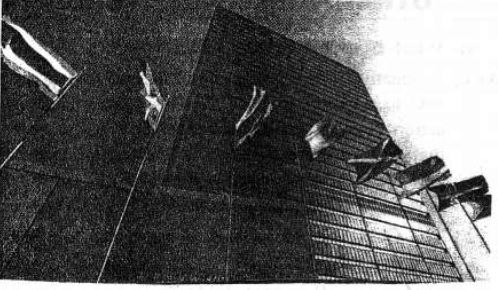
Question 1. Name the organization.
Answer: United Nations (UN)
In simple words: This building belongs to the United Nations.
Exam Tip: Always use the plural form "United Nations" rather than "United Nation".
Question 2. Where are the headquarters of this organization located?
Answer: The headquarters are located in New York City.
In simple words: The main offices of the UN are in New York City, USA.
Exam Tip: Though situated in New York City, the land occupied by the UN headquarters is international territory.
Question 3. Mention four important objectives of this organization.
Answer: The main aims of the United Nations, as written in its Charter, are:
1. To preserve world peace and security.
2. To foster friendly connections between nations as equal partners.
3. To work together on solving global economic, social, and cultural challenges.
4. To support and protect human rights for everyone.
In simple words: The UN wants to keep peace, help countries get along, solve global problems together, and keep everyone's rights safe.
Exam Tip: Be sure to list exactly four objectives as specified by the question to get full marks.
Question 4. Name three major organs of this organization.
Answer: Three primary branches of the UN are:
1. The General Assembly
2. The Security Council
3. The Economic and Social Council
In simple words: Three main parts of the UN are the General Assembly, the Security Council, and the Economic and Social Council.
Exam Tip: The UN has a total of six principal organs; memorizing at least three to four is crucial for examinations.
Other Important Questions
Question 1. What is meant by the term ‘veto’?
Answer: A veto is the power of any of the five permanent members to reject a decision. If even one of these countries votes 'no', the proposal cannot be passed. Therefore, all major agreements require the agreement of all permanent members to succeed.
In simple words: Veto means "I forbid." It lets any of the five big countries stop a UN decision just by voting against it.
Exam Tip: The "Veto Power" is held only by the five permanent members: USA, UK, France, Russia, and China.
Question 2. The Cold War has ended. What is the relevance of the UN in today’s world?
Answer: Before World War II, the USA and the Soviet Union had strong political and economic differences. These disagreements grew into deep suspicion after the war ended. However, after 1953, Cold War tensions began to decrease for two main reasons.
First, by 1953, both countries had powerful hydrogen bombs. They knew that using these weapons would destroy both sides, so they chose to improve relations to avoid a direct war.
Second, after 1954, the connections between these superpowers and their smaller allied states started to weaken. Since their allies no longer offered full support, both superpowers found it wiser to work together.
In simple words: The tension between America and the Soviet Union began to calm down because both sides had dangerous hydrogen bombs that could destroy everyone, and their allies stopped supporting them fully.
Exam Tip: Explain both reasons clearly: the threat of mutually assured destruction by hydrogen bombs, and the weakening of alliances with satellite nations.
Free study material for History Civics
ICSE Study Resources for Class 8 History Civics Chapter 19 The United Nations
About ICSE Solutions for Class 8 History Civics Chapter 19 The United Nations
Access structured ICSE solutions for Class 8 History Civics Chapter 19 The United Nations designed to match CISCE curriculum standards. These verified answers help clarify complex numericals and support daily homework revision.
Concept Clarification for Chapter 19 The United Nations
Every exercise question in this chapter includes step-by-step working steps, allowing you to self-evaluate, catch mistakes early, and understand the underlying logic.
Effective Revision Strategies for Chapter 19 The United Nations
Pair your solution review with additional practice papers to test your execution speed and ensure total preparedness for school exams.
FAQs
You can download the verified Oxford solutions for Chapter 19 The United Nations on StudiesToday.com. Our teachers have prepared answers for Class 8 History Civics as per 2026-27 ICSE academic session.
Yes, our solutions for Chapter 19 The United Nations are designed as per new 2026 ICSE standards. 40% competency-based questions required for Class 8, are included to help students understand application-based logic behind every History Civics answer.
Yes, every exercise in Chapter 19 The United Nations from the Oxford textbook has been solved step-by-step. Class 8 students will learn History Civics conceots before their ICSE exams.
Yes, follow structured format of these Oxford solutions for Chapter 19 The United Nations to get full 20% internal assessment marks and use Class 8 History Civics projects and viva preparation as per ICSE 2026 guidelines.