

Class 6 History Civics Chapter 04 The Chinese Civilization: Oxford Study Material
Review the Oxford Solutions for ICSE Class 6 History Civics Chapter 4 The Chinese Civilization designed for Class 6 History Civics students. Published under the latest ICSE guidelines for 2026-27, these chapter-wise solutions provide the foundational knowledge required for exam success.
Chapter 04 The Chinese Civilization Answer Guide
View or download the dedicated Chapter 04 The Chinese Civilization resource below. This chapter-by-chapter structuring ensures easy navigation for daily study routines and immediate access to core academic concepts.
1. Shang dynasty: It was the first known dynasty in China. Ancestor worship is to pray to the dead people of the family. The Chinese believed that human beings become powerful souls after death.
This dynasty marks the beginning of recorded history in China where people lived in organized groups under a king. They believed that by honoring their deceased family members, they would receive protection and good luck.
Teacher's Tip: Think of a "Dynasty" as a long-running family business that rules a country.
Exam Tip: Mention both the name of the dynasty and the concept of ancestor worship for a complete definition.
2. Oracles: They were priests or holy people who were in close touch with the gods.
These individuals were consulted to predict the future or seek advice on important state matters. They often used animal bones or turtle shells to interpret messages from the divine world.
Teacher's Tip: Oracles were like the "human telephones" connecting people to the gods.
Exam Tip: Use the word "priests" to describe their role in society to get full marks.
3. Confucianism: Was the religious movement named after its founder, Confucius. It taught a practical code of moral conduct and became the state religion of China. Seri-culture It is the breeding of silkworms for the production of silk.
This system focused on how people should treat one another with respect and kindness in their daily lives. Sericulture was a separate but vital industry that made China famous for its beautiful and expensive fabric.
Teacher's Tip: "Confucianism" is about character, while "Sericulture" is about silk.
Exam Tip: Define Sericulture specifically as the "breeding of silkworms" to show technical knowledge.
4. Mulberry tree: It is a tree with broad, dark, green leaves and edible berries. Silkworms eat the leaves of the white mulberry and the trees are used for rearing silkworms to produce silk.
Without these specific trees, the silk industry in ancient China could not have existed. The leaves provided the essential nutrients needed for the silkworms to grow and spin their cocoons.
Teacher's Tip: No Mulberry = No Silk! They are perfectly connected.
Exam Tip: Mention the "white mulberry" leaves as the specific food source for silkworms.
5. Porcelain: It is a hard, white, shiny substance made by baking clay and used for making delicate pottery.
This material was so uniquely Chinese that the Western world eventually began calling high-quality dishes "china." It is known for being very strong yet appearing thin and elegant.
Teacher's Tip: Think of the fancy white plates used for special dinners - that is porcelain.
Exam Tip: Describe it using keywords like "hard," "white," and "shiny" for the best score.
6. Great Wall of China: It was built by Emperor Shi Huangdi to protect the country from the frequent attacks of the barbarians.
This massive structure stretched for thousands of miles across rugged terrain to keep northern invaders away from Chinese lands. It stands today as one of the greatest engineering feats in human history.
Teacher's Tip: The wall was like a "Giant Shield" made of stone and brick.
Exam Tip: Always name "Emperor Shi Huangdi" as the primary builder in your answers.
7. Pagodas: Are stupa-type temples that were an important feature of the Chinese architecture.
These multi-storied buildings often have curved roofs and were used for religious purposes or as memorial towers. They are a iconic symbol of the artistic style developed during the ancient Chinese civilization.
Teacher's Tip: Picture a tower with many levels and "curly" roof corners - that is a pagoda.
Exam Tip: Link the term to "Chinese architecture" to explain its historical significance.
EXERCISES
A. Fill in the blanks.
Question 1: The great rivers of China are Huang Ho and Yangtze Kiang.
Answer: Huang Ho and Yangtze Kiang.
These two rivers provided the water and fertile soil necessary for the early Chinese people to settle and farm. They were the lifelines of the entire civilization, allowing it to grow and prosper.
Teacher's Tip: Remember the "Yellow River" is another name for the Huang Ho.
Exam Tip: Be sure to memorize the correct spelling of both river names.
Question 2: Emperor Shi Huangdi began the task of joining the independent walls of the Great Wall of China to protect China from the frequent attacks of invaders.
Answer: Great Wall of China.
By connecting separate local walls, the Emperor created a continuous defensive barrier that guarded the northern borders. This project required the labor of hundreds of thousands of workers over many years.
Teacher's Tip: Think of it as "The Great Connector" of ancient defenses.
Exam Tip: Capitalize the name "Great Wall of China" as it is a proper noun.
Question 3: The Chinese were the first to make silk cloth.
Answer: silk cloth.
They kept the secret of how to make silk for hundreds of years, making it a very rare and valuable item. It became so popular that a famous trade route, the Silk Road, was named after it.
Teacher's Tip: Silk is the "Soft Secret" of ancient China.
Exam Tip: Mention "silk cloth" specifically as it was their most famous invention for trade.
Question 4: The chief exports of China were silk, chinaware, tea and paper.
Answer: silk, chinaware, tea and paper.
These four products were in high demand all over the world because other civilizations did not know how to produce them yet. Trading these goods brought great wealth and new ideas into the Chinese empire.
Teacher's Tip: Remember the "Four Treasures" - Silk, China, Tea, and Paper.
Exam Tip: Listing all four items demonstrates a thorough understanding of Chinese trade.
Question 5: Confucianism became the state religion of China.
Answer: Confucianism.
This set of beliefs helped maintain order by teaching people to fulfill their duties to their families and the government. It deeply influenced how the Chinese government functioned for nearly two thousand years.
Teacher's Tip: It is named after the teacher "Confucius".
Exam Tip: Note that it was the "state religion," meaning it was officially supported by the government.
Question 6: The Chinese wrote on silk or bamboo slips and later on paper.
Answer: silk, bamboo slips, paper.
Before paper was common, they used heavy bamboo sticks or expensive silk fabric for their records. The invention of paper made writing much easier, cheaper, and more accessible for everyone.
Teacher's Tip: Think of the progress: from "Hard" (bamboo) to "Soft" (silk) to "Light" (paper).
Exam Tip: List the materials in the order they were used to show chronological understanding.
Question 7: In the 1st century ce the Chinese made paper from bark of old trees, old rags and fishing nets.
Answer: bark of old trees, old rags and fishing nets.
This early form of recycling used waste materials to create something incredibly useful for communication and record-keeping. It was a revolutionary invention that eventually spread to the rest of the world.
Teacher's Tip: Ancient Chinese people were the original recyclers!
Exam Tip: Be sure to include all three source materials (bark, rags, nets) for a full mark.
B. Match the following
Question : Match the items in Column A with their correct descriptions in Column B.
Column A
1. Huang He
2. Pagodas
3. Tea
4. Silkworms
5. Shangdi
Column B
(a) mulberry tree
(b) god of heaven
(c) stupa-style temples
(d) Sorrow of China
(e) medicine
Answer:
1. Huang He - (d) Sorrow of China
2. Pagodas - (c) stupa-style temples
3. Tea - (e) medicine
4. Silkworms - (a) mulberry tree
5. Shangdi - (b) god of heaven
This exercise connects the geographic features, architectural styles, and cultural beliefs of ancient China. Understanding these pairs helps build a complete picture of how the civilization functioned and what they valued.
Teacher's Tip: "Huang He" is the "Sorrow" because it flooded so often.
Exam Tip: Use the process of elimination by matching the most obvious ones, like "Silkworms" and "Mulberry Tree," first.
C. Choose the correct answer:
Question 1: China is bordered by the Himalayas/Pacific Ocean/ deserts in the east.
Answer: China is bordered by the Pacific Ocean in the east.
The massive ocean acted as a natural protective barrier, isolating China from civilizations further away. It also provided a vast area for fishing and later, international sea trade.
Teacher's Tip: Think of the sun rising over the "Pacific" in the east.
Exam Tip: Remember your cardinal directions: East = Ocean, South = Himalayas, West = Deserts.
Question 2: The chief occupation of the Chinese was agriculture/ woodwork/sericulture.
Answer: The chief occupation of the Chines was agriculture.
Like most ancient river valley civilizations, farming provided the food necessary for the entire population to survive. The fertile plains around the Huang Ho and Yangtze rivers were ideal for growing crops.
Teacher's Tip: If you see "Chief Occupation" in ancient history, the answer is almost always "Agriculture."
Exam Tip: While they were good at woodwork and silk, agriculture was the most common job.
Question 3: People in China made terracotta/porcelain/bamboo pottery.
Answer: People in China made porcelain pottery.
Their specialized skills in baking clay at very high temperatures allowed them to create this unique, glass-like ceramic. Porcelain was highly prized globally and became one of China's most important trade items.
Teacher's Tip: Just think of "Fine China" - it's another name for porcelain.
Exam Tip: Do not confuse terracotta (red clay) with porcelain (white, baked clay).
Question 4: The oracles were holy priests/farmers/potters.
Answer: The oracles were holy priests.
They held a high status in society because they were believed to have the power to communicate with spirits and gods. Kings would consult them before making major decisions like going to war.
Teacher's Tip: Oracles = Priests who "talk" to the heavens.
Exam Tip: Define them as "holy priests" to show you understand their religious role.
Question 5: Taoism/Confucianism/Buddhism became the state religion of China.
Answer: Confucianism became the state religion of China.
The government adopted these teachings because they promoted loyalty to the ruler and social harmony. It became the foundation for the civil service exams that determined who could work for the government.
Teacher's Tip: Confucianism = Rules for a Good State.
Exam Tip: Be sure to choose "Confucianism" as the official state-supported belief system.
D. State whether the following are true or false:
Question 1: The first known dynasty of China was the Qin dynasty.
Answer: False.
Correct: The first known dynasty of China was the Shang dynasty.
While the Qin dynasty is very famous for unifying China, historical records show that the Shang dynasty came much earlier. The Shang provided the first archaeological evidence of a complex Chinese society.
Teacher's Tip: "S" comes before "Q" in the alphabet, just as "Shang" comes before "Qin."
Exam Tip: Always provide the correct name (Shang) when marking a statement as False.
Question 2: The emperor occupied the highest position in Chinese society.
Answer: True.
He was known as the "Son of Heaven" and was believed to rule with a divine mandate. His authority over the people, the government, and the military was absolute.
Teacher's Tip: The Emperor was the "King of the Mountain" in their social ladder.
Exam Tip: Use the term "highest position" to describe the emperor's rank.
Question 3: The Chinese developed the art of making porcelain.
Answer: True.
They refined the process of selecting the right clay and firing it in kilns until it became translucent and strong. This invention was so successful that it is still a major industry in China today.
Teacher's Tip: Porcelain is one of China's "Greatest Inventions."
Exam Tip: Mark this as True to acknowledge China's unique contribution to pottery.
Question 4: The Chinese worshiped the forces of nature.
Answer: True.
Early Chinese religion included the belief that spirits lived in the sun, moon, rivers, and mountains. They performed rituals to ensure these natural forces remained favorable for their crops and safety.
Teacher's Tip: Nature worship is common in almost all ancient river civilizations.
Exam Tip: This belief was later integrated into their more formal religions like Taoism.
Question 5: The Chinese script is a form of picture writing.
Answer: True.
Each character in their writing system originally represented a specific object or idea rather than a sound. This makes it one of the most unique and complex writing systems in the world.
Teacher's Tip: Think of it as writing with "Tiny Drawings."
Exam Tip: Note that this system is called "Logographic" or picture-based.
Question 6: In China, temples were known as stupas.
Answer: False.
Correct :In China, temples were known as pagodas.
While "stupas" are a type of religious monument in Indian culture, the Chinese developed their own distinct multi-tiered towers. These pagodas became the center of religious life and architectural beauty.
Teacher's Tip: "Stupa" = Round/India, "Pagoda" = Tall Tower/China.
Exam Tip: Always associate the word "Pagoda" with Chinese temple architecture.
E. Answer the following questions in one or two words/ sentences:
Question 1: How was China isolated and protected from the rest of the world?
Answer: China, this vast country is bordered by the Pacific Ocean in the east, the Himalayas in the south, broad deserts and mountains in the west and Great Wall in the north. Within these boundaries lie the valley of two rivers. In this way China was isolated and protected from the rest of the world.
These geographic barriers made it extremely difficult for foreigners to enter China by land or sea. This isolation allowed China to develop its own unique culture and traditions without much outside interference.
Teacher's Tip: Think of China as a "Natural Castle" with mountains and oceans as walls.
Exam Tip: List at least three of the natural barriers (Ocean, Mountains, Deserts) for a complete answer.
Question 2: Name the rivers that gave rise to the ancient Chinese civilization.
Answer: Huang Ho and Yangtze Kiang are two rivers that gave rise to ancient Chinese civilization.
These rivers flooded annually, leaving behind rich silt that was perfect for growing rice and wheat. Most of China's early cities and kingdoms were built right along their banks.
Teacher's Tip: Remember the two "Main Streets" of ancient China were these rivers.
Exam Tip: Always name both rivers to show that the civilization was not limited to just one area.
Question 3: Describe the social structure of the ancient Chinese civilization.
Answer: The emperor occupied the highest rung of the social ladder followed by the nobles, the merchants, the craftspeople, the farmers and the slaves. The soldiers occupied a special place in society. They were feared and respected by the people. People lived in groups or clans and respected their ancestors and elders. The family was a close-knit unit.
Society was very hierarchical, meaning everyone knew exactly where they belonged based on their job or family rank. Respect for parents and the elderly was the most important social rule in every household.
Teacher's Tip: It was a "Pyramid" where the Emperor was at the very top.
Exam Tip: Mention the "Clans" and "Respect for Elders" as they were key parts of their social life.
Question 4: What were the important occupations of the ancient Chinese?
Answer: Agriculture, sericulture, domestication of animals, pottery and woodwork are main occupations of the ancient Chinese.
While most people were farmers, the growth of cities created a need for skilled artisans like potters and weavers. These specialized jobs allowed China to produce high-quality goods that they could trade with other nations.
Teacher's Tip: Most people were "Farming and Making things."
Exam Tip: List at least three occupations to show the diversity of their economy.
Question 5: Name the countries with which the Chinese carried on trade?
Answer: The Chinese carried on trade with Japan, India, Egypt, Mesopotamia , and regions as far as the shores of the Mediterranean Sea.
The famous "Silk Road" connected China to these distant lands, allowing merchants to travel through deserts and mountains. This international trade helped spread Chinese inventions like paper and silk across the globe.
Teacher's Tip: They traded with almost every major ancient civilization!
Exam Tip: Mention the "Mediterranean Sea" to highlight how far their trade networks reached.
Question 6: Which famous Chinese product was the chief item of export in the ancient and medieval ages?
Answer: Chinese silk was world-famous and the chief item of export during the ancient and medieval ages.
Because silk was soft, strong, and beautiful, it was highly desired by royalty and wealthy people in distant lands. It was so valuable that it was sometimes used as a form of money in trade.
Teacher's Tip: Think of "Silk" as ancient China's "Gold."
Exam Tip: Use the term "chief item of export" to emphasize its economic importance.
Question 7: Name the state religion of ancient China.
Answer: Confucianism was the state religion of ancient China.
Even though it is more of a moral code, it functioned like a religion because the government required people to follow its rules. It focused on social order, respect for authority, and good governance.
Teacher's Tip: "State Religion" means it's the "Official Rulebook" for the country.
Exam Tip: Do not confuse it with Taoism or Buddhism, which were also popular but not the official state creed.
Question 8: Why were the vast majority of people in ancient China illiterate?
Answer: The Chinese script is a from of picture writing. There were about 40,000 word-pictures. Thus making the script complex and difficult. The Chinese could not understand them. So the vast majority of people in ancient China was illiterate.
Learning thousands of different characters took many years of study, which only wealthy families could afford. Most common people had to spend their time working in the fields rather than going to school.
Teacher's Tip: Imagine if our alphabet had 40,000 letters - it would be impossible to learn!
Exam Tip: Mention the specific number "40,000 word-pictures" to explain the difficulty clearly.
F. Answer the following questions briefly:
Question 1: Why was the Huang He known as the ‘Sorrow of China’?
Answer: The river Huang Ho was also known as the ‘Sorrow of China’ because it often changed its course after the floods and caused destruction of crops and canals dug for irrigation. People living on the banks of this river were especially affected.
The unpredictable floods could wipe out entire villages and ruin the food supply for thousands of people in a single season. While the river provided life-giving water, its destructive power made it a constant source of fear for the ancient Chinese.
Teacher's Tip: It was a "Bitter-Sweet" river - it gave food but could take away everything else.
Exam Tip: Use the phrase "changed its course" to explain why the floods were so dangerous.
Question 2: Describe the Great Wall of China. Why was it built?
Answer: The Great Wall of China was built by Emperor Shi Huangdi.It is one of the most impressive of Chinese architectural accomplishments. It is about 2,400 km long and varies in height from 4.5m to 9m. This wall forms the northern boundary of China. It was built across mountains, deserts and plains. There are 10,000 watch-towers at regular intervals along the wall. It was built to protect the China from the frequent attacks of barbarians.
The watch-towers allowed soldiers to quickly send smoke signals or light fires to warn the rest of the empire about an approaching enemy. This massive defense system helped unify the different parts of China under a single protected border.
Teacher's Tip: It is the longest "No-Entry" sign in world history!
Exam Tip: Include the measurements (2,400 km long) and the number of watch-towers (10,000) for more detail.
Question 3: Describe the town planning in ancient China.
Answer: City Town Planning - City planning in ancient China began with the urbanization of the Huang He valley in the later part of die Neolithic Age. Urban planning in ancient China followed strict traditional rules of layout and design based on specific religious (e.g. feng shui) and scientific (i.e. astronomical) ideas and principles. The objective was to create favourable and auspicious conditions that would bring balance and harmony between man, government, heaven and earth. The city of Chengzhou, built during the rule of the Zhou dynasty, represents an ideal city layout. The city was laid out in the form of a square, further subdivided into nine squares. Broad, parallel roads, running north to south, were intercepted at right angles by roads The square running east to west, dividing the city into wards. Palaces, houses, temples, markets etc. were built within these blocks, each reserved for a specific group of buildings, for e.g., the Inner City with the central palace and government buildings was built in the center (square 5 in the diagram). The Outer City was built around it. The audience hail (square 1), the temples (squares 3 and 7) and the market buildings (square 9) were built within the Inner City. In large cities, rectangular defensive walls with gates were built around the Inner City as well as the Outer City. Some of the larger cities were surrounded by moats.
The grid-like structure made the cities very organized and easy for the government to manage. By placing the most important buildings in the center, they ensured that the heart of the city was always protected by multiple layers of walls.
Teacher's Tip: Think of their city plan as a "Giant Game of Tic-Tac-Toe" with 9 squares.
Exam Tip: Mention the "Nine Squares" concept and the "Inner vs. Outer City" division.
Question 4: Briefly discuss the characteristics of the Chinese civilization with reference to (a) society and (b) Religion.
Answer:
(a) Society: Chinese lived in groups or clans. They respected their ancestors and elders. The family was a close-knit unit. The emperor occupied the highest rung of the social ladder followed by the nobles, the merchants the crafts- people, the farmers and the slaves. The soldiers occupied a special place and respected by the people.
(b) Religion: The Chinese worshiped the forces of nature. A widely prevalent practice was ancestor worship. Astrologers and oracles were greatly respected. The oracles or holy priests were supposed to be in touch with the gods.
Their social life was based on a strong sense of duty to one's family and the state. Religiously, they sought to live in harmony with nature and stay connected to their deceased relatives through regular prayers and rituals.
Teacher's Tip: Society = Respect for Elders; Religion = Respect for Nature.
Exam Tip: Be sure to describe both parts (a) and (b) separately as requested in the question.
Question 5: Give a brief account of the following: (a) Agriculture (b) Sericulture.
Answer:
(a) Agriculture: Agriculture was the main occupation of Chinese. They grew rice, wheat, millet, barley and soya bean. At first Chinese cultivated tea for medicinal purposes and later as a popular drink.
(b) Sericulture: Sericulture is the breading of silk warms for the production of silk. The Chinese were the first to make silk cloth and Chinese silk was world-famous and was the chief item of export during the Ancient and Medieval Ages.
These two industries were the foundation of China's economy for thousands of years. Agriculture fed the massive population, while sericulture produced luxury goods that made the empire wealthy through international trade.
Teacher's Tip: Agriculture is about "Eating," and Sericulture is about "Clothing."
Exam Tip: Mention that tea was originally used as "medicine" before it became a daily drink.
Question 6: Briefly describe: (a) Chinese pottery (b) Chinese woodwork.
Answer:
(a) Chinese pottery: The Chinese developed the art of making exquisite porcelain types of pots and they decorated pots with colourful designs. They were first to make vases, jars, cups, saucers and bowls.
(b) Chinese woodwork: Chinese used wood on a large scale for the construction of buildings. They made cabinets. The walls of palaces were made of polished wood.
The Chinese were master craftsmen who created beautiful objects for both everyday use and for decorating the royal palaces. Their skill with porcelain and wood made their artistic style famous throughout the world.
Teacher's Tip: Think of "Shiny Pots" (Porcelain) and "Polished Palaces" (Woodwork).
Exam Tip: Mention specific items they made, like "vases" and "cabinets," to show detail.
Question 7: Describe the religious beliefs of people in the ancient Chinese civilization.
Answer: The Chinese worshiped the forces of nature. A widely prevalent practice was ancestor worship. Astrologers and oracles were greatly respected. The oracles or holy priests were supposed to be in touch with the gods. The emperor of China was regarded as the son of Shangdi, the god of heaven. Later, the Chinese became followers of Confucianism, Taoism and Buddhism.
Religion in China was a mix of honoring natural spirits, family history, and following the moral teachings of great thinkers like Confucius. They believed that the Emperor's power came directly from a heavenly god named Shangdi.
Teacher's Tip: Their religion evolved from "Nature Spirits" to "Philosophical Rules."
Exam Tip: Name the three major belief systems: Confucianism, Taoism, and Buddhism.
Question 8: Discuss the main feature of Confucianism?
Answer: The principles he taught were basically a practical code of moral conduct. It was more a way of life than a religion. Confucius taught his disciples to appreciate the present world and cultivate the virtues of hard work, modesty, sobriety, gravity and thoughtfulness towards others. He stressed on loyalty and obligations. He attracted a large number of disciples. Later, Confucianism became the state religion of China.
Confucianism did not focus on gods or the afterlife but on how to build a peaceful and successful society here and now. It taught that if everyone fulfilled their duties to their family and ruler, the entire country would prosper.
Teacher's Tip: It is like a "How-To Guide" for being a good person and citizen.
Exam Tip: Use the phrase "code of moral conduct" to describe its main purpose.
Question 9: Explain the important features of the Chinese script?
Answer: The main features of Chinese script were following
1. The Chinese script is a form of picture writing. Each picture represents an idea.
2. The Chinese language does not have any alphabet.
3. There were about 40,000 word-pictures making the script complex and difficult.
Because there was no alphabet, a person had to memorize thousands of individual symbols to read and write correctly. This meant that only scholars and wealthy officials usually had the time to become fully literate.
Teacher's Tip: One symbol = One whole idea. It is a "Visual" language.
Exam Tip: Mention the "lack of an alphabet" as a key distinguishing feature from modern English.
Question 10: Several Chinese inventions have changed the history of the world. Explain any five.
Answer: Following Chinese inventions have changed the history of the world.
1. Chinese first made paper from bark of old trees, old rags and fishing nets.
2. The Chinese developed the art of block printing.
3. Seismograph was made in China to record earthquakes.
4. Other notable inventions were manufacture of gunpowder.
5. The mariner’s compass, the water mill, the wheelbarrow, umbrellas and kites.
These inventions made everyday life easier and helped explore new parts of the world. Paper and printing allowed knowledge to spread, while the compass and gunpowder changed the way people traveled and fought wars.
Teacher's Tip: Think of how different your life would be without paper or umbrellas!
Exam Tip: Be ready to explain how at least two of these (like paper or compass) were used.
G. Picture study.
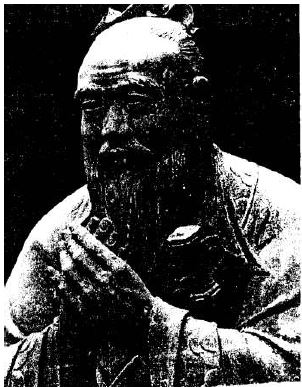
Question 1: Identify the person in the picture.
Answer: The person name is Confucius.
He was a famous teacher and philosopher whose ideas about respect and social duty shaped Chinese culture for centuries. His teachings are still followed by many people around the world today.
Teacher's Tip: He is the most famous teacher in ancient Chinese history.
Exam Tip: Make sure you know his face for picture-based identification questions.
Question 2: Name the religion founded by him.
Answer: He founded Confucianism religion.
Although it is technically a philosophy or code of conduct, it had such a deep impact that it is treated with the same respect as a major religion. It became the guiding light for the Chinese government and families.
Teacher's Tip: The name of the religion is just his name with "-ism" at the end.
Exam Tip: Use the full term "Confucianism" in your answer.
Question 3: Mention the important teachings of this religion.
Answer: This religion taught disciples to appreciate the present world and cultivate the virtues of hard word modesty, sobriety, gravity and thoughtfulness towards others. This religion stressed on loyalty and obligations.
Confucius believed that if every person respected their parents and elders, then the whole society would remain stable and peaceful. It focused on living a life of high moral standards through daily self-discipline.
Teacher's Tip: It is all about "Respect" and "Responsibility."
Exam Tip: List at least three virtues (like modesty, hard work, and loyalty) for a complete score.
Question 4: Name two other major religions that are followed by the people in this country.
Answer: Taoism and Buddhism are two other major religions that are followed by the people in this country.
Taoism emphasizes living in harmony with nature, while Buddhism teaches that one can find peace by letting go of worldly desires. Together with Confucianism, these three are often called the "Three Teachings" of China.
Teacher's Tip: Remember "T" and "B" - Taoism and Buddhism.
Exam Tip: Naming both religions clearly is the key to scoring full marks here.
OTHER IMPORTANT QUESTIONS
Question 1: Explain the geographical position of China?
Answer: China is vast country is boardered by Pacific Ocean in the east, the Himalayas in the south, broad deserts and mountains in the west and Great Wall in the north.
These natural boundaries effectively locked China away from the rest of the world for thousands of years. This protected the civilization from invaders and allowed it to grow in its own unique way.
Teacher's Tip: China is like an "Island on Land" because of its surrounding barriers.
Exam Tip: Describe the boundary in all four directions (North, South, East, West).
Question 2: What were the important occupations of the ancient Chinese? Mention two important points for each of the these occupations.
Answer: Agriculture, sericulture, domestication of animals, pottery and woodwork are main occupations of the ancient Chinese. Sericulture - The second occupation of Chinese was to make silk cloth. Chinese silk was world-famous and was the chief items of export. Domestication of animals The Chinese domesticated horses, cattle, sheep, pigs, dogs and poultry. They used horses and Horse-drawn carts as a mean of transport.
Farming was the primary way people survived, while raising animals helped with travel and labor. Their expertise in making silk and pottery allowed them to become one of the greatest trading nations in history.
Teacher's Tip: Focus on "Farming, Silk-making, and Animal-raising."
Exam Tip: For "Discuss" questions, always give specific examples like the types of animals they raised.
Question 4: Give a brief account of the following: 1. Chinese society 2. Tea cultivation
Answer:
1. Chinese society - Chinese lived in groups or clans. They respected their ancestors and elders. The family was a close-knit unit. The emperor occupied the highest rung of the social ladder followed by the nobles, the merchants the crafts- people, the farmers and the slaves. The soldiers occupied a special place and respected by the people.
2. Tea cultivation - The Chinese were the first to cultivate tea. At first tea was cultivated for medicinal purposes and later as a popular drink.
The tight-knit family structure was the backbone of Chinese society, ensuring everyone was cared for by their relatives. Their invention of tea cultivation turned a bitter medicinal leaf into one of the most famous beverages in the world.
Teacher's Tip: Society was "Ordered" and Tea was originally "Medicine."
Exam Tip: Mention the "Clans" and the " medicinal use of tea" to show you read the textbook thoroughly.
Free study material for History Civics
Verified Textbook Solutions for Class 6 History Civics Chapter 04 The Chinese Civilization
ICSE Chapter Solutions: Class 6 History Civics Chapter 04 The Chinese Civilization
Find reliable chapter-wise explanations for Class 6 History Civics Chapter 04 The Chinese Civilization. Curated to follow standard ICSE guidelines, these problem solutions assist students in building strong conceptual foundations.
Step-by-Step Explanations and Breakdown
Tackle complex theorems and numerical problems easily by cross-referencing your working steps with our structured solution guides.
More Study Resources for Class 6 History Civics
Pair your solution review with additional practice papers to test your execution speed and ensure total preparedness for school exams.
FAQs
You can download the verified Oxford solutions for Chapter 04 The Chinese Civilization on StudiesToday.com. Our teachers have prepared answers for Class 6 History Civics as per 2026-27 ICSE academic session.
Yes, our solutions for Chapter 04 The Chinese Civilization are designed as per new 2026 ICSE standards. 40% competency-based questions required for Class 6, are included to help students understand application-based logic behind every History Civics answer.
Yes, every exercise in Chapter 04 The Chinese Civilization from the Oxford textbook has been solved step-by-step. Class 6 students will learn History Civics conceots before their ICSE exams.
Yes, follow structured format of these Oxford solutions for Chapter 04 The Chinese Civilization to get full 20% internal assessment marks and use Class 6 History Civics projects and viva preparation as per ICSE 2026 guidelines.