

Download ICSE Class 8 History Civics Solutions by Goyal Brothers
Access the official Goyal Brothers textbook solutions for Class 8 History Civics, updated for the 2026-27 academic year. This digital resource is structured to help students build strong conceptual clarity and prepare effectively for school examinations.
Access Chapter 05 Traders To Rulers I Solutions for Class 8 History Civics
Access the complete PDF for Chapter 05 Traders To Rulers I below. This focused excerpt allows students to isolate specific topics for thorough review and uninterrupted reading, complementing standard ICSE textbooks.
Time To Learn
I. Fill in the blanks:
1. Elizabeth 1 was the Queen of England.
2. The French company set up its headquarters at Pondicherry.
3. A group of English merchants formed the English East India Company.
4. The first Englishman to meet Emperor Jahangir was Sir Thomas Roe.
5. In 1668 the English East India Company acquired Bombay due to a marriage.
6. The wars between the English and the French companies in India are known as Carnatic Wars.
II. Match the contents of Column A and Column B:
| Column A | Column B (Correct Match) |
|---|---|
| 1. Shuja-ud-daulah | (h) Nawab of Awadh |
| 2. Shah Alam II | (g) Mughal Emperor |
| 3. Mir Qasim | (f) Formed an alliance with the Mughal Emperor and Nawab of Awadh |
| 4. Siraj-ud-daulah | (a) Nawab of Bengal |
| 5. Battle of Plassey | (i) 1757 |
| 6. Battle of Buxar | (j) 1764 |
| 7. Grant of Diwani | (c) 1765 |
| 8. Dual Government | (d) 1765-1772 |
| 9. Clive | (b) Founder of British Empire in India |
| 10. Forth William | (e) Calcutta |
III. State whether the following statements are True or False:
1. Calcutta (now Kolkata) was the centre of the English East India Company’s power in India for many years.
Answer: True
2. A Charter is a formal deed by the ruler of a country guaranteeing certain rights to the subjects or a company.
Answer: True
3. The English prestige rose after the First Carnatic War.
Answer: False
4. Mir Jafar hatched a conspiracy with the English against Siraj-ud-daulah.
Answer: True
5. Clive rose to fame after his success in the Second Carnatic War.
Answer: True
6. The Battle of Buxar led to the foundation of British empire in India.
Answer: True
IV. Answer the following questions:
Question 1. What were ‘factories’ and who were called factors?
Answer: In the early colonial period, the term 'factories' referred to the fortified mercantile depots or trading stations set up by European companies. The commercial agents and administrative officers who managed these centers were known as 'factors'.
In simple words: Factories were early trading posts established by European merchants, and the officials who worked in them were called factors.
Exam Tip: Define 'factories' as trading stations and clarify that 'factors' were the company officials stationed there.
Question 2. When and how was the English East India Company formed?
Answer: The English East India Company was established by a group of private London merchants seeking to trade with the East Indies. Queen Elizabeth I granted them an exclusive royal charter on December 31, 1600. To secure their trade, Sir Thomas Roe obtained a commercial decree from the Mughal Emperor Jahangir in 1615, allowing the British to open their first factory in Surat. Right from the start, English merchants combined trade with political diplomacy, setting up factories at major trade ports like Surat, Agra, Ahmedabad, Bharuch, Hooghly, Masulipatnam, and Madras.
In simple words: A group of English merchants started the Company after receiving a royal charter from Queen Elizabeth I on December 31, 1600. In 1615, Sir Thomas Roe obtained permission from Mughal Emperor Jahangir to set up their first factory in Surat.
Exam Tip: Make sure to write down the exact founding date and identify Sir Thomas Roe's 1615 mission to Jahangir's court.
Question 3. What were the main reasons for Anglo-French rivalry in India?
Answer: The primary cause of the conflict was the commercial and territorial ambition of the French East India Company to build a French Empire in India. This ambition clashed directly with the expanding business interests of the English East India Company. This rivalry led to three successive Carnatic Wars, resulting in the defeat of the French and establishing British supremacy in southern India, which served as a stepping stone to conquering the rest of the country.
In simple words: Both the French and the British wanted to build an empire in India and control trade, which led to a fierce rivalry and three Carnatic Wars, where the French were defeated.
Exam Tip: State that conflicting trade and territorial ambitions led to the three Carnatic Wars, which established British dominance in the South.
Question 4. What were the causes of Conflict between Siraj-ud-daulah and the English?
Answer: The conflict arose after Siraj-ud-daulah became the Nawab of Bengal in 1756. The English East India Company, which had built trade factories at Kassimbazar and Patna, began to build military fortifications around their settlements in Calcutta without the Nawab's permission. Viewing this as a threat to his authority, the Nawab attacked and captured Fort William in 1756. In response, British forces under Robert Clive retook Calcutta, forcing the Nawab to agree to their terms and pay compensation. Clive then conspired with the Nawab's commander, Mir Jafar, leading to the decisive Battle of Plassey in 1757, where Siraj-ud-daulah was defeated, captured, and executed.
In simple words: The conflict started because the British fortified their settlement in Calcutta without the Nawab's permission. Siraj-ud-daulah captured Fort William in response, but Robert Clive retook it, conspired with Mir Jafar, and defeated the Nawab at the Battle of Plassey in 1757.
Exam Tip: Identify unauthorized British fortifications in Calcutta and Clive's conspiracy with Mir Jafar as the main causes of the Battle of Plassey.
Question 5. Why did Mir Jafar enter into a conflict with English East India Company?
Answer: Following the Battle of Plassey, the English East India Company became the ultimate authority in Bengal, using Mir Jafar as a puppet ruler. However, a conflict arose because the Company made constant financial demands and demanded massive cash payments that the Nawab could not meet, eventually emptying his treasury. Furthermore, Company officials began interfering in the day-to-day administration of Bengal. Deeply unhappy with this overreach, Mir Jafar resisted their demands, leading the Company to depose him in favor of his son-in-law, Mir Qasim.
In simple words: Mir Jafar clashed with the Company because they constantly demanded massive payments that emptied his treasury and kept interfering in his daily administration, leading him to resist their control.
Exam Tip: Focus on the empty treasury of Bengal due to constant Company financial demands and their political interference as the primary causes of conflict.
Question 6. How did Mir Qasim become the Nawab of Bengal?
Answer: The East India Company deposed Mir Jafar after he failed to meet their financial demands, replacing him with his son-in-law, Mir Qasim, as the new Nawab of Bengal. However, relations were strained from the start, as Mir Qasim resisted Company control and strongly objected to the widespread abuse of duty-free trade concessions by British merchants.
In simple words: The Company made Mir Qasim the Nawab after deposing Mir Jafar. However, relations quickly turned sour because Mir Qasim objected to British merchants abusing trade concessions.
Exam Tip: State that the Company appointed him after deposing Mir Jafar, and note that their relations quickly soured over the misuse of trade privileges.
Question 7. Describe the circumstances that led to the Battle of Buxar.
Answer: The Battle of Buxar was triggered by growing conflicts between Nawab Mir Qasim and the East India Company:
1. Trade Abuse: Mir Qasim strongly opposed the misuse of duty-free trade permits by British merchants, which severely reduced Bengal's customs revenues.
2. Military and Administrative Reforms: To strengthen his position, the Nawab began training his army on European lines and shifted his state treasury from Murshidabad to the safer fort of Monghyr.
3. Early Conflicts: Viewing these reforms as an act of defiance, the British launched military actions against him. After suffering early defeats, Mir Qasim fled to Awadh.
4. Triple Alliance: In Awadh, he formed a military alliance with Shuja-ud-daulah, the Nawab of Awadh, and Shah Alam II, the Mughal Emperor.
5. The Battle: On October 22, 1764, this allied army met the British forces at Buxar. The battle ended in a decisive British victory, establishing the Company as the supreme political power in India.
In simple words: Mir Qasim tried to stop the abuse of trade privileges, trained his army on European lines, and moved his treasury. When the British attacked, he fled and formed an alliance with the Nawab of Awadh and the Mughal Emperor. Their combined army was defeated by the British at Buxar on October 22, 1764.
Exam Tip: List the key causes: trade permit abuse, the shift of the treasury to Monghyr, and the creation of the triple alliance with Awadh and the Mughal Emperor.
Question 8. What were the results and significance of the Battle of Buxar?
Answer: The Treaty of Allahabad was signed in 1765, which had far-reaching consequences:
1. Territorial and Financial Terms: The Nawab of Awadh was forced to cede the districts of Allahabad and Kara to the Mughal Emperor Shah Alam II, and had to pay a massive war indemnity of Rs. 50 lakhs to the Company.
2. Grant of Diwani Rights: The Mughal Emperor formally granted the Diwani of Bengal, Bihar, and Odisha to the English East India Company.
3. Annual Tribute: In exchange, the Company agreed to pay an annual tribute of Rs. 26 lakhs to the Mughal Emperor.
4. Direct Political Control: This treaty marked the first time the British Company took direct control of Bengal's revenues, establishing them as the actual rulers of northern India.
In simple words: The Treaty of Allahabad in 1765 forced the Nawab of Awadh to pay Rs. 50 lakhs to the British, and the Mughal Emperor granted the Company the Diwani rights to collect taxes in Bengal, Bihar, and Odisha, making the British the rulers of Bengal.
Exam Tip: Focus on the 1765 Treaty of Allahabad, the acquisition of Diwani tax collection rights, and the war indemnity of Rs. 50 lakhs as the key results.
V. Picture Study
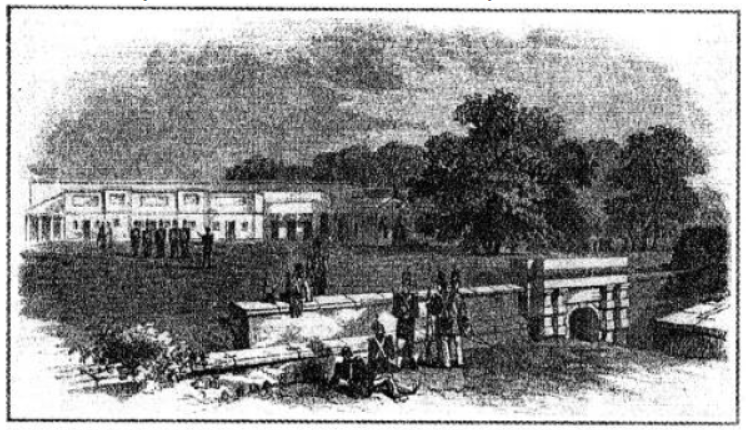
Question 1. Identify the building.
Answer: The illustration depicts the historic Fort William, located in Calcutta.
In simple words: The building shown in the picture is Fort William in Calcutta.
Exam Tip: Identify the fort as Fort William, situated on the banks of the Hooghly River in Calcutta.
Question 2. When did the British purchase the three villages to develop into a city? Also name the villages and the city.
Answer: In AD 1680, the British purchased the three local villages of Sutanuti, Govindpur, and Kalikata. These settlements were subsequently developed and expanded to form the major presidency city of Calcutta.
In simple words: In 1680, the British purchased three villages called Sutanati, Govindpur, and Kalikata, which they developed to build the city of Calcutta.
Exam Tip: Name all three villages - Sutanuti, Govindpur, and Kalikata - and state that they were merged to form Calcutta.
Question 3. Write a short note on establishment of British factories in India.
Answer: The establishment of British factories formed the foundation of their trade empire in India:
1. First Factory: In 1615, Sir Thomas Roe successfully obtained a royal decree from the Mughal Emperor Jahangir, allowing the Company to set up its first factory in Surat.
2. Regional Expansion: The English subsequently set up trade factories in northern and western hubs, including Agra, Ahmedabad, and Bharuch.
3. Southern Expansion: They established their first factory in South India at Masulipatnam in 1639, followed by Fort St. George in Madras.
4. Eastern Expansion: In 1640, they expanded into the eastern region by establishing a factory at Hooghly in Bengal.
In simple words: The British set up their first factory in Surat after receiving permission from Jahangir in 1615. They expanded by setting up factories in Agra, Ahmedabad, Masulipatnam in 1639, and Hooghly in 1640.
Exam Tip: Explain the role of Sir Thomas Roe's 1615 farman, and track their geographical expansion from Surat to Masulipatnam and Hooghly.
Exercises
A. Fill in the blanks:
1. Balaji Vishwanath laid the foundation of the Hereditary Dynastic rule of the Peshwas.
2. Lucknow was the cultural capital of Awadh.
3. Mysore, under the leadership of Hyder Ali became the most formidable adversary of the English East India Company in the south.
4. Guru Govind Singh ji, the tenth Sikh guru, organized a military brotherhood of Sikhs called Khalsa.
5. The Sikhs were organized into a loose confederacy of 12 misls or groups.
B. Match the following:
| Column A | Column B (Correct Match) |
|---|---|
| 1. Shahu | (e) Maratha king |
| 2. Murshid Quli Khan | (d) Bengal |
| 3. Shuja-ud-Daulah | (b) Awadh |
| 4. Tipu Sultan | (c) Mysore |
| 5. Ranjit Singh | (a) Sikh kingdom |
C. Choose the correct answer:
Question 1. Which group had the power and potential to establish an all-India empire after the collapse of the Mughal empire?
(a) The Marathas
(b) The Sikhs
(c) The Rajputs
(d) None of the options
Answer: (a) The Marathas
In simple words: Following the decline of the Mughals, the Marathas emerged as the most powerful confederacy capable of establishing nationwide rule.
Exam Tip: Identify the Marathas as the primary contender for supreme power in India during the 18th century.
Question 2. Which Maratha ruler was ease-loving and weak?
(a) Shahu
(b) Baji Rao I
(c) Balaji Baji Rao
(d) None of the options
Answer: (a) Shahu
In simple words: Chatrapati Shahu, the grandson of Shivaji, was a weak and ease-loving ruler, which led to the transfer of actual administrative power to the Peshwas.
Exam Tip: Note how Shahu's passive nature allowed the office of the Peshwa to become the real power in the Maratha state.
Question 3. Under whose reign did the Maratha empire reach the heights of its power and glory?
(a) Balaji Vishwanath
(b) Baji Rao I
(c) Balaji Baji Rao
(d) None of the options
Answer: (a) Balaji Vishwanath
In simple words: The Maratha power expanded rapidly during the reign of Peshwa Balaji Vishwanath, laying the foundations of their imperial glory.
Exam Tip: Identify Balaji Vishwanath as the Peshwa who initiated the expansion of Maratha power in northern India.
Question 4. Shuja-ud-Daulah was the nawab of which state?
(a) Awadh
(b) Hyderabad
(c) Bengal
(d) None of the options
Answer: (a) Awadh
In simple words: Shuja-ud-Daulah was the Nawab of Awadh, who later formed an alliance to fight the British at the Battle of Buxar.
Exam Tip: Match Shuja-ud-Daulah with the kingdom of Awadh in any regional power questions.
Question 5. Which state was founded by the Mughal viceroy of the Deccan, Nizam-ul-Mulk Asaf Jah?
(a) Hyderabad
(b) Awadh
(c) Mysore
(d) None of the options
Answer: (a) Hyderabad
In simple words: Nizam-ul-Mulk Asaf Jah, the Mughal governor of the Deccan, established the independent state of Hyderabad in 1724.
Exam Tip: Name 'Nizam-ul-Mulk Asaf Jah' as the founder of the independent state of Hyderabad.
D. State whether the following are true or false:
1. Bengal was one of the poorest provinces of the Mughal empire.
Answer: False (Correct statement: Bengal was the richest province of the Mughal empire.)
2. The most capable among the successors of Murshid Quli Khan was Alivardi Khan.
Answer: True
3. Lucknow was the cultural centre of Bengal.
Answer: False (Correct statement: Lucknow was the cultural centre of Awadh.)
4. The most powerful kingdom in the south was Mysore.
Answer: True
5. Ranjit Singh became the master of Punjab by the end of the 18th century.
Answer: True
E. Answer the following questions in one or two words/ sentences:
Question 1. What followed the disintegration of the Mughal empire?
Answer: The political collapse of the centralized Mughal Empire was followed by the rise of several independent and semi-independent regional powers, including the kingdoms of Bengal, Awadh, Hyderabad, Mysore, the Maratha Confederacy, and the Sikh State.
In simple words: As the Mughal Empire broke apart, several independent regional kingdoms grew, including Bengal, Awadh, Hyderabad, the Marathas, Mysore, and the Sikhs.
Exam Tip: List at least three regional kingdoms - such as Bengal, Awadh, and Mysore - that emerged after the fall of the Mughals.
Question 2. What is the significance of the Third Battle of Panipat?
Answer: The Third Battle of Panipat in 1761, where the Maratha forces were decisively defeated by the Afghan invader Ahmad Shah Abdali, had major consequences. It shattered the Maratha ambition of replacing the Mughals as rulers of India. Since the Afghans also failed to consolidate their hold, the resulting power vacuum cleared the way for a new competitor - the English East India Company - to establish its supremacy over India.
In simple words: In 1761, the Marathas were defeated by the Afghan ruler Ahmad Shah Abdali. This crushed the Maratha hope of building an empire, and because the Afghans left soon after, it cleared the path for the British East India Company to conquer India.
Exam Tip: Focus on how the 1761 defeat weakened the Marathas and created a power vacuum that allowed the British to take control.
Question 3. What advantage did Murshid Quli Khan take of the decline in the power of the Mughal empire?
Answer: Murshid Quli Khan, the Governor of Bengal, took advantage of the weakening central authority in Delhi to establish his own independent rule over the province. While he continued to send an annual tribute to the Mughal court to maintain formal relations, he operated as the sovereign ruler of Bengal.
In simple words: Murshid Quli Khan took advantage of the weak Mughal emperors to free Bengal from their control, ruling the province independently while only sending an annual tribute to Delhi.
Exam Tip: Explain that he established independent rule in Bengal but maintained formal ties by continuing to pay an annual tribute to Delhi.
Question 4. How did political and economic stability in Awadh impact cultural development in Lucknow?
Answer: The capable and efficient Nawabs of Awadh maintained order, introduced administrative reforms, and built a strong army. This long period of peace and economic stability encouraged the growth of a highly refined 'Lucknavi' culture. The capital city of Lucknow blossomed into a famous center for music, dance, literature, poetry, and grand architecture.
In simple words: Because the Nawabs kept Awadh peaceful and prosperous, a highly refined 'Lucknavi' culture grew in Lucknow, making the capital famous for poetry, music, dance, and beautiful buildings.
Exam Tip: State that political peace and economic wealth allowed Lucknow to blossom as a major center for arts, literature, and architecture.
Question 5. How did political instability in the Carnatic benefit the European trading companies?
Answer: When the Nawab of the Carnatic broke free from the Nizam of Hyderabad's control and established hereditary rule, it triggered bitter wars of succession. This political instability provided both the French and English East India companies with valuable opportunities to interfere in regional politics, back rival candidates, and secure major commercial privileges, money, and territories.
In simple words: Wars of succession in the Carnatic created political instability, which allowed French and British trading companies to interfere, support rival princes, and gain territories and trade privileges.
Exam Tip: Focus on how succession disputes allowed European companies to intervene as political allies in exchange for land and trade concessions.
Question 6. Name any two principal Rajupt states that took advantage of the declining power of the Mughals and asserted their independence.
Answer: Two major Rajput states that took advantage of the weakening Mughal empire to assert their independence were Jaipur and Jodhpur.
In simple words: Two Rajput kingdoms that became independent as the Mughals declined were Jaipur and Jodhpur.
Exam Tip: Listing 'Jaipur' and 'Jodhpur' is the most direct way to answer this question.
Question 7. What made the Rajputs vulnerable to the selfish designs of the English East India Company?
Answer: The Rajput states suffered from internal rivalries, succession disputes, and corruption that mirrored the decline of the Mughal court. These constant internal conflicts and court conspiracies drained their resources, making them weak and vulnerable to British political interference.
In simple words: Constant internal fights, court conspiracies, and corruption among different Rajput rulers drained their strength, leaving them weak and open to British control.
Exam Tip: Point out that internal rivalries and court conspiracies drained their resources, making it easy for the British to intervene.
Question 8. Name the signatories of the Treaty of Amritsar.
Answer: The famous Treaty of Amritsar of 1809 was signed between Maharaja Ranjit Singh, the ruler of Punjab, and the British East India Company, represented by Lord Minto.
In simple words: The treaty was signed between Maharaja Ranjit Singh and the British Governor-General, Lord Minto.
Exam Tip: Name Maharaja Ranjit Singh and Lord Minto as the key signatories of this 1809 treaty.
F. Answer the following questions briefly:
Question 1. The second phase of Maratha history was a period of the dominance of the peshwas. In this context answer the following questions:
(a)State the circumstances that led of the growth of peshwa dominance in the Maratha kingdom.
(b)Discuss the achievements of 1. Baji Rao I and 2. Balaji Baji Rao.
(c) was the Maratha confederacy established?
Answer:
(a) Rise of Peshwa Dominance: Maharaja Shahu, the grandson of Shivaji, secured control of the Maratha kingdom with the valuable assistance of Balaji Vishwanath. In gratitude for his loyalty and services, Shahu appointed Balaji Vishwanath as his Peshwa. Shahu was a passive, ease-loving ruler, content with acting as the ceremonial head of state. Consequently, actual executive power and administrative authority shifted to the office of the Peshwa, establishing their dominance.
(b) Achievements of the Peshwas:
1. Baji Rao I: A brilliant military strategist, Baji Rao I launched bold campaigns against the Mughals and regional rivals, expanding Maratha territories out of Maharashtra and transforming the kingdom into a powerful empire.
2. Balaji Baji Rao: Followed a policy of rapid expansion, during which the Maratha Empire reached its greatest geographical extent and glory. In the north, they became so influential that they acted as the real power behind the Mughal throne in Delhi.
(c) Establishment of the Maratha Confederacy: A major political change during this era was the rise of powerful Maratha families, namely the Scindias, Bhonsles, Holkars, and Gaekwads. To manage his expanding empire, the Peshwa divided territories into 'spheres of influence' and placed them under the administration of these families. These chiefs enjoyed high regional autonomy while recognizing the Peshwa as their official head, creating a loose union known as the Maratha Confederacy.
In simple words: Peshwa dominance grew because Shahu was a weak king who left all government work to his Prime Minister, Balaji Vishwanath. Baji Rao I expanded the empire through brilliant military victories, and Balaji Baji Rao made the Marathas the real power in Delhi. To govern, they divided territories among powerful families like the Scindias and Holkars, forming the Maratha Confederacy.
Exam Tip: For part (a), explain the shift of power from Shahu to Balaji Vishwanath. For part (c), name the four major families that made up the Confederacy.
Question 2. With reference to the rise and growth of Bengal as a regional power, discuss the following:
(a) achievements of Murshid Quli Khan
(b) The rule of Alivardi Khan
(c) The failures of the nawabs of Bengal
Answer:
(a) Achievements of Murshid Quli Khan: Murshid Quli Khan was a highly capable administrator who stabilized Bengal during a period of transition. He successfully protected the province from internal rebellions and external threats, establishing law, order, and economic prosperity.
(b) The Rule of Alivardi Khan: Alivardi Khan recognized the importance of promoting trade and encouraged merchants-Indian as well as foreign-to carry on trade in Bengal. He, however, did not allow the French and British merchants to fortify their factories in Chandernagore and Calcutta, respectively.
(c) Failures of the Nawabs of Bengal: Despite their administrative skills, the Nawabs failed to recognize the imperial ambitions of the English East India Company, viewing them merely as merchants who posed no threat to their sovereignty. They made no efforts to modernize or strengthen their military forces. Furthermore, widespread administrative corruption and bribery among top officials left Bengal vulnerable, making it easy for the British to execute their plans.
In simple words: Murshid Quli Khan brought peace and stability to Bengal. Alivardi Khan encouraged trade but strictly banned the British and French from building military forts. However, later Nawabs underestimated the British, failed to modernize their army, and suffered from internal corruption, which allowed the British to conquer Bengal.
Exam Tip: For part (b), focus on Alivardi Khan's ban on foreign fortifications. For part (c), identify their military neglect and inability to foresee the Company's imperial designs.
Question 3. The collapse of the Vijayanagar kingdom was followed by the emergence of the powerful kingdom of Mysore. In this context discuss the following:
(a) The collapse of the Vijayanagar empire
(b)The achievements of Hyder Ali
(c)The contribution of Tipu Sultan
Answer:
(a) Collapse of the Vijayanagar Empire: The disintegration of the Vijayanagar Empire in the 17th century led to a power struggle, with several independent regional states emerging and fighting for dominance. Among these, the kingdom of Mysore successfully defended its borders against rival neighbors. By the mid-18th century, under the military leadership of Hyder Ali, Mysore rose to become a major power in southern India.
(b) Achievements of Hyder Ali: In 1761, Hyder Ali took control of the Mysore administration, establishing his absolute authority over the state. Under his capable rule, Mysore expanded its territory, grew highly prosperous, and became a powerful military adversary that successfully challenged the British East India Company in the South.
(c) Contributions of Tipu Sultan: Tipu Sultan succeeded his father and introduced several modern reforms to reorganize Mysore's administration. He modernized his army using French tactics and weaponry, and strengthened the state economy by encouraging agriculture, establishing state industries, and promoting international trade.
In simple words: After the fall of the Vijayanagar Empire, Mysore emerged as a strong independent kingdom. Hyder Ali took control in 1761, making Mysore a wealthy and powerful military state. His son, Tipu Sultan, modernized the army, promoted trade, and developed agriculture to resist the British.
Exam Tip: In part (b), specify the year 1761 for Hyder Ali's rise to power. In part (c), describe Tipu Sultan's efforts to modernize his army and economy.
Question 4. With reference to the rise of independent Rajput states and the establishment of the Sikh kingdom, answer the following questions:
(a) Why did the resurgent Rajputs fail to establish an empire in India?
(b) To what extent was Guru Gobind Singh responsible for the transformation of the peace-loving Sikhs into a martial race?
(c) Discuss the achievements of Ranjit Singh.
Answer:
(a) Failure of the Rajputs: The Rajputs failed to build a unified empire because individual rulers focused on their own narrow, conflicting interests. Instead of working together to establish a central Rajput state, they wasted their military resources on local rivalries and petty disputes. Furthermore, Rajput courts suffered from corruption and conspiracies similar to the declining Mughal court, which weakened their political power.
(b) Role of Guru Gobind Singh: Guru Gobind Singh, the tenth and final Sikh Guru, was instrumental in transforming the community. To resist Mughal persecution, he organized the Sikhs into a dedicated military brotherhood known as the Khalsa. He instilled a powerful martial spirit in the community, transforming them into a disciplined force capable of defending their faith and rights.
(c) Achievements of Maharaja Ranjit Singh: Ranjit Singh, the leader of one of the Sikh misls, was an exceptional leader. He unified the scattered Sikh chiefs west of the Sutlej River under his centralized rule, establishing a powerful, independent kingdom in Punjab by the close of the 18th century.
In simple words: The Rajputs failed because they wasted their strength on internal rivalries instead of uniting. Guru Gobind Singh transformed the Sikhs by founding the Khalsa military brotherhood to fight Mughal persecution. Maharaja Ranjit Singh unified different Sikh clans to build a powerful, independent kingdom in Punjab.
Exam Tip: In part (b), emphasize the creation of the 'Khalsa' by Guru Gobind Singh. In part (c), focus on Ranjit Singh's unification of the Sikh 'misls'.
G. Picture study
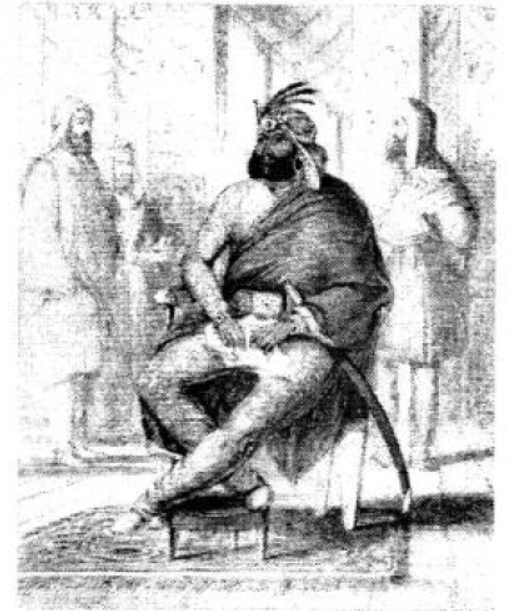
Question 1. Identify the person in the picture.
Answer: The portrait depicts Maharaja Ranjit Singh, the celebrated founder of the Sikh kingdom in Punjab.
In simple words: The person shown in the picture is Maharaja Ranjit Singh.
Exam Tip: Identify him as Maharaja Ranjit Singh, the prominent ruler of Punjab.
Question 2. Name the kingdom founded by him.
Answer: He founded the independent Sikh Kingdom of Punjab.
In simple words: He founded the kingdom of Punjab.
Exam Tip: Punjab is the correct answer.
Question 3. What did he do to expand his kingdom?
Answer: To expand his realm, he successfully unified the various independent Sikh clans situated west of the Sutlej River, consolidating his power to become the undisputed ruler of Punjab by the late 18th century.
In simple words: He united all the independent Sikh clans west of the Sutlej River under his rule, making himself the master of Punjab.
Exam Tip: State that he unified the various independent Sikh chiefs west of the Sutlej River to consolidate his kingdom.
Question 4. Name the treaty signed between him and the English East India Company.
Answer: He signed the historic Treaty of Amritsar in 1809 with the British East India Company.
In simple words: The treaty signed between them was the Treaty of Amritsar.
Exam Tip: The Treaty of Amritsar, signed in 1809, is the correct historical name to write down.
Question 5. What effect did this treaty have on his policy of expansion?
Answer: The Treaty of Amritsar established the Sutlej River as the boundary between his kingdom and British territories, stopping his eastward expansion. Consequently, Ranjit Singh focused his military campaigns westward and northward, conquering territories that expanded his kingdom from the Khyber Pass in the north to Sindh in the south.
In simple words: The treaty stopped him from expanding east of the Sutlej River, so he expanded north and west, building an empire that stretched from the Khyber Pass to Sindh.
Exam Tip: Explain that the treaty fixed the Sutlej River as his eastern boundary, forcing him to expand his kingdom northward and westward instead.
Free study material for History Civics
Complete Guide and Answers: Class 8 History Civics Chapter 05 Traders To Rulers I
Verified Problem Answers for Class 8 History Civics Chapter 05 Traders To Rulers I
Find reliable chapter-wise explanations for Class 8 History Civics Chapter 05 Traders To Rulers I. Curated to follow standard ICSE guidelines, these problem solutions assist students in building strong conceptual foundations.
Detailed Problem Solving for ICSE Class 8 History Civics
Every exercise question in this chapter includes step-by-step working steps, allowing you to self-evaluate, catch mistakes early, and understand the underlying logic.
Next Steps in Your Class 8 History Civics Preparation
Wrap up your chapter revision by verifying core concepts against standard ICSE question formats. All resources on our platform are free to access.
FAQs
You can download the verified Goyal Brothers solutions for Chapter 05 Traders To Rulers I on StudiesToday.com. Our teachers have prepared answers for Class 8 History Civics as per 2026-27 ICSE academic session.
Yes, our solutions for Chapter 05 Traders To Rulers I are designed as per new 2026 ICSE standards. 40% competency-based questions required for Class 8, are included to help students understand application-based logic behind every History Civics answer.
Yes, every exercise in Chapter 05 Traders To Rulers I from the Goyal Brothers textbook has been solved step-by-step. Class 8 students will learn History Civics conceots before their ICSE exams.
Yes, follow structured format of these Goyal Brothers solutions for Chapter 05 Traders To Rulers I to get full 20% internal assessment marks and use Class 8 History Civics projects and viva preparation as per ICSE 2026 guidelines.