NEET Biology Plant Body Systems Revision Notes

Download the latest NEET Biology Plant Body Systems Revision Notes in PDF format. These Full Course Transport in Plants revision notes are carefully designed by expert teachers to align with the 2025-26 syllabus. These notes are great daily learning and last minute exam preparation and they simplify complex topics and highlight important definitions for Full Course students.

Chapter-wise Revision Notes for Full Course Transport in Plants Transport in Plants

To secure a higher rank, students should use these Full Course Transport in Plants Transport in Plants notes for quick learning of important concepts. These exam-oriented summaries focus on difficult topics and high-weightage sections helpful in school tests and final examinations.

Transport in Plants Revision Notes for Full Course Transport in Plants


Transport in Plants
 
(1) Types of osmosis
 
Depending upon the movement of water into or outward of the cell, osmosis is of two types.
 
NEET Biology Plant Body Systems Revision Notes
 
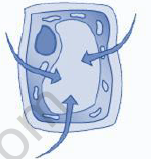
(a) Endosmosis: The osmotic inflow of water into a cell, when it is placed in a solution, whose solute concentration is less than the cell sap, is called endosmosis e.g., swelling of raisins, when they are placed in water.
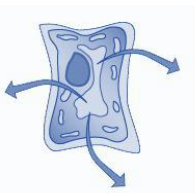
(b) Exosmosis: The osmotic outflow of water from a cell, when it is placed in a solution, whose solute concentration is more than the cell sap, is called exosmosis. e.g.,shrinkage of grapes when they are placed in strong sugar solution.
 
(2) Osmotic concentrations (Types of solutions)
 
A solution can be termed as hypotonic, hypertonic and isotonic depending upon its osmotic concentration, with respect to another solution or cell sap.
NEET-Biology-Plant-Body-Systems-Revision-Notes 1
 
(a) Hypotonic solution (hypo = less than). A solution, whose osmotic concentration (solute potential) is less than that of another solution or cell sap is called hypotonic solution. If a cell is placed in such a solution, water start moving into the cell by the process of endosmosis, and cell become turgid.
 
(b) Hypertonic solution (hper = more than). A solution, whose osmotic concentration (solute potential) is more than that of another solution or cell sap is called hypertonic solution. If a cell is placed in such a solution, water comes out of the cell by the process of exosmosis and cell become flaccid. If potato tuber is placed in concentrated salt solution it would become shrink due to loss of water from its cell.
 
(c) Isotonic solution (iso = the same). A solution, whose osmotic concentration (solute potential) is equal to that of another solution or cell sap, is called isotonic solution. If a cell is placed in isotonic solution, there is no net change of water between the cell and the solution and the shape of cell remain unchanged. The normal saline (0.85% solution of NaCl) and 0.4 m to 0.5 m solution of sucrose are isotonic to the cell sap.
 
(3) Significance of osmosis in plants
 
(a) The phenomenon of osmosis is important in the absorption of water by plants.
(b) Cell to cell movement of water occurs throughout the plant body due to osmosis.
(c) The rigidity of plant organs (i.e., shape and form of organism) is maintained through osmosis.
(d) Leaves become turgid and expand due to their OP.
(e) Growing points of root remain turgid because of osmosis and are thus, able to penetrate the soil particles.
(f) The resistance of plants to drought and frost is brought about by osmotic pressure of their cells.
(g) Movement of plants and plant parts, for example, movement of leaflets of Indian telegraph plant, bursting of many fruits and sporangia, etc. occur due to osmosis.
(h) Opening and closing of stomata is affected by osmosis.
 
(4) Turgor pressure (TP)
 
The plant cell, when placed in pure water, swells but does not burst. Because of negative osmotic potential of the vacuolar solution (cell sap), water will move into the cell and will cause the plasmalemma be pressed against the cell wall.
 
(5) Wall pressure (WP)
 
Due to turgor pressure, the protoplast of a plant cell will press the cell wall to the outside. The cell wall being elastic, presses back the protoplast with a pressure equal in magnitude but opposite in direction. This pressure is called wall pressure. Wall pressure (WP) may, therefore, be defined as 'the pressure exerted by the cell wall over the protoplast to counter the turgor pressure.
 
(6) Plasmolysis (Gr. Plasma = something formed; lysis = loosing)
 
If a living plant cell is placed in a highly concentrated solution (i.e. hypertonic solution), water comes out of the cell due to exosmosis, through the plasmamembrane. The loss of water from the cell sap causes shrinkage of the protoplast away from the cell wall in the form of a round mass in the centre. "The shrinkage of the protoplast of a living cell from its cell wall due to exosmosis under the influence of a hypertonic solution is called plasmolysis".
 
(7) Water potential (y)
 
The movement of water in plants cannot be accurately explained in terms of difference in concentration or in any other linear expression. The best way to express spontaneous movement of water from one region to another is in terms of the difference of free energy of water between two regions. Free energy is the thermodynamic parameter that determines the direction in which physical and chemical changes must occur. The potential energy of water is called water potential. e.g., water is stored behind a dam.
 
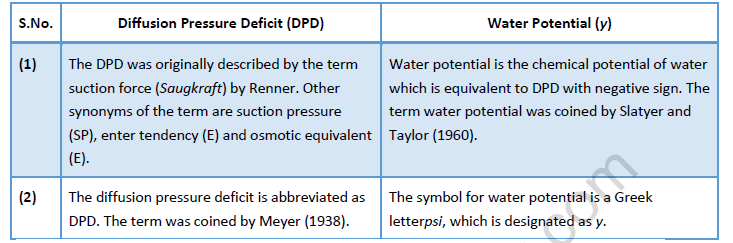
(8) Differences between diffusion pressure deficit and water potential
NEET-Biology-Plant-Body-Systems-Revision-Notes 2
 
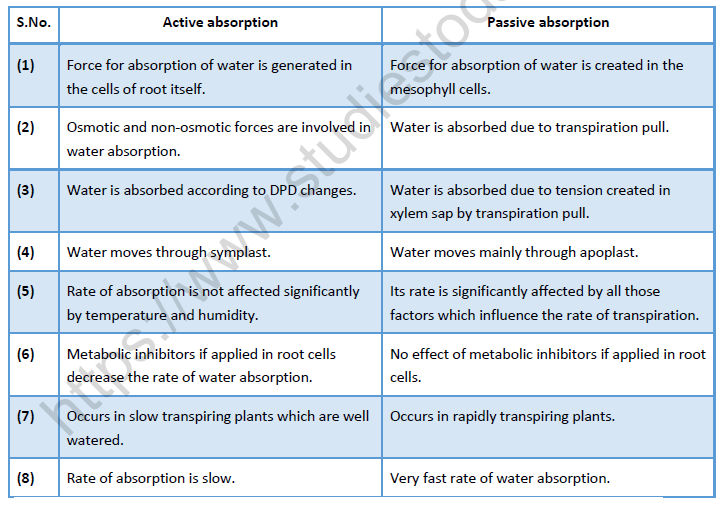
(9) Differences between active and passive absorption of water
NEET-Biology-Plant-Body-Systems-Revision-Notes 3
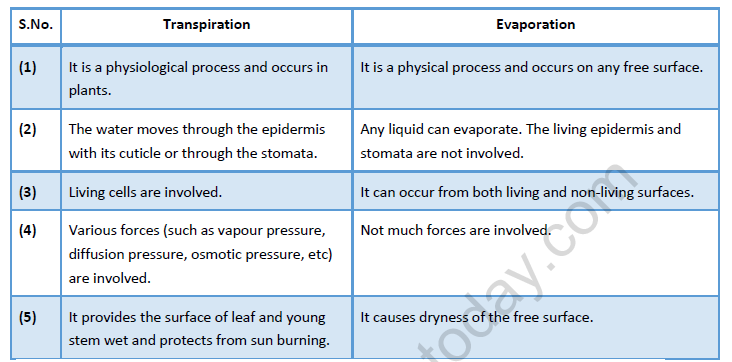
(10) Differences between transpiration and evaporation
NEET-Biology-Plant-Body-Systems-Revision-Notes 4
 
(11) Types of stomata
 
On the basis of orientation of subsidiary cells around the guard cells, Metcalfe and Chalk classified stomata into following types :
 
(i) Anomocytic : The guard cells are surrounded by a limited number of unspecialised subsidiary cells which appear similar to other epidermal cells. e.g., in Ranunculaceae family.
(ii) Anisocytic : The guard cells are surrounded by three subsidiary cells, two of which are large and one is very small. e.g., in Solanaceae and Cruciferae families.
(iii) Paracytic : The guard cells are surrounded by only two subsidiary cells lying parallel to the guard cells e.g., Magnoliaceae family.
(iv) Diacytic : The guard cells are surrounded by only two subsidiary cells lying at right angles to the longitudinal axis of the guard cells. e.g., Acanthaceae and Labiatae families.
(v) Actinocytic : The guard cells are surrounded by four or more subsidiary cells and which are elongated radially to stomata.
 
(12)Differences between transpiration and guttation
MineralNutrition
 
(1) Macronutrients (Macroelements or major elements): Nutrients which are required by plants in larger amounts (Generally present in the plant tissues in concentrations of 1 to 10 mg per gram of dry matter).
 
(2) The macronutrients include carbon, hydrogen, oxygen, nitrogen, phosphorous, sulphur,potassium, calcium, magnesium.
 
(3) Micronutrients (Microelements or minor elements or trace elements): Nutrients which are required by plants in very small amounts, i.e., in traces (equal to or less than 0.1 mg per gram dry matter).
 
(4) The micronutrients include iron, manganese, copper, molybdenum, zinc, boron and chlorine.Recent research has shown that some elements, such as cobalt, vanadium and nickel, may be essential for certain plants.
 
(5) The usual concentration of essential elements in higher plants according to D.W. Rains (1976) based on the data of Stout are as follows:
 
Major Role of Nutrients
 
Various elements perform the following major role in the plants:
 
(1) Construction of the plant body: The elements particularly C, H and O construct the plant body by entering into the constitution of cell wall and protoplasm. They are, therefore, referred to as frame work elements. Besides, these (C, H and O) N, P and S also enter in the constitution of protoplasm. They are described asprotoplasmic elements.
 
(2) Maintenance of osmotic pressure: Various minerals present in the cell sap in organic or inorganic form maintain the osmotic pressure of the cell.
 
(3) Maintenance of permeability of cytomembranes: The minerals, particularly Ca++, K+ and Na+ maintainthe permeability of cytomembranes.
 
(4) Influence the pH of the cell sap: Different cations and anions influence on the pH of the cell sap.
 
(5) Catalysis of biochemical reaction: Several elements particularly Fe, Ca, Mg, Mn, Zn, Cu, Cl act as metallic catalyst in biochemical reactions.
 
(6) Toxic effects: Minerals like Cu, As, etc. impart toxic effect on the protoplasm under specific conditions.
 
(7) Balancing function: Some minerals or their salts act against the harmful effect of the other nutrients, thus balancing each other.
 
Please click the link below to download pdf file of NEET Biology Plant Body Systems Revision Notes
 
Reproduction in Flowering Plants
NEET Botany Reproductive Morphology Chapter Notes

NEET Full Course Transport in Plants Transport in Plants Notes

Students can use these Revision Notes for Transport in Plants to quickly understand all the main concepts. This study material has been prepared as per the latest NEET syllabus for Full Course. Our teachers always suggest that Full Course students read these notes regularly as they are focused on the most important topics that usually appear in school tests and final exams.

NCERT Based Transport in Plants Summary

Our expert team has used the official NCERT book for Full Course Transport in Plants to design these notes. These are the notes that definitely you for your current academic year. After reading the chapter summary, you should also refer to our NCERT solutions for Full Course. Always compare your understanding with our teacher prepared answers as they will help you build a very strong base in Transport in Plants.

Transport in Plants Complete Revision and Practice

To prepare very well for y our exams, students should also solve the MCQ questions and practice worksheets provided on this page. These extra solved questions will help you to check if you have understood all the concepts of Transport in Plants. All study material on studiestoday.com is free and updated according to the latest Transport in Plants exam patterns. Using these revision notes daily will help you feel more confident and get better marks in your exams.

Where can I download the latest PDF for NEET Biology Plant Body Systems Revision Notes?

You can download the teacher prepared revision notes for NEET Biology Plant Body Systems Revision Notes from StudiesToday.com. These notes are designed as per 2025-26 academic session to help Full Course students get the best study material for Transport in Plants.

Are these Transport in Plants notes for Full Course based on the 2026 board exam pattern?

Yes, our NEET Biology Plant Body Systems Revision Notes include 50% competency-based questions with focus on core logic, keyword definitions, and the practical application of Transport in Plants principles which is important for getting more marks in 2026 NEET exams.

Do these Full Course notes cover all topic-wise concepts for Transport in Plants?

Yes, our NEET Biology Plant Body Systems Revision Notes provide a detailed, topic wise breakdown of the chapter. Fundamental definitions, complex numerical formulas and all topics of NEET syllabus in Full Course is covered.

How can I use NEET Biology Plant Body Systems Revision Notes for quick last-minute revision?

These notes for Transport in Plants are organized into bullet points and easy-to-read charts. By using NEET Biology Plant Body Systems Revision Notes, Full Course students fast revise formulas, key definitions before the exams.

Is there any registration required to download Full Course Transport in Plants notes?

No, all study resources on StudiesToday, including NEET Biology Plant Body Systems Revision Notes, are available for immediate free download. Full Course Transport in Plants study material is available in PDF and can be downloaded on mobile.