Chapter Outline
10.1 Neural system
10.2 Human Neural System
10.3 Neuron as a structural and functional unit of neural system
10.4 Central neural system
10.5 Reflex action and reflex arc
10.6 Sensory reception and processing
Learning Objectives:
• Understands the structure of neuron and neural system of human beings
• Learns to differentiate the functions of sensory and motor neuron
• Understands the conduction of nerve impulses and learns the importance of myelin sheathsaltatory conduction.
• Outlines the role of synapse and neuromuscular junction.
• Learns the structure and functions of central neural system
• Understands the structure, sensory reception and processing in Photo,Phono, Olfactory, Gustatory and Skin Receptors
Did you ever wonder how our body functions? The body maintains a stable condition even when the outside environment changes; Our eyes help to see things around us; Ears help us to hear various sounds; Heart beats continuously and rhythmically; Air goes in and out of lungs; Eyes shed tears when our limbs get hurt. Each cell of the body works in a coordinated manner. Do you know how it is coordinated and controlled?
The neural system of our body coordinates all the other systems to work together effectively and smoothly. Every second, diverse functions in our body are performed by the neural system. Day and night, millions of messages pass as stimuli through the cells of the neural system to stimulate the heart to beat; kidney to excrete waste; and mouth to relish the delicious food. An even more remarkable feature of the neural system is its ability to respond simultaneously to several stimuli, for instance, we can play piano and sing; listen to music and do household chores. In all such coordinated movements, whether skilled performances or routine tasks like cycling or driving, the integrating power of the neural system is involved. In this chapter, you will understand how neural system is organized; how it integrates all organs and what kind of cellular events underlie its functioning.
10.1 Neural system
The neural system comprises of highly specialized cells called neurons, which can detect, receive, process and transmit different kinds of stimuli. Simple form of neural system as nerve net is seen in lower invertebrates. The neural system of higher animals are well developed and performs the following basic functions:
• Sensory functions- It receives sensory input from internal and external environment.
• Motor functions- It transmits motor commands from the brain to the skeletal and muscular system.
• Autonomic functions- Reflex actions.
10.2 Human Neural System
The human neural system is divided into two, the central neural system (CNS) and the peripheral neural system (PNS).The structural and functional units of the neural system are neurons that transmit nerve impulses. The non-nervous special cells called neuroglia form the supporting cells of the nervous tissue.There are three functional classes of neurons. They are the afferent neurons that take sensory impulses to the Central Neural system (CNS) from the sensory organs; the efferent neurons that carry motor impulses from the CNS to the effector organs; and interneurons that lie entirely within the CNS between the afferent and efferent neurons.
The central neural system lacks connective tissue, so the interneuron space is filled by neuroglia. They perform several functions such as providing nourishment to the surrounding neurons; involving the memory process; repairing
the injured tissues due to their dividing and regenerating capacity; and acting as phagocyte cells to engulf the foreign particles at the time of any injury to the brain.
Glial cells do not lose the ability to undergo cell division; so most brain tumours of neural origin consists of glial cells. Neurons themselves do not form tumours because they are unable to divide and multiply.
10.3 Neuron as a structural and functional unit of Neural system
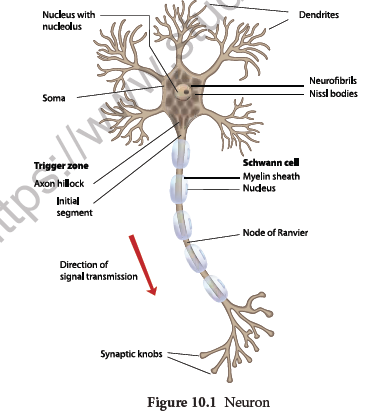
A neuron is a microscopic structure composed of three major parts namely cell body (soma), dendrites and axon. The cell body is the spherical part of the neuron that contains all the cellular organelles as a typical cell (except centriole). The plasma membrane covering the neuron is called neurilemma and the axon is axolemma. The repeatedly branched short fibres coming out of the cell body are called dendrites, which transmit impulses towards the cell body. The cell
body and the dendrites contain cytoplasm and granulated endoplasmic reticulum called Nissl’s granules.
An axon is a long fibre that arises from a cone shaped area of the cell body called the Axon hillock and ends at the branched distal end. Axon hillock is the place where the nerve impulse is generated in the motor neurons. The axon of one-neuron branches and forms connections with many other neurons. An axon contains the same organelles found in the dendrites and cell body but lacks Nissl’s granules and Golgi apparatus.The axon, particularly of peripheral nerves is surrounded by Schwann cells
The longest cells in the human body are the neurons. The longest axons in the human body, for example, are those of the sciatic nerve, which run from the base of the spine to the big toe of each foot. These single-cell fibers may extend a meter or even longer. The axons of the inter neurons in the CNS are the shortest.
(a type of glial cell) to form myelin sheath, which act as an insulator. Myelin sheath is associated only with the axon; dendrites are always non-myelinated.Schwann cells are not continuous along the axon; so there are gaps in the myelin sheath between adjacent Schwann
cells. These gaps are called Nodes of Ranvier. Large myelinated nerve fibres conduct impulses rapidly, whereas nonmyelinated fibres conduct impulses quite slowly (Figure 10.1).
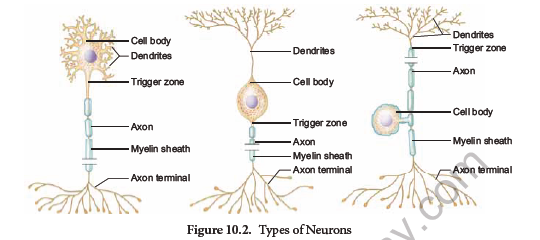
Each branch at the distal end of the axon terminates into a bulb like structure called synaptic knob which possesses synaptic vesicles filled with neurotransmitters.The axon transmits nerve impulses away from the cell body to an inter neural space or to a neuro-muscular junction.The neurons are divided into three types based on number of axon and dendrites they possess (Figure.10.2).
1. Multipolar neurons have many processes with one axon and two or more dendrites. They are mostly interneurons.
2. Bipolar neurons have two processes with one axon and one dendrite. These are found in the retina of the eye, inner ear and the olfactory area of the brain.
3. Unipolar neurons have a single short process and one axon. Unipolar neurons are located in the ganglia of cranial and spinal nerves.
10.3.1 Generation and conduction of nerve impulses
This section deals with how the nerve impulses are produced and conducted in our body. Sensation felt in the sensory organs are carried by the nerve fibres in the form of electrical impulses. A nerve impulse is a series of electrical impulses,which travel along the nerve fibre. Inner to the axolemma, the cytoplasm contains the intracellular fluid (ICF) with large amounts of potassium and magnesium phosphate along with negatively charged proteins and other organic molecules.The extra cellular fluid (ECF) found outside the axolemma contains large amounts of sodium chloride, bicarbonates, nutrients and oxygen for the cell; and carbon dioxide and metabolic wastes released by the
Note: The charged particles have potential energy. The potential difference is the measure of potential energy between two points which is measured in volts or millivolts.