NEET Zoology Chemical Coordination And Integration Chapter Notes

Download the latest NEET Zoology Chemical Coordination And Integration Chapter Notes in PDF format. These Full Course Chemical Control and Coordination revision notes are carefully designed by expert teachers to align with the 2025-26 syllabus. These notes are great daily learning and last minute exam preparation and they simplify complex topics and highlight important definitions for Full Course students.

Chapter-wise Revision Notes for Full Course Chemical Control and Coordination Chemical Control and Coordination

To secure a higher rank, students should use these Full Course Chemical Control and Coordination Chemical Control and Coordination notes for quick learning of important concepts. These exam-oriented summaries focus on difficult topics and high-weightage sections helpful in school tests and final examinations.

Chemical Control and Coordination Revision Notes for Full Course Chemical Control and Coordination


Chapter Outline
 
11.1 Endocrine glands and hormones
11.2 Human endocrine system
11.3 Hypo and hyper activity of endocrine glands and related disorders
11.4 Mechanism of hormone action.
 
Learning Objectives:
 
• Understands the positions of the various endocrine glands and their secretions.
• Learns the mechanism of hormone action.
• Understands the disorders related to hypo and hyper activity of the endocrine glands.
• Learns the role of gastro intestinal hormones.
 
 
While hearing your test marks, some may have anxiety and some may hesitate to hear and some may be worried. Do you know the reasons for such immediate changes? While seeing any unexpected happenings, we get goose bumps. Do you know the reason, why? These are all due to the biochemical changes happening in our body, Which are created by the endocrine system. The Klotho an anti-aging hormone makes people smart enhances cognitive abilities and longevity. above mentioned biochemical changes are due to the hormone adrenalin (flight, fright and fight hormone).
 
11.1 Endocrine glands and hormones
 
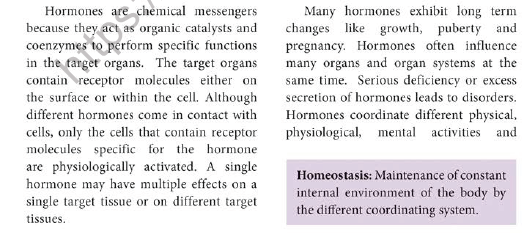
Physiological functions of our human body is regulated and coordinated by both neural and endocrine systems. The endocrine system influences the metabolic activities by means of hormones (hormone means to excite) which are chemical messengers released into the blood and circulated as chemical signals and acts specifically on certain organs or tissues called target organs or target tissues. Hormones may speed up or slow down or alter the activity of the target organs. The hormones secreted do not remain permanently in the blood but are converted by the liver into inactive compounds and excreted by the kidneys.
 
 
NEET Zoology Chemical Coordination and Integration Chapter Notes
NEET-Zoology-Chemical-Coordination-and-Integration-Chapter-Notes1
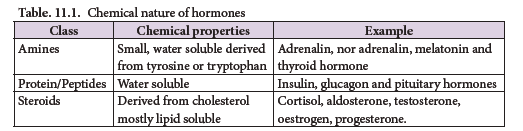
maintain homeostasis. Hormones are composed of water soluble proteins or peptides or amines or fat soluble steroids.
 
11.2 Human endocrine system
 
There are two glandular systems such as the exocrine glands and the endocrine glands. The exocrine glands secrete enzymes, saliva and sweat and have ducts that carry their substances to the membrane surfaces. Example: salivary
gland and gastric gland. The endocrine glands, called ductless glands produce hormones and lack ducts; they release their hormone to the surrounding tissue fluid. The hormones circulate around the body and eventually reach the target organs. Endocrine glands (Figure: 11. 1) include the pituitary,thyroid, parathyroid, pineal, adrenal,thymus and are also known as exclusive endocrine glands. The hypothalamus along with its neural function also produces hormones and is considered as a neuro endocrine gland. In addition several organs such as pancreas, gastro intestinal tract epithelium, kidney,heart, gonads and placenta are also have endocrine tissues and are known as partial endocrine glands.
NEET-Zoology-Chemical-Coordination-and-Integration-Chapter-Notes2
 
11.2.1 Hypothalamus
 
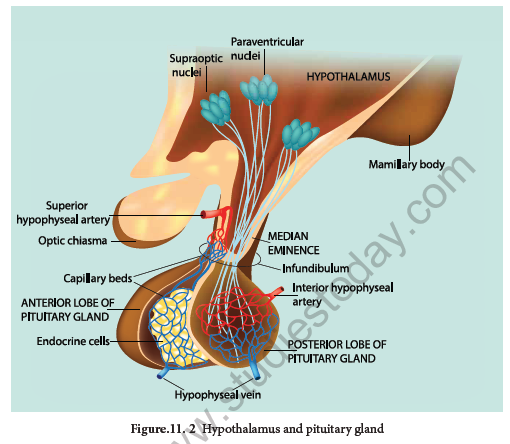
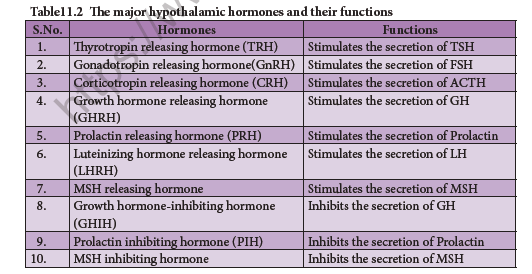
Hypothalamus is a small cone shaped structure that projects downward from the brain ending into the pituitary stalk.It interlinks both the nervous system and endocrine system. Though pituitary gland is known as master endocrine glands that controls the other endocrine glands, but it is, in turn controlled by the hypothalamus. Hypothalamus contains groups of neurosecretory cells.It produces neurotransmitters which regulate the secretions of the pituitary (Figure11. 2). The hormones produced by the hypothalamus act either as a releasing hormone or as an inhibitory hormone.
 
In the basal region of the brain, the hypothalamic hypophyseal portal blood vessel connects hypothalamus and anterior pituitary. It allows hypothalamic hormones to control anterior pituitary secretion. The posterior pituitary is connected with hypothalamus by a nerve bundle called hypothalamic hypophyseal axis. It produces nerve signal that control the posterior pituitary secretion.Hypothalamus maintains homeostasis,blood pressure, body temperature, cardio and fluid electrolyte balance of the body. As the part of limbic system it influences various emotional responses.
NEET-Zoology-Chemical-Coordination-and-Integration-Chapter-Notes3
NEET-Zoology-Chemical-Coordination-and-Integration-Chapter-Notes4
 
11.2.2 Pituitary gland or Hypophysis
 
The pituitary gland (means to grow under) is ovoid in shape and is located in the sella turcica, a bony cavity of the sphenoid bone at the base of brain and connected to the hypothalamic region of the brain by a stalk called infundibulum. It is about one centimetre in diameter and 0.5 gm in weight. The pituitary consists of two lobes, anterior glandular adenohypophysis and posterior neural neurohypophysis.The anterior lobe originates from the embryonic invagination of pharyngeal epithelium called Rathke’s pouch and the posterior lobe is originates from the base of the brain as an outgrowth of hypothalamus. Anatomically the adenohypophysis has three lobes or zones namely pars intermedia, pars distalis and pars tuberalis. The neurohypophysis is otherwise known as pars nervosa.The anterior lobe of pituitary secretes six tropic hormones such as growth hormone (GH), thyroid stimulating hormone (TSH), adreno corticotropic hormone (ACTH), follicle stimulating hormone (FSH), luteinizing hormone (LH), luteotropic hormone (LTH) and melanocyte stimulating hormone (MSH) (in lower animals only). The posterior lobe of pituitary secretes the hormones namely vasopressin and oxytocin.
Reproduction in Flowering Plants
NEET Botany Reproductive Morphology Chapter Notes

NEET Full Course Chemical Control and Coordination Chemical Control and Coordination Notes

Students can use these Revision Notes for Chemical Control and Coordination to quickly understand all the main concepts. This study material has been prepared as per the latest NEET syllabus for Full Course. Our teachers always suggest that Full Course students read these notes regularly as they are focused on the most important topics that usually appear in school tests and final exams.

NCERT Based Chemical Control and Coordination Summary

Our expert team has used the official NCERT book for Full Course Chemical Control and Coordination to design these notes. These are the notes that definitely you for your current academic year. After reading the chapter summary, you should also refer to our NCERT solutions for Full Course. Always compare your understanding with our teacher prepared answers as they will help you build a very strong base in Chemical Control and Coordination.

Chemical Control and Coordination Complete Revision and Practice

To prepare very well for y our exams, students should also solve the MCQ questions and practice worksheets provided on this page. These extra solved questions will help you to check if you have understood all the concepts of Chemical Control and Coordination. All study material on studiestoday.com is free and updated according to the latest Chemical Control and Coordination exam patterns. Using these revision notes daily will help you feel more confident and get better marks in your exams.

Where can I download latest NEET Full Course Chemical Control and Coordination Chemical Control and Coordination notes

You can download notes for Full Course Chemical Control and Coordination Chemical Control and Coordination for latest academic session from StudiesToday.com

Are the revision notes available for Chemical Control and Coordination Full Course Chemical Control and Coordination for the latest NEET academic session

Yes, the notes issued for Full Course Chemical Control and Coordination Chemical Control and Coordination have been made available here for latest NEET session

Is there any charge for the Full Course Chemical Control and Coordination Chemical Control and Coordination notes

There is no charge for the notes for NEET Full Course Chemical Control and Coordination Chemical Control and Coordination, you can download everything free of charge

Which is the best online platform to find notes for Chemical Control and Coordination Full Course Chemical Control and Coordination

www.studiestoday.com is the best website from which you can download latest notes for Chemical Control and Coordination Chemical Control and Coordination Full Course

Where can I find topic-wise notes for Full Course Chemical Control and Coordination Chemical Control and Coordination

Come to StudiesToday.com to get best quality topic wise notes for Full Course Chemical Control and Coordination Chemical Control and Coordination