INTRODUCTION
The living and non-living components of the atmosphere, hydrosphere and lithosphere which can be used for human needs is called natural resources.
Inorganic resources are minerals, water, coal, petroleum, air and so on.
Organic resources include plants and animals and products obtained from them.
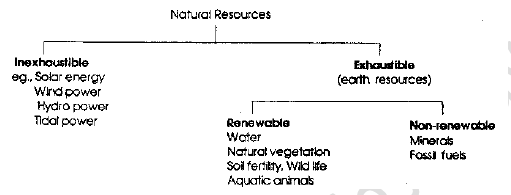
Natural resources can be classified as inexhaustible resources and exhaustible resources.
1. Inexhaustible resources are those which will not be depleted by human consumption, such as air, water and soil.
2. Exhaustible resources are those which are depleted by man’s activity. E.g.,forests, minerals, coal, aquatic organisms etc.
Exhaustible resources are of two types: Renewable and non-renewable resources.
Renewable resource: It is a natural resource which can be used and replenished,recycled or reproduced and should not be used beyond its renewability. E.g., forests,
ground water, wildlife, water resources etc.
Non-renewable resource: A natural resource which cannot be replenished or recycled, or else it takes a very long time to be recycled. E.g., minerals. Fossil fuels etc.
Renewable and non-renewable resources are generally earth resources.
7.1 Atmosphere/Air
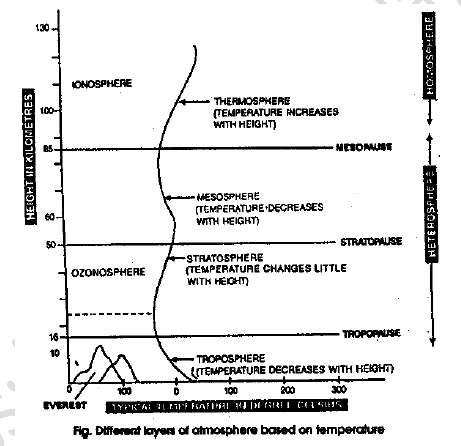
Air is an important form of inexhaustible natural resource forming the atmosphere. The air we breathe, exists in the first zone, 10 to 12 km from the surface of the earth. This is a protective layer as it absorbs the harmful ultra-violet rays from the solar radiations.
Atmospheric air consists of a mixture of gases containing 78% of nitrogen, 21% of oxygen and carbon dioxide, ozone, noble gases (helium, argon etc.) constitute 1% of the total volume of air.
Air is essential for animal and plant life, and as medium of communication.
Atmosphere determines climatic conditions and also responsible for water O2, CO2 and Nitrogen cycles. Air also is a medium for flying animals like birds and insects and help in dispersal of spores, fruits and seeds and in pollination.
Greenhouse effect and Global warming
Of the solar radiation that reaches the earth’s surface, some is absorbed by the land and some is reflected into space by water, snow, ice and other reflective surfaces.
The earth also absorbs some radiation and eventually reradiates it as long wavelength infrared radiation (i.e., heat). However, a portion of the outgoing long wavelength radiation encounters clouds and gases in the atmosphere that prevent this energy from escaping, and the energy that is retained in the lower atmospheres causes the temperature at the earth’s surface to rise. This is similar to the air in a glass house which is warmer that of the air outside; the glass act in the same way as the clouds and atmospheric gases, prevents the escape of radiant energy. Hence, this phenomenon is referred to as the greenhouse effects. Atmospheric gases such as carbon dioxide.
Methane, ozone are efficient absorbers of infrared radiations and are referred to as greenhouse gases. Water vapour naturally present in the atmosphere is the most important greenhouse gas.
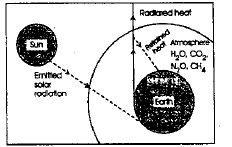
Fig. The greenhouse effect. Solar radiation easily penetrates into the atmosphere of the earth (emitted solar radiation). Carbon dioxide and other atmospheric gases inhibit the escape of total radiation; thereby the atmosphere above earth’s surface is warm.
7.2 WATER
Water is a major renewable inorganic resource which is an essential component o all living beings, a habitat for several organisms, determinant of vegetation and climate, floods and droughts. It is required from drinking, bathing, washing cooling,construction work, disposal of sewage and industrial effluents, irrigation etc. It is also important as a universal solvent.
Water table:
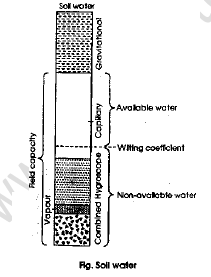
The earth contains lot of water, the source being rainfall. When rain water falls on the earth little part of it seeps into the ground and a part of it evaporates, flows into rivers, takes etc. This portion of rain water which seeps into the ground is available as the ground water’. Water is generally seen in the pore space between soil particles,below certain depth. The porous rocks are saturated with water at a certain level below the surface which is called zone of saturation and the upper level of zone of saturation is called water table. Thus, water table may be defined as the depth in the soil in which all the pore spaces between the soil particles are filled with water only. When water is pumped out from the ground, the water tale decreases but is replenished by rainfall.Excess ground water use has depleted the resource at certain places. Only 40% of cropland is irrigated in India using ground water. A lot of water is lost as run off due to deforestation into the sea and causes floods during rains and drought at other times.
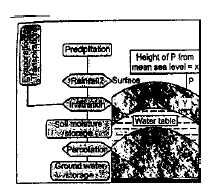
Fig. Diagram showing hydrological cycle and ground water storage showing water table and zone of saturation. The vertical distance (depth) y from a place (p) on the surface is called water level. The water table at a place (p) is expressed as x-y, where x is the height of p from mean sea level.
The ultimate source of water is precipitation. As per the intensity of annual rainfall our country has four zones which are
(1) Wet zone: in this zone the annual rainfall is over 200 cm.
(2) Intermediate zone: Where the annual rainfall ranges from 100 to 200 cm.
(3) Semiarid zone: is a zone, where rainfall is moderate i.e., from 50 to 100 cm.
(4) Arid zone: In this zone the annual rainfall is very low, ranging from 20 to 50 cm.