INTRODUCTION :
Embryology is the branch of biology which involves the study of all those processes, which take place during the development of an adult from the egg.
FORMATION OF GAMETES :
Follicle stimulating hormone stimulates gametogenesis. Besides this hormone vitamin E is also essential for gametogenesis. Deficiency of vitamin E leads to sterility. Vitamin A is also required for the formation of healthy gametes.
Gemetogenesis is divided in three stages :
(i) Multiplication phase
(ii) Growth phase
(iii) Maturation phase.
As there are two types of gametes, the spermatozoa and ova, gametogenesis can be studied under two broad headings : spermatogenesis and oogenesis. Spermatogenesis is the formation of spermatozoa, whereas oogenesis is the formation of ova. Both spermatozoa and ova originate from primordial germ cells or PGCs, which are extra-gonadal in origin. In humans, the PGCs originate during early embryonic development from the extra-embryonic mesoderm. Eventually, they migrate to the yolk sac endoderm, and ultimately, to the gonads of the developing embryo, where they undergo further development. You can recall that spermatogenesis occurs in the seminiferous tubules of the testes of
oogenesis occurs in the follicles of ovary. Formation of gametes starts at puberty.
SPERMATOGENESIS :
Spermoatogenesis : i.e. formation of sperms. In most of the animals spermatogenesis takes place in testes, (exception-earthworm). Mammalian testes contain seminiferous tubules and wall of seminiferous tubule is composed of germinal epithelium. It contains some special types of cells called primordial germ cells and these cells start spermatogenesis. On the basis of origin, primordial germ cells are extra embryonic mesodermal. Besides these cells, germinal epithelium contains some large sized cell called sertoli cells. Occurrence of sertoli cells is the unique feature of mammalian testis. Sertoli cells provide nutrition of developing sperm i.e. developing sperms are embedded in cytoplasm of sertoli cells and absorb nutrition. After maturation sperms comes out from sertoli cells and librate in seminiferous tubules.
Liberation of sperms from Sertoli cells is called spermiation.
Liberation of sperms from testes is called semination.
Liberation of sperms from body of male is called ejaculation.
Mammalian sperms are transferred to vagina of female by the process called insemination.
♦ Sertoli cells form 'blood testes barrier' and protect the sperm from immune system of the body.
antibody may attach on haploid cells and destroy them. (Sperms are haploid and other cells of body are diploid).
Sertoli cells function as an endocrine gland i.e. secrete three type of hormones :
(i) Antimullerian hormone : function of this hormone is degradation of female gonads in male embryo.(In male seminal vesicle is the ruminant part of oviduct of female).
(ii) Inhibin hormone : Function of this hormone is to control excess secretion of pituitary gland to prevent the over-production of sperms.
(iii) Androgen binding protein : Function of this hormone is to concentrate testosterone in seminiferous tubules because testosterone is must for spermatogenesis in seminiferous tubules.
STEPS OF SPERMATOGENESIS :
Spermatozoa are formed in the wall of the seminiferous tubules of the testes. The various cell-stages in spermatogenesis are as follows (the number of chromosomes at each stage is given in brackets)

An adult male produces over 1012 to 1013 sperm cells each day. These gradually move into the epididymis and the first portion of the vas deferens, where they undergo further maturation and are stored.
A. The spermatogonia (type A) or germ cells (44 X + Y) divide mitotically, to give rise to more spermatogonia of type A (spermatogenic lineage) and also spermatogonia of type B.
B. The spermatogonia (type B) (44 + X + Y) enlarge, to from primary spermatocytes (spermato cytogeneis)
C. The primary spermatocytes (44 + X + Y) now divide so that each of them forms two secondary spermatocytes. This is the first meiotic division. it reduces the number of chromosomes to half.
D. Each secondary spermatocyte has 22 + X or 22 + Y chromosomes. It divides to form two spermatids.
This is the second meiotic division and this time there is no reduction in chromosome number.
E. Each spermatid (22 + X or 22 + Y) gradually changes its shape to become a spermatozoon. This process of transformation of a circular spermatid to a spermatozoon is called spermiogenesis/spermateleosis
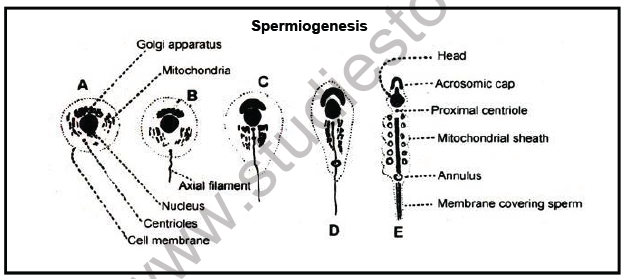
• In spermiogenesis first, of all nucleus of spermatid shift at one side. Except chromatin material, all the structures come out from nucleus as a result nucleus become small and light in weight. Then several golgi vesicles gathered just above the nucleus. Some of the Golgi vesicles develop granules called proacrosomal granules, such granule containing vesicle is called proacroblast. Rest of the golgi vesicles are called golgirest, the golgirest dissolve in cytoplasm. All the proacroblast fuse and form large vesicle called acroblast and it's granule is called acrosomal granule. Acroblast arranged just above the nucleus. Then cytoplasm of spermatid starts moving towards posterior side. As a result, plasma membrane shrinks and gets attached to acroblast and nucleus. Due to this head of sperm is formed. Now centriole starts forming axonema, then all the mitochondria of spermatid are arranged in spiral order around axonema. In this way middle piece of sperm is formed. Now axonema elongates towards posterior side and forms tail.
Cytoplasm of spermatid continuously flows towards posterior side.

