

Download CBSE Class 11 History Assignments
Explore structured practice materials through the CBSE Class 11 History Nomadic Empires Concepts and Assignment. Tailored for Class 11 learners, utilizing these History assignments ensures thorough preparation and strengthens foundational knowledge before final CBSE evaluations.
Access CBSE School Assignments and Answers
View or download the dedicated CBSE Class 11 History Nomadic Empires Concepts and Assignment resource below. Engaging with these assignments under focused study conditions ensures continuous academic progress and mastery of the 2026-27 curriculum.
2 Marks Questions
Question 1. What do you understand by the term 'barbarian'?
Answer: The term 'barbarian' is derived from the Greek word 'barbaros', which meant a non-Greek whose language sounded to Greeks like random, unintelligible noise: 'bar-bar'. In historical contexts, civilized urban societies often used this term to describe pastoral nomadic groups whom they perceived as cruel, greedy, and politically incapable of governing.
In simple words: The word barbarian comes from a Greek term for foreigners whose speech sounded like gibberish, often used by city-dwellers to label outsiders as uncultured.
Exam Tip: Mention the Greek origin word 'barbaros' and its literal meaning to score full marks in definition-based questions.
Question 2. Write two military skills of Genghis Khan?
Answer: Two key military skills and innovations of Genghis Khan were:
1. Organization of the army into strict decimal units (divisions of 10s, 100s, 1000s, and 10,000 soldiers) which ensured absolute discipline and rapid mobilization.
2. Strategic integration of defeated tribes into new military units under trusted commanders (noyans), completely breaking old tribal loyalties and building a unified merit-based force.
In simple words: Genghis Khan organized his army into neat decimal units and broke old tribal ties to build a unified, highly disciplined fighting force.
Exam Tip: Highlight the decimal system of military organization and the role of 'noyans' as trusted commanders.
Question 3. What was Yasa?
Answer: 'Yasa' was the code of law promulgated by Genghis Khan at the assembly of chieftains (quriltai) in 1221. Although often referred to as 'Yasa' in historical sources, the term originally referred to decrees, military regulations, and administrative edicts issued by Genghis Khan to govern his nomadic empire.
In simple words: Yasa was the legal code and set of regulations established by Genghis Khan to maintain order and administration across his empire.
Exam Tip: Clarify that Yasa was not a fixed comprehensive penal code from the start, but evolved as a compilation of Genghis Khan's decrees.
Question 4. Write two achievements of Genghis Khan?
Answer: Two major achievements of Genghis Khan were:
1. He united the fragmented and warring Mongol tribes, freeing them from interminable tribal warfare.
2. He fashioned a grand transcontinental empire straddling Asia and Europe through brilliant military campaigns and administrative foresight.
In simple words: Genghis Khan successfully united the warring Mongol clans and created one of the largest empires in world history.
Exam Tip: Keep the points distinct: unification of tribes first, followed by the creation of the transcontinental empire.
Question 5. Why was the Great Wall of China constructed?
Answer: The Great Wall of China was constructed by various Chinese dynasties over centuries primarily as a massive fortification barrier to protect agricultural civilizations of China from repeated raids and invasions by nomadic pastoral tribes (such as the Xiongnu and later Mongols) inhabiting the northern steppe regions.
In simple words: The Great Wall was built by China to keep out raiding nomadic tribes from the northern steppes.
Exam Tip: Emphasize the economic and security conflict between sedentary agricultural civilizations and pastoral nomads as the root cause for the wall's construction.
5 Marks Questions
Question 1. Describe about the nomadic societies?
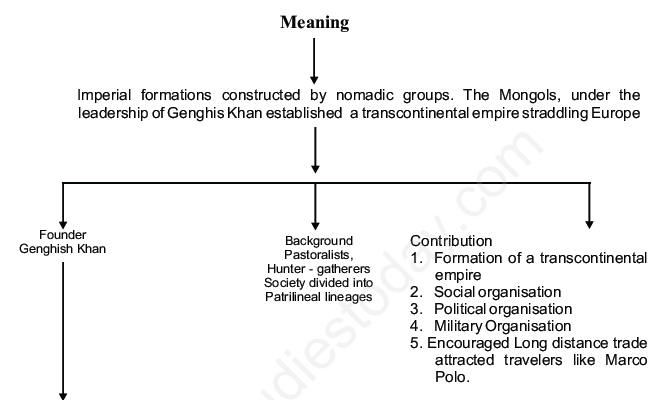
Answer: Nomadic societies, particularly the Mongols and related pastoral groups of the Eurasian steppe, possessed distinctive social, economic, and political features:
1. Economy: They were primarily pastoralists and hunter-gatherers, depending on livestock (horses, sheep, goats, camels) for milk, meat, hides, and transport, supplemented by trade and raiding of sedentary neighbors.
2. Social Structure: Society was divided into patrilineal lineages. All able-bodied adult males bore arms and participated in warfare and hunting expeditions.
3. Heterogeneity: Mongol society was not ethnically homogenous; it incorporated diverse groups including Turkic Uighurs and defeated populations like the Kereyits.
4. Leadership: Political power was vested in chiefs who maintained loyalty through the distribution of plunder, pasture lands, and cattle.
In simple words: Nomadic societies relied on livestock grazing, had warrior-based patrilineal clans, and integrated diverse conquered groups into their fold.
Exam Tip: Structure your answer under clear subheadings like Economy, Social Structure, and Leadership to secure full marks.
Question 2. Mention the estimated extent of Mongol destruction?
Answer: The Mongol military expansions under Genghis Khan and his successors caused unprecedented devastation across Eurasia:
1. Urban Centers: Major flourishing cities in Transoxiana, Khwarazm, Nishapur, Samarkand, and Bukhara faced massive destruction, massacres of populations, and destruction of sophisticated irrigation networks (qanats).
2. Demographic Loss: Millions of lives were lost during campaigns in China, Central Asia, Russia, and Persia, leading to a temporary decline in urban populations and agricultural output.
3. Economic Disruption: Long-standing trade routes were severely disrupted initially, though they later revived and flourished under the unified protection of the Pax Mongolica.
In simple words: Mongol conquests caused massive loss of life, destruction of famous cities and irrigation systems, and severe disruption across Eurasia before stabilizing into a peaceful trade network.
Exam Tip: Balance your answer by mentioning both the initial destructive impact on cities and the subsequent long-term stabilization of trade.
Question 3. Why was trade so significant to the Mongols?
Answer: Trade was vital to the Mongol empire for several key reasons:
1. Scarcity of Resources: Nomadic pastoral economies could not produce agricultural goods, iron utensils, textiles, and luxury items locally; hence, they depended heavily on trade with sedentary civilizations.
2. Economic Lifeline: Control over trade routes, especially the Silk Route, generated immense wealth, taxes, and tribute for the Mongol elite.
3. Diplomatic and Political Control: By encouraging long-distance trade and protecting merchants, the Mongols integrated distant regions, facilitated cultural exchange, and attracted foreign travelers like Marco Polo and Ibn Battuta.
In simple words: Since nomads could not grow crops or manufacture luxury goods, trade was essential for supplies, wealth, and connecting different parts of their vast empire.
Exam Tip: Connect the nomadic lifestyle's lack of agricultural goods directly to their reliance on trade and taxation of merchant caravans.
Question 4. Describe about 'the Great Wall of China'?
Answer: The Great Wall of China is a monumental defensive fortification system built across historical northern borders of ancient Chinese states and Imperial China:
1. Purpose: Constructed to protect agrarian Chinese empires from nomadic incursions and raids by steppe pastoralists.
2. Historical Context: Construction began as early as the Qin dynasty and was continually expanded, rebuilt, and linked over successive dynasties.
3. Interaction with Nomads: For nomadic empires like the Mongols, the wall represented both a military barrier and a barometer of Chinese military strength. When Chinese dynasties grew weak, nomads easily breached or bypassed the wall; when dynasties were strong, trade and tribute were strictly regulated along its borders.
In simple words: The Great Wall was a massive barrier built by China to defend against northern nomads, reflecting the ongoing struggle between farming empires and pastoral warriors.
Exam Tip: Emphasize the strategic interplay between the wall's defenses and the military strength of the nomadic tribes.
Question 5. Write about the military system of Genghis Khan?
Answer: Genghis Khan revolutionized steppe warfare through a highly disciplined and organized military structure:
1. Decimal System: The army was organized strictly according to decimal units in divisions of 10s, 100s, 1000s, and 10,000 soldiers.
2. Destruction of Tribal Ties: He dismantled old tribal groupings and redistributed warriors into new military units to ensure absolute loyalty to the supreme commander rather than clan chiefs.
3. Strict Discipline: Any individual attempting to desert or move from their allotted military unit without permission faced harsh, immediate punishment.
4. Leadership: The largest military units (tümens of 10,000 soldiers) and contingents were placed under his four sons and specially chosen loyal captains called noyans.
In simple words: Genghis Khan built a disciplined army using decimal units, mixed up old tribes to ensure loyalty to himself, and placed trusted commanders in charge.
Exam Tip: Mention key terms like decimal units, noyans, and the breaking of old tribal loyalties to score full marks.
10 Marks Questions
Question 1. Mention the important events after the death of Genghis Khan?
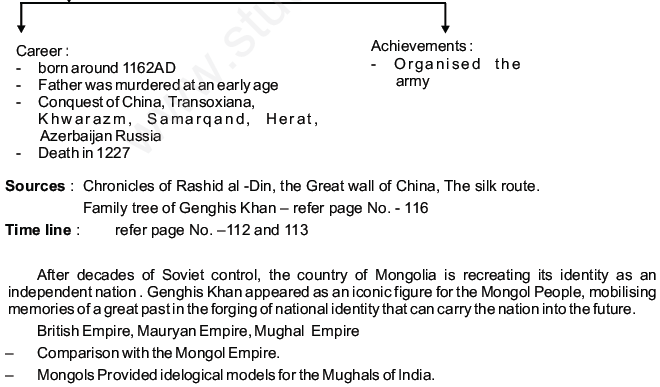
Answer: Following the death of Genghis Khan in 1227 AD, the Mongol Empire experienced significant transformations and expansion:
1. Continuation of Expansion: Under his successors (such as Ögedei, Güyük, Möngke, and Kublai Khan), Mongol armies continued massive campaigns, conquering parts of Eastern Europe, the Middle East (capturing Baghdad in 1258), and completing the conquest of China under the Yuan dynasty.
2. Division into Ulus: The empire was formally divided among his sons into four distinct territorial entities known as uluses (Jochi, Chagatai, Ögedei, and Tolui ulus).
3. Institutionalization of Administration: The nomadic military regime transitioned into structured imperial administration with the establishment of the Yam (rapid courier system), collection of the qubcur tax, and regular meetings of the quriltai.
4. Cultural Assimilation: Over generations, Mongol rulers in different regions (such as the Ilkhanate in Persia and the Yuan in China) adopted local religions, languages, and administrative traditions, leading to the eventual fragmentation of the unified transcontinental empire.
In simple words: After Genghis Khan died, his sons expanded the empire further, divided it into four regions, set up efficient postal and tax systems, and eventually blended with local cultures.
Exam Tip: Divide your 10-mark answer into logical phases: military expansion under successors, division into uluses, administrative consolidation (Yam, qubcur), and cultural assimilation.
Question 2. Write about the administrative system of Genghis Khan?
Answer: Genghis Khan established a sophisticated administrative framework to govern his vast transcontinental empire:
1. Four Ulus: Governance of newly conquered territories was assigned to his four sons, creating the foundational administrative units known as uluses.
2. Collective Rule and Quriltais: Genghis Khan envisioned collective rule by his family. All major decisions regarding campaigns, distribution of plunder, pasture lands, and succession were collectively decided at the assembly of chieftains known as the quriltai.
3. Military Contingents (Tama): Military contingents of individual princes, known as tama, were strategically stationed across each ulus to maintain order.
4. Communication and Taxation: A rapid courier system called the Yam connected distant parts of the empire. To maintain this communication network, Mongol nomads contributed a tenth of their herd, known as the qubcur tax.
In simple words: Genghis Khan shared governance among his sons through assemblies, set up military garrisons, and created a brilliant postal and tax system to manage the empire.
Exam Tip: Clearly define key administrative terms like ulus, quriltai, tama, Yam, and qubcur tax in your answer.
Question 3. Describe about the code of law of Genghis Khan?
Answer: The legal code of Genghis Khan, commonly known as Yasa, played a pivotal role in unifying and administering the Mongol Empire:
1. Promulgation: It was formally instituted during the great assembly (quriltai) held in 1221 AD.
2. Scope and Nature: The Yasa codified customary laws of the Mongol steppes, military regulations, and administrative decrees. It laid down strict punishments for crimes such as theft, adultery, false witness, and treason.
3. Maintenance of Order: It ensured absolute discipline within the army and harmonious coexistence among diverse ethnic and religious groups within the empire.
4. Preservation of Nomadic Traditions: While incorporating elements from conquered sedentary cultures, the Yasa preserved core nomadic values of loyalty, communal sharing of plunder, and respect for pastoral customs.
In simple words: Genghis Khan's code of law, Yasa, maintained strict discipline, punished crimes severely, and united diverse people under common rules.
Exam Tip: Mention the year 1221 AD and explain how Yasa bridged traditional steppe customs with imperial governance needs.
Passage-Based Question
Question 1. When did Genghis Khan introduce Yasa?
Answer: In 1221 AD.
In simple words: Genghis Khan introduced Yasa in the year 1221 AD.
Exam Tip: Direct factual recall question; memorize the year 1221 AD.
Question 2. Who were assembled at the festival ground?
Answer: The rich Muslim residents.
In simple words: Wealthy Muslim residents were assembled at the festival ground.
Exam Tip: Answer strictly based on the provided textbook passage context.
Question 3. Who was Abdullah Khan?
Answer: A distant descendant of Jochi, Genghis Khan's eldest son.
In simple words: Abdullah Khan was a distant descendant of Jochi, who was Genghis Khan's eldest son.
Question 4. Who was his chronicler?
Answer: Hafiz-i Tanish.
In simple words: His chronicler was Hafiz-i Tanish.
Exam Tip: Remember historian names associated with Mongol and Timurid chronicles.
Themes In World History Chapter 03 Nomadic Empires Printable Assignments & Solutions for Class 11 History
Chapter Practice Questions for Class 11 History
Access structured practice assignments for Themes In World History Chapter 03 Nomadic Empires designed in alignment with the latest CBSE curriculum for Class 11 History. These printable sets cover objective and descriptive problem types to support thorough revision.
Key Advantages of Solving Themes In World History Chapter 03 Nomadic Empires Assignments
- Exam Alignment: Questions strictly follow contemporary CBSE sample papers and grading schemes.
- Comprehensive Coverage: Features objective drills, case studies, and structured descriptive problems for Themes In World History Chapter 03 Nomadic Empires.
- Pacing & Precision: Regular problem-solving builds critical calculation speed and test-taking accuracy.
Effective Strategy for Class 11 History Assignments
- Initial Reading: Begin by reading the NCERT book for Class 11 History to build a baseline understanding.
- Independent Testing: Attempt assignment questions unassisted, then verify work using provided answer keys.
- Supplementary Aids: Leverage revision notes and worksheets whenever you encounter difficult topics.
FAQs
You can download free PDF assignments for Class 11 History Themes In World History Chapter 03 Nomadic Empires from StudiesToday.com. These practice sheets have been updated for the 2026-27 session covering all concepts from latest NCERT textbook.
Yes, our teachers have given solutions for all questions in the Class 11 History Themes In World History Chapter 03 Nomadic Empires assignments. This will help you to understand step-by-step methodology to get full marks in school tests and exams.
Yes. These assignments are designed as per the latest CBSE syllabus for 2026. We have included huge variety of question formats such as MCQs, Case-study based questions and important diagram-based problems found in Themes In World History Chapter 03 Nomadic Empires.
Practicing topicw wise assignments will help Class 11 students understand every sub-topic of Themes In World History Chapter 03 Nomadic Empires. Daily practice will improve speed, accuracy and answering competency-based questions.
Yes, all printable assignments for Class 11 History Themes In World History Chapter 03 Nomadic Empires are available for free download in mobile-friendly PDF format.