

Download CBSE Class 12 Economics Assignments
Review targeted academic assignments with the CBSE Class 12 Economics Theory of Consumer Behaviour Assignment. Built according to official CBSE standards for the 2026-27 term, these downloadable Class 12 Economics worksheets support effective daily practice for Part A Microeconomics Chapter 02 Theory Of Consumer Behaviour.
Access CBSE School Assignments and Answers
View or download the dedicated CBSE Class 12 Economics Theory of Consumer Behaviour Assignment resource below. Engaging with these assignments under focused study conditions ensures continuous academic progress and mastery of the 2026-27 curriculum.
Question. What is meant by ‘negative returns to a factor’ ? Discuss any two reasons behind negative returns to a factor.
Answer: Negative returns to a factor states that if more and more units of variable factor are employed with fixed factor beyond a certain level of output marginal product of the variable factor become negative and total product will fall.
Reasons for the Negative returns to a variable factor are:
(i) Limitation of fixed factor: Any increase in variable factor along with fixed factor, beyond a certain level of output may lead to negative marginal product and hence total product will fall.
(ii) Poor co-ordination between variable and fixed factor: Exceeding the optimum capacity of fixed and variable factors, the work relationship between the factors may get disturb, therefore, marginal product may become negative and hence total product will fall.
Question. State giving reasons whether the following statements are true or false.
(a) Under diminishing returns to a factor, marginal product and total product both increase at a diminishing rate.
(b) Average product falls only when marginal product is less than average product.
Answer: (a) False: Although TP increases at diminishing rate, but MP falls under diminishing returns to a factor.
(b) True: Because AP, like an average, falls if the MP, the marginal value, lower than AP.
Question. Answer the followings questions:
(i) Why MP curve cuts AP curve at its maximum point?
(ii) Can AP rise when MP starts declining?
Answer: (i) MP curve cuts AP curve from above at its maximum point because as long as the AP increases, MP > AP . Otherwise, AP cannot rise. Similarly, when AP falls, MP < AP. It, therefore, follows that MP curve cuts AP curve from above at its maximum point where MP = AP and AP is constant and maximum.
(ii) Yes, AP can rise when MP starts declining.
Explanation: For the first unit of the variable factor, MP = AP. As we increase the units of the variable factor, initially, MP rises. Then, after a point, MP starts falling due to diminishing returns to a factor. However, as long as MP > AP, AP continues to rise.
Question. Let the production function of a firm be: Q = 5L + 2K. Find out the maximum possible output that the firm can produce with 50 units of L and 10 units of K.
Answer: Given Q = 5L + 2K , L = 50, K = 10
Therefore, Q = 5(50) + 2(10) = 250 + 20 = 270
Thus, the maximum possible output that the firm can produce with 0 unit of L and 10 units of K is 270 units.
Question. What is meant by ‘returns to a factor’? Explain the meaning of diminishing returns to a factor.
Answer: Returns to a factor refers to change in output when only one input is changed, other inputs remaining unchanged. Diminishing returns to a factor: When only one input is increased, other inputs remaining unchanged, after a certain level of employment of the variable input, TPP starts increasing at diminishing rate (phase II of production). Finally, TPP falls (phase III of production).
Question. What is meant by “diminishing returns to a factor”? Discuss any two reasons for the operation of diminishing returns to a factor.
Answer: Diminishing returns to a variable input referred to a stage in production when with the employment of more and more units of variable factor with the given fixed factor, marginal product (MP) decreases and total product (TP) increases at diminishing rate.
Reasons for the decreasing returns to a variable factor are:
(i) Over-utilisation of the fixed factor: As we keep on increasing the variable factor along with the fixed factor eventually a position comes when the fixed factor has its limits and starts yielding diminishing returns.
(ii) Improper coordination between Fixed and Variable factors: After a certain level of employment, the production process becomes too crowded with the variable input and factor proportion tends to become less and less suitable for the production.
Question. State giving reasons whether the following statements are true or false.
(a) Under diminishing returns to a factor, total product continues to increase till marginal product reaches zero.
(b) When total product is constant, average product will fall.
Answer: (a) True: Under diminishing returns to a factor, MP falls. TP increases till MP is positive and when MP becomes zero, TP is maximum and constant.
(b) True: AP = TP/L. Since TP is constant and variable input (L) increases, AP will fall. TP is constant and maximum when MP = 0. Here, AP must be falling.
Question. MP curve looks like an inverse U-shaped curve in the input-output plane. Why?
Answer: According to the law of variable proportions, initially MP of a variable factor rises. Therefore, MP curve is upward sloping. Then, after a certain level of employment of the variable factor, MP falls but remains positive. Therefore , MP curve is downward sloping but above the X-axis. Finally, MP becomes negative. Therefore, MP curve is downward sloping and below the X-axis. Thus, the MP curve looks like an inverse U-shaped curve in the input-output plane.
Question. Explain the likely behaviour of Total Product and Marginal Product when only one input is increased while all other inputs are kept unchanged.
Answer: When only one input is increased while all other inputs are kept unchanged, the behaviour of Total Product (TP) and Marginal Product (MP) is summed up as follows:
Phase I: TP increases at increasing rate and MP increases.
When the units of the variable factor increases, efficient utilisation of the fixed factors takes place due to specialisation. This increases efficiency of the variable factor. Therefore, MP increases and hence TP increases at increasing rate.
Phase II: TP increases at diminishing rate and MP decreases but remains positive.
Beyond a point, increasing variable factor puts pressure on fixed factors. This lowers the efficiency of the variable factor. So, MP of the variable factor starts falling, hence TP increases at decreasing rates.
Phase III: TP declines and MP becomes negative.
Increasing variable factor puts so much pressure on the fixed factors that MP becomes negative and TP starts falling.
Question. State giving reasons whether the following statements are true or false.
(a) Average product will increase only when marginal product increases.
(b) Total product always increases whether there is increasing returns or diminishing returns to a factor.
(c) When there are diminishing returns to a factor, total product first increases and then starts falling.
Answer: (a) False: Average product rises as long as marginal product is greater than average product. Here, marginal product could be rising or falling.
(b) False: When there is diminishing returns to a factor, total product (TP) can decrease when marginal product (MP) of the variable factor becomes negative.
(c) True: When there are diminishing returns to a factor, TP first increases (though at decreasing rate when MP falls but is positive) and then TP starts falling when MP becomes negative.
Question. What is meant by increasing returns to a factor ? Discuss any two reasons behind increasing returns to a factor.
Answer: With the employment of more and more units of the variable factor along with the given fixed factor, MP increases and hence TP increases at an increasing rate. This is called Increasing returns to a factor.
Reasons for the Increasing returns to a variable factor are:-
(i) Fuller utilisation of the fixed factor: Certain factors of production are indivisible. They can put to their best use only when they are fully employed
(ii) Division of labour and specialisation: When a large number of labour units are employed, it is possible to divide a job in different stages. It results in specialisation implies higher efficiency and more production.
Question. State the behaviour of Marginal Physical Product, under returns to a factor.
Answer: The behaviour of Marginal Physical Product, under returns to a factor:
(i) MPP initially rises to its maximum.
(ii) MPP then decreases (stays positive) to become zero.
(iii) MPP becomes negative.
Question. State giving reasons whether the following statements are true or false.
(a) Under diminishing returns to a factor, total product continues to increase till marginal product reaches zero.
(b) Increase in total product always indicates that there are increasing returns to a factor.
(c) When there are diminishing returns to a factor marginal and total product both always fall.
Answer: (a) True: Under diminishing returns to a factor, total product (TP) continues to increase till marginal product reaches zero, though TP increases at decreasing rate.
(b) False: TP also increases when there are diminishing returns to a factor so long as MP is positive.
(c) False: MP falls (i.e., diminishing returns), TP can rise so long as MP is positive.
Question. State the relation between Average Product (AP) and Marginal Product (MP), using a schedule and a diagram.
Answer:
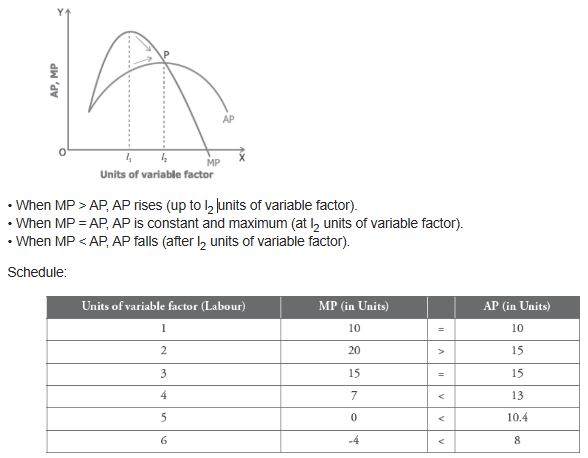
• When, MP is greater than AP; AP rises (At 2nd unit of variable factor employed).
• When, MP is equal to AP; AP is constant and maximum (At 3rd unit of variable factor employed).
• When, MP is lesser than AP, AP falls (4th unit to 6th unit of variable factor employed).
Free study material for Economics
Download Practice Assignments: Class 12 Economics Part A Microeconomics Chapter 02 Theory Of Consumer Behaviour
Revision Assignment: Part A Microeconomics Chapter 02 Theory Of Consumer Behaviour (CBSE)
Explore reliable practice questions for Part A Microeconomics Chapter 02 Theory Of Consumer Behaviour tailored for Class 12 learners. Use these structured worksheets to evaluate preparedness and strengthen core problem-solving skills.
Why Practice Class 12 Economics Assignments?
- Curriculum Standards: Assignments match modern CBSE sample formats to ensure relevant preparation.
- Thorough Revision: Detailed problem sets reinforce core concepts and eliminate conceptual weak spots.
- Execution Speed: Timed practice with assignment sets sharpens overall response timing.
Effective Strategy for Class 12 Economics Assignments
- Initial Reading: Begin by reading the NCERT book for Class 12 Economics to build a baseline understanding.
- Independent Testing: Attempt assignment questions unassisted, then verify work using provided answer keys.
- Supplementary Aids: Leverage revision notes and worksheets whenever you encounter difficult topics.
FAQs
You can download free PDF assignments for Class 12 Economics Part A Microeconomics Chapter 02 Theory Of Consumer Behaviour from StudiesToday.com. These practice sheets have been updated for the 2026-27 session covering all concepts from latest NCERT textbook.
Yes, our teachers have given solutions for all questions in the Class 12 Economics Part A Microeconomics Chapter 02 Theory Of Consumer Behaviour assignments. This will help you to understand step-by-step methodology to get full marks in school tests and exams.
Yes. These assignments are designed as per the latest CBSE syllabus for 2026. We have included huge variety of question formats such as MCQs, Case-study based questions and important diagram-based problems found in Part A Microeconomics Chapter 02 Theory Of Consumer Behaviour.
Practicing topicw wise assignments will help Class 12 students understand every sub-topic of Part A Microeconomics Chapter 02 Theory Of Consumer Behaviour. Daily practice will improve speed, accuracy and answering competency-based questions.
Yes, all printable assignments for Class 12 Economics Part A Microeconomics Chapter 02 Theory Of Consumer Behaviour are available for free download in mobile-friendly PDF format.