

School Assignments for IPCC Costing: Operating Costing Solutions
Explore structured practice materials through the CA IPCC Operating Costing Solutions. Tailored for IPCC learners, utilizing these Costing assignments ensures thorough preparation and strengthens foundational knowledge before final Chartered Accountancy evaluations.
Practice IPCC Costing Assignments: Operating Costing Solutions
Access the complete assignment PDF for IPCC Costing below. Regular practice with these targeted academic tasks builds familiarity with standard question patterns and helps secure higher marks in final school evaluations.
CA IPCC Operating Costing Solutions to Questions for CA IPCC Cost Accounting also includes notes, Questions and answers. CA IPCC Students please refer to the attached file for solutions for important questions which came in previous examinations for Cost Accounting and also study notes. Refer to other links too for detailed study notes/ question banks and solutions on all chapters of Cost Accounting for CA IPCC Refer to attached file for CA IPCC Operating Costing Solutions
Operating Costing - Introduction and Concepts
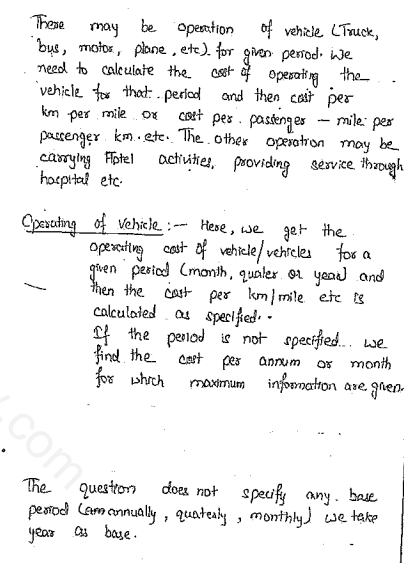
Answer: Operating costing is a method of costing applied to undertakings which provide service rather than manufacture goods, such as transport undertakings (truck, bus, car, taxi), power houses, hotels, hospitals, etc.
The main objective is to compute the cost of operating the service per unit, such as cost per passenger-km, cost per tonne-km, cost per passenger-mile, or cost per sleeping berth-km.
In transport costing, total operating costs are divided into fixed (standing) charges and variable (running/operating) charges. The period for cost collection is generally taken as a year, month, or quarter as specified.
In simple words: Operating costing calculates the cost of providing a service, like running a bus or a truck, per unit of service delivered.
Exam Tip: Always distinguish between fixed charges (insurance, tax, garage rent, driver salary) which remain constant regardless of mileage, and variable charges (petrol, diesel, oil, routine repairs) which vary directly with distance traveled.
Question 1. (Transport Problem - Bus Operation)
A bus is operated on a route of 20 km (one side). The bus makes 4 round trips per day. The seating capacity of the bus is 40 passengers. The bus is normally 80% full throughout the year. Calculate the annual passenger-km and operating cost per passenger-km given annual operating cost is Rs. 4,80,000.
Answer:
Distance of round trip = \(20 \text{ km} \times 2 = 40 \text{ km}\)
Number of round trips per day = 4
Total distance per day = \(40 \text{ km} \times 4 = 160 \text{ km}\)
Total distance per year (assuming 365 days) = \(160 \text{ km} \times 365 = 58,400 \text{ km}\)
Alternatively, using monthly basis (12 months):
Distance per month = \(40 \text{ km} \times 4 \text{ trips} \times 25 \text{ days} = 4,000 \text{ km}\)
Annual distance = \(4,000 \text{ km} \times 12 = 48,000 \text{ km}\)
Total passenger-km = Distance \(\times\) Seating Capacity \(\times\) Capacity Utilization
Passenger-km = \(48,000 \text{ km} \times 40 \text{ passengers} \times 80\% = 15,36,000 \text{ passenger-km}\)
Cost per passenger-km = \(\frac{\text{Total Annual Cost}}{\text{Total Passenger-km}} = \frac{4,80,000}{15,36,000} = \text{Rs. } 0.3125 \text{ per passenger-km}\)
In simple words: Total passenger-km is calculated by multiplying total distance covered by the number of passengers and the percentage of seats actually occupied.
Exam Tip: Be careful whether distance given is one-way or round-trip. Always multiply one-way distance by 2 to get the complete round trip distance.
Question 2. (Truck Operation and Fleet Costing)
A transport company runs a truck of 6 tonne capacity. It runs between two centers covering a distance of 150 km each way. On outward journey, freight is carried to full capacity and on return journey, 20% of capacity is utilized. Calculate absolute tonne-km and commercial tonne-km.
Answer:
One-way distance = 150 km
Outward journey load = 6 tonnes (100% capacity)
Return journey load = \(6 \text{ tonnes} \times 20\% = 1.2 \text{ tonnes}\)
Absolute Tonne-km = Sum of (Load carried \(\times\) distance for each journey segment)
Absolute Tonne-km = \((6 \text{ tonnes} \times 150 \text{ km}) + (1.2 \text{ tonnes} \times 150 \text{ km})\)
\(= 900 + 180 = 1080 \text{ tonne-km per round trip}\)
Commercial Tonne-km = Average load \(\times\) Total distance of round trip
Average load = \(\frac{6 + 1.2}{2} = 3.6 \text{ tonnes}\)
Total round trip distance = \(150 \text{ km} \times 2 = 300 \text{ km}\)
Commercial Tonne-km = \(3.6 \text{ tonnes} \times 300 \text{ km} = 1080 \text{ tonne-km}\)
In simple words: Absolute tonne-km multiplies each actual load by its respective distance, whereas commercial tonne-km multiplies the average load by the total round-trip distance. Both give the same total for a simple two-way trip.
Exam Tip: Absolute tonne-km is more accurate when loads vary across multiple intermediate stops, while commercial tonne-km is a simpler average measure.
Chartered Accountancy IPCC Costing Assignments for Operating Costing Solutions
Chapter Practice Questions for IPCC Costing
Access structured practice assignments for Operating Costing Solutions designed in alignment with the latest Chartered Accountancy curriculum for IPCC Costing. These printable sets cover objective and descriptive problem types to support thorough revision.
Why Practice IPCC Costing Assignments?
- Curriculum Standards: Assignments match modern Chartered Accountancy sample formats to ensure relevant preparation.
- Thorough Revision: Detailed problem sets reinforce core concepts and eliminate conceptual weak spots.
- Execution Speed: Timed practice with assignment sets sharpens overall response timing.
Steps to Complete Operating Costing Solutions Assignments Successfully
- Textbook Review: Always study the core NCERT book for IPCC Costing prior to beginning the assignment.
- Independent Attempt: Solve Operating Costing Solutions questions on your own initially before cross-checking with expert solutions.
- Error Tracking: Record challenging concepts in a dedicated notebook and practice online MCQ tests for revision.
FAQs
You can download free PDF assignments for IPCC Costing Operating Costing Solutions from StudiesToday.com. These practice sheets have been updated for the 2026-27 session covering all concepts from latest NCERT textbook.
Yes, our teachers have given solutions for all questions in the IPCC Costing Operating Costing Solutions assignments. This will help you to understand step-by-step methodology to get full marks in school tests and exams.
Yes. These assignments are designed as per the latest Chartered Accountancy syllabus for 2026. We have included huge variety of question formats such as MCQs, Case-study based questions and important diagram-based problems found in Operating Costing Solutions.
Practicing topicw wise assignments will help IPCC students understand every sub-topic of Operating Costing Solutions. Daily practice will improve speed, accuracy and answering competency-based questions.
Yes, all printable assignments for IPCC Costing Operating Costing Solutions are available for free download in mobile-friendly PDF format.