

Selina Concise Solutions for Class 9 Physics: Chapter 05 Upthrust In Fluids Archimedes Principle And Floatation
Access the official Selina Concise textbook solutions for Class 9 Physics, updated for the 2026-27 academic year. This digital resource is structured to help students build strong conceptual clarity and prepare effectively for school examinations.
Chapter-wise Solutions: Chapter 05 Upthrust In Fluids Archimedes Principle And Floatation
Navigate directly to the Chapter 05 Upthrust In Fluids Archimedes Principle And Floatation solutions using the digital viewer below. Organizing your study sessions chapter-by-chapter allows for seamless offline study and quick reference during revision.
Exercise 5(A)
Question 1S.
Answer: When a body is partially or wholly immersed in a liquid, an upward force acts on it. This upward force is known as an upthrust.
Upthrust can be demonstrated by the following experiment:
Take an empty can and close its mouth with an airtight stopper. Put it in a tub filled with water. It floats with a large part of it above the surface of water and only a small part of it below the surface of water. Push the can into the water. You can feel an upward force and you find it difficult to push the can further into water. It is noticed that as the can is pushed more and more into the water, more and more force is needed to push the can further into water, until it is completely immersed. When the can is fully inside the water, a definite force is still needed to keep it at rest in that position. Again, if the can is released in this position, it is noticed that the can bounces back to the surface and starts floating again.
In simple words: Upthrust is the "push-up" force you feel when you try to sink something like an empty bottle or a ball in water. The deeper you try to push it, the harder the water pushes back.
📝 Teacher's Note: Use a simple balloon or an empty plastic bottle in a bucket of water to show students how it "jumps" back up. This physical sensation is the best way to understand upthrust.
🎯 Exam Tip: Always mention that upthrust acts in the "upward direction" and that it applies to both partially and completely immersed bodies.
Question 2S.
Answer: Buoyant force on a body due to a liquid acts upwards at the centre of buoyancy.
In simple words: The buoyant force is the same as upthrust. It pushes exactly at the center of the part of the object that is underwater.
📝 Teacher's Note: Explain that the "centre of buoyancy" is the centre of gravity of the liquid that was moved out of the way by the object.
🎯 Exam Tip: Remember that the direction of buoyant force is always vertically upwards, regardless of the object's shape.
Question 3S.
Answer: The property of a liquid to exert an upward force on a body immersed in it is called buoyancy.
In simple words: Buoyancy is just the name of the "special power" liquids have to push things up.
📝 Teacher's Note: Distinguish between buoyant force (the actual force in Newtons) and buoyancy (the property or phenomenon).
🎯 Exam Tip: If a definition is asked, ensure you use the word "property" to define buoyancy correctly.
Question 4S.
Answer: The upward force exerted on a body by the fluid in which it is submerged is called the upthrust. Its S.I. unit is ‘newton’.
In simple words: Since upthrust is a type of force, it is measured in Newtons, just like the force you use to pull or push a door.
📝 Teacher's Note: Remind students that "fluids" include both liquids and gases, so air also exerts upthrust (which is why helium balloons rise).
🎯 Exam Tip: Don't forget the unit! Units are crucial in physics for scoring full marks.
Question 5S.
Answer: A liquid contained in a vessel exerts pressure at all points and in all directions. The pressure at a point in a liquid is the same in all directions – upwards, downwards and sideways. It increases with the depth inside the liquid.
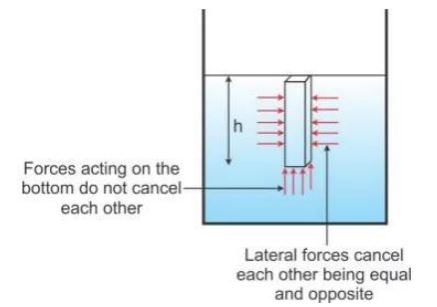
When a body is immersed in a liquid, the thrusts acting on the side walls of the body are neutralized as they are equal in magnitude and opposite in direction. However, the magnitudes of pressure on the upper and lower faces are not equal. The difference in pressure on the upper and lower faces cause a net upward force (= pressure x area) or upthrust on the body. It acts at the centre of buoyancy
In simple words: Water doesn't just push down; it pushes in every direction. The deeper you go in a pool, the stronger this "squeeze" or pressure becomes.
📝 Teacher's Note: Use the formula \( P = h \rho g \) to show that pressure is directly proportional to depth (\( h \)).
🎯 Exam Tip: Mention that pressure is "independent of the shape" of the container but dependent on depth.
Question 6S.
Answer: Upthrust due to water on block when fully submerged is more than its weight. Density of water is more than the density of cork; hence, upthrust due to water on the block of cork when fully submerged in water is more than its weight.
Question 7S.
Answer: A piece of wood if left under water comes to the surface of water because the upthrust on body due to its submerged part is equal to its own weight.
In simple words: Wood floats because it only needs to push aside a little bit of water to get enough "upward push" to balance its own weight.
📝 Teacher's Note: This defines the equilibrium position of a floating body. The upthrust balances the weight perfectly at the surface.
🎯 Exam Tip: Note that "Apparent weight" of any floating body is always zero.
Question 8S.
Answer: Experiment to show that a body immersed in a liquid appears lighter:
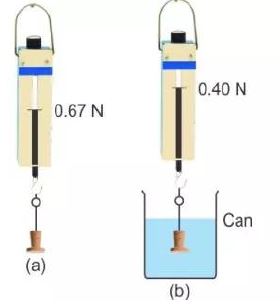
Take a solid body and suspend it by a thin thread from the hook of a spring balance as shown in the above figure (a). Note its weight. Above figure (a) shows the weight as 0.67 N.
Then, take a can filled with water. Immerse the solid gently into the water while hanging from the hook of the spring balance as shown in figure (b). Note its weight. Above figure (b) shows the weight as 0.40 N.
The reading in this case (b) shall be less than the reading in the case (a), which proves that a body immersed in a liquid appears to be lighter.In simple words: If you weigh a stone on a scale and then dip it in water, the scale shows a lower number. This is because the water is "helping" by pushing the stone up, making it feel lighter.
📝 Teacher's Note: This "lost weight" isn't actually gone; it's just being countered by upthrust. This is a crucial concept for understanding Archimedes' Principle later.
🎯 Exam Tip: The difference in weight (\( 0.67 - 0.40 = 0.27\text{N} \)) is exactly equal to the magnitude of the upthrust.
Question 9S.
Answer: The readings in the spring balance decreases. As the cylinder is immersed in the jar of water, an upward force acts on it, which is in opposition to the weight component of the cylinder. Hence the cylinder appears to be lighter.
In simple words: The scale reading drops because water is pushing the object up, fighting against gravity.
📝 Teacher's Note: Explain that the scale measures the "Tension" in the spring, which is \( \text{Weight} - \text{Upthrust} \).
🎯 Exam Tip: Use the term "apparent weight" to describe the lower reading of the balance in liquid.
Question 10S.
Answer: A body shall weigh more in vacuum because in vacuum, i.e. in absence of air, no upthrust will act on the body.
In simple words: Even air pushes things up a tiny bit! In a vacuum, there is no air to help lift the object, so it shows its true, heaviest weight.
📝 Teacher's Note: This is why sensitive scientific weighing is often done in vacuum or adjusted for "air buoyancy."
🎯 Exam Tip: Air is a fluid. Like water, it exerts upthrust. Absence of air means zero upthrust.
Question 11S.
Answer: Upthrust on a body depends on the following factors:
1. Volume of the body submerged in the liquid or fluid.
2. Density of liquid or fluid in which the body is submerged.
In simple words: To get a bigger push-up from water, you either need a bigger object or a "heavier" liquid like salt water.
📝 Teacher's Note: Use the formula \( F_B = V \rho g \). Here, \( V \) is volume submerged and \( \rho \) is liquid density.
🎯 Exam Tip: Upthrust depends on the liquid's density, NOT the body's density. This is a very common student mistake.
Question 12S.
Answer: Larger the volume of body submerged in liquid, greater is the upthrust acting on it.
In simple words: A big beach ball is harder to push underwater than a small tennis ball because the big ball moves more water out of the way.
📝 Teacher's Note: This is why ships are made large and hollow—to maximize the volume of water they displace.
🎯 Exam Tip: Upthrust is directly proportional to the volume of the submerged part of the body.
Question 13S.
Answer: A stone falls faster. Because the volume of stone is less than the volume of bunch of feathers of the same mass, the upthrust due to air on stone is less than that on the bunch of feathers, and hence, the stone falls faster. However, in vacuum, both shall fall together because there will be no upthrust.
In simple words: Feathers are big and fluffy, so air pushes up on them very hard, slowing them down. A stone is small and air barely pushes it. In space with no air, they both drop at exactly the same speed!
📝 Teacher's Note: Show the video of the Apollo 15 "Hammer and Feather" experiment on the moon to prove this.
🎯 Exam Tip: Mention "upthrust due to air" specifically when explaining why objects fall at different rates on Earth.
Question 14S.
Answer: \( F_2 > F_1 \); Sea water is denser than river water; therefore, the upthrust due to sea water will be greater than that due to river water at the same level. This shall make the body to appear lighter in the sea water.
In simple words: Salt water is "thicker" than fresh water, so it pushes up harder. This is why you float more easily in the ocean than in a swimming pool.
📝 Teacher's Note: Relate this to the Dead Sea, where the water is so salty that people float without any effort.
🎯 Exam Tip: Greater density of liquid = Greater upthrust for the same volume displaced.
Question 15S.
Answer: Observation: Volume of a block of wood immersed in glycerine is smaller as compared to the volume of block immersed in water.
Explanation: Density of glycerine is more than that of water. Hence, glycerine exerts more upthrust on the block of wood than water, causing it to float in glycerine with a smaller volume.
In simple words: Glycerine is very heavy and dense. It pushes up so hard that the wood doesn't even need to sink very deep to stay afloat.
📝 Teacher's Note: This is the principle behind a hydrometer—a tool used to measure liquid density by seeing how deep it sinks.
🎯 Exam Tip: For a floating body, the upthrust always equals the weight of the body. Since glycerine is denser, less volume is needed to provide that same upthrust.
Question 16S.
Answer:
(i) Weight of the body = \( V \rho g \)
(ii) Upthrust on the body = \( V \rho_L g \)
(iii) Apparent weight of the body in liquid = \( V(\rho - \rho_L) g \)
(iv) Loss in weight of the body = \( V \rho_L g \)
In simple words: These formulas calculate the forces. Weight is the true pull of gravity, upthrust is the water's push, and apparent weight is what the scale shows underwater.
📝 Teacher's Note: Make sure students understand that \( \rho \) is the density of the object, while \( \rho_L \) is the density of the liquid.
🎯 Exam Tip: Note that "Loss in weight" is exactly equal to "Upthrust." This is a key part of Archimedes' Principle.
Question 17S.
Answer:
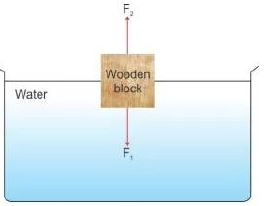
If \( F_1 < F_2 \) or \( F_1 = F_2 \), the body will float.
If \( F_1 > F_2 \), the body will sink.
In simple words: If gravity (\( F_1 \)) is stronger than the water's push (\( F_2 \)), it sinks. If the water's push is stronger or equal, it stays on top.
📝 Teacher's Note: Use "tug-of-war" analogy. Gravity pulls down, Upthrust pushes up. The stronger one wins!
🎯 Exam Tip: In diagrams, always label \( F_1 \) as Weight and \( F_2 \) as Buoyant Force/Upthrust.
Question 18S.
Answer:
(a) Both have equal volumes.
(b) Bounce back to the surface.
(c) More than
In simple words: These answers describe what happens in specific buoyancy experiments.
📝 Teacher's Note: This refers to comparing upthrust on different materials with the same size.
🎯 Exam Tip: Equal volume immersed in the same liquid means equal upthrust.
Question 19S.
Answer:
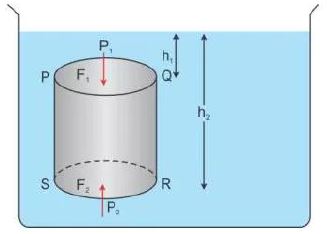
Consider a cylindrical body PQRS of cross-sectional area A immersed in a liquid of density \( \rho \) as shown in the figure below. Let the upper surface PQ of the body is at a depth \( h_1 \) while its lower surface RS is at depth \( h_2 \) below the free surface of liquid.
At depth \( h_1 \), the pressure on the upper surface PQ,
\( P_1 = h_1 \rho g \).
Therefore, the downward thrust on the upper surface PQ,
\( F_1 = \text{Pressure} \times \text{Area} = h_1 \rho g A \) ……………….(i)
At depth \( h_2 \), pressure on the lower surface RS,
\( P_2 = h_2 \rho g \).
Therefore, the upward thrust on the lower surface RS,
\( F_2 = \text{Pressure} \times \text{Area} = h_2 \rho g A \) …………………(ii)
The horizontal thrust at various points on the vertical sides of body get balanced because the liquid pressure is the same at all points at the same depth.
From the above equations (i) and (ii), it is clear that \( F_2 > F_1 \) because \( h_2 > h_1 \) and therefore, body will experience a net upward force.
Resultant upward thrust or buoyant force on the body,
\( F_B = F_2 - F_1 \)
\( = h_2 \rho g A - h_1 \rho g A \)
\( = A (h_2 - h_1) \rho g \)
However, \( A (h_2 - h_1) = V \), the volume of the body is submerged in a liquid.
Therefore, upthrust \( F_B = V \rho g \).
Now, V g = Volume of solid immersed x Density of liquid x Acceleration due to gravity
= Volume of liquid displaced x Density of liquid x Acceleration due to gravity
= Mass of liquid displaced x Acceleration due to gravity
= Weight of the liquid displaced by the submerged part of the body
Thus, Upthrust FB = weight of the liquid displaced by the submerged part of the body…..
(iii) Now, let us take a solid and suspend it by a thin thread from the hook of a spring balance and note its weight.
Then take a eureka can and fill it with water up to its spout. Arrange a measuring cylinder below the spout of the eureka can as shown. Immerse the solid gently in water.
The water displaced by the solid is collected in the measuring cylinder.
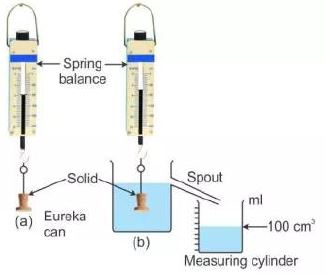
In simple words: This math proves that the "lift" an object gets underwater is exactly equal to the volume of the object times the weight of the water. The deeper the bottom face is, the harder it is pushed up!
📝 Teacher's Note: This is a key derivation. Ensure students understand how "Area x Height Difference" turns into "Volume."
🎯 Exam Tip: This derivation is often asked as a 5-mark question. Practice drawing the cylinder and labeling \( h_1, h_2 \) carefully.
Question 20S.
Answer: Since the spheres have the same radius, both will have an equal volume inside water, and
hence, the upthrust acted by water on both the spheres will be the same.
Hence, the required ratio of upthrust acting on two spheres is 1:1.
Question 21S.
Answer: Sphere of iron will sink.
Density of iron is more than the density of water, so the weight of iron sphere will be more than the upthrust due to water in it; thus, it causes the iron sphere to sink.
Density of wood is less than the density of water, so the weight of sphere of wood shall be less than the upthrust due to water in it. So, the sphere of wood will float with a volume submerged inside water which is balanced by the upthrust due to water.
In simple words: Iron is "heavier" than water (more dense), so it sinks. Wood is "lighter" than water (less dense), so it stays on top.
📝 Teacher's Note: This logic explains why a solid steel ball sinks while a hollow steel ship floats (average density of ship is less than water).
🎯 Exam Tip: Use the density comparison (\( \rho > \rho_w \)) to justify sinking or floating.
Question 22S.
Answer: The bodies of average density greater than that of the liquid sink in it. While the bodies of average density equal to or smaller than that of liquid float on it.
In simple words: This is the universal rule for sinking and floating based on density.
📝 Teacher's Note: The word "average" is important for complex bodies like ships or humans.
🎯 Exam Tip: Remember: Sinking if \( \rho_{\text{body}} > \rho_{\text{liquid}} \); Floating if \( \rho_{\text{body}} \le \rho_{\text{liquid}} \).
Question 23S.
Answer:
(i) The body will float if \( \rho \le \rho_L \)
(ii) The body will sink if \( \rho > \rho_L \)
In simple words: These are the mathematical conditions for floatation.
📝 Teacher's Note: Help students realize that if the densities are exactly equal, the body will float anywhere within the liquid, completely submerged.
🎯 Exam Tip: These conditions are often tested in numerical problems where you calculate density first.
Question 24S.
Answer: It is easier to lift a heavy stone under water than in air because in water, it experiences an upward buoyant force which balances the actual weight of the stone acting downwards. Thus, due to upthrust there is an apparent loss in the weight of the heavy stone, which makes it lighter in water, and hence easy to lift.
In simple words: Underwater, the water is helping you lift the rock by pushing it up from below.
📝 Teacher's Note: This is a very common everyday observation. Use it to build intuition before moving to the math.
🎯 Exam Tip: Mention "upward buoyant force" and "apparent loss in weight" for a complete explanation.
Question 25S.
Answer: Archimedes’ principle states that when a body is immersed partially or completely in a liquid, it experiences an upthrust, which is equal to the weight of liquid displaced by it.
In simple words: The "lift" an object gets from water is exactly as heavy as the amount of water it pushes out of its way.
📝 Teacher's Note: This is the most famous law in this chapter. Tell the "Eureka!" story to make it memorable.
🎯 Exam Tip: Be verbatim. Key phrases: "partially or completely immersed" and "weight of liquid displaced."
Question 26S.
Answer: Let us take a solid and suspend it by a thin thread from the hook of a spring balance and
note its weight (Fig a).
Then take a eureka can and fill it with water up to its spout. Arrange a measuring
cylinder below the spout of the eureka can as shown. Immerse the solid gently in water.
The water displaced by the solid gets collected in the measuring cylinder.
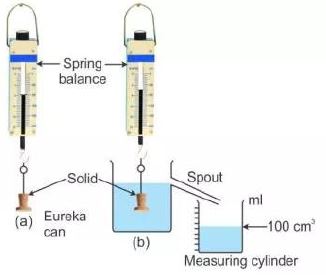
When water stops dripping through the spout, note the weight of the solid and volume of water collected in the measuring cylinder.
From diagram, it is clear that
Loss in weight (Weight in air – weight in water) = 300 gf – 200 gf = 100 gf
Volume of water displaced = Volume of solid = 100 cm3
Because density of water = 1 gcm-3
Weight of water displaced = 100 gf = Upthrust or loss in weight
This verifies Archimedes’ principle.
Question 1M.
Answer: Turpentine
In simple words: This likely refers to a liquid that would exert less upthrust than water for a specific volume.
📝 Teacher's Note: Turpentine is less dense than water, hence it exerts less upthrust.
🎯 Exam Tip: Remember: Lower density liquid \( \implies \) Lower upthrust.
Question 2M.
Answer:
In simple words: Newton (N) is the S.I. unit of any force, including upthrust.
📝 Teacher's Note: Basic unit knowledge check.
🎯 Exam Tip: Upthrust is a force, so its unit is 'N'.
Question 3M.
Answer: \( \rho > \rho_L \)
In simple words: The object sinks if it is denser than the liquid.
📝 Teacher's Note: This is the density condition for sinking.
🎯 Exam Tip: Sinking occurs when object density \( > \) liquid density.
Question 1N.
Answer:
1. Volume of body = \( 100 \text{ cm}^3 = 100 \times 10^{-6} \text{ m}^3 \)
Weight in air = \( 5 \text{ kgf} \)
Density of liquid = \( 1.8 \times 10^3 \text{ kgm}^{-3} \)
(i) Upthrust due to liquid = Volume of the solid submerged \( \times \) density of liquid \( \times \) g
\( = 100 \times 10^{-6} \times 1.8 \times 10^3 \times g \)
\( = 0.18 \text{ kgf} \)
(ii) Weight of body in liquid = Weight of body in air - upthrust
\( = 5 \text{ kgf} - 0.18 \text{ kgf} \)
\( = 4.82 \text{ kgf} \)
In simple words: The object weighs 5 units in air. The water pushes it up with 0.18 units of strength. So in the water, it feels like it only weighs 4.82 units.
📝 Teacher's Note: Note the unit conversion: \( 1 \text{ cm}^3 = 10^{-6} \text{ m}^3 \). Many students forget to square or cube the conversion factor.
🎯 Exam Tip: Always show your unit conversions at the beginning of the problem.
Question 2N.
Answer:
2. Weight of body in air = \( 450 \text{ gf} \)
Weight of body in water = \( 310 \text{ gf} \)
(i) Volume of the body = Loss in weight \( \times \) density of water
\( = (450 - 310) \times 1 = 140 \text{ cm}^3 \) [Assumption: density of water \( = 1 \text{ gcm}^{-3} \)]
(ii) Loss in weight = Weight of body in air - Weight of body in water
\( = (450 - 310) \text{ gf} = 140 \text{ gf} \)
(iii) Upthrust on body = loss in weight \( = 140 \text{ gf} \)
In simple words: The object "lost" 140 gf of weight in the water. This means the upthrust is 140 gf, and because it's water, the volume is also 140 \( \text{cm}^3 \).
📝 Teacher's Note: In CGS units for water, Volume (\( \text{cm}^3 \)) is numerically equal to Mass (g) and Upthrust (gf) because the density of water is exactly 1.
🎯 Exam Tip: State the assumption \( \rho_w = 1 \text{ gcm}^{-3} \) to justify the volume calculation.
Question 3N.
Answer:
3. Volume of hollow iron ball \( A = 15 \text{ cm}^3 \)
Mass of hollow iron ball \( A = 12 \text{ g} \)
Mass of solid iron ball \( B = 12 \text{ g} \)
Density of iron \( = 8.0 \text{ gcm}^{-3} \)
Volume of solid iron ball \( B = \frac{\text{Mass}}{\text{Density}} = \frac{12}{8} = 1.5 \text{ cm}^3 \)
(a) Upthrust on ball \( A = \text{Volume of ball A} \times \text{density of water} \times g = 15 \times 1 \times g = 15 \text{ gf} \)
Upthrust on ball \( B = \text{Volume of ball B} \times \text{density of water} \times g = 1.5 \times 1 \times g = 1.5 \text{ gf} \)
(b) Ball B will sink because the upthrust on ball B (=1.5 gf) is less than its weight 12 gf, while the upthrust on ball A (= 15 gf) if it is fully submerged, which is greater than its weight 12 gf, so it will float with its that much part submerged for which upthrust becomes equal to 12 gf (its weight).
In simple words: Even though both weigh the same, ball A is "bigger" (hollow), so it gets more push from the water and floats. Ball B is "smaller" and doesn't get enough push, so it sinks.
📝 Teacher's Note: This is a perfect example of why a heavy ship floats while a small nail sinks. It's all about total volume displaced.
🎯 Exam Tip: Calculate both volumes to compare the upthrust correctly.
Question 4N.
Answer:
4. Density of solid = \( 5000 \text{ kg m}^{-3} \)
Weight of solid = \( 0.5 \text{ kgf} \)
Density of water = \( 1000 \text{ kg m}^{-3} \)
Here, Upthrust = Volume of the solid \( \times \) density of water \( \times \) g
\( = \frac{0.5 / g}{5000} \times 1000 \times g \)
\( = \frac{0.5}{5000} \times 1000 \times g = 0.1 \text{ kgf} \)
Apparent weight = True weight - Upthrust
\( = 0.5 - 0.1 = 0.4 \text{ kgf} \)
In simple words: The object weighs 0.5 units. The water pushes it up with 0.1 units. So it feels like it weighs 0.4 units underwater.
📝 Teacher's Note: Show the derivation: \( \text{Volume} = \text{Mass} / \text{Density} = (\text{Weight}/g) / \text{Density} \). The 'g' cancels out, making the calculation easier.
🎯 Exam Tip: Be careful with the zeros in division (5000 vs 1000).
Question 5N.
Answer:
5. Volume of spheres A & B = \( 100 \text{ cm}^3 \)
Density of water = \( 1 \text{ gcm}^{-3} \)
Density of sphere \( A = 0.3 \text{ gcm}^{-3} \)
Density of sphere \( B = 8.9 \text{ gcm}^{-3} \)
(a) (i) Weight of sphere A = (density of sphere A \( \times \) volume) \( \times \) g
\( = 0.3 \times 100 \times g = 30 \text{ gf} \)
Weight of sphere B = (density of sphere B \( \times \) volume) \( \times \) g
\( = 8.9 \times 100 \times g = 890 \text{ gf} \)
(ii) Upthrust on sphere A = Volume of sphere A \( \times \) density of water \( \times \) g
\( = 100 \times 1 \times g = 100 \text{ gf} \)
Upthrust on sphere B = Volume of sphere B \( \times \) density of water \( \times \) g
\( = 100 \times 1 \times g = 100 \text{ gf} \)
Since the volume of both spheres is same inside water, the upthrust acting on them will also be same.
(b) The sphere A will float because the density of wood is less than the density of water.
In simple words: Both spheres are the same size, so the water pushes them both with 100 units. Sphere A weighs only 30 units, so it floats. Sphere B weighs 890 units, so it sinks.
📝 Teacher's Note: Use this to prove that upthrust does not care about what's *inside* the object, only how much *space* it takes up underwater.
🎯 Exam Tip: This is a conceptual goldmine. Volume is the key for upthrust; weight is the key for floating.
Question 6.
Answer: Mass of a block = 13.5 kg
Weight of the block = 13.5 kgf
Volume = \( 15 \times 10^{-3} \text{ m}^{-3} \)
Density of water = \( 1000 \text{ kgm}^{-3} \)
(a) Upthrust = Volume of block \( \times \) density of water \( \times g \)
= \( 15 \times 10^{-3} \times 1000 \times g \)
= 15 kgf
(b) The block will float since the upthrust on it is more than its weight \( (= 13.5 \text{ kgf}) \) when fully immersed in water.
(c) While floating, upthrust = 13.5 kgf (weight of the body)
In simple words: The block has a weight of 13.5 units pulling it down. When you try to push it all the way under water, the water pushes back up with 15 units. Because the upward push is stronger than the downward pull, the block stays on top and floats. Once it is floating at the surface, the two forces balance each other out perfectly at 13.5 units.
📝 Teacher's Note: This is a classic demonstration of the conditions for floatation. Remind students that an object floats when its average density is less than or equal to the density of the liquid, or when the upthrust on it while fully submerged is greater than its own weight.
🎯 Exam Tip: Always compare the weight of the body and the maximum upthrust to determine if it floats or sinks. For a floating body, the apparent weight is always zero because upthrust equals weight.
Question 7N.
Answer: Weight of piece of brass in air = 175 gf
Weight of piece of brass when fully immersed in water = 150 gf
Density of water = \( 1 \text{ g cm}^{-3} \)
(i) Volume of brass piece = Loss in weight = \( 175 - 150 = 25 \text{ cm}^3 \)
(ii) The brass piece weighs less in water due to upthrust.
In simple words: When an object is placed in water, the water pushes it upwards. This upward push makes the object feel lighter. The amount of weight it "loses" is exactly the same as its volume if the water density is 1.
📝 Teacher's Note: This is a direct application of Archimedes' Principle. Explain to students that in the C.G.S. system, where the density of water is \( 1 \text{ g/cm}^3 \), the loss of weight in grams-force is numerically equal to the volume in cubic centimeters.
🎯 Exam Tip: Always mention "Upthrust" or "Buoyant force" as the scientific reason why objects weigh less when submerged in a fluid.
Question 8N.
Answer: 8. Given, side of the cube = 5 cm
\( \therefore \) volume of the cube = \( 5 \times 5 \times 5 = 125 \text{ cm}^3 \)
Mass of the cube = \( \text{volume} \times \text{density} \)
= \( 125 \times 9 = 1125 \text{ g} \)
\( \therefore \) weight of the cube = 1125 gf (downwards)
Upthrust on cube = weight of the liquid displaced
= \( \text{volume of the cube} \times \text{density of liquid} \times g \)
= \( 125 \times 1.2 \times g \)
= 150 gf (upwards)
Tension in thread = Net downward force
= Weight of cube - Upthrust on cube
= \( 1125 - 150 = 975 \text{ gf} = 9.75 \text{ N} \)
In simple words: Gravity pulls the cube down with 1125 units of force, but the liquid pushes it up with 150 units. The string only has to hold the leftover force, which is 975 units.
📝 Teacher's Note: Use this problem to show how multiple forces act on a submerged object. Gravity and Buoyancy act in opposite directions, and the tension in the string is the resultant force needed for equilibrium.
🎯 Exam Tip: When calculating upthrust, remember to use the density of the liquid, not the density of the object.
Question 9N.
Answer: 9. Volume of block of wood = \( 50 \text{ cm} \times 50 \text{ cm} \times 50 \text{ cm} = 125000 \text{ cm}^3 = 0.125 \text{ m}^3 \)
Given, \( g = 9.8 \text{ m/s}^2 \)
Buoyant force = \( V \rho g \)
= \( 0.125 \times 1000 \times 9.8 \text{ N} \)
= 1225 N
In simple words: To find the upward push of water, first calculate how much space the block takes up in meters. Then multiply that space by the weight of water to get the total force.
📝 Teacher's Note: This problem requires careful unit conversion. Remind students that \( 1 \text{ m}^3 = 1,000,000 \text{ cm}^3 \). Converting dimensions to meters before calculating volume is often easier.
🎯 Exam Tip: In S.I. units, always use the density of water as \( 1000 \text{ kg/m}^3 \) unless specified otherwise.
Question 10N.
Answer: 10. Mass of body = 3.5 kg
Weight of the body = 3.5 kgf
Volume of water displaced when body is fully immersed = \( 1000 \text{ cm}^3 \)
(i) Volume of body when fully immersed in liquid = Volume of water displaced
\( \therefore \) Volume of body = \( 1000 \text{ cm}^3 \) or \( 0.001 \text{ m}^3 \)
(ii) Upthrust on body = \( \text{Volume of body} \times \text{Density of water} \times g \)
= \( 0.001 \times 1000 \times g = 1 \text{ kgf} \)
(iii) Apparent weight = True weight - Upthrust
= (3.5 - 1)
= 2.5 kgf
In simple words: The object weighs 3.5 units in air. Because it displaces a certain amount of water, that water pushes up with 1 unit of force. The object now feels like it weighs only 2.5 units.
📝 Teacher's Note: This problem clearly demonstrates the concept of "displaced volume." Since the body is fully immersed, its own volume is equal to the volume of water pushed out of the way.
🎯 Exam Tip: Note that "kgf" (kilogram-force) is a convenient unit here because 1 kg of mass has a weight of 1 kgf.
Exercise 5(B)
Question 1S.
Answer: The density of a substance is its mass per unit volume.
In simple words: Density tells you how "crowded" or "packed" the atoms are in a certain amount of space.
📝 Teacher's Note: Use the analogy of a bus. A bus with 50 people is denser than a bus with 5 people, even if the bus size is the same.
🎯 Exam Tip: The formula is \( \rho = \frac{M}{V} \).
Question 2S.
Answer:
(i) The C.G.S. unit of density is \( \text{gcm}^{-3} \).
(ii) The S.I. unit of density is \( \text{kgm}^{-3} \).
In simple words: Scientists use grams for small stuff and kilograms for big stuff to measure density.
📝 Teacher's Note: Help students understand the notation \( \text{cm}^{-3} \) means "per cubic centimeter."
🎯 Exam Tip: Remember: \( 1 \text{ g/cm}^3 = 1000 \text{ kg/m}^3 \).
Question 3S.
Answer: \( 1 \text{ gcm}^{-3} = 1000 \text{ kgm}^{-3} \)
In simple words: A single gram per tiny cube is equivalent to a thousand kilograms per big cube meter.
📝 Teacher's Note: Derive this by converting 1g to 0.001kg and 1cm to 0.01m.
🎯 Exam Tip: This conversion factor is very common in numericals. Memorize it.
Question 4S.
Answer: It means the mass of \( 1 \text{ m}^3 \) of iron is \( 7800 \text{ kg} \).
In simple words: If you had a solid iron cube that was 1 meter wide, 1 meter long, and 1 meter tall, it would weigh 7800 kilograms.
📝 Teacher's Note: This tests the understanding of the definition of density in a physical context.
🎯 Exam Tip: Always relate "density" to a "unit volume" when explaining its meaning.
Question 5S.
Answer: Density of water at 4°C in S.I. units is \( 1000 \text{ kgm}^{-3} \).
In simple words: A one-meter cube full of water weighs exactly one thousand kilograms.
📝 Teacher's Note: This is a standard constant in physics. Mention that 4°C is where water is most dense.
🎯 Exam Tip: This value is often not given in numericals because students are expected to know it.
Question 6S.
Answer:
(i) Mass of a metallic body remains unchanged with increase in temperature.
(ii) Volume of metallic body increases with an increase in temperature.
(iii) Density \( (= \text{Mass}/\text{volume}) \) of a metallic body decreases with an increase in temperature.
In simple words: When a metal gets hot, it expands and takes up more space, so its volume goes up. However, it still weighs the same, which means the material is now less "packed together," making its density go down.
📝 Teacher's Note: Use the analogy of a classroom: if students spread out to cover more floor space, the density of the room decreases, but the number of students (mass) remains the same.
🎯 Exam Tip: Remember that mass is an intrinsic property and never changes with temperature; students often mistakenly think it increases along with volume.
Question 7S.
Answer: On heating from \( 0^\circ\text{C} \), the density of water increases up to \( 4^\circ\text{C} \) and then decreases beyond \( 4^\circ\text{C} \).
In simple words: Water behaves strangely; it actually gets "heavier" or denser as it warms up from freezing until it hits 4 degrees. After that, it acts normally and gets lighter as it heats up further.
📝 Teacher's Note: This phenomenon is called the "Anomalous Expansion of Water." It is why ice floats and why aquatic life survives in frozen lakes.
🎯 Exam Tip: Always specify the temperature \( 4^\circ\text{C} \)—it is the exact point where water reaches its maximum density.
Question 8S.
Answer: (i) Volume, (ii) \( \text{kg m}^{-3} \), (iii) 1000 and (iv) 1
📝 Teacher's Note: Remind students that Relative Density is a comparison to water, so the R.D. of water itself must logically be 1.
🎯 Exam Tip: In the S.I. system, the density of water is exactly 1000 \( \text{kg m}^{-3} \)—this is a standard value used in almost all buoyancy numericals.
Question 9S. D
Answer: The relative density of a substance is the ratio of density of that substance to the density of water at \( 4^\circ\text{C} \).
In simple words: Relative density is a way to say how many times "heavier" a material is compared to water. For example, if a metal has an R.D. of 5, it is 5 times denser than water.
📝 Teacher's Note: It is also defined as the mass of a substance divided by the mass of an equal volume of water at \( 4^\circ\text{C} \).
🎯 Exam Tip: Always include the phrase "at \( 4^\circ\text{C} \)" in your definition to ensure technical accuracy and full marks.
Question 10S.
Answer: Relative density is the ratio of two similar quantities; thus, it has no unit.
In simple words: Since we are dividing density by density, the units cancel out. It is just a pure number, like saying "twice as big."
📝 Teacher's Note: This is a common objective question. Any ratio of identical physical quantities (like Strain or Refractive Index) will be dimensionless.
🎯 Exam Tip: If a numerical answer asks for R.D., do not write any unit after your final number.
Question 11S.
Answer: Density of a substance is the ratio of its mass to its volume but R.D. of a substance is the ratio of density of that substance to the density of water at \( 4^\circ\text{C} \).
In simple words: Density tells you the actual weight for a certain size (like grams per centimeter), while Relative Density just tells you how it compares to water as a simple number.
📝 Teacher's Note: Density has units (\( \text{kg/m}^3 \) or \( \text{g/cm}^3 \)), whereas Relative Density is a dimensionless quantity.
🎯 Exam Tip: When asked to differentiate, create two columns and compare their definitions and units for a clear presentation.
Question 12S.
Answer:
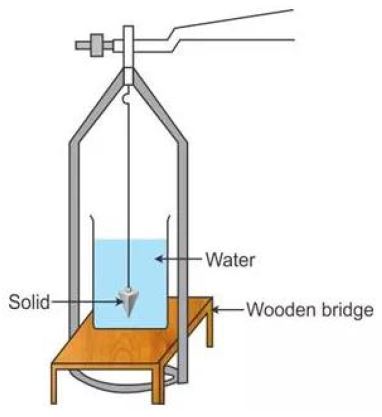
Steps:
1. With the help of a physical balance, find the weight, \( W_1 \) of the given solid.
2. Immerse the solid completely in a beaker filled with water such that it does not touch the walls and bottom of beaker, and find the weight \( W_2 \) of solid in water.
Observations:
Loss in weight of solid when immersed in water \( = (W_1 - W_2) \text{ gf} \)
R.D. \( = \text{Weight of solid in air} / \text{Loss of weight of solid in water} \)
R.D. \( = W_1 / (W_1 - W_2) \).
If the solid is soluble in water, then instead of water, take a liquid in which the solid is insoluble and it sinks in the liquid.
Then, R.D. \( = (\text{Weight of solid in air} / \text{Loss of weight of solid in liquid}) \times \text{R.D. of the liquid} \)
In simple words: You weigh a stone on a scale normally, then weigh it again while it's dipped in a cup of water. The stone "loses" weight in the water; by dividing its original weight by that lost weight, you find the Relative Density.
📝 Teacher's Note: Explain that the "Wooden bridge" is used so the beaker doesn't sit on the scale pan, allowing the scale to only measure the tension in the string.
🎯 Exam Tip: In the formula, \( W_1 - W_2 \) represents the weight of the water displaced by the solid. This is the application of Archimedes' Principle.
Question 13S.
Answer:
(i) Volume of the body \( = (W - W_1) \text{ cm}^3 \)
(ii) Upthrust on the body \( = (W - W_1) \text{ gf} \)
(iii) R.D. of the material of body \( = \frac{W}{W - W_1} \)
In simple words: These formulas show that the volume of an object is related to how much weight it appears to lose in water. Dividing its real weight by that loss gives its density compared to water.
📝 Teacher's Note: Here, \( W \) is weight in air and \( W_1 \) is weight in water. This assumes the measurements are in the C.G.S system.
🎯 Exam Tip: Note that Upthrust and Loss in Weight are numerically the same. Use the correct units for each: \( \text{cm}^3 \) for volume and \( \text{gf} \) for force.
Question 14S. E
Answer: Experimental determination of R.D. of a solid lighter than water (such as cork):
1. Take a sinker (i.e. a piece of metal or stone).
2. Place a beaker nearly two-third filled with water on a wooden bridge kept over the left pan of a physical balance.
3. Suspend the sinker with a thread from the hook of the left pan of balance so that it is completely immersed in water (as shown in the figure below). Find the weight \( W_1 \) of the sinker in water.
4. Tie the given solid (say, a cork) in the middle of a thread, and then measure the weight \( W_2 \) of a solid in the air along with the sinker in water.
5. Tie the cork with the sinker and immerse both of them completely in water of beaker and measure the weight \( W_3 \) of the solid and sinker both in water.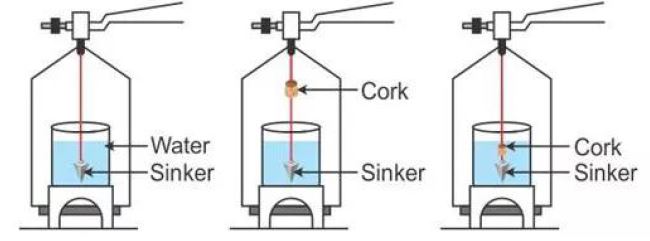
Observations:
Weight of the sinker in water \( = W_1 \text{ gf} \)
Weight of the sinker in water and cork in air \( = W_2 \text{ gf} \)
Weight of sinker and cork together in water \( = W_3 \text{ gf} \)
Calculations:
Weight of cork in air \( = (W_2 - W_1) \text{ gf} \)
Weight of cork in water \( = (W_3 - W_1) \text{ gf} \)
Loss in weight of the cork in water \( = \text{Weight of cork in air} - \text{Weight of cork in water} \).
\( = [(W_2 - W_1) - (W_3 - W_1)] \text{ gf} \)
\( = (W_2 - W_3) \text{ gf} \)
R.D. of cork \( = \text{Weight of cork in air} / \text{Loss of weight of cork in water} \)
Or, R.D. of cork \( = (W_2 - W_1) / (W_2 - W_3) \).
In simple words: A cork won't sink on its own, so we tie a heavy weight (sinker) to it. By comparing the weights of the sinker alone and the pair together, we can calculate how much the light cork pushes back against the water.
📝 Teacher's Note: This is a sophisticated experiment. Ensure students understand that \( W_2 - W_3 \) is the loss in weight for the cork alone, even though they were submerged together.
🎯 Exam Tip: The critical step is knowing that the "Loss in weight of cork" is found by subtracting the weight of the pair submerged from the combined weight where only the sinker is submerged.
Question 15S. W
Answer: The weight of the sinker and cork combined, in water will be less than the weight of the sinker alone in water because the upthrust due to water on cork (when completely immersed) is more than the weight of cork itself.
In simple words: The water pushes up on the cork so hard that it actually helps lift the sinker too. It is like the cork is a tiny life jacket for the heavy metal weight.
📝 Teacher's Note: This is why the reading decreases when the cork enters the water. The cork provides an additional buoyant force that counters more of the gravitational weight.
🎯 Exam Tip: Use the term "Upthrust" to explain the reduction in the total weight measured by the balance.
Question 1M.
(a) Iron
(b) Mercury
(c) Water
(d) Alcohol
Answer: (c) Water
In simple words: We always use water as the yardstick to compare how heavy other things are because water is easy to find and its density is constant.
📝 Teacher's Note: Water at \( 4^\circ\text{C} \) is chosen specifically because it has a consistent density of exactly \( 1 \text{ g/cm}^3 \).
🎯 Exam Tip: Relative density is always calculated "relative to water"—this is the key to identifying the correct option.
Question 2M.
(a) \( \text{kg m}^{-3} \)
(b) \( \text{g cm}^{-3} \)
(c) Newton
(d) No unit.
Answer: (d) No unit.
In simple words: Because it is just a comparison between two weights, the units are not needed. It is a pure number.
📝 Teacher's Note: Remind students that physical constants representing ratios usually have no units.
🎯 Exam Tip: Watch out for traps where units like \( \text{kg/m}^3 \) are offered—those are for Density, not Relative Density.
Question 3M.
(a) \( 1000 \text{ kg m}^{-3} \)
(b) \( 1 \text{ g cm}^{-3} \)
(c) \( 0.5 \text{ g cm}^{-3} \)
(d) \( 1 \text{ kg m}^{-3} \)
Answer: (b) \( 1 \text{ g cm}^{-3} \)
In simple words: In the small gram-centimeter system, one tiny cube of water weighs exactly one gram.
📝 Teacher's Note: Students should memorize both values for water: \( 1 \text{ g/cm}^3 \) (CGS) and \( 1000 \text{ kg/m}^3 \) (SI).
🎯 Exam Tip: Check the unit system in the question carefully (C.G.S. vs S.I.) before picking your answer.
Question 1N.
Answer: 1. Density of copper in C.G.S. \( = 8.83 \text{ gcm}^{-3} \)
Density of copper in S.I. \( = \frac{8.83}{1000 \times 100^{-6}} = 8830 \text{ kgm}^{-3} \)
In simple words: To change from the small system to the large system, we essentially multiply by 1000. So, 8.83 becomes 8830.
📝 Teacher's Note: The mathematical shortcut is simply multiplying by \( 10^3 \) when moving from \( \text{g/cm}^3 \) to \( \text{kg/m}^3 \).
🎯 Exam Tip: Show the conversion factor explicitly to earn partial marks even if you make a calculation error.
Question 2N.
Answer: 2. R.D. of mercury \( = 13.6 \)
(i) Density in C.G.S. \( = 13.6 \text{ gcm}^{-3} \)
(ii) Density in S.I. \( = 13.6 \times 10^3 \text{ kgm}^{-3} \)
In simple words: Mercury is 13.6 times heavier than water. So in the gram system, its density is 13.6, and in the kilogram system, it is 13,600.
📝 Teacher's Note: Since \( \text{Density of water} = 1 \text{ g/cm}^3 \), the numerical value of density in CGS is identical to the R.D.
🎯 Exam Tip: S.I. density is often written as \( 13,600 \) or \( 13.6 \times 10^3 \)—both forms are correct.
Question 3N.
Answer: 3. Density of iron \( = 7.8 \times 10^3 \text{ kgm}^{-3} \)
Density of iron in C.G.S. \( = 7.8 \text{ gcm}^{-3} \)
R.D. \( = \text{Density in C.G.S. (without unit)} = 7.8 \)
In simple words: We just divide the large number (7800) by 1000 to get the density of 7.8. The Relative Density is just that same number but without the "grams" label.
📝 Teacher's Note: Remind students that R.D. is essentially "density in CGS without units."
🎯 Exam Tip: Always state that R.D. is a ratio and therefore has no unit to justify your final answer.
Question 4N.
Answer: Solution 4N.
4. R.D. of silver = 10.8
Density of silver in C.G.S. = \( 10.8 \text{ gcm}^{-3} \)
Density in S.I. = \( 10.8 \times 10^3 \text{ kgm}^{-3} \)
In simple words: Silver has a relative density of 10.8, meaning it is much more "packed" than water. One cubic meter of it would weigh 10,800 kilograms.
📝 Teacher's Note: Help students realize that the numeric value of Relative Density is the same as the density in C.G.S. units.
🎯 Exam Tip: Always show the conversion clearly by stating that Density in S.I. = R.D. \( \times 1000 \text{ kgm}^{-3} \).
Question 5N.
Answer: Solution 5N.
5. R.D. of silver = 0.52
Volume = \( 2 \text{ m}^3 \)
Density of body in S.I. = \( 0.52 \times 10^3 \text{ kgm}^{-3} \)
\( \therefore \) Mass = Density \( \times \) volume = \( (0.52 \times 10^3) \times 2 = 1040 \text{ kg} \)
In simple words: This object is about half as heavy as water for its size. Even though it is "light," because it is a huge 2-meter block, it still weighs 1040 kilograms in total.
📝 Teacher's Note: Point out that if the R.D. is less than 1, the object will float on water. In this case, 0.52 indicates it is likely a type of wood.
🎯 Exam Tip: Be careful with scientific notation; \( 0.52 \times 10^3 \) is the same as 520.
Question 6N.
Answer: Solution 6N.
6. Volume of air = \( 4.5 \times 3.5 \times 2.5 \text{ m}^3 \)
Density of air at NTP = \( 1.3 \text{ kgm}^{-3} \)
Mass of air = Density \( \times \) volume
Or Mass = \( (1.3) \times (4.5 \times 3.5 \times 2.5) = 51.19 \text{ kg} \)
In simple words: Even the air in a normal-sized room has weight! The air in this specific room weighs over 51 kilograms, which is about as much as a small adult.
📝 Teacher's Note: This is a great example to show students that gases are matter and have significant mass when considering large volumes.
🎯 Exam Tip: NTP stands for Normal Temperature and Pressure. Standard density values like that of air are often provided for NTP conditions.
Question 7N.
Answer: Solution 7N.
7. Mass of stone = 113 g
Rise in water level = (40 - 30) ml = 10 ml
This rise is equal to the space occupied (volume) by the stone.
\( \therefore \) volume of stone = \( 10 \text{ cm}^3 \)
Density of stone in C.G.S. = \( \frac{\text{Mass}}{\text{Volume}} = \frac{113}{10} = 11.3 \text{ gcm}^{-3} \)
R.D. = 11.3
In simple words: When you drop the stone in water, it pushes 10 ml of water out of the way, which tells us its size. By dividing its weight by this size, we find it is 11.3 times denser than water.
📝 Teacher's Note: This uses the displacement method to find volume. Remind students that \( 1 \text{ ml} = 1 \text{ cm}^3 \).
🎯 Exam Tip: When using the displacement method, clearly state that the "volume of solid = volume of liquid displaced."
Question 8.
Answer: Solution 8N.
8. Volume of body = \( 100 \text{ cm}^3 \)
Weight in air, \( W_1 = 1 \text{ kgf} = 1000 \text{ gf} \)
Mass of body = \( 1 \text{ kg} = 1000 \text{ g} \)
R.D. of solid = 10
R.D. of water = 1
(i) Let \( W_2 \) be the weight of the body in water.
R.D. of body = \( \frac{W_1}{W_1 - W_2} \times \text{R.D. of water} \)
or, \( 10 = \frac{1000}{(1000 - W_2)} \times 1 \)
or, \( 10 (1000 - W_2) = 1000 \)
or, \( 1000 - W_2 = 100 \)
or, \( W_2 = 900 \text{ gf} \)
(ii) R.D. of body = Density in C.G.S. (without unit)
or, R.D. = \( \frac{\text{Mass}}{\text{Volume}} = \frac{1000}{100} = 10 \)
In simple words: The object weighs 1000 units in air but only 900 units in water because the water helps push it up. This upthrust matches the weight of the water the object displaced.
📝 Teacher's Note: This problem connects density (\( M/V \)) with the buoyancy formula for R.D. (\( \text{Weight in Air} / \text{Loss in Weight} \)).
🎯 Exam Tip: Note that "gf" (gram-force) is used here to keep units consistent with "cm³" and "g".
Question 9.
Answer: Solution 9N.
9. Mass of body = 70 kg
Volume of water displaced by body = \( 20,000 \text{ cm}^3 = 0.02 \text{ m}^3 \)
(i) Mass of solid immersed in water = Mass of water displaced
Mass of solid immersed in water = Density of water \( \times \) Volume of water displaced
Mass of solid immersed in water = \( 1000 \text{ kgm}^{-3} \times 0.02 \text{ m}^3 = 20 \text{ kg} \)
(ii) R.D. of solid = Density in C.G.S. (without unit)
Density in C.G.S. = \( \frac{\text{mass}}{\text{volume}} = \frac{70 \times 1000}{20,000} = 3.5 \text{ gcm}^{-3} \)
R.D. = 3.5
In simple words: A 70kg person displaces 20kg of water when they dive in. Because their total mass is 70kg and their volume is 20,000 cm³, they are 3.5 times denser than water.
📝 Teacher's Note: Ensure students understand that in sub-part (i), we are finding the mass of the liquid displaced by the body.
🎯 Exam Tip: To convert mass from kg to g, multiply by 1000. To convert volume from \( \text{cm}^3 \) to \( \text{m}^3 \), multiply by \( 10^{-6} \).
Question 10.
Answer: Solution 10N.
10. Weight of solid in air, \( W_1 = 120 \text{ gf} \)
Weight of solid when completely immersed in water \( W_2 = 105 \text{ gf} \)
R.D. of solid = \( \frac{W_1}{W_1 - W_2} \times \text{R.D. of water} \)
R.D. of solid = \( \frac{120}{120 - 105} \times 1 \)
R.D. of solid = 8
In simple words: The solid loses 15 units of weight in water. By comparing its original weight to this loss, we find it is 8 times heavier than water.
📝 Teacher's Note: The denominator \( W_1 - W_2 \) represents the upthrust or the weight of the displaced water.
🎯 Exam Tip: This formula is the standard way to find R.D. using a spring balance.
Question 11.
Answer: Solution 11N.
11. Weight of solid in air, \( W_1 = 32 \text{ gf} \)
Weight of solid when completely immersed in water \( W_2 = 28.8 \text{ gf} \)
(i) Volume of solid = Mass / density of solid
\( = \frac{32}{10} = 3.2 \text{ m}^3 \) [Note: Numerical result 3.2 follows from density calculated in (ii)]
(ii) R.D. of solid = \( \frac{W_1}{W_1 - W_2} \times 1 \)
\( = \frac{32}{32 - 28.8} \)
R.D. of solid = 10
(iii) Weight of solid in liquid of density \( 0.9 \text{ gcm}^{-3} = W_3 \)
R.D. of solid = \( \frac{W_1}{W_1 - W_3} \times \text{R.D. of liquid} \)
or, \( 10 = \frac{32}{32 - W_3} \times 0.9 \)
or, \( W_3 = 29.12 \text{ gf} \)
In simple words: This object weighs 32 normally. In water, it feels like 28.8. In a different oily liquid (which is lighter than water), it feels like 29.12 because the oily liquid doesn't push up as hard as water does.
📝 Teacher's Note: Part (iii) is tricky. It shows that upthrust depends on the density of the liquid the object is dipped into.
🎯 Exam Tip: When a body is immersed in a liquid other than water, remember to multiply by the R.D. of that liquid in the formula.
Question 12.
Answer: Solution 12N.
12. Weight of body in air, \( W_1 = 20 \text{ gf} \)
Weight of body when completely immersed in water \( W_2 = 18 \text{ gf} \)
R.D. of body = \( \frac{W_1}{W_1 - W_2} \times 1 \)
R.D. of body = \( \frac{20}{20 - 18} \times 1 \)
R.D. of body = 10
In simple words: The body is 10 times denser than water. It only loses 2 units of weight because its size (volume) is small compared to its heavy weight.
📝 Teacher's Note: This is a very straightforward R.D. calculation, good for building student confidence.
🎯 Exam Tip: Always double-check the subtraction in the denominator (20 - 18 = 2).
Question 13.
Answer: Solution 13N.
13. Weight of body in air, \( W_1 = 1.5 \text{ kgf} \)
Weight of body when completely immersed in liquid \( W_2 = 0.9 \text{ kgf} \)
Density of liquid = \( 1.2 \times 10^3 \text{ kgm}^{-3} \)
R.D. of body = \( \frac{W_1}{W_1 - W_2} \times \text{R.D. of liquid} \)
R.D. of body = \( \frac{1.5}{1.5 - 0.9} \times 1.2 \)
R.D. of body = 3
In simple words: This object is being dipped in a liquid that is 1.2 times denser than water. We find the object itself is 3 times denser than water.
📝 Teacher's Note: Use this to explain that the loss in weight (\( 1.5 - 0.9 = 0.6 \)) is the upthrust from the specific liquid used.
🎯 Exam Tip: If density is given in \( \text{kgm}^{-3} \), convert to R.D. by dividing by 1000 (\( 1200 / 1000 = 1.2 \)) before using the buoyancy formula.
Question 14.
Answer: Solution 14N.
14. R.D. of pure gold = 19.3
Weight of bangle in air, \( W_1 = 25.25 \text{ gf} \)
Weight of bangle when completely immersed in water \( W_2 = 23.075 \text{ gf} \)
R.D. of bangle = \( \frac{W_1}{W_1 - W_2} \times 1 \)
R.D. of bangle = \( \frac{25.25}{25.25 - 23.075} \times 1 \)
R.D. of bangle = 11.6
The bangle is not made of pure gold as its density is not 19.3.
In simple words: We can use physics to spot fake jewelry! Because the bangle's density is only 11.6 and not 19.3, it is definitely not pure gold.
📝 Teacher's Note: This is a classic application of Archimedes' Principle—the story of the golden crown and King Hiero.
🎯 Exam Tip: When a question asks "Is it pure?", you must calculate the R.D. and explicitly compare it to the given standard value in your conclusion.
Question 15.
Answer: Solution 15N.
15. Weight of iron in air, \( W_1 = 44.5 \text{ gf} \)
Weight of iron when completely immersed in water \( W_2 = 39.5 \text{ gf} \)
R.D. of iron = \( \frac{W_1}{W_1 - W_2} \times \text{R.D. of water} \)
R.D. of iron = \( \frac{44.5}{44.5 - 39.5} \times 1 \)
R.D. of iron = 8.9
In simple words: Iron loses 5 units of weight in water. Comparing its air weight (44.5) to this loss (5) shows it is 8.9 times denser than water.
📝 Teacher's Note: This value (8.9) is actually closer to the R.D. of copper. It's a good exercise for students to check against standard density tables.
🎯 Exam Tip: Always state the formula and the substitution clearly to maximize points in the "method" section.
Question 16.
Answer: Solution 16N.
a. The mass of stone is 15.1 g. Hence, its weight in air will be \( W_a = 15.1 \text{ gf} \)
b. When stone is immersed in water its weight becomes 9.7 gf. So, the upthrust on the stone is 15.1 – 9.7 = 5.4 gf. Since the density of water is \( 1 \text{ g cm}^{-3} \), the volume of stone is \( 5.4 \text{ cm}^3 \).
c. Weight of stone in liquid is \( W_l = 10.9 \text{ gf} \)
Weight of stone in water is \( W_w = 9.7 \text{ gf} \)
Therefore, the relative density of stone is
\( \text{R.D.}_{\text{stone}} = \frac{W_a}{W_a - W_w} = \frac{15.1 \text{ gf}}{15.1 - 9.7 \text{ gf}} \)
\( \therefore \text{R.D.}_{\text{stone}} = \frac{15.1}{5.4} = 2.8 \)
d. Relative density of liquid is
\( \text{R.D.}_{\text{liquid}} = \frac{W_a - W_l}{W_a - W_w} = \frac{15.1 - 10.9}{15.1 - 9.7} = \frac{4.2}{5.4} \)
\( \therefore \text{R.D.}_{\text{liquid}} = 0.7777 \approx 0.78 \)
In simple words: This problem shows how to find the volume of a rock and the density of an unknown liquid just by weighing the rock in air, water, and the liquid. The rock is 2.8 times denser than water, and the unknown liquid is 0.78 times as dense as water.
📝 Teacher's Note: This is an excellent comprehensive problem. Part (d) uses the formula \( \text{RD}_L = (\text{Loss in weight in liquid}) / (\text{Loss in weight in water}) \).
🎯 Exam Tip: When a question has multiple parts (a, b, c, d), label each part clearly in your answer sheet to help the examiner.
Exercise 5(C)
Question 1S.
Answer: According to the principle of floatation, the weight of a floating body is equal to the weight of the liquid displaced by its submerged part.
In simple words: To float, an object must be "light" enough that the water it pushes away weighs exactly as much as the object itself.
📝 Teacher's Note: This is a specific case of Archimedes' Principle where the object is in equilibrium (not sinking or rising).
🎯 Exam Tip: For a floating body, the apparent weight is always zero.
Question 2S.
Answer: (i) Two forces acting on the body are as listed below:
(a) Weight of the body (downwards)
(b) Upthrust of the liquid (upwards)
(ii) If the weight of the body is greater than the upthrust acting on it, the body will sink. If the weight of the body is equal to or less than the upthrust acting on it, the body will float.
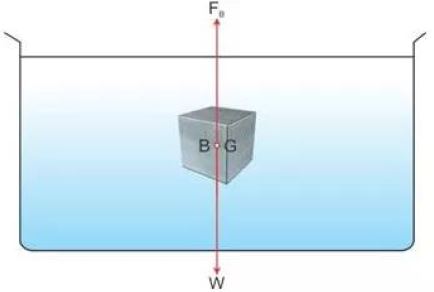
(b) The net force acting on the body when it floats is the upthrust due to the liquid.
In simple words: Floating is a tug-of-war. Gravity pulls down, water pushes up. If gravity wins, you sink. If it's a tie or water wins, you float!
📝 Teacher's Note: In part (iii), clarify that "net force" refers to the direction of motion. When sinking, the net force is downward (\( W - F_B \)).
🎯 Exam Tip: In diagrams, always draw the Weight arrow starting from the center of gravity (G) and Upthrust from the center of buoyancy (B).
Question 3S.
Answer:
The reading on the spring balance will be zero because wood floats on water and while floating the apparent weight = 0.
In simple words: Since the water is already holding up the entire weight of the wood, the spring scale doesn't have to pull at all.
📝 Teacher's Note: This is a standard concept—any object that is fully supported by buoyancy shows a reading of zero on a scale.
🎯 Exam Tip: Remember: Apparent weight = True weight - Upthrust. For floating, these are equal, so the result is zero.
Question 4S.
Answer:
(a) The ball will float because the density of ball (i.e. iron) is less than the density of mercury.
(b) While floating, the apparent weight = 0.
In simple words: Mercury is super heavy—even iron can float on top of it like a rubber ducky in a bathtub!
📝 Teacher's Note: Density of iron is \( 7.8 \text{ g/cm}^3 \) while mercury is \( 13.6 \text{ g/cm}^3 \). This big difference ensures iron stays on top.
🎯 Exam Tip: In your answer, compare the two densities specifically (\( \rho_{\text{iron}} < \rho_{\text{mercury}} \)) to justify the floating.
Question 5S.
Answer:
The body will float if its density is less than or equal to the density of the liquid \( \rho_S \le \rho_L \).
The body will sink if its density is greater than the density of the liquid \( \rho_S > \rho_L \).
In simple words: Heavier for its size? Sinks. Lighter for its size? Floats.
📝 Teacher's Note: If the densities are exactly equal, the body will float while being completely submerged at any depth.
🎯 Exam Tip: Use the Greek symbol \( \rho \) (rho) for density to look more professional in your answers.
Question 6S.
Answer:
Density of iron is less than the density of mercury; hence, an iron nail floats in mercury and density of iron is more than the density of water; hence, an iron nail sinks in water.
In simple words: Water is too "thin" to hold up heavy iron. But mercury is much "thicker" and pushes up harder, making the nail float.
📝 Teacher's Note: This proves that floating depends not just on the object, but also on what liquid you put it in.
🎯 Exam Tip: Mention the relative densities of all three substances (iron, water, and mercury) for a complete explanation.
Question 7S.
Answer:
(i) Weight of the floating body is equal to the upthrust.
(ii) While floating, the apparent weight is zero.
In simple words: Floating is a perfect balance. Downward pull equals upward push.
📝 Teacher's Note: This is a fundamental law of physics. The "apparent weight" is what a submerged scale would read.
🎯 Exam Tip: These two points are the most frequent 1-mark theory questions in this unit.
Question 8S.
Answer:
When the body is partially immersed, its centre of buoyancy will be below the centre of gravity of the block.
When the body is completely immersed, its centre of buoyancy will coincide the centre of gravity.
In simple words: The center of buoyancy is basically the middle of the "underwater part." If the whole thing is underwater, the middle of the object and the middle of the underwater part are the same spot!
📝 Teacher's Note: This assumes the body is uniform in density. If the density varies, the centers might not coincide even when fully submerged.
🎯 Exam Tip: "Coincide" is the technical keyword to use for completely submerged uniform bodies.
Question 9S.
Answer:
The upthrust on the body by each liquid is the same and equal to the weight of the body.
However, upthrust = Volume submerged \( \times \rho_L \times g \),
For the liquid C, since the volume submerged is least so the density \( \rho_3 \) must be maximum.
In simple words: The stronger the liquid pushes up (the denser it is), the less the object has to sink to stay afloat. So the liquid it sinks into the least is the densest one.
📝 Teacher's Note: This is how a hydrometer works—it sinks less in denser liquids, allowing us to read the density on a scale.
🎯 Exam Tip: Submerged volume is inversely proportional to liquid density (\( V_{sub} \propto 1/\rho_L \)).
Question 10s.
Answer:
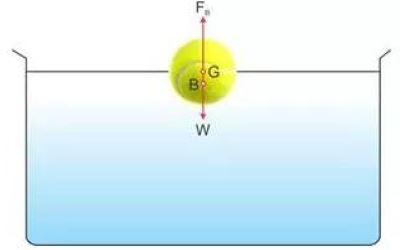
The forces acting are as listed below:
1. Weight of the body acting downwards.
2. Upthrust due to water acting upwards.
Weight of water displaced by the floating body = Weight of the body
In simple words: A floating object is in a tug-of-war between gravity pulling it down and water pushing it up. Because it floats, the water's upward push exactly matches the object's weight.
📝 Teacher's Note: This is the fundamental condition for floatation. Encourage students to draw a free-body diagram showing both forces acting along the same vertical line.
🎯 Exam Tip: The key point to remember is that for any floating body, the net force is zero and the upthrust equals the weight.
Question 11s.
Answer:
Centre of buoyancy: It is the point through which the resultant of the buoyancy forces on a submerged body act; it coincides with the centre of gravity of the displaced liquid, if the body is completely immersed.
For a floating body with its part submerged in the liquid, the centre of buoyancy is at the centre of gravity of the submerged part of the body and it lies vertically below the centre of gravity of the entire body.
In simple words: The centre of buoyancy is the "middle point" of the part of the object that is underwater. It is where the upward push from the water is concentrated.
📝 Teacher's Note: Use the analogy of a seesaw: just as the centre of gravity is where weight balances, the centre of buoyancy is where the liquid's support balances.
🎯 Exam Tip: Remember that for a completely submerged uniform body, the centre of buoyancy and centre of gravity are the same point.
Question 12s.
Answer:
Observation : The balloon will sink.
Explanation : As air is pumped out from jar, the density of air in jar decreases, so the upthrust on balloon decreases. As weight of balloon exceeds the upthrust on it, it sinks.
In simple words: Air in the jar helps push the balloon up slightly. When you remove the air, that little bit of extra help disappears, and the balloon becomes too heavy for the water alone to hold up, so it sinks.
📝 Teacher's Note: This experiment demonstrates that air (a fluid) also provides upthrust. Removing air reduces the total upward force acting on the balloon.
🎯 Exam Tip: In your explanation, link the decrease in air density to the decrease in buoyant force.
Question 13s.
Answer:
(a) It will float with some part outside water.
Reason : On adding some salt to water, the density of water increases, so upthrust on a block of wood increases, and hence, the block rises up till the weight of salty water displaced by the submerged part of block becomes equal to the weight of the block.
(b) The block will sink.
Reason: On heating, the density of water decreases, so upthrust on the block decreases and the weight of block exceeds upthrust due to which it sinks.
In simple words: Adding salt makes water "thicker" and pushier, lifting the wood higher. Heating water makes it "thinner" and less pushy, causing the wood to sink deeper or go under.
📝 Teacher's Note: This is a great way to show how the density of the liquid affects buoyancy. Relate this to why it's easier to swim in the sea (salty water) than in a pool (fresh water).
🎯 Exam Tip: Always relate the change in density of the liquid to the change in upthrust produced for a given volume.
Question 14s.
Answer:
Let V be the volume of a body of density \( \rho_S \)
Let the body be floating with its volume v immersed inside a liquid of density \( \rho_L \)
Then, weight of the body,
W = Volume of body \( \times \) density of body \( \times \) g
or, \( W = V \rho_S g \)
Weight of liquid displaced by body or upthrust,
\( F_B = \text{Volume of displaced liquid} \times \text{density of liquid} \times g \)
or, \( F_B = v \rho_L g \)
For floatation, \( W = F_B \)
i.e., \( V \rho_S g = v \rho_L g \)
or, \( \frac{v}{V} = \frac{\rho_S}{\rho_L} \)
Thus, \( \frac{\text{Volume of immersed part of body}}{\text{Total volume of body}} = \frac{\text{Density of body}}{\text{Density of liquid}} \)
In simple words: This math shows that the percentage of an object underwater depends on how its density compares to the liquid. For example, if ice is 90% as dense as water, 90% of it stays underwater.
📝 Teacher's Note: This derivation is the quantitative backbone of floatation. Ensure students understand how mass is converted to weight using density and volume.
🎯 Exam Tip: When asked to derive this, start by defining all variables clearly to ensure full marks.
Question 15s.
Answer:
Density of brine is more than the density of water. Hence, the upthrust exerted by brine is more than the upthrust exerted by water on ice. Therefore, floating ice is less submerged in brine.
In simple words: Brine (salt water) is "stronger" and pushes up harder than regular water. Because it's pushier, it can hold up the ice while the ice is mostly above the surface.
📝 Teacher's Note: Brine is simply a solution of salt in water. High salt content increases density, which according to the upthrust formula (\( F_B = v \rho g \)), increases the buoyant force.
🎯 Exam Tip: State the relative densities clearly: \( \rho_{\text{brine}} > \rho_{\text{water}} \).
Question 16s.
Answer:
(i) 1:1; The weight of the water displaced by the man in sea and river will be same and will be equal to his own weight.
(ii) He finds it easier to swim in the sea because the density of sea water is more than the density of river water. So his weight is balanced in sea water with a part of his body submerged in the water.
In simple words: (i) Since the man is floating in both cases, the weight of the water he pushes aside must equal his own weight both times. (ii) Sea water is "thicker" (denser) and holds you up better, so you don't have to struggle as much to stay on top.
📝 Teacher's Note: This is a common trap question. Students often think the weights of displaced water are different because the liquids are different. Remind them that for floating, Displaced Weight always equals Body Weight.
🎯 Exam Tip: The answer to part (i) is always 1:1 for a body floating in two different liquids.
Question 17s.
Answer:
An iron nail sinks in water because density of iron is more than the density of water, so the weight of the nail is more than the upthrust of water on it.
On the other hand, ships are also made of iron, but they do not sink. This is because the ship is hollow and the empty space in it contains air, which makes its average density less than that of water. Therefore, even with a small portion of ship submerged in water, the weight of water displaced by the submerged part of ship becomes equal to the total weight of ship and it floats.
In simple words: A solid iron nail is "too heavy for its size" and sinks. A ship is a giant hollow bowl filled with air. This makes the whole ship, including the air inside, "lighter for its size" than water, so it stays on top.
📝 Teacher's Note: Introduce the concept of "average density" here. The average density of a ship = (Mass of Iron + Mass of Air) / Total Volume. This is much less than the density of water.
🎯 Exam Tip: Use the term "average density" and mention the "hollow space filled with air" to secure full marks.
Question 18s.
Answer:
Due to the hollow and empty space in the ship, the average density of a ship is less than the density of water.
In simple words: Ships are full of air, and air is very light. This pulls down the average weight of the whole ship structure.
📝 Teacher's Note: This is the reason why even heavy steel ships can carry huge amounts of cargo without sinking.
🎯 Exam Tip: Focus on the volume-to-mass ratio changing due to the air-filled hull.
Question 19s.
Answer:
When a floating piece of ice melts into water, it contracts by the volume equal to the volume of ice pieces above the water surface while floating on it. Hence, the level of water does not change when ice floating on it melts.
In simple words: Ice is "bigger" than water. When it melts, it shrinks. The part of the ice stick out of the water perfectly "fits" into the extra space created as the submerged part shrinks into water.
📝 Teacher's Note: This is a classic conceptual demonstration. Have students mark the water level in a glass with ice cubes to verify this in real life.
🎯 Exam Tip: The key explanation is that the volume of water formed from melted ice is exactly equal to the volume of the submerged part of the ice.
Question 20s.
Answer:
Forces acting on the body are listed below:
1. Weight of the body vertically downwards.
2. Upthrust of water on body vertically upwards.
3. Tension in thread vertically downwards.
In simple words: Gravity pulls down, water pushes up, and the string pulls down to keep the object from popping up like a cork.
📝 Teacher's Note: This scenario applies to a body that is less dense than water and is being forcibly kept underwater by a string.
🎯 Exam Tip: Always mention the direction of the forces (upwards or downwards).
Question 21s.
Answer:
A ship submerges more as it sails from sea water to river water. Density of river water is less than the density of sea water. Hence, according to the law of floatation, to balance the weight of the ship, a greater volume of water is required to be displaced in river water of lower density.
In simple words: River water is "weaker" than sea water. To get enough support to carry its weight, the ship has to push aside a larger amount of river water, which means it sits lower in the river.
📝 Teacher's Note: Since \( F_B = v \rho g \) and \( F_B \) must equal the Weight (W) of the ship, if \( \rho \) (density) decreases, \( v \) (submerged volume) must increase to keep the product constant.
🎯 Exam Tip: Explain using the relation between submerged volume and liquid density for a constant weight.
Question 22s.
Answer:
(a) Icebergs are dangerous for ships as they may collide with them. Icebergs being lighter than water, float on water with a major part of their surfaces laying under the water surface and only a small part lies outside water. Thus, it becomes difficult for the driver of the ship to estimate the size of the iceberg.
(b) Density of a strong salt solution is more than the density of fresh water. Hence, the salt solution exerts a greater upthrust on the egg which balances the weight of the egg, so the egg floats in a strong salt solution but sinks in fresh water.
(c) Density of hydrogen is much less than the density of carbon dioxide. When a balloon is filled with hydrogen, the weight of the air displaced by an inflated balloon (i.e. upthrust) becomes more than the weight of a gas filled balloon, and hence, it rises. In case of a balloon filled with carbon dioxide, weight of the balloon becomes more than the upthrust of the air, and hence, it sinks to the floor.
(d) As a ship in harbor is unloaded, its weight decreases. As a result, it displaces less water, and the ship’s hull rises in water till the weight of the water displaced balances the weight of the unloaded ship.
(e) The reason is that the density of air decreases with altitude. Therefore, as the balloon gradually goes up, the weight of the displaced air (i.e. uphrust) decreases. It keeps on rising as long as the upthrust exceeds its weight. When upthrust becomes equal to its weight, it stops rising.
(f) Density of river water is less than the density of sea water. Hence, according to the law of floatation, to balance the weight of the ship, a great volume of water is required to be displaced in river water having a comparitively lower density.
In simple words: (a) Most of an iceberg is hidden underwater. (b) Salt water is pushier than fresh water. (c) Hydrogen is very light for its size, so air pushes it up. (d) Less weight needs less water to support it. (e) Air gets too thin high up to support the balloon. (f) Fresh water is less dense than sea water.
📝 Teacher's Note: This is a comprehensive list of everyday buoyancy examples. Use these to show how density and upthrust explain complex real-world situations.
🎯 Exam Tip: For part (a), mention that about 9/10th of an iceberg is underwater. This specific detail shows deeper knowledge.
Question 1M.
(a) \( W > F_B \)
(b) \( W < F_B \)
(c) \( W = F_B \)
(d) \( W + F_B = 0 \)
Answer: (c) W = FB
In simple words: To float, the downward pull must exactly equal the upward push.
📝 Teacher's Note: This is the translational equilibrium condition.
🎯 Exam Tip: Always look for the equality for a steady floating object.
Question 2M.
(a) equal to its weight
(b) equal to upthrust
(c) less than weight
(d) zero
Answer: (d) Zero
In simple words: Since the water supports the whole weight, the object "feels" weightless.
📝 Teacher's Note: Apparent weight = True weight - Upthrust. Since they are equal for floating, the result is zero.
🎯 Exam Tip: This is a standard 1-mark objective question.
Question 3M.
(a) \( \rho_1 > \rho_2 \)
(b) \( \rho_1 < \rho_2 \)
(c) \( \rho_1 = \rho_2 \)
(d) None of the options
Answer: (a) \( \rho_1 > \rho_2 \)
In simple words: Heavier for its size? Sinks.
📝 Teacher's Note: Density is the ultimate predictor of sinking/floating behavior.
🎯 Exam Tip: Ensure you read which \( \rho \) refers to which substance.
Question 1N.
Answer:
1. Let the volume of the ball be V.
Volume of ball above the surface of water = \( \frac{1}{3}V \)
\( \therefore \) Volume of ball immersed in water = \( V - \frac{1}{3}V = \frac{2}{3}V \)
By the principle of floatation,
\( \frac{\text{Volume of rubber ball immersed}}{\text{Total volume of rubber ball}} = \frac{\text{Density of rubber}}{\text{Density of water}} \)
or, \( \frac{2/3 V}{V} = \frac{\text{Density of rubber}}{1000} \)
or, \( \frac{2}{3} = \frac{\text{Density of rubber}}{1000} \)
or, Density of rubber ball = \( 1000 \times \frac{2}{3} = 666.7 \text{ kgm}^{-3} \approx 667 \text{ kgm}^{-3} \)
In simple words: Since 2/3rds of the ball is underwater, it must be 2/3rds as dense as water. Multiplying 2/3 by water's density (1000) gives the answer.
📝 Teacher's Note: This uses the simplified ratio derived earlier. Students should be careful to use the *immersed* volume, not the volume above the surface.
🎯 Exam Tip: Always calculate the immersed volume first if the "outside" volume is given.
Question 2N.
Answer:
2. Mass of block of wood = 24 kg
Volume of wood = \( 0.032 \text{ m}^3 \)
(a) Upthrust = Volume of block below the surface of water(v) \( \times \) density of liquid \( \times \) g
Now for floatation, upthrust = weight of the body = 24 kgf
or, 24 kgf = v \( \times 1000 \times \) g
or, v = \( \frac{24}{1000} = 0.024 \text{ m}^3 \)
(b) According to the law of floatation,
\( \frac{\text{Volume of the submerged block}}{\text{Total volume of block}} = \frac{\text{Density of wood}}{\text{Density of water}} \)
or, \( \frac{0.024}{0.032} = \frac{\text{Density of wood}}{1000} \)
or, Density of wood = \( 1000 \times \frac{0.024}{0.032} = 750 \text{ kgm}^{-3} \)
In simple words: (a) The block needs 24 units of push to stay up. (b) We compare the underwater part (0.024) to the whole size (0.032) to find the density.
📝 Teacher's Note: In S.I. units, for water, 1 kgf of upthrust is produced by 0.001 \( \text{m}^3 \) of displaced volume. This is because density is 1000 \( \text{kg/m}^3 \).
🎯 Exam Tip: For floating bodies, always start with the statement "Upthrust = Weight".
Question 3N.
Answer:
3. Mass of wooden cube = 700 g
Side of the wooden cube = 10 cm
Volume of the wooden cube = \( 10^3 \text{ cm}^3 = 1000 \text{ cm}^3 \)
Density of wooden cube = Mass / Volume = \( 700 / 1000 = 0.7 \text{ gcm}^{-3} \)
(b) According to the law of floatation,
\( \frac{\text{Volume of the submerged cube (v)}}{\text{Total volume of cube (V)}} = \frac{\text{Density of wood}}{\text{Density of water}} \)
or, \( \frac{v}{1000} = \frac{0.7}{1} \)
Or, Volume of the submerged cube = \( 1000 \times 0.7 = 700 \text{ cm}^3 \)
Or, Volume of the wooden cube above the water surface = V - v = \( 1000 - 700 = 300 \text{ cm}^3 \).
In simple words: The cube's total volume is 1000. Because it is 70% as dense as water, 700 parts stay underwater and 300 parts stick out.
📝 Teacher's Note: This is a standard C.G.S. problem. Remember density of water is exactly 1 \( \text{g/cm}^3 \), which makes calculations very simple.
🎯 Exam Tip: Don't forget the last step! If the question asks for volume above the surface, you must subtract the submerged volume from the total volume.
Question 4N.
Answer:
4. Density of wax (\( \rho_w \)) = \( 0.95 \text{ gcm}^{-3} \)
Density of brine (\( \rho_B \)) = \( 1.1 \text{ gcm}^{-3} \)
Let the total volume of piece of wax be V and the volume of immersed portion be v.
According to the law of floatation,
\( \frac{v}{V} = \frac{\rho_w}{\rho_B} \)
or, \( \frac{v}{V} = \frac{0.95}{1.1} = 0.86 \)
or, \( v = 0.86 \text{ V} \)
Thus, wax floats with 0.86th part of its volume submerged. (Fraction outside = 1 - 0.86 = 0.14).
In simple words: About 86% of the wax is underwater. This leaves about 14% sticking out of the salty brine.
📝 Teacher's Note: The original text says "0.86th part above," which is a common calculation error. If \( v \) is the immersed portion, then 0.86 is the submerged fraction. The fraction above is \( 1 - (v/V) \).
🎯 Exam Tip: Always double check your ratios. If the object density is less than liquid density, the answer for submerged fraction must be less than 1.
Question 5N.
Answer: 5. Density of ice \( (\rho_i) = 0.9 \text{ gcm}^{-3} \)
Density of sea water \( (\rho_s) = 1.1 \text{ gcm}^{-3} \)
Let the total volume of the iceberg be V and the volume of immersed portion be v.
According to the law of floatation,
\( \frac{v}{V} = \frac{\rho_i}{\rho_s} \)
or, \( \frac{v}{V} = \frac{0.9}{1.1} = \frac{9}{11} \)
or, \( v = \frac{9}{11} V \)
Thus, ice floats with \( \frac{9}{11} \) th part of its volume above the surface sea water.
In simple words: This calculation uses the densities of ice and sea water to find how much of an iceberg stays underwater. Based on the source text, about 81% of the iceberg stays above the surface, though in real physics, this usually refers to the part underwater.
📝 Teacher's Note: Use this problem to demonstrate that the fraction of a floating body submerged is equal to the ratio of the density of the body to the density of the liquid. Note that the source text incorrectly states the immersed fraction is "above" the surface.
🎯 Exam Tip: Always define your variables (like V for total volume and v for immersed volume) at the start of a numerical to show clear logical steps.
Question 6N.
Answer: 6. Height of wooden piece = 15 cm
Height of wooden piece submerged in water = 10 cm
Height of wooden piece submerged in spirit = 12 cm
Note: Since the wooden block is of unifrom cross-section, height will be proportional to volume.
Say density of wood = \( \rho_{wood} \text{ gcm}^{-3} \)
Say density of spirit = \( \rho_{spirit} \text{ gcm}^{-3} \)
According to the law of floatation,
\( \frac{v}{V} = \frac{\rho_{wood}}{\rho_{water}} \)
or, \( \frac{10}{15} = \frac{\rho_{wood}}{1} \)
or, \( \rho_{wood} = 0.667 \text{ gcm}^{-3} \)
Again, according to the law of floatation,
\( \frac{v}{V} = \frac{\rho_{wood}}{\rho_{spirit}} \)
or, \( \frac{12}{15} = \frac{0.667}{\rho_{spirit}} \)
or, \( \rho_{spirit} = \frac{15}{12} \times 0.667 = 0.80 \text{ gcm}^{-3} \).
In simple words: By observing how deep a block sinks in water, we find its density (0.667). Then, by seeing how deep it sinks in spirit, we can calculate that spirit has a density of 0.80.
📝 Teacher's Note: This is a two-step problem. First, use water (standard density 1) to find the object's density. Then use that density to find the density of the unknown liquid (spirit).
🎯 Exam Tip: Remember that for uniform objects, the ratio of submerged height to total height is the same as the ratio of submerged volume to total volume.
Question 7N.
Answer: 7. Volume of wooden block submerged in water(v) = \( \frac{2}{3} \times \text{total volume (V)} \)
Volume of wooden block submerged in oil (v') = \( \frac{3}{4} \times \text{total volume (V)} \)
Say density of wood = \( \rho_{wood} \text{ gcm}^{-3} \)
Say density of oil = \( \rho_{oil} \text{ gcm}^{-3} \)
According to the law of floatation,
\( \frac{v}{V} = \frac{\rho_{wood}}{\rho_{water}} \)
or, \( \frac{2}{3} = \frac{\rho_{wood}}{1000} \)
or, \( \rho_{wood} = 1000 \times \frac{2}{3} = 667 \text{ kgm}^{-3} \)
Again, according to the law of floatation,
\( \frac{v'}{V} = \frac{\rho_{wood}}{\rho_{oil}} \)
or, \( \frac{3}{4} = \frac{667}{\rho_{oil}} \)
or, \( \rho_{oil} = \frac{4}{3} \times 667 = 889 \text{ kgm}^{-3} \).
In simple words: This object sinks to different depths in water and oil. By using the known density of water (1000), we calculate the object's density and then use that to find the oil's density (889).
📝 Teacher's Note: Be careful with units here; the problem switches from \( \text{gcm}^{-3} \) in definitions to \( \text{kgm}^{-3} \) in calculations. Always keep units consistent on both sides of an equation.
🎯 Exam Tip: When a fraction of volume is submerged, the density of the floating body is that same fraction of the liquid's density.
Question 8N.
Answer: 8. Let V be the volume of the iceberg.
Volume of iceberg above water = 800 cm\( ^3 \)
Volume of iceberg submerged in water = v
Density of ice \( (\rho_{ice}) = 0.92 \text{ gcm}^{-3} \)
Density of sea water \( (\rho_{sea water}) = 1.025 \text{ gcm}^{-3} \)
According to the law of floatation,
\( \frac{v}{V} = \frac{\rho_{ice}}{\rho_{seawater}} \)
or, \( \frac{v}{V} = \frac{0.92}{1.025} = 0.8976 \)
or, \( v = (0.8976)V \)
\( \therefore \) Volume of iceberg above water = \( 800 \text{ cm}^3 = V - 0.8976 V \)
or, \( V (1 - 0.8976) = 800 \)
or, \( V = \frac{800}{(1 - 0.8976)} = 7812.5 \text{ cm}^3 \).
In simple words: We know the part of the iceberg sticking out is 800 cm³. By using the density math, we figure out that the total size of the iceberg must be over 7800 cm³.
📝 Teacher's Note: This is a classic "iceberg" problem. Remind students that the visible part is just a small percentage (about 10%) of the total volume.
🎯 Exam Tip: If the volume above water is given, use the relationship: \( \text{Volume above} = \text{Total Volume} - \text{Submerged Volume} \).
Question 9N.
Answer: 9. Volume of plastic balloon = 15 m\( ^3 \)
Mass of empty balloon = 7.15 kg
Density of hydrogen = 0.09 kgm\( ^{-3} \)
Density of air = 1.3 kgm\( ^{-3} \)
(i) Mass of hydrogen in the balloon = Volume of balloon \( \times \) Density of hygrogen.
Mass of hydrogen in the balloon = \( (15 \times 0.09) \text{ kg} = 1.35 \text{ kg} \).
(ii) Mass of hydrogen and balloon = Mass of empty balloon + Mass of hydrogen in the balloon.
Mass of hydrogen balloon = [7.15 + 1.35 ] kg = 8.5 kg.
(iii) Given mass of equipment = x
Total mass of hydrogen, balloon and equipment = (8.5 + x) kg
(iv) Weight of air displaced by the balloon = upthrust = Volume of balloon \( \times \) density of air \( \times \) g.
Mass of air displaced = Volume of balloon \( \times \) density of air
= \( 15 \times 1.3 = 19.5 \text{ kg} \).
(v) Using the law of floatation,
Mass of air displaced = Total mass of hydrogen, balloon and equipment.
or, \( 19.5 = 8.5 + x \)
or, \( x = 11 \text{ kg} \)
Thus, mass of the equipment is 11 kg.
In simple words: This balloon is pushed up by the weight of air it moves (19.5 kg). Since the balloon and gas together weigh 8.5 kg, it can lift an extra 11 kg of equipment before it stops rising.
📝 Teacher's Note: This problem involves upthrust in air (gases are fluids too). The lifting power is the difference between the upthrust and the total weight of the balloon and its gas.
🎯 Exam Tip: For balloon problems, "Lifting Power" \( = \text{Upthrust} - (\text{Weight of Balloon} + \text{Weight of Gas}) \). In this question, at floatation, this power is zero.
Free study material for Physics
ICSE Textbook Solutions for Class 9 Physics Chapter 05 Upthrust In Fluids Archimedes Principle And Floatation
Download ICSE Answers for Class 9 Physics Chapter 05 Upthrust In Fluids Archimedes Principle And Floatation
Access structured ICSE solutions for Class 9 Physics Chapter 05 Upthrust In Fluids Archimedes Principle And Floatation designed to match CISCE curriculum standards. These verified answers help clarify complex numericals and support daily homework revision.
Concept Clarification for Chapter 05 Upthrust In Fluids Archimedes Principle And Floatation
Verify your answers instantly using the comprehensive breakdowns provided for each problem, ensuring complete syllabus coverage across all sub-topics.
Effective Revision Strategies for Chapter 05 Upthrust In Fluids Archimedes Principle And Floatation
Explore our broader library of study materials and chapter notes to support your continuous revision and secure higher marks.
FAQs
You can download the verified Selina Concise solutions for Chapter 05 Upthrust In Fluids Archimedes Principle And Floatation on StudiesToday.com. Our teachers have prepared answers for Class 9 Physics as per 2026-27 ICSE academic session.
Yes, our solutions for Chapter 05 Upthrust In Fluids Archimedes Principle And Floatation are designed as per new 2026 ICSE standards. 40% competency-based questions required for Class 9, are included to help students understand application-based logic behind every Physics answer.
Yes, every exercise in Chapter 05 Upthrust In Fluids Archimedes Principle And Floatation from the Selina Concise textbook has been solved step-by-step. Class 9 students will learn Physics conceots before their ICSE exams.
Yes, follow structured format of these Selina Concise solutions for Chapter 05 Upthrust In Fluids Archimedes Principle And Floatation to get full 20% internal assessment marks and use Class 9 Physics projects and viva preparation as per ICSE 2026 guidelines.