

Class 10 Physics Chapter 01 Force: Selina Concise Study Material
Access the official Selina Concise textbook solutions for Class 10 Physics, updated for the 2026-27 academic year. This digital resource is structured to help students build strong conceptual clarity and prepare effectively for school examinations.
Chapter 01 Force Answer Guide
Access the complete PDF for Chapter 01 Force below. This focused excerpt allows students to isolate specific topics for thorough review and uninterrupted reading, complementing standard ICSE textbooks.
Exercise 1(A)
Question 1. What are contact forces? Give two Examples.
Answer: The forces that act on objects only when they are physically touching are known as contact forces. Examples include the force of friction and the force exerted between two colliding bodies.
In simple words: Contact forces are forces that only happen when two things actually touch each other, like friction when you rub your hands together.
Exam Tip: Always provide two distinct examples when asked, and clearly emphasize the requirement of physical contact in your definition.
Question 2. What are non-contact forces? Give two example.
Answer: Forces that bodies experience even without any physical contact between them are called non-contact forces. Examples include gravitational pull and electrostatic attraction or repulsion.
In simple words: Non-contact forces can push or pull things from a distance without touching them, like a magnet pulling a nail.
Exam Tip: Remember that non-contact forces act through a space or field, and their strength decreases as the distance between the objects increases.
Question 3. Classify the following amongst contact and non-contact forces.
(a) Frictional force
(b) normal reaction force,
(c) force of tension in a string
(d) gravitation force
(e) electrostatic force
(f) magnetic force
Answer:
Contact forces: (a) frictional force, (b) normal reaction force, (c) force of tension in a string.
Non-contact forces: (d) gravitational force, (e) electrostatic force, (f) magnetic force.
In simple words: Friction, normal force, and tension need physical contact to exist, while gravity, electrostatic, and magnetic forces work across a distance.
Exam Tip: Classification questions are highly scoring. Group them clearly under bold sub-headings in your answer sheets.
Question 4. Give one example in each case where:
(a) the force is of contact and
(b) Force is at a distance.
Answer:
(a) The impact force experienced by two billiard balls when they collide.
(b) The magnetic attraction between two opposite magnetic poles.
In simple words: Contact force happens when things hit each other, while distance force happens when magnets pull each other without touching.
Exam Tip: Use simple, everyday physical phenomena as examples to ensure clarity and accuracy.
Question 5. (a) A ball is hanging by a thread from the ceiling of the roof. Draw a neat labelled diagram showing the forces acting on the ball and the string.
(b) A spring is compressed against a rigid wall. Draw a neat and labelled diagram showing the forces acting on the spring.
Answer:
(a) The diagram below shows the tension force \( T \) acting vertically upwards along the thread and the weight \( W \) of the ball acting vertically downwards.
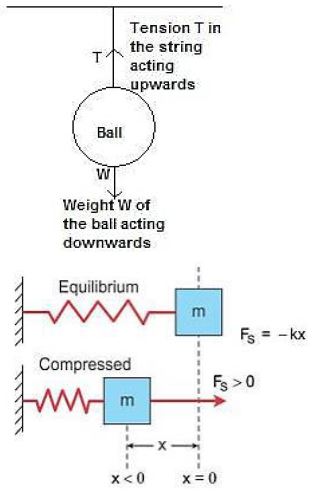
In simple words: (a) The ball pulls down due to gravity, and the string pulls up to hold it. (b) When you squash a spring against a wall, it tries to push back to its normal shape.
Exam Tip: Draw force arrows starting from the center of gravity of the body, and clearly label the direction of tension and weight.
Question 6. State one factor on which the magnitude of a non-contact force depends. How does it depend on the factor stated by you?
Answer: The magnitude of a non-contact force is determined by the distance of separation between the two interacting bodies. Specifically, the strength of the force decreases as this distance increases.
In simple words: A non-contact force depends on how far apart the two objects are. The force gets weaker when they move further away.
Exam Tip: This relationship often follows an inverse square law (like gravity or electrostatic force), which is a key concept to remember for exams.
Question 7. The separation between two masses is reduced to half. How is the magnitude of gravitational force between them affected?
Answer: The magnitude of the gravitational attraction between the two masses will increase to four times its original value. This occurs because the gravitational force is inversely proportional to the square of the distance separating the two objects: \( F \propto \frac{1}{r^2} \).
In simple words: If you cut the distance between two masses in half, the gravity pulling them together becomes four times stronger because force changes with the square of the distance.
Exam Tip: Show the proportional relation \( F \propto \frac{1}{r^2} \) in your steps to secure full marks for calculation-based questions.
Question 8. Define the term ‘force’?
Answer: A force is a physical agency or influence that alters, or attempts to alter, the state of rest, uniform motion, or the dimensions (size and shape) of a body.
In simple words: A force is a push or pull that can make a stationary object move, stop a moving object, or change its shape and size.
Exam Tip: Be sure to mention both aspects of force in your definition: changing the state of motion and changing the shape or size of the object.
Question 9. State the effects of a force applied on (i) a non-rigid, and (ii) a rigid body. How does the effect of the force differ in the two cases?
Answer:
(i) When a force acts on a non-rigid body, it changes the spacing between its internal particles, which alters the body's dimensions (size and shape) and can also set it in motion.
(ii) Conversely, when applied to a rigid body, the force does not alter the spacing of its constituent particles, meaning its dimensions remain unchanged, and the force only produces translational or rotational motion.
In simple words: Pushing a soft object like clay changes its shape and moves it. Pushing a hard rock only moves it without changing its shape.
Exam Tip: Highlight the difference in "inter-particle spacing" to write a highly technical and precise answer.
Question 10. Give one example in each case where:
(a) A force stops a moving body
(b) A force moves a stationary body
(c) A force changes the size of a body
(d) A force changes the shape of a body
Answer:
(a) A cricket fielder catches a flying ball by applying a stopping force with his palms.
(b) A horse pulling a cart exerts a force that brings the cart into motion from rest.
(c) Compressing air inside a bicycle pump by pushing down the piston reduces its volume.
(d) Squeezing a sponge or a piece of rubber changes its shape.
In simple words: You can use force to catch a ball, pull a wagon, compress air in a pump, or squeeze a rubber ball.
Exam Tip: Use distinct examples for size and shape to show the examiner that you understand the difference between volume changes and geometric shape changes.
Question 11. State Newton’s first law of motion. Why is it called the law of inertia?
Answer: Newton's first law of motion states that an object will persist in its state of rest or uniform motion along a straight path unless compelled to change that state by an external unbalanced force. It is referred to as the law of inertia because it describes the inherent property of matter (inertia) by which any material body resists changes to its current state of rest or motion.
In simple words: Things keep doing what they are doing - staying still or moving in a straight line - unless something pushes or pulls them. This tendency to resist change is called inertia.
Exam Tip: Clearly define "inertia" when explaining why the first law is named after it, as this is a core evaluation point.
Question 12. Define the term linear momentum. State its S.I. unit.
Answer: Linear momentum is defined as the physical quantity representing the product of an object's mass and its velocity. Its S.I. unit is \( \text{kg m s}^{-1} \).
In simple words: Momentum is the "strength" of a moving object, calculated by multiplying how heavy it is by how fast it is going.
Exam Tip: Always write the S.I. unit clearly as \( \text{kg m s}^{-1} \) to prevent losing marks.
Question 13. (a) Write an expression for the change in momentum of a body of mass m moving with velocity v if (i) v ≪ c and (ii) v ⟶ c.
(b) State the condition when the change in the momentum of a body depends only on the change in its velocity.
Answer:
(a) (i) Under the condition \( v \ll c \), the change in momentum is given by: \[ \Delta p = m \Delta v \] (ii) When the velocity approaches the speed of light (\( v \rightarrow c \)), mass is no longer constant, and the momentum change is: \[ \Delta p = \Delta(mv) \] (b) The change in momentum depends solely on the variation in velocity when the speed of the body is significantly lower than the speed of light (\( v \ll c \)), keeping the mass constant.
In simple words: (a) If a body moves slowly, we calculate momentum change using only velocity change. If it moves near light speed, the mass also changes. (b) Mass stays constant at normal everyday speeds, so momentum only changes with speed.
Exam Tip: Note that mass varies at relativistic speeds (\( v \rightarrow c \)), which is why we must write \( \Delta(mv) \) instead of \( m \Delta v \) in that case.
Question 14. How is force related to the momentum of a body?
Answer: The net external force acting on an object is directly proportional to the rate at which its momentum changes over time, and this change happens in the direction of the applied force: \[ F \propto \frac{\Delta p}{\Delta t} \] where \( p \) represents momentum and \( \Delta p \) is the change in momentum occurring over the time interval \( \Delta t \).
In simple words: The harder you push something, the faster its momentum changes. The force is equal to how much momentum changes every second.
Exam Tip: Express this proportional relationship mathematically to make your explanation precise and complete.
Question 15. State Newton’s Second law of motion. Under what condition does it take the form F = ma?
Answer: Newton's second law of motion states that the rate of change of momentum of an object is directly proportional to the applied force, and this change occurs in the direction of the force. \[ F \propto \frac{\Delta p}{\Delta t} \] This relation simplifies to the equation \( F = ma \) under the condition that the mass \( m \) of the object remains constant, which is valid when its velocity is much smaller than the speed of light (\( v \ll c \)).
Rate of change of momentum:
\( F = \frac{\Delta p}{\Delta t} = m \frac{\Delta v}{\Delta t} = ma \implies F = ma \)
In simple words: Force is how fast momentum changes. If the mass of the object does not change (which is true at normal speeds), then force is just mass times acceleration.
Exam Tip: Explicitly state the constant mass condition (\( v \ll c \)) as it is the key requirement for deriving \( F = ma \) from the second law.
Question 16. Complete the following sentences:
(a) Mass X change in velocity = ….. x time interval.
(b) The mass of a body remains constant till the velocity of body is……
Answer:
(a) Mass \(\times\) change in velocity = Force \(\times\) time interval.
(b) The mass of a body remains constant till the velocity of body is much less than the speed of light.
In simple words: (a) Mass times velocity change equals force times time. (b) An object's mass only starts changing when it moves close to the speed of light.
Exam Tip: Fill-in-the-blank questions must be answered using exact technical terms like "Force" and "much less than the speed of light".
Question 17. Prove the force = mass x acceleration. State the condition when it holds.
Answer: The rate of change of linear momentum is expressed as: \[ \frac{\Delta p}{\Delta t} = \frac{\Delta(mv)}{\Delta t} \] If the mass \( m \) of the object is constant (which holds true when the velocity is much lower than the speed of light, \( v \ll c \)), then the mass can be factored out:
Rate of change of momentum: \[ \frac{\Delta p}{\Delta t} = m \frac{\Delta v}{\Delta t} \] Since the rate of change of velocity \( \frac{\Delta v}{\Delta t} \) is acceleration \( a \), we have: \[ \text{Rate of change of momentum} = ma \] According to Newton's second law, force is proportional to this rate:
\( F \propto ma \implies F = kma \)
By defining the unit of force such that the constant of proportionality \( k = 1 \), we get: \[ F = ma \] This equation is valid only when the mass \( m \) remains constant during motion (\( v \ll c \)).
In simple words: Since momentum is mass times velocity, if mass does not change, then momentum changes only because velocity changes. The rate of velocity change is acceleration, so force equals mass times acceleration.
Exam Tip: Remember to explain how the constant of proportionality \( k \) becomes equal to 1 by defining the unit of force (Newton).
Question 18. Name the S.I. unit of (a) momentum, (b) rate of change in momentum.
Answer:
(a) The S.I. unit of momentum is \( \text{kg m s}^{-1} \).
(b) The S.I. unit of the rate of change in momentum is the newton (\(\text{N}\)).
In simple words: Momentum is measured in kilogram meters per second, while the rate of change of momentum is measured in Newtons (since it equals force).
Exam Tip: Make sure to recognize that "rate of change in momentum" is physically equivalent to force, hence its S.I. unit is the Newton.
Question 19. State the relationship between force, mass and acceleration. Draw graphs showing the relationship between:
(a) Acceleration and force for a constant mass.
(b) Acceleration and mass for a constant force.
Answer: The relationship is given by: \[ F = m \times a \] Where \( F \) is force, \( m \) is mass, and \( a \) is acceleration.
(a) Graph of Acceleration vs Force (at constant mass): An acceleration vs force graph is a straight line passing through the origin, showing a direct variation (\( a \propto F \)).
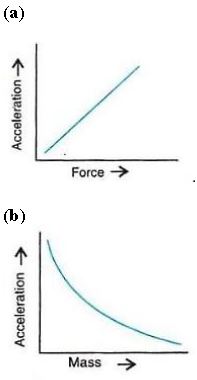
In simple words: Acceleration is directly proportional to force (more force means more acceleration), and inversely proportional to mass (heavier objects accelerate slower).
Exam Tip: Ensure the axes are correctly labeled with units, and draw a smooth hyperbolic curve for the acceleration-mass relationship.
Question 20. A rocket is moving at a constant speed in space by burning its fuel and ejecting out the burnt gases through a nozzle. Answer the following:
(a) Is there any change in the momentum of the rocket? If yes, what causes the change in momentum?
(b) Is there any force acting on the rocket? If yes, how much?
Answer:
(a) Yes, the momentum of the rocket changes. This change is caused by the continuous reduction in the rocket's mass as it burns and expels fuel.
(b) Yes, an external thrust acts on the rocket, and its magnitude is equal to the rate of change of the rocket's momentum.
In simple words: (a) Yes, because the rocket gets lighter as it burns fuel, its momentum changes even though its speed is constant. (b) Yes, the thrust force pushing it is equal to the rate of change of its momentum.
Exam Tip: Remember that momentum can change either due to a change in velocity or a change in mass. In rockets, the mass change is the main driver.
Question 21. State Newton’s third law of motion.
Answer: Newton's third law of motion states that for every action, there is an equal and opposite reaction. This means the forces of action and reaction between two interacting bodies are equal in magnitude and opposite in direction.
In simple words: Whenever you push something, it pushes back on you just as hard in the opposite direction.
Exam Tip: Emphasize that action and reaction always act on two different bodies, which is why they do not cancel each other out.
Question 22. Name and define the S.I. and C.G.S. unit of force. How are they related?
Answer:
The S.I. unit of force is the Newton (\(\text{N}\)). One Newton is the force that, when acting on a mass of \( 1\text{ kg} \), produces an acceleration of \( 1\text{ m s}^{-2} \).
The C.G.S. unit of force is the dyne. One dyne is the force that, when acting on a mass of \( 1\text{ g} \), produces an acceleration of \( 1\text{ cm s}^{-2} \).
The relationship between them is: \[ 1\text{ N} = 10^5\text{ dyne} \]
In simple words: The standard metric unit is the Newton, and the smaller centimeter-gram unit is the dyne. One Newton is equal to one hundred thousand dynes.
Exam Tip: Memorize the conversion factor \( 1\text{ N} = 10^5\text{ dyne} \) as it is frequently asked in multiple-choice and short-answer questions.
Question 23. Define newton (the S.I. unit of force).
Answer: One Newton is defined as the magnitude of force which, when applied to a body of mass \( 1\text{ kg} \), produces an acceleration of \( 1\text{ m s}^{-2} \) in its direction.
In simple words: One Newton is the force needed to make a 1 kilogram object speed up by 1 meter per second every second.
Exam Tip: Include all three components in your definition: mass (1 kg), acceleration (1 m s-2), and the S.I. unit (N).
Question 24. Define 1 kgf how is it related to newton?
Answer: One kilogram-force (\(1\text{ kgf}\)) is the force with which the Earth's gravitational pull attracts a mass of \( 1\text{ kg} \) towards its center. The relationship is: \[ 1\text{ kgf} = 9.8\text{ N} \]
In simple words: 1 kgf is the gravity pull on a 1 kg mass, which is equal to 9.8 Newtons of force.
Exam Tip: Remember that kgf is a gravitational unit of force, while Newton is the absolute S.I. unit.
Question 25. Explain what is understood by the following statement: 1 kilogram force (kgf) = 9.8 newton’
Answer: This statement means that the gravitational force exerted by the Earth on a mass of \( 1\text{ kg} \) at its surface has a magnitude of \( 9.8\text{ N} \). Thus, to hold or lift a \( 1\text{ kg} \) object against gravity, an upward force of \( 9.8\text{ N} \) is required.
In simple words: The Earth pulls down on a 1 kilogram weight with a force of 9.8 Newtons, which is the force you must exert to hold it up.
Exam Tip: Explain the practical meaning of the statement, which relates to the force needed to overcome gravity for a unit mass.
Question 26. How can you feel a force of 1 N?
Answer: You can experience a force of approximately \( 1\text{ N} \) by placing a mass of about \( 100\text{ g} \) (or \( 0.1\text{ kg} \)) on your palm, as the gravitational pull on this mass is: \[ F = 0.1\text{ kg} \times 9.8\text{ m s}^{-2} \approx 0.98\text{ N} \approx 1\text{ N} \]
In simple words: Placing a small apple or a 100-gram mass on your hand lets you feel a force of about 1 Newton pushing down on your palm.
Exam Tip: Use the formula \( F = mg \) to show how holding a 100-gram mass corresponds to experiencing a 1 Newton force.
Question 27. Complete the following:
(a) Force = mass x …….
(b) 1 N = ……… dyne
(c) 1 N = ………… kgf (approx.)
(d) newton is the unit of ……….
Answer:
(a) Force = mass \(\times\) acceleration
(b) 1 N = \( 10^5 \) dyne
(c) 1 N = 0.1 kgf (approx.)
(d) Newton is the unit of force.
In simple words: (a) Force is mass times acceleration. (b) One Newton is 100,000 dynes. (c) One Newton is about 0.1 kgf. (d) Newton is the unit used to measure force.
Exam Tip: Memorize standard unit conversions as they are commonly tested in fill-in-the-blank questions.
Multiple Choice Type
Question 1. which of the following is not the force at a distance:
(a) electrostatic force
(b) gravitational force
(c) frictional force
(d) magnetic force.
Answer: (c) frictional force
In simple words: Friction is a contact force because it only exists when two surfaces are touching and rubbing against each other.
Exam Tip: Remember that electrostatic, gravitational, and magnetic forces can all act across empty space without physical contact.
Question 2. Newton’s second law of motion applicable in all conditions is:
(a) \( F = \frac{\Delta p}{\Delta t} \)
(b) \( F = ma \)
(c) \( F = M \frac{\Delta v}{\Delta t} \)
(d) all of the options
Answer: (a) \( F = \frac{\Delta p}{\Delta t} \)
In simple words: The most fundamental form of Newton's second law is that force equals the rate of change of momentum, which is true even if mass changes.
Exam Tip: \( F = ma \) is only a special case of the second law when the mass is constant, whereas \( F = \frac{\Delta p}{\Delta t} \) is universally applicable.
Numericals
Question 1. A body of mass 1 kg is thrown vertically up with an initial speed of 5 m s-1. What is the magnitude and direction of force due to gravity acting on the body when it is at its highest point? Take g = 9.8 N kg-1
Answer: Mass of the body, \( m = 1\text{ kg} \)
Initial speed, \( u = 5\text{ m/s} \)
Acceleration due to gravity, \( g = 9.8\text{ N/kg} \) (acting vertically downwards)
The gravitational force \( F \) acting on the body is: \[ F = m \times g \] \[ F = 1\text{ kg} \times 9.8\text{ N/kg} = 9.8\text{ N} \text{ (or } 1\text{ kgf)} \] The magnitude of the force is \( 9.8\text{ N} \), and its direction is vertically downwards.
In simple words: No matter how fast or high the body is thrown, gravity always pulls it down with the same force, which is 9.8 Newtons downwards.
Exam Tip: The force of gravity acting on a body is always constant near the Earth's surface and always points straight down, regardless of the object's direction of motion or its velocity.
Question 2. A body of mass 1.5 kg is dropped from a height of 12m. What is the force acting on it during its fall? (g = 9.8 m s-2)
Answer: Mass of the body, \( m = 1.5\text{ kg} \)
Acceleration due to gravity, \( g = 9.8\text{ m s}^{-2} \)
The force acting on the body during its free fall is the gravitational pull: \[ F = m \times g \] \[ F = 1.5\text{ kg} \times 9.8\text{ m s}^{-2} = 14.7\text{ N} \]
In simple words: During its fall, the only force acting on the body is gravity, which is calculated as mass times acceleration, giving 14.7 Newtons.
Exam Tip: A free-falling body experiences only the force of gravity, which remains constant throughout its fall (neglecting air resistance).
Question 3. Two balls of masses in ratio 1:2 are dropped from the same height find:
(a) the ratio between their velocities when they strike the ground, and
(b) the ratio of the forces acting on them during motion.
Answer: Let the masses of the two balls be \( m_1 \) and \( m_2 \), such that: \[ \frac{m_1}{m_2} = \frac{1}{2} \] Both are dropped from the same height \( h \) with an initial velocity \( u = 0\text{ m/s} \).
(a) From the equations of motion: \[ v^2 - u^2 = 2gh \implies v = \sqrt{2gh} \] Since both balls are dropped from the same height, their final velocities \( v_1 \) and \( v_2 \) will be: \[ v_1 = \sqrt{2gh}, \quad v_2 = \sqrt{2gh} \] The ratio of their velocities is: \[ \frac{v_1}{v_2} = \frac{\sqrt{2gh}}{\sqrt{2gh}} = 1:1 \] (b) The force acting on each ball during motion is its weight: \[ F_1 = m_1 g \quad \text{and} \quad F_2 = m_2 g \] The ratio of the forces is: \[ \frac{F_1}{F_2} = \frac{m_1 g}{m_2 g} = \frac{m_1}{m_2} = 1:2 \]
In simple words: (a) Both balls hit the ground at the same speed because gravity accelerates all falling objects equally, regardless of weight. (b) The heavier ball has twice the force acting on it because force equals mass times gravity.
Exam Tip: Show that velocity is independent of mass during free fall, but the gravitational force (weight) is directly proportional to mass.
Question 4. A body X of mass 5 kg is moving with velocity 20 m s-1 while another body Y of mass 20 kg is moving with velocity 5 m s-1. Compare the momentum of the two bodies.
Answer: For body X:
Mass, \( m_1 = 5\text{ kg} \)
Velocity, \( v_1 = 20\text{ m/s} \)
Momentum, \( P_1 = m_1 \times v_1 = 5 \times 20 = 100\text{ kg m s}^{-1} \)
For body Y:
Mass, \( m_2 = 20\text{ kg} \)
Velocity, \( v_2 = 5\text{ m/s} \)
Momentum, \( P_2 = m_2 \times v_2 = 20 \times 5 = 100\text{ kg m s}^{-1} \)
Comparing the momentum: \[ \frac{P_1}{P_2} = \frac{100}{100} = 1:1 \] Both bodies have equal momentum.
In simple words: Although body X is lighter, it moves faster than body Y, resulting in both having the exact same momentum.
Exam Tip: Clearly state both mass and velocity values before multiplying to show your step-by-step working.
Question 5. Calculate the acceleration produced in a body of mass 50g when acted upon by a force of 20 N.
Answer: Mass of the body, \( m = 50\text{ g} = 0.05\text{ kg} \)
Force applied, \( F = 20\text{ N} \)
Using the relationship \( F = ma \): \[ a = \frac{F}{m} \] \[ a = \frac{20\text{ N}}{0.05\text{ kg}} = 400\text{ m s}^{-2} \]
In simple words: A force of 20 Newtons acting on a very light 50-gram object causes it to accelerate extremely fast at 400 meters per second squared.
Exam Tip: Always convert the mass from grams to kilograms before calculating acceleration to keep all values in the S.I. system.
Question 6. A car of mass 600 kg is moving with a speed of 10 ms-1 while a scooter of mass 80kg is moving with a speed of 50 m s-1 (a) Compare their momentum (b) which vehicle will require more force to stop it in the (i) same interval of time (ii) same distance.
Answer: For the car:
Mass, \( M = 600\text{ kg} \)
Velocity, \( V = 10\text{ m/s} \)
Momentum, \( P_{\text{car}} = M \times V = 600 \times 10 = 6000\text{ kg m s}^{-1} \)
For the scooter:
Mass, \( m = 80\text{ kg} \)
Velocity, \( v = 50\text{ m/s} \)
Momentum, \( P_{\text{scooter}} = m \times v = 80 \times 50 = 4000\text{ kg m s}^{-1} \)
(a) Comparing their momentum: \[ \frac{P_{\text{car}}}{P_{\text{scooter}}} = \frac{6000}{4000} = \frac{3}{2} \] The ratio of their momentum is \( 3:2 \).
(b) (i) For the same time interval (\( \Delta t \)), the stopping force is directly proportional to the momentum: \[ F \propto \Delta p \] Since the car has a larger momentum (\( 6000\text{ kg m s}^{-1} > 4000\text{ kg m s}^{-1} \)), the car will require more force to stop.
(ii) For stopping over the same distance, the vehicle with the higher kinetic energy or moving with a greater velocity requires more force. Since the scooter has a much higher velocity (\( 50\text{ m/s} > 10\text{ m/s} \)), the scooter will require more force to stop within the same distance.
In simple words: (a) The car has more momentum than the scooter in a 3:2 ratio. (b) If stopped in the same time, the car needs more force due to its higher momentum. If stopped in the same distance, the faster scooter needs more force.
Exam Tip: Carefully distinguish between the two stopping conditions (same time vs. same distance) as they depend on different physical principles (momentum change vs. kinetic energy change).
Question 7. How much acceleration will be produced in a body of mass 10 kg acted upon by a force of 2 kgf? (g = 9.8 ms-2)
Answer: Mass of the body, \( m = 10\text{ kg} \)
Force applied, \( F = 2\text{ kgf} = 2 \times 9.8\text{ N} = 19.6\text{ N} \)
Using the formula \( F = ma \): \[ a = \frac{F}{m} \] \[ a = \frac{19.6\text{ N}}{10\text{ kg}} = 1.96\text{ m s}^{-2} \]
In simple words: A force of 2 kgf (which is 19.6 Newtons) acting on a 10 kg body accelerates it at 1.96 meters per second squared.
Exam Tip: Convert the force from gravitational units (kgf) to absolute units (Newtons) before applying the formula \( F = ma \).
Question 8. Two bodies have masses in the ratio 3:4, when a force is applied on the first body, it moves with an acceleration of 6 ms-2. How much acceleration will the same force produce in the other body?
Answer: Let the masses of the two bodies be \( m_1 \) and \( m_2 \), with: \[ \frac{m_1}{m_2} = \frac{3}{4} \] The acceleration of the first body is \( a_1 = 6\text{ m s}^{-2} \).
Since the same force \( F \) is applied to both: \[ F_1 = F_2 \implies m_1 a_1 = m_2 a_2 \] \[ a_2 = a_1 \times \frac{m_1}{m_2} \] \[ a_2 = 6\text{ m s}^{-2} \times \frac{3}{4} = 4.5\text{ m s}^{-2} \]
In simple words: Since both bodies experience the same force, the heavier body (mass ratio 4) accelerates slower than the lighter body (mass ratio 3), resulting in an acceleration of 4.5 meters per second squared.
Exam Tip: Setting the forces equal (\( m_1 a_1 = m_2 a_2 \)) is a standard, clean method to solve mass-acceleration ratio questions.
Question 9. A cricket ball of mass 100 g strikes the hand of a player with a velocity of 20 ms-1 and is brought to rest in 0.01 s. calculate :
(i) the force applied by the hand of the player,
(ii) the acceleration of the ball
Answer: Mass of the cricket ball, \( m = 100\text{ g} = 0.1\text{ kg} \)
Initial velocity, \( u = 20\text{ m/s} \)
Final velocity, \( v = 0\text{ m/s} \)
Time interval, \( \Delta t = 0.01\text{ s} \)
(i) The force applied by the hand is: \[ F = \frac{\Delta p}{\Delta t} = \frac{m(v - u)}{\Delta t} \] \[ F = \frac{0.1 \times (0 - 20)}{0.01} = \frac{-2}{0.01} = -200\text{ N} \] The negative sign shows that it is a resistive force.
(ii) The acceleration of the ball is: \[ a = \frac{v - u}{\Delta t} = \frac{0 - 20}{0.01} = -2000\text{ m s}^{-2} \]
In simple words: (i) The player's hand must apply an opposing force of 200 Newtons to stop the ball. (b) The ball decelerates rapidly at 2000 meters per second squared.
Exam Tip: A negative sign indicates deceleration or resistive force. Explain the significance of the negative sign in your final answer to show a deeper understanding.
Question 10. A lead bullet of mass 20g, travelling with a velocity of 350 ms-1, comes to rest after penetrating 40 cm in a still target. Find :
(i) the resistive force offered by the target and
(ii) the retardation caused by it.
Answer: Mass of the bullet, \( m = 20\text{ g} = 0.02\text{ kg} \)
Initial velocity, \( u = 350\text{ m/s} \)
Final velocity, \( v = 0\text{ m/s} \)
Distance penetrated, \( s = 40\text{ cm} = 0.4\text{ m} \)
(i) First, calculate the acceleration using the third equation of motion: \[ v^2 - u^2 = 2as \] \[ 0^2 - (350)^2 = 2 \times a \times 0.4 \] \[ -122500 = 0.8a \implies a = \frac{-122500}{0.8} = -1.53 \times 10^5\text{ m s}^{-2} \] The resistive force \( F \) is: \[ F = m \times a \] \[ F = 0.02\text{ kg} \times (-1.53 \times 10^5\text{ m s}^{-2}) = -3062.5\text{ N} \] The resistive force is \( 3062.5\text{ N} \).
(ii) The retardation is the magnitude of deceleration: \[ \text{Retardation} = -a = 1.53 \times 10^5\text{ m s}^{-2} \]
In simple words: (i) The target exerts a huge stopping force of 3062.5 Newtons on the bullet. (ii) This causes a massive retardation of 153,000 meters per second squared.
Exam Tip: Retardation is always written as a positive value because the term "retardation" itself implies a negative acceleration.
Question 11. A body of mass 50g is moving with a velocity of 10 ms-1. It is brought to rest by a resistive force of 10 N. find:
(i) the retardation and
(ii) the distance that the body will travel after the resistive force is applied.
Answer: Mass of the body, \( m = 50\text{ g} = 0.05\text{ kg} \)
Initial velocity, \( u = 10\text{ m/s} \)
Final velocity, \( v = 0\text{ m/s} \)
Resistive force, \( F = -10\text{ N} \)
(i) Using the equation \( F = ma \): \[ a = \frac{F}{m} = \frac{-10}{0.05} = -200\text{ m s}^{-2} \] The retardation is: \[ \text{Retardation} = -a = 200\text{ m s}^{-2} \] (ii) Using the third equation of motion to find distance \( s \): \[ v^2 - u^2 = 2as \] \[ 0^2 - (10)^2 = 2 \times (-200) \times s \] \[ -100 = -400s \implies s = \frac{100}{400} = 0.25\text{ m} = 25\text{ cm} \]
In simple words: (i) The opposing force slows the body down at a rate of 200 meters per second squared. (ii) The body travels a distance of 25 centimeters before coming to a complete stop.
Exam Tip: When calculating retardation or stopping distance, ensure the resistive force is substituted with a negative sign in your mathematical steps.
Question 12. A uniform car of mass 500g travels with a uniform velocity of \( 25\text{ m s}^{-1} \) for \( 5\text{ s} \). The brakes are then applied and the car is uniformly retarded and comes to rest in further \( 10\text{ s} \) calculate:
(a) the retardation,
(b) the distance which the car travels after the brakes are applied,
(c) The force exerted by the brakes.
Answer:
Given: - Mass of the car, \( m = 500\text{ g} = 0.5\text{ kg} \) - Initial velocity of the car before braking, \( u = 25\text{ m s}^{-1} \) - Final velocity after coming to rest, \( v = 0\text{ m s}^{-1} \) - Time interval for braking, \( t = 10\text{ s} \) (a) Using the first equation of motion: \( v = u + at \) Substituting the given values: \( 0 = 25 + a \times 10 \) \( 10a = -25 \)
\( \implies a = -2.5\text{ m s}^{-2} \) Since retardation is defined as negative acceleration: \( \text{Retardation} = -a = 2.5\text{ m s}^{-2} \). (b) Using the third equation of motion to find the stopping distance: \( v^2 - u^2 = 2as \) Substituting the values: \( 0^2 - (25)^2 = 2 \times (-2.5) \times s \) \( -625 = -5s \)
\( \implies s = \frac{625}{5} = 125\text{ m} \). Thus, the car travels \( 125\text{ m} \) after the brakes are applied. (c) To find the braking force, we apply Newton's second law: \( F = m \times a \) Substituting the mass and acceleration: \( F = 0.5 \times (-2.5) = -1.25\text{ N} \) Hence, the resistive force exerted by the brakes is \( 1.25\text{ N} \).
In simple words: First, we use the speed change over 10 seconds to find how fast the car slows down, which is 2.5 meters per second squared. Then, we use the motion formulas to find that it travels 125 meters before stopping, and multiply the mass by deceleration to get a braking force of 1.25 Newtons.
Exam Tip: Remember to convert the mass from grams to kilograms before calculating the force, and state retardation as a positive value because the word 'retardation' already implies a negative acceleration.
Question 13. A truck of mass \( 5 \times 10^3\text{ kg} \) starting from rest travels a distance of \( 0.5\text{ km} \) in \( 10\text{ s} \) when a force is applied on it calculate:
(a) the acceleration acquired by the truck and
(b) the force applied
Answer:
Given details: - Mass of the truck, \( m = 5 \times 10^3\text{ kg} = 5000\text{ kg} \) - Initial velocity (starting from rest), \( u = 0\text{ m s}^{-1} \) - Distance travelled, \( s = 0.5\text{ km} = 500\text{ m} \) - Time duration, \( t = 10\text{ s} \) (a) Using the second equation of motion: \( s = ut + \frac{1}{2}at^2 \) Substituting the given values: \( 500 = (0 \times 10) + \frac{1}{2} \times a \times (10)^2 \) \( 500 = 50a \)
\( \implies a = \frac{500}{50} = 10\text{ m s}^{-2} \). Thus, the acceleration of the truck is \( 10\text{ m s}^{-2} \). (b) Applying Newton's formula for force: \( F = m \times a \) Substituting the mass and calculated acceleration: \( F = 5000 \times 10 = 50,000\text{ N} \) (or \( 5 \times 10^4\text{ N} \)). Therefore, the applied force is \( 5 \times 10^4\text{ N} \).
In simple words: We find how quickly the truck speeds up by using its distance and travel time. After getting an acceleration of 10 meters per second squared, we multiply it by the truck's mass to find a total applied force of 50,000 Newtons.
Exam Tip: Always make sure to convert the distance from kilometers to meters so that all terms are in standard S.I. units before you begin any calculations.
Question 14. A force of \( 10\text{ kgf} \) is applied on a body of mass \( 100\text{ g} \) initially at rest for \( 0.1\text{ s} \) calculate:
(a) the momentum acquired by the body,
(b) the distance travelled by the body in \( 0.1\text{ s} \). Take \( g = 10\text{ N kg}^{-1} \)
Answer:
Given: - Mass of the body, \( m = 100\text{ g} = 0.1\text{ kg} \) - Initial velocity (starting from rest), \( u = 0\text{ m s}^{-1} \) - Time interval, \( \Delta t = 0.1\text{ s} \) - Acceleration due to gravity, \( g = 10\text{ N kg}^{-1} \) (a) First, convert the applied force from kilogram-force (kgf) to Newtons (N): \( F = 10\text{ kgf} = 10 \times 10 = 100\text{ N} \) (since \( 1\text{ kgf} = 10\text{ N} \)) The relationship between force and the change in momentum is: \( \text{Change in momentum } (\Delta p) = F \times \Delta t \) Substituting the values: \( \Delta p = 100 \times 0.1 = 10\text{ kg m s}^{-1} \). Thus, the momentum gained by the body is \( 10\text{ kg m s}^{-1} \). (b) To calculate the distance covered, we first determine the acceleration using Newton's second law: \( F = m \times a \) \( 100 = 0.1 \times a \)
\( \implies a = \frac{100}{0.1} = 1000\text{ m s}^{-2} \) Now, using the second equation of motion: \( s = ut + \frac{1}{2}at^2 \) \( s = (0 \times 0.1) + \frac{1}{2} \times 1000 \times (0.1)^2 \) \( s = 0 + 500 \times 0.01 = 5\text{ m} \). Therefore, the distance covered by the body is \( 5\text{ m} \).
In simple words: The change in momentum is just the force multiplied by time, which equals 10 kg m/s. To find the distance, we calculate the massive acceleration of 1000 meters per second squared first, and then find that the object moves 5 meters in 0.1 seconds.
Exam Tip: Pay close attention to unit conversions: converting the force from kgf to Newtons and the mass from grams to kilograms is essential to arrive at the correct S.I. unit calculations.
Exercise 1(B)
Question 1. State the condition when a force produces
(a) translational motion,
(b) rotational motion, in a body
Answer:
(a) A force produces translational motion when the body is completely free to move along a path. (b) A force produces rotational motion when the body is pivoted or secured at a particular point, causing it to turn about that point when the force is applied.
In simple words: Pushing a loose object makes it slide forward in a straight line. Pushing an object that is pinned down at one spot makes it spin around that pin.
Exam Tip: Use the words 'free to move' for translational motion and 'pivoted at a point' for rotational motion as these are key marking terms.
Question 2. Define moment of force and state its S.I. unit.
Answer: The moment of a force is defined as the turning effect produced by the force on a body about a pivot, and is mathematically equal to the product of the magnitude of the applied force and the perpendicular distance from the axis of rotation to the force's line of action. The S.I. unit of the moment of force is the Newton-meter (\( \text{N m} \)).
In simple words: The moment of force measures how easily a push turns an object. It is calculated by multiplying the strength of the push by the distance from the pivot point.
Exam Tip: Ensure you include the word 'perpendicular' before 'distance' in your definition, as writing just 'distance' will lead to a loss of marks.
Question 3. Is moment of force a scalar or a vector?
Answer: The moment of force is a vector quantity because it has both a magnitude and a specific direction of rotation (which is conventionally classified as either clockwise or anticlockwise).
In simple words: The turning effect is a vector because it has a direction, such as spinning clockwise or counterclockwise.
Exam Tip: Be ready to explain why it is a vector by mentioning that its direction is determined by the sense of rotation it produces.
Question 4. State two factor on which moment of force about a point depends.
Answer: The moment of force about a given pivot point depends on the following two factors: (a) The magnitude of the force applied to the body. (b) The perpendicular distance from the axis of rotation to the line along which the force acts.
In simple words: How easily something spins depends on how hard you push it and how far away from the hinge you apply that push.
Exam Tip: List both the force and the perpendicular distance separately to ensure you get full marks for a two-point question.
Question 5. When does a body rotate? State one way to change the direction of rotation of a body. Give a suitable example to explain your answer.
Answer: A body rotates when it is fixed or pivoted at a certain point and an external force is applied at a suitable point away from the pivot, generating a turning moment about the axis. One way to change the direction of rotation is to alter the point of application of the force relative to the pivot. For example, if we have a circular disc pivoted at its center, applying a force tangential to the bottom edge at point A rotates the disc in an anticlockwise direction. However, if we apply the same force tangential to the top edge at point B, the disc rotates in the opposite, clockwise direction.
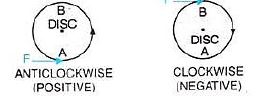
Exam Tip: Illustrating your answers with a simple, neat diagram showing the change in the point of application of force helps score maximum marks.
Question 6. Write the expression for calculating the moment of force about a given a axis.
Answer: The mathematical formula used to calculate the moment of force around a specified axis is: \( \text{Moment of force} = \text{Force} \times \text{perpendicular distance of the force's line of action from the axis of rotation} \).
In simple words: To calculate the turning effect, you multiply the strength of the force by how far away it is applied from the center axis.
Exam Tip: Always state the formula clearly and define what each variable stands for to ensure clarity in your answers.
Question 7. State one way to reduce the moment of given force about a given axis of rotation.
Answer: To decrease the moment of a given force about an axis, you can reduce the perpendicular distance from the axis of rotation to the line of action of the applied force.
In simple words: You can weaken the turning power by pushing much closer to the hinge or center of rotation.
Exam Tip: Point out that since moment is directly proportional to distance, decreasing the distance directly decreases the moment.
Question 8. What do you understand by the clockwise and anticlockwise moment of force? When is it taken positive?
Answer: If a force turns a body in a direction opposite to the rotation of a clock's hands, the turning effect is called an anticlockwise moment. Conversely, if it turns the body in the direction of the clock's hands, it is called a clockwise moment. By physics convention, the anticlockwise moment of force is taken as positive, while the clockwise moment is taken as negative.
In simple words: An anticlockwise moment spins something counterclockwise and is counted as positive. A clockwise moment spins it clockwise and is counted as negative.
Exam Tip: Clearly state the sign convention for both types of moments, as this is critical for balanced-moment numerical questions.
Question 9. Why is it easier to open a door by applying the force at the free end of it?
Answer: It is much easier to open a door by pushing at its free end because this maximizes the perpendicular distance from the hinges (which act as the rotational axis). With a larger distance, a much smaller force is required to produce the necessary turning moment to open the door.
In simple words: Pushing a door near the edge furthest from the hinges gives you more leverage. This means you need to push with less effort to swing it open.
Exam Tip: Use the formula \( \text{Moment} = F \times d \) to explain that for a constant moment, a larger distance \( d \) requires a smaller force \( F \).
Question 10. The stone of hand flour grinder is provided with a handle near its rim. Give a reason.
Answer: The handle of a hand flour grinder is positioned near the outer rim to maximize the perpendicular distance from the central pivot. This increased distance minimizes the effort or force required to rotate the heavy grinding stone.
In simple words: Putting the handle on the outer edge makes the distance to the center pivot as long as possible, so you don't have to push very hard to turn the heavy stone.
Exam Tip: Relate practical applications to the primary concept of torque by highlighting the maximization of 'perpendicular distance' to reduce required effort.
Question 11. It is easier to turn the steering wheel of a large diameter then that of a small diameter. Give reason.
Answer: A steering wheel with a larger diameter has a greater radius, which increases the perpendicular distance of the applied force from the central steering axle. This larger distance means a smaller force is needed to produce the same turning moment compared to a smaller wheel.
In simple words: A bigger wheel gives you more leverage, allowing you to turn the steering column with less physical effort.
Exam Tip: Make sure to explain that the radius of the wheel acts as the perpendicular distance from the rotational center.
Question 12. A spanner (or wrench) has a long handle. Why?
Answer: A spanner is designed with a long handle to increase the perpendicular distance from the nut (the axis of rotation). This larger distance creates a much larger turning moment, which allows tight nuts to be turned easily with very little force.
In simple words: A long handle on a wrench increases your leverage, so you can easily turn tight nuts without having to push extremely hard.
Exam Tip: Identify the nut as the pivot point and the handle as the couple arm or perpendicular distance to show clear structural reasoning.
Question 13. A, B and C are the three forces each of magnitude 4 n acting in the plane of paper as shown in Fig. 1.30. The point O lies in the same plane.
(i) Which force has the least moment about O? Give a reason.
(ii) which force has the greatest moment about O? Give a reason.
(iii) Name the forces producing (a) Clockwise, (b) anticlockwise moments.
(iv) what is the resultant torque about the point O?
Answer:
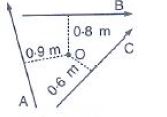
(i) **Least Moment:** The turning moment depends on the perpendicular distance from the pivot. Since all three forces are equal in magnitude (\( 4\text{ N} \)), the force with the smallest distance will produce the least moment. Force C has the smallest perpendicular distance of \( 0.6\text{ m} \), so vector C has the least moment about O. (ii) **Greatest Moment:** Force A has the largest perpendicular distance from O, which is \( 0.9\text{ m} \). Consequently, vector A produces the greatest turning moment about O. (iii) (a) The forces producing **clockwise** moments are Vector A and Vector B. (b) The force producing an **anticlockwise** moment is Vector C. (iv) **Resultant Torque:** Let us take anticlockwise moments as positive and clockwise moments as negative: \( \tau_{\text{net}} = -(\text{Moment of A}) - (\text{Moment of B}) + (\text{Moment of C}) \) \( \tau_{\text{net}} = -(4 \times 0.9) - (4 \times 0.8) + (4 \times 0.6) \) \( \tau_{\text{net}} = -3.6 - 3.2 + 2.4 \) \( \tau_{\text{net}} = -4.4\text{ N m} \) The negative sign confirms that the net resultant torque is \( 4.4\text{ N m} \) in the clockwise direction.
In simple words: Since all forces are 4 N, the one with the shortest distance (C) has the least turn, and the longest (A) has the most turn. Combining their clockwise and counterclockwise directions gives a final net turning force of 4.4 Nm clockwise.
Exam Tip: When calculating resultant torque, always clearly state your sign conventions (clockwise as negative and anticlockwise as positive) before starting the addition.
Question 14. The adjacent diagram (Fig. 1.31) Shows a heavy roller, with its axle at O, which its axle at O, which is to be raised on a pavement XY by applying a minimum possible force. Show by an arrow on the diagram the point of application and the direction in which the force should be applied.
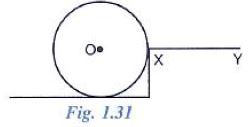
Answer: To raise the heavy roller over the pavement step XY, the wheel must pivot about the corner point X. To minimize the required force, the perpendicular distance from the pivot point X must be maximized. The greatest possible distance from X on a circle is its full diameter. Therefore, the force F should be applied at the point on the rim that is diametrically opposite to point X. The force must act perpendicular to this diameter line (pointing upwards and to the right), as shown in the diagram
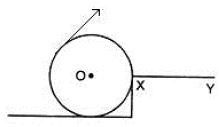
In simple words: To lift the wheel over the step with the least work, we must push it at the point furthest from the pivot corner X. This is the spot directly opposite X, and we push perpendicular to that straight line.
Exam Tip: Remember that the pivot is not the center O, but rather the contact point with the pavement corner X, which is a common point of confusion for students.
Question 15. A body is acted upon by two forces each of magnitude F, but in opposite direction. State the effect of the forces if
(a) both forces act at the same point of the body.
(b) the two forces act at two different point of the body at a separation r.
Answer:
(a) If both equal and opposite forces act at the exact same point, they lie along the same line of action. The net resultant force is \( F - F = 0 \) and the net moment is also zero. Thus, the forces cancel out completely, and the body remains in a state of rest (no motion). (b) If the two equal and opposite forces act at two different points separated by a distance \( r \), they form a couple. While the net translational force is still zero, they produce a turning effect. The body will rotate about its midpoint with a torque equal to: \( \text{Moment of forces} = F \times r \).
In simple words: Pulling an object in opposite directions at the exact same spot does nothing. But pulling at two different spots makes the object spin around its center.
Exam Tip: Differentiate clearly between 'no motion' (when forces share the same point) and 'pure rotational motion' (when they act at a distance to form a couple).
Question 16. Draw a neat labelled diagram to show the direction of two forces acting on a body to produce rotation in it. Also mark the point about which rotation takes place, by the letter O.
Answer: Below is the diagram of a bar AB with a couple of forces acting on it to produce rotation around its center point O:
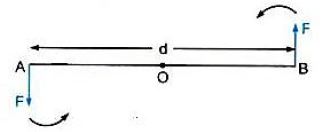
At points A and B, two equal and opposite forces of magnitude F are applied. These forces form a couple that causes the bar to rotate in an anticlockwise direction about its center O.
In simple words: This diagram shows two equal pushes acting on opposite ends of a bar in opposite directions. Together, they spin the bar around the center pivot point O.
Exam Tip: Label the pivot O, force vectors F, the distance d, and indicate the direction of rotation with curved arrows to get full marks for a drawing question.
Question 17. What do you understand by the term couple? State its effect. Give two examples of couple action in our daily life.
Answer: A couple consists of two parallel forces of equal magnitude that act in opposite directions along different lines of action. The dynamic effect of a couple is that it produces purely rotational motion in a body, as the net translational force is zero. Two real-life examples of couple action are: 1. Turning a key inside a lock cylinder. 2. Rotating the steering wheel of a vehicle with both hands.
In simple words: A couple is two equal but opposite forces that push on different parts of an object to make it spin. Examples include turning a key or a steering wheel.
Exam Tip: To define a couple completely, make sure to list three details: 'equal magnitude', 'opposite directions', and 'different lines of action'.
Question 18. Define moment of couple. Write its S.I. unit.
Answer: The moment of a couple is defined as the product of the magnitude of either force and the perpendicular distance separating the lines of action of the two forces (known as the couple arm). The S.I. unit of the moment of a couple is the Newton-meter (\( \text{N m} \)).
In simple words: The moment of a couple measures its total turning power. You calculate it by multiplying the strength of one of the forces by the total distance between the two forces.
Exam Tip: Remember that the distance used in this definition is the entire length between the two forces (the couple arm), not just the distance from a pivot.
Question 19. Prove that
Moment of couple = Force × couple arm.
Answer: Let us consider a bar AB pivoted at its midpoint O:
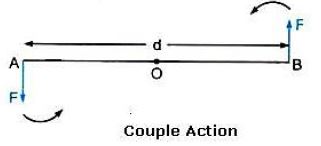
At points A and B, two equal and opposite forces, each of magnitude F, are applied. The perpendicular distance between these two forces is AB, which represents the couple arm. - The moment of force F at point A about pivot O is: \( \text{Moment}_A = F \times OA \quad (\text{anticlockwise}) \) - The moment of force F at point B about pivot O is: \( \text{Moment}_B = F \times OB \quad (\text{anticlockwise}) \) Since both forces produce an anticlockwise rotation, the total moment of the couple is the sum of their individual moments: \( \text{Total Moment} = (F \times OA) + (F \times OB) \) \( \text{Total Moment} = F \times (OA + OB) \) Since \( OA + OB = AB \), we get: \( \text{Total Moment} = F \times AB \) Letting \( AB = d \) (the couple arm): \( \text{Moment of couple} = \text{Force} \times \text{couple arm} \). Hence proved.
Exam Tip: Be sure to state that both moments are in the same direction, which explains why they are added together rather than subtracted.
Question 20. What do you mean by equilibrium of a body?
Answer: A body is said to be in a state of equilibrium when multiple forces acting upon it produce no change in its current state of rest or its state of uniform motion.
In simple words: Equilibrium means that all forces pushing on an object are perfectly balanced, so the object stays completely still or continues moving at a steady pace.
Exam Tip: Use the phrase 'no change in its state of rest or motion' to give a precise and complete textbook definition.
Question 21. State the condition when a body is in (i) static (ii) dynamic, equilibrium. Give one example each of static and dynamic equilibrium.
Answer:
(i) **Static Equilibrium:** A body is in static equilibrium when it continues to remain at rest under the influence of several external forces. *Example:* A book resting stationary on top of a table. (ii) **Dynamic Equilibrium:** A body is in dynamic equilibrium when it maintains its state of uniform motion (translational or rotational) under the influence of several active external forces. *Example:* A falling raindrop descending towards the ground at a constant terminal velocity.
In simple words: Static equilibrium is when forces are balanced on a stationary object, like a book on a table. Dynamic equilibrium is when forces are balanced on a moving object, like a raindrop falling at a steady speed.
Exam Tip: Emphasize that in static equilibrium the velocity is zero, whereas in dynamic equilibrium the velocity is constant and non-zero.
Question 22. State two condition for a body acted upon by several forces to be in equilibrium.
Answer: For a body acted upon by multiple forces to remain in equilibrium, two conditions must be met: (i) The resultant sum of all external translational forces acting on the body must be zero (no net force). (ii) The resultant sum of all moments of forces (torques) about any axis of rotation must be zero (clockwise moments must equal anticlockwise moments).
In simple words: To stay balanced, all the pushes and pulls must cancel out so it doesn't slide, and all the turning forces must cancel out so it doesn't spin.
Exam Tip: Mention both conditions: 'no translational acceleration' (net force is zero) and 'no rotational acceleration' (net torque is zero).
Question 23. State the principal of moments. Give one device as application of it.
Answer: The principle of moments states that when a body is in rotational equilibrium, the algebraic sum of the clockwise moments about any axis of rotation is equal to the algebraic sum of the anticlockwise moments about that same axis. A physical balance (or beam balance) is a standard device that works on this principle.
In simple words: The principle of moments says that for an object to stay balanced, the forces trying to tilt it clockwise must perfectly balance the forces trying to tilt it counterclockwise.
Exam Tip: Remember to specify the condition 'in equilibrium' when stating the principle, as this relationship only holds true when the system is balanced.
Question 24. Describe a simple experiment to verify the principle of moments, if you are supplied with a metre rule, a fulcrum and two springs with slotted weights.
Answer: To verify the principle of moments, perform the following experiment:
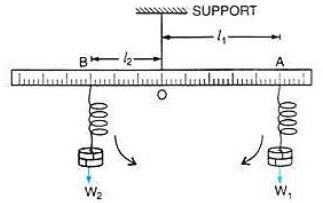
1. **Setup:** - Suspend a standard metre rule horizontally from a support by tying a thread at its center point \( O \). - Hang two spring balances loaded with slotted weights, \( W_1 \) and \( W_2 \), on opposite sides of the thread. - Slide the hangers (let them be at point \( A \) on the right and point \( B \) on the left) until the rule becomes perfectly horizontal and balanced once again. 2. **Observations:** - Record the weight on the right, \( W_1 \), suspended at a distance \( OA = l_1 \) from the pivot. - Record the weight on the left, \( W_2 \), suspended at a distance \( OB = l_2 \) from the pivot. - The force \( W_1 \) exerts a clockwise moment, while \( W_2 \) exerts an anticlockwise moment. 3. **Verification:** - \( \text{Clockwise moment} = W_1 \times l_1 \) - \( \text{Anticlockwise moment} = W_2 \times l_2 \) Upon observation, it is found that when the rule rests in horizontal equilibrium: \( \text{Clockwise moment} = \text{Anticlockwise moment} \) \( W_1 \times l_1 = W_2 \times l_2 \). This experimentally verifies the principle of moments.
In simple words: We hang a ruler from its center so it is level. Then, we hang different weights on each side and slide them until the ruler is balanced. We find that multiplying each weight by its distance from the middle gives the same value on both sides.
Exam Tip: Structure your experimental answer into clear headings: Setup, Observations, and Verification, and always include a neat, labelled diagram.
Multiple Choice Type:
Question 1. The moment of a force about a given axis depends:
(a) only on the magnitude of force
(b) only on the perpendicular distance of force from the axis.
(c) neither on the force nor on the perpendicular distance of force from the axis
(d) both on the force and its perpendicular distance from the axis.
Answer: (d) both on the force and its perpendicular distance from the axis.
In simple words: The turning power of a force depends on both how hard you push (force) and how far from the pivot you push (distance).
Exam Tip: Remember the basic formula \( \text{Moment} = \text{Force} \times \text{Perpendicular Distance} \) to instantly solve this conceptual question.
Question 2. A body is acted upon by two unequal forces in opposite directions, but not in same line. The effect is that:
(a) the body will have only the rotational motion
(b) the body will have only the translational motion
(c) the body will have neither the rotational motion nor the translational motion.
(d) the body will have rotational as well as translational motion.
Answer: (d) the body will have rotational as well as translational motion.
In simple words: Since the two opposite forces are unequal, they don't cancel out, making the object slide. Because they aren't lined up, they also make the object spin.
Exam Tip: Remember that equal and opposite forces along different lines create pure rotation, whereas unequal forces create both rotational and translational motion.
Numericals
Question 1. The moment of a force of 10 N about a fixed point O is 5 N m. Calculate the distance of the point O from the line of action of the force.
Answer:
Given: - Force, \( F = 10\text{ N} \) - Moment of force about point O, \( M = 5\text{ N m} \) Let \( r \) represent the perpendicular distance of the point O from the force's line of action. Using the formula: \( \text{Moment of force} = F \times r \) Substituting the given values: \( 5 = 10 \times r \)
\( \implies r = \frac{5}{10} = 0.5\text{ m} \). Therefore, the distance of the point O from the line of action of the force is \( 0.5\text{ m} \).
In simple words: We find the distance by dividing the turning moment of 5 Nm by the force of 10 N, which gives us 0.5 meters.
Exam Tip: Write down the basic equation before substituting the values to ensure you perform the algebra correctly.
Question 2. A nut is opened by a wrench of length 10 cm. if the least force required is 5.0 N, find the moment of force needed to turn the nut.
Answer:
Given: - Length of the wrench (perpendicular distance), \( r = 10\text{ cm} = 0.1\text{ m} \) - Force required, \( F = 5.0\text{ N} \) Using the formula for the moment of force: \( \text{Moment of force} = F \times r \) Substituting the values: \( \text{Moment of force} = 5.0 \times 0.1 = 0.5\text{ N m} \). Therefore, the moment of force needed to turn the nut is \( 0.5\text{ N m} \).
In simple words: First, convert the wrench length of 10 cm into 0.1 meters. Then, multiply it by the 5 N force to get a turning effect of 0.5 Nm.
Exam Tip: Always convert non-standard units (such as centimeters) into standard S.I. units (meters) before doing multiplication.
Question 3. A Wheel of diameter 2 m is shown in Fig. 1.32 with axle at O. A force F = 2 N is applies at B in the direction shown in figure. Calculate the moment of force about (i) Centre O, and (ii) point A.
Answer:
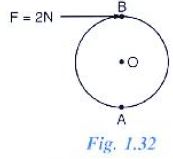
Given: - Force applied at B, \( F = 2\text{ N} \) - Diameter of the wheel, \( d = 2\text{ m} \) (Radius, \( r = 1\text{ m} \)) (i) **Moment of force about O:** The perpendicular distance from O to the line of action of the force at B is equal to the radius of the wheel, \( r = 1\text{ m} \). \( \text{Moment} = F \times r = 2 \times 1 = 2\text{ N m} \quad (\text{clockwise}) \). (ii) **Moment of force about A:** The perpendicular distance from point A to the line of action of the force at B is equal to the diameter of the wheel, \( d = 2\text{ m} \). \( \text{Moment} = F \times d = 2 \times 2 = 4\text{ N m} \quad (\text{clockwise}) \).
In simple words: The turning effect about the center is 2 Nm because the distance is 1 meter. The turning effect about the bottom point A is 4 Nm because the distance is the full 2-meter diameter.
Exam Tip: Be sure to state the direction of the moment (clockwise or anticlockwise) alongside the magnitude to secure full marks.
Question 4. The diagram in fig.1.33 shows two forces F1 = 5 N and F2 = 3N acting at points A and B of a rod pivoted at a point O, such that OA = 2m and OB = 4m. Calculate:
(i) Moment of force F1 about O.
(ii) Moment of force F2 about O.
(iii) Total moment of the two forces about O.
Answer:
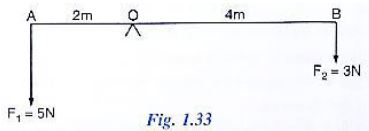
Given details: - Force at point A, \( F_1 = 5\text{ N} \) at distance \( OA = 2\text{ m} \) - Force at point B, \( F_2 = 3\text{ N} \) at distance \( OB = 4\text{ m} \) (i) **Moment of force \( F_1 \) about O:** The force \( F_1 \) pulls downwards on the left of pivot O, producing an anticlockwise turning effect. \( \text{Moment}_1 = F_1 \times OA = 5 \times 2 = 10\text{ N m} \quad (\text{anticlockwise}) \). (ii) **Moment of force \( F_2 \) about O:** The force \( F_2 \) pulls downwards on the right of pivot O, producing a clockwise turning effect. \( \text{Moment}_2 = F_2 \times OB = 3 \times 4 = 12\text{ N m} \quad (\text{clockwise}) \). (iii) **Total moment of the two forces about O:** Using the sign convention (clockwise is positive, anticlockwise is negative): \( \text{Resultant Moment} = \text{Moment}_2 - \text{Moment}_1 \) \( \text{Resultant Moment} = 12 - 10 = 2\text{ N m} \quad (\text{clockwise}) \).
In simple words: Force 1 tries to rotate the rod anticlockwise with 10 Nm of power, and Force 2 tries to rotate it clockwise with 12 Nm of power. Since the clockwise turn is stronger, the net turn is 2 Nm clockwise.
Exam Tip: Show all individual moments and their directions clearly in steps (i) and (ii) before subtracting them in step (iii).
Question 5. Two forces each of magnitude 10 N act vertically upwards and downwards respectively at the two ends of a uniform road of length 4 m which is pivoted at its mid point as shown in fig 1.34. Determine the magnitude of resultant moment of forces about the pivot O.
Answer:
Given data: - Total length of the rod, \( AB = 4\text{ m} \) - Since O is the midpoint, the distances are: \( OA = OB = 2\text{ m} \) - Force at point A, \( F_A = 10\text{ N} \) (acting upwards) - Force at point B, \( F_B = 10\text{ N} \) (acting downwards) 1. **Moment of force at end A about O:** The upward force at A rotates the rod clockwise around pivot O. \( \text{Moment}_A = F_A \times OA = 10 \times 2 = 20\text{ N m} \quad (\text{clockwise}) \). 2. **Moment of force at end B about O:** The downward force at B also rotates the rod clockwise around pivot O. \( \text{Moment}_B = F_B \times OB = 10 \times 2 = 20\text{ N m} \quad (\text{clockwise}) \). 3. **Resultant Moment of forces:** Since both moments are clockwise, they add up: \( \text{Total Moment} = \text{Moment}_A + \text{Moment}_B = 20 + 20 = 40\text{ N m} \quad (\text{clockwise}) \).
In simple words: The force pushing up on the left and the force pushing down on the right both spin the rod clockwise. Because they act together in the same direction, we add their turning effects to get 40 Nm.
Exam Tip: Draw a simple direction circle around the pivot for each force to verify if they reinforce each other (same direction) or oppose each other.
Question 6. Fig 1.35 shows two forces each of magnitude 10 N acting at the points A and B at a separation of 50 cm, in opposite directions. Calculate the resultant moment of the two forces about the point (i) A, (ii) B and (iii) O, situated exactly at the middle of the two forces.
Answer:
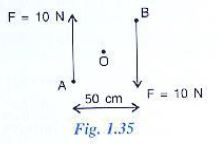
Given details: - Magnitude of each force, \( F = 10\text{ N} \) - Distance between A and B, \( d = 50\text{ cm} = 0.5\text{ m} \) (i) **Resultant moment about point A:** - The force at A acts directly on point A, so its distance is zero: \( \text{Moment}_A = 10 \times 0 = 0\text{ N m} \). - The force at B is at a distance of \( 0.5\text{ m} \) and turns the rod clockwise about A: \( \text{Moment}_B = 10 \times 0.5 = 5\text{ N m} \quad (\text{clockwise}) \). - Resultant moment about A: \( 0 + 5 = 5\text{ N m} \quad (\text{clockwise}) \). (ii) **Resultant moment about point B:** - The force at B acts directly on point B, so its distance is zero: \( \text{Moment}_B = 10 \times 0 = 0\text{ N m} \). - The force at A is at a distance of \( 0.5\text{ m} \) and turns the rod clockwise about B: \( \text{Moment}_A = 10 \times 0.5 = 5\text{ N m} \quad (\text{clockwise}) \). - Resultant moment about B: \( 5 + 0 = 5\text{ N m} \quad (\text{clockwise}) \). (iii) **Resultant moment about midpoint O:** - The distance of midpoint O from both A and B is \( 0.25\text{ m} \). - The moment of force at A about O is: \( \text{Moment}_A = 10 \times 0.25 = 2.5\text{ N m} \quad (\text{clockwise}) \). - The moment of force at B about O is: \( \text{Moment}_B = 10 \times 0.25 = 2.5\text{ N m} \quad (\text{clockwise}) \). - Resultant moment about O: \( 2.5 + 2.5 = 5\text{ N m} \quad (\text{clockwise}) \).
Exam Tip: This problem proves that the moment of a couple has the same value about any point in its plane, which is a key concept in mechanics.
Question 7. A steering wheel of diameter 0.5 m is rotated anticlockwise by applying two forces each of magnitude 5 N. Draw a diagram to show the application of forces and calculate the moment of couple applied.
Answer:
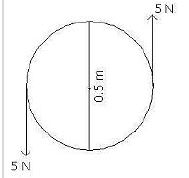
Given: - Diameter of steering wheel (couple arm), \( d = 0.5\text{ m} \) - Force applied at each side, \( F = 5\text{ N} \) Using the formula for the moment of a couple: \( \text{Moment of couple} = \text{Force} \times \text{couple arm} \) Substituting the values: \( \text{Moment of couple} = 5 \times 0.5 = 2.5\text{ N m} \). Therefore, the moment of the couple applied is \( 2.5\text{ N m} \).
In simple words: The turning strength of the couple is calculated by multiplying one force (5 N) by the total distance across the wheel (0.5 m), which gives 2.5 Nm of torque.
Exam Tip: When drawing a steering wheel couple, make sure the force vectors point in opposite directions (one up, one down) to correctly demonstrate the anticlockwise rotation.
Question 8. A uniform metre rule is pivoted at its mid-point. A weight of 50 gf is suspended at one end of it. Where should a weight of 100 gf be suspended to keep the rule horizontal?
Answer: Assume the 50 gf load is hung at one end (say, the 0 cm mark), which creates an anticlockwise moment around the pivot at the 50 cm mark. To balance this, let the 100 gf load be placed on the opposite side at a distance of \( d \) cm from the center to create a clockwise moment.
By applying the law of moments:
Anticlockwise moment = Clockwise moment
\( 50 \text{ gf} \times 50 \text{ cm} = 100 \text{ gf} \times d \)
\( 2500 = 100 \times d \)
\( d = \frac{2500}{100} = 25 \text{ cm} \)
Therefore, the 100 gf load must be suspended 25 cm away from the midpoint on the other half. This corresponds to a position 25 cm from the outer edge.
In simple words: To keep the ruler level, the turning effect on both sides of the center must be equal. Since the second weight is twice as heavy as the first, it needs to be placed at half the distance from the middle.
Exam Tip: Always define the direction of the moments (clockwise and anticlockwise) and clearly state the reference point, which is the pivot at the 50 cm mark.
Question 9. A uniform metre rule balance horizontally on a knife edge placed at the 58 cm mark when a weight of 20 gf is suspended from one end.
(i) Draw a diagram of the arrangement
(ii) What is the weight of the rule?
Answer:
(i) The gravitational pull acts at the scale's center of gravity (the 50 cm mark), generating a counter-clockwise rotational effect around the knife-edge pivot at 58 cm. For balance, the 20 gf load must be hung at the far end (the 100 cm mark) to provide an opposing clockwise rotational effect.
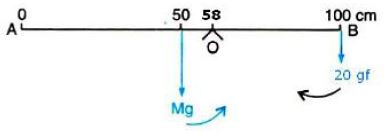
(ii) Using the principle of moments:
Anticlockwise moment = Clockwise moment
\( W \times (58 - 50) = 20 \text{ gf} \times (100 - 58) \)
\( W \times 8 = 20 \text{ gf} \times 42 \)
\( W = \frac{20 \times 42}{8} = 105 \text{ gf} \)
Thus, the rule has a weight of 105 gf.
In simple words: The weight of the ruler acts at its center point (50 cm). Since the balance point is at 58 cm, the ruler's own weight tries to tilt it to the left, which is balanced by putting the 20 gf weight at the rightmost end.
Exam Tip: A uniform metre rule always has its weight concentrated exactly at the 50 cm mark. Remember to calculate distances from the pivot (58 cm in this case), not from the ends.
Question 10. The diagram below (Fig 1.36) Shows a uniform bar supported at the middle point O. A weight of 40 gf is placed at a distance 40 cm to the left of the point O. How can you balance the bar with a weight of 80 gf?
Answer: The load of 40 gf on the left side creates a counter-clockwise moment: Anticlockwise moment = \( 40 \text{ gf} \times 40 \text{ cm} = 1600 \text{ gf cm} \)
Let the 80 gf load be positioned at a distance of \( d \) cm to the right of pivot O to produce an equal clockwise moment:
Clockwise moment = \( 80 \text{ gf} \times d \)
Applying the law of moments:
Anticlockwise moment = Clockwise moment
\( 1600 \text{ gf cm} = 80 \text{ gf} \times d \)
\( d = \frac{1600}{80} = 20 \text{ cm} \)
Hence, placing the 80 gf weight 20 cm to the right of pivot O will balance the bar.
In simple words: To balance a heavy weight with a lighter one, the heavier weight must be placed closer to the pivot. Here, the 80 gf load needs to go 20 cm to the right of the center.
Exam Tip: Double check your units during calculations. If weights are in gf and distances in cm, the resulting moments must be written in gf cm.
Question 11. Fig 1.37 shows a uniform metre rule placed on a fulcrum at its mid-point O and having a weight 40 gf at the 10 cm mark and a weight of 20 gf at the 90 cm mark.
(i) Is the metre rule in equilibrium? If not, how will the rule turn?
(ii) How can the rule be brought in equilibrium by using an additional weight of 40 gf?
Answer:
(i) Let us find the turning effects on both sides of the midpoint O (50 cm mark):
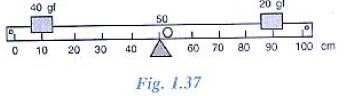
Counter-clockwise turning effect = \( 40 \text{ gf} \times (50 - 10) \text{ cm} = 40 \text{ gf} \times 40 \text{ cm} = 1600 \text{ gf cm} \)
Clockwise turning effect = \( 20 \text{ gf} \times (90 - 50) \text{ cm} = 20 \text{ gf} \times 40 \text{ cm} = 800 \text{ gf cm} \)
Since the counter-clockwise turning effect exceeds the clockwise turning effect, the rule is unbalanced and will rotate in the anticlockwise direction.
(ii) To restore balance, we must add the 40 gf load to the right-hand side to supplement the clockwise moment. Let this extra load be placed at a distance of \( d \) cm from the center O.
New clockwise moment = \( (20 \text{ gf} \times 40 \text{ cm}) + (40 \text{ gf} \times d) \)
According to the law of moments:
Anticlockwise moment = Clockwise moment
\( 1600 = 800 + 40 \times d \)
\( 40 \times d = 800 \)
\( d = \frac{800}{40} = 20 \text{ cm} \)
So, the extra 40 gf load must be hung 20 cm to the right of the pivot, which is at the 70 cm mark.
In simple words: (i) The left side has a stronger turning force, so the ruler tilts to the left. (ii) To make it level, we add a 40 gf weight on the right side at the 70 cm mark to balance the forces.
Exam Tip: To find the position on the rule, remember to add the calculated distance \( d \) to the pivot's position (50 + 20 = 70 cm), or subtract if it's on the left.
Question 12. When a boy weighing 20 kgf sits at one end of a 4 m long see saw, it gets depressed at this end. How can it be brought to the horizontal position by a man weighing 40 kgf.
Answer: The see-saw is pivoted at its middle point, which is 2 m from either end. The boy sits at one end (2 m from the pivot) creating an anticlockwise moment:
Anticlockwise moment = \( 20 \text{ kgf} \times 2 \text{ m} = 40 \text{ kgf m} \)
To balance this, a man of weight 40 kgf must sit on the opposite side at a distance of \( d \) meters from the center:
Clockwise moment = \( 40 \text{ kgf} \times d \)
Using the principle of moments:
Anticlockwise moment = Clockwise moment
\( 40 = 40 \times d \)
\( d = 1 \text{ m} \)
Therefore, the man should sit at a distance of 1 m from the pivot on the side opposite to the boy.
In simple words: Since the man is twice as heavy as the boy, he must sit exactly half as far from the center as the boy to keep the see-saw level.
Exam Tip: For see-saws, the pivot is always at the center of its length. Be careful to use the half-length of the see-saw (2 m) as the boy's distance, not the total length (4 m).
Question 13. A physical balance has its arms of length 60 cm and 40 cm. what weight kept on pan of longer arm will balance an object of weight 100 gf kept on other pan?
Answer: Let the 100 gf object be placed on the shorter arm (40 cm) to produce a counter-clockwise moment. Let the weight to be placed on the longer arm (60 cm) be \( W \):
By applying the law of moments:
Anticlockwise moment = Clockwise moment
\( 100 \text{ gf} \times 40 \text{ cm} = W \times 60 \text{ cm} \)
\( 4000 = 60 \times W \)
\( W = \frac{4000}{60} = 66.67 \text{ gf} \)
Thus, a load of 66.67 gf must be placed on the longer arm's pan.
In simple words: A longer balance arm gives a greater turning effect. Therefore, you need a smaller weight (66.67 gf) on the longer side to balance the heavier weight on the shorter side.
Exam Tip: Always associate the smaller distance with the larger weight, and the larger distance with the smaller weight when dealing with unequal arms.
Question 14. The diagram in Fig 1.38 shows a uniform metre rule weighing 100gf, pivoted as its centre O. two weights 150 gf and 250 gf hang from the metre rule as shown.
Calculate:
(i) the total anticlockwise moment about o,
(ii) the total clockwise moment about O,
(iii) the difference of anticlockwise and clockwise moments, and
(iv) the distance from O where a 100 gf weight should be placed to balance the metre rule.
Answer:
(i) The anticlockwise rotational effect is caused by the 150 gf load on the left: Anticlockwise moment = \( 150 \text{ gf} \times 40 \text{ cm} = 6000 \text{ gf cm} \)
(ii) The clockwise rotational effect is caused by the 250 gf load on the right:
Clockwise moment = \( 250 \text{ gf} \times 20 \text{ cm} = 5000 \text{ gf cm} \)
(iii) The difference between these two moments is:
Difference = \( 6000 \text{ gf cm} - 5000 \text{ gf cm} = 1000 \text{ gf cm} \) (acting anticlockwise)
(iv) Since the anticlockwise moment is larger, we must place the 100 gf load on the right side of pivot O to create an additional clockwise moment. Let this distance from O be \( d \) cm:
Using the principle of moments:
Anticlockwise moment = Total clockwise moment
\( 150 \text{ gf} \times 40 \text{ cm} = (250 \text{ gf} \times 20 \text{ cm}) + (100 \text{ gf} \times d) \)
\( 6000 = 5000 + 100 \times d \)
\( 100 \times d = 1000 \)
\( d = 10 \text{ cm} \)
Therefore, the 100 gf weight should be hung at a distance of 10 cm to the right of center O.
In simple words: (i) The left side pulls down with a turning force of 6000. (ii) The right side pulls down with a turning force of 5000. (iii) The left side is stronger by 1000. (iv) To balance it, we must add a 100 gf weight 10 cm to the right of the center.
Exam Tip: Notice that the ruler's own weight of 100 gf acts at the pivot point O, so its distance is 0, and it does not contribute to any moment about O.
Question 15. A uniform metre rule of weight 10gf is pivoted at its 0 mark.
(i) What moment of force depresses the rule?
(ii) How can it be made horizontal by applying a least force?
Answer:
(i) The weight of the uniform rule (10 gf) acts at its center of gravity, which is the 50 cm mark. Since it is pivoted at the 0 mark, this force acts downwards and causes a rotational moment:
Moment of force = \( 10 \text{ gf} \times 50 \text{ cm} = 500 \text{ gf cm} \) (clockwise/depressing moment)
(ii) To balance this with the minimum possible force, we must apply it at the maximum distance from the pivot (which is the 100 cm mark) in the upward direction:
According to the principle of moments:
Upward moment = Downward moment
\( W \times 100 \text{ cm} = 10 \text{ gf} \times 50 \text{ cm} \)
\( W = \frac{500}{100} = 5 \text{ gf} \)
So, we can keep the scale horizontal by applying an upward force of 5 gf at the 100 cm mark.
In simple words: (i) The ruler's weight pulls it down from the middle, creating a turning force of 500. (ii) To keep it straight with the easiest effort, pull up at the very end with a force of 5 gf.
Exam Tip: To apply the 'least force' to balance a system, always choose the position that is furthest from the pivot point, as force and distance are inversely proportional for a constant moment.
Question 16. A uniform metre scale can be balanced at the 70.0 cm mark when a mass 0.05 kg is hung from the 94.0 cm mark.
(a) draw a diagram of the arrangement.
(b) Find the mass of the metre scale
Answer:
(a) A diagram of the balanced arrangement is shown below:
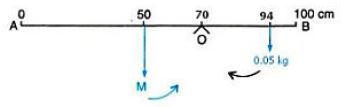
(b) The mass \( M \) of the scale acts at its midpoint (50 cm). This mass is located to the left of the pivot (70 cm), creating an anticlockwise moment. The 0.05 kg mass is at the 94 cm mark (to the right of the pivot), creating a clockwise moment.
Distance of mass \( M \) from the pivot = \( 70 - 50 = 20 \text{ cm} \)
Distance of 0.05 kg mass from the pivot = \( 94 - 70 = 24 \text{ cm} \)
Using the principle of moments:
Anticlockwise moment = Clockwise moment
\( M \times 20 \text{ cm} = 0.05 \text{ kg} \times 24 \text{ cm} \)
\( M \times 20 = 1.2 \)
\( M = \frac{1.2}{20} = 0.06 \text{ kg} \)
Therefore, the mass of the metre scale is 0.06 kg (or 60 g).
In simple words: The ruler behaves as if all its weight is at the 50 cm mark. We use the distances from the pivot at 70 cm to find that the scale weighs 0.06 kg.
Exam Tip: Make sure to keep units consistent. If you use kg for the hanging mass, the final answer for the scale's mass will naturally be in kg.
Question 17. A uniform metre rule of mass 100 g is balanced on a fulcrum at mark 40 cm by suspending an unknown mass M at the mark 20 cm.
(i) Find the value of M
(ii) To which side the rule will tilt if the mass m is moved to the mark 10cm?
(iii) what is the resultant moment now?
(iv) How can it be balanced by another mass of 50g?
Answer:
(i) The mass of the rule (100 g) acts at its mid-point (50 cm), which is to the right of the fulcrum (40 cm), creating a clockwise moment. The unknown mass \( M \) is at the 20 cm mark, creating an anticlockwise moment.
Using the principle of moments:
Anticlockwise moment = Clockwise moment
\( M \times (40 - 20) \text{ cm} = 100 \text{ g} \times (50 - 40) \text{ cm} \)
\( M \times 20 = 100 \times 10 \)
\( M = \frac{1000}{20} = 50 \text{ g} \)
(ii) If the 50 g mass \( M \) is shifted leftward to the 10 cm mark, its distance from the pivot increases, which increases the anticlockwise moment. Thus, the rule will tilt to the left (anticlockwise side).
(iii) When the mass is at 10 cm:
New anticlockwise moment = \( 50 \text{ g} \times (40 - 10) \text{ cm} = 50 \times 30 = 1500 \text{ g cm} \)
Clockwise moment = \( 100 \text{ g} \times (50 - 40) \text{ cm} = 1000 \text{ g cm} \)
Resultant moment = \( 1500 \text{ g cm} - 1000 \text{ g cm} = 500 \text{ g cm} \) (directed anticlockwise)
(iv) Since there is a net anticlockwise moment, we must add the 50 g mass to the right side of the fulcrum at a distance of \( d \) cm to create an additional clockwise moment.
Applying the principle of moments:
Anticlockwise moment = Total clockwise moment
\( 1500 \text{ g cm} = (100 \text{ g} \times 10 \text{ cm}) + (50 \text{ g} \times d) \)
\( 1500 = 1000 + 50 \times d \)
\( 50 \times d = 500 \)
\( d = 10 \text{ cm} \)
So, the 50 g mass should be hung 10 cm to the right of the fulcrum, which is at the 50 cm mark.
In simple words: (i) We find that the unknown mass must be 50 g to balance the ruler. (ii) Moving this weight further to the left makes that side heavier, tilting the rule leftwards. (iii) The net turning force becomes 500 g cm towards the left. (iv) Hanging another 50 g weight at the 50 cm mark balances the rule again.
Exam Tip: When multiple weights act on one side, add their individual moments together to find the total moment on that side of the fulcrum.
Exercise 1(C)
Question 1. Define the term 'centre of gravity of a body'.
Answer: The centre of gravity of an object is that specific point where its complete weight appears to act, and the sum of the turning effects of all the individual particles making up the body is zero around this point.
In simple words: The center of gravity is the single point where an object balances perfectly, as if all its weight is concentrated there.
Exam Tip: Make sure to mention both key aspects in your definition: that the total weight acts at this point, and that the sum of moments about this point is zero.
Question 2. Can the centre of gravity be situated outside the material of the body? Give an example.
Answer: Yes, it is possible for the centre of gravity of an object to lie outside its physical material. An example of this is a circular ring, where the center of gravity is located at its geometric center, which contains no material.
In simple words: Yes, the balance point doesn't have to be on the solid part of an object. For a hollow ring, the center of gravity is right in the middle where there is only empty space.
Exam Tip: A ring or a hollow sphere are classic examples used to demonstrate that the center of gravity can exist in empty space outside the object's physical mass.
Question 3. On what factor does the position of centre of gravity of a body depend? Explain your answer with an example.
Answer: The location of an object's centre of gravity is determined by its physical shape, which dictates how its mass is distributed. For instance, a straight, uniform metal wire has its center of gravity at its physical midpoint. However, if you bend that exact same wire to form a circle, the center of gravity shifts to the center of the circle, which is outside the wire itself.
In simple words: The balance point depends on the shape of the object and where most of its weight is spread. Changing the shape of a wire into a circle moves its balance point to the center of the circle.
Exam Tip: Always explain the concept of mass distribution alongside shape, and use the wire-to-ring example as it clearly illustrates both ideas.
Question 4. What is the position of centre of gravity of a:
(a) rectangular lamina
(b) cylinder?
Answer:
(a) For a rectangular lamina, the center of gravity is located where its two diagonals cross each other.
(b) For a cylinder, the center of gravity lies exactly at the midpoint along its central longitudinal axis.
In simple words: For a flat rectangle, it balances right where the diagonal lines cross. For a cylinder, it balances at the exact middle of its central axis.
Exam Tip: Be precise with geometric terms like 'intersection of diagonals' and 'midpoint of the axis' to secure full marks.
Question 5. At which point is the centre of gravity situated in:
(a) a triangular lamina
(b) a circular lamina?
Answer:
(a) The center of gravity of a triangular lamina is located at the centroid, where its three medians intersect.
(b) The center of gravity of a circular lamina is positioned at its exact geometric center.
In simple words: A flat triangle balances where its median lines cross. A flat circle balances at its very center.
Exam Tip: Remember that a median connects a corner of a triangle to the middle of the opposite side. The crossing point of these three lines is where it balances.
Question 6. Where is the centre of gravity of a uniform ring situated?
Answer: The center of gravity of a uniform ring is located at its geometric center.
In simple words: A uniform ring balances at the exact center of its circle, which is in the empty space inside it.
Exam Tip: Keep the answer concise but clear that the point lies at the center of the ring, even though there is no physical material there.
Question 7. A square card board is suspended by passing a pin through a narrow hole at its one corner. Draw a diagram to show its rest position. In the diagram, mark the point of suspension by the letter S and centre of gravity by the letter G.
Answer: The square cardboard will hang in a stable position such that its diagonal passing through the corner S lies vertically. The center of gravity G will lie vertically below the point of suspension S.
In simple words: When hung from a corner, the cardboard rotates until its center of gravity is directly below the pin.
Exam Tip: In your diagram, ensure that the point of suspension S and the center of gravity G lie on a straight vertical line.
Question 8. Explain how you will determine the position of centre of gravity experimentally for a triangular lamina (or a triangular piece of card board)
Answer: To find the center of gravity of a triangular lamina experimentally:
1. Punch three small holes labeled \( a \), \( b \), and \( c \) near the outer boundary of the triangular cardboard.
2. Hang the cardboard from the first hole \( a \) using a pin, so it can swing freely, and hang a plumb line from the same pin.
3. Once the cardboard stops moving, trace the vertical line of the plumb line onto the cardboard as line \( ad \).
4. Suspend the cardboard from hole \( b \) and draw a second line \( be \) along the plumb line.
5. Finally, hang it from hole \( c \) and mark the line \( cf \).
The point where these three lines \( ad \), \( be \), and \( cf \) intersect is the center of gravity \( G \), which corresponds to the meeting point of the triangle's medians. In simple words: Hang the triangle from three different corners one by one. Draw a vertical line straight down each time; the point where all three lines cross is the balance point.
Exam Tip: Make sure to describe the use of a plumb line and explain that the intersection point of the lines represents the center of gravity.
Question 9. State whether the following statements are true or false.
(i) 'The position of centre of gravity of a body remains unchanged even when the body is deformed'
(ii) 'Centre of gravity of a freely suspended body always lies vertically below the point of suspension'
Answer:
(i) False. Deforming an object changes its physical shape and how its mass is spread out, which directly shifts its center of gravity.
(ii) True.
In simple words: (i) False. If you bend or change the shape of an object, its balance point will also move. (ii) True. When hanging freely, an object naturally settles with its center of gravity directly below the pivot.
Exam Tip: For false statements, always write a brief explanation showing why it is incorrect to secure full marks.
Question 10. A uniform flat circular rim is balanced on a sharp vertical nail by supporting it at point A, as shown in fig 1.42. Mark the position of centre of gravity of the rim in the diagram by the letter G.
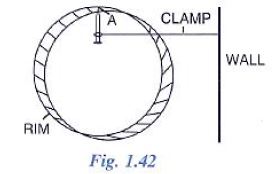
Answer: The center of gravity \( G \) of a circular rim lies at its geometric center.
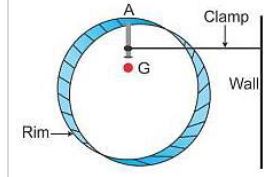
In simple words: The center of gravity is right in the middle of the circle, even though there is no metal there.
Exam Tip: Ensure that G is marked exactly at the center of the circle, directly below the support point A.
Question 11. Fig. 1.43 shows three pieces of card board of uniform thickness cut into three different shapes. On each diagram draw two lines to indicate the position of centre of gravity G.
Answer: To find the center of gravity \( G \) for each shape: 1. For the rectangle, draw two diagonals; their crossing point is \( G \). 2. For the triangle, draw two medians; their crossing point is \( G \). 3. For the circle, draw two diameters; their crossing point is \( G \). In simple words: Draw crossing lines (like diagonals, medians, or diameters) for each shape to find their balance points in the center.
Exam Tip: Use a ruler to draw clean, straight lines that intersect precisely at the geometric center of each figure.
Multiple Choice Type
Question 1. The centre of gravity of a uniform ball is
(a) at its geometrical centre
(b) at its bottom
(c) at its topmost point
(d) at any point on its surface
Answer: (a) at its geometrical centre
In simple words: A perfectly round, uniform ball has its weight distributed equally in all directions, so it balances exactly at its central point.
Exam Tip: For symmetrical solid shapes like spheres and cubes, the center of gravity is always at their geometric center.
Exercise 1(D)
Question 1. Explain the meaning of uniform circular motion. Give one example of such motion.
Answer: Uniform circular motion occurs when an object travels along a circular path at a steady speed. An example of this motion is the Earth orbiting around the Sun.
In simple words: Uniform circular motion is when something moves in a perfect circle at the same speed all the time, like a planet orbiting the sun.
Exam Tip: Always mention two essential conditions: the path must be circular, and the speed must remain constant.
Question 2. Draw a neat labelled diagram for a particle moving in a circular path with a constant speed. In you diagram show the direction of velocity at any instant.
Answer: A particle moving along a circular trajectory with constant speed has its velocity directed tangentially at any given moment. In simple words: As the object goes in a circle, its velocity always points straight ahead along a tangent line at that exact moment.
Exam Tip: Draw velocity vectors as straight arrows tangent to the circle, pointing in the direction of motion.
Question 3. Is it possible to have an accelerated motion with a constant speed? Name such type of motion.
Answer: Yes, it is possible. This type of motion is known as uniform circular motion.
In simple words: Yes, when you move in a circle at a steady speed, your direction keeps changing, which means you are accelerating.
Exam Tip: Be ready to explain that acceleration occurs because velocity is a vector, and changing its direction (even if speed is constant) constitutes acceleration.
Question 4. Give an example of motion in which speed remains uniform, but the velocity changes.
Answer: An example is a cyclist riding at a constant speed along a circular track.
In simple words: A bicycle going around a circular track at a steady speed has a constant speed, but its velocity keeps changing because its direction is always turning.
Exam Tip: Using a cyclist or a car on a circular track is an excellent, practical example of constant speed with changing velocity.
Question 5. A uniform circular motion is an accelerated motion explain it.
Answer: Although the speed (the magnitude of velocity) remains constant during uniform circular motion, the direction of travel is constantly changing at every point. Since velocity is a vector quantity, any change in direction means the velocity is changing, which represents acceleration.
In simple words: Even if you don't speed up or slow down, turning in a circle means your direction is always changing, which counts as acceleration.
Exam Tip: Emphasize that velocity depends on both speed and direction. Since direction changes continuously in a circle, acceleration is always present.
Question 6. Differentiate between a uniform linear motion and uniform circular motion.
Answer: The major differences are detailed in the table below:
| Uniform Linear Motion | Uniform Circular Motion |
|---|---|
| The body travels along a straight path. | The body travels along a circular path. |
| Both speed and direction of travel remain constant. | The speed is constant, but the direction of motion is constantly changing. |
| There is no acceleration in this motion. | This represents a type of accelerated motion. |
In simple words: Linear motion is going straight without turning, so there is no acceleration. Circular motion is turning continuously, which means it is accelerated even at constant speed.
Exam Tip: Use a clear tabular format for differences. Highlighting the state of acceleration in each is a key marking scheme point.
Question 7. Name the force required for circular motion. State its direction.
Answer: The force necessary to maintain circular motion is called centripetal force. Its direction is always aimed inward toward the center of the circular path.
In simple words: Centripetal force is the pull that keeps something moving in a circle, and it always points straight toward the center.
Exam Tip: Remember to state both the name (centripetal force) and the direction (towards the center) clearly when asked.
Question 8. What is a centripetal force?
Answer: A centripetal force is the inward-directed force acting on a moving object that keeps it traveling along a curved or circular track.
In simple words: It is the force that pulls an object toward the center to keep it spinning or moving in a circle.
Exam Tip: Define it as a force that acts on a body in circular motion, pointing radially inward.
Question 9. A piece of stone tied at the end of a thread is whirled in a horizontal circle. Name the force which provides the centripetal force.
Answer: The tension force in the thread provides the required centripetal force.
In simple words: The tightness or tension of the string is what pulls the stone inward to keep it going in a circle.
Exam Tip: Specify 'tension' as the source of the centripetal force in string-based rotational motion.
Question 10. Explain the motion of a planet around the sun in a circular path.
Answer: A planet orbits the Sun in an approximately circular orbit. The gravitational pull exerted by the Sun on the planet acts as the centripetal force needed to maintain this circular movement.
In simple words: The sun's gravity pulls on the planet, acting as the inward force that keeps the planet from flying off into space and makes it circle the sun.
Exam Tip: Identify gravity as the specific physical force that supplies the centripetal force for celestial orbits.
Question 11. (a) with reference to the direction of action, how does a centripetal force differ from a centrifugal force?
(b) Is centrifugal force the force of reaction of centripetal force?
Answer:
(a) While centripetal force is directed inward toward the center of rotation, centrifugal force is directed radially outward away from the center.
(b) No, centrifugal force is not the action-reaction counterpart of centripetal force.
In simple words: (a) One pulls inward, while the other acts outward. (b) No, they are not a standard action-reaction pair.
Exam Tip: Emphasize that centrifugal force is a pseudo-force, which is why it cannot be a real reaction force to the real centripetal force.
Question 12. Is centrifugal force a real force?
Answer: No, centrifugal force is not a real force; it is classified as a fictitious or pseudo force.
In simple words: No, it is an imaginary force that we only seem to feel because of our inertia when spinning.
Exam Tip: Use the terms 'fictitious force' or 'pseudo force' to describe centrifugal force.
Question 13. A small pebble is placed near the periphery of a circular disc which is rotating about an axis passing through it centre.
(a) What will be your observation when you are standing outside the disc? Explain it.
(b) What will be your observation when you are standing at the centre of the disc. Explain it
Answer:
(a) From an external, stationary frame of reference, the pebble is seen traveling in a circular path. This is because the friction between the pebble and the disc supplies the needed centripetal force.
(b) From a rotating frame of reference at the center of the disc, the pebble appears to be completely stationary in front of you. This is because the centrifugal force acting outward balances the inward frictional force in this rotating frame.
In simple words: (a) If you watch from outside, the pebble spins in a circle. (b) If you stand in the middle and spin with the wheel, the pebble looks like it is sitting still right in front of you.
Exam Tip: Contrast the two observations by mentioning the different frames of reference (stationary vs. rotating frame).
Question 14. State whether the following statements are true or false by writing T/F against them.
(a) The earth moves around the sun with a uniform
(b) the motion of the moon around the earth in circular path is an accelerated motion.
(c) A uniform linear motion is an accelerated motion.
(d) In a uniform circular motion, the speed continuously changes because the direction of motion changes.
Answer:
(a) False
(b) True
(c) True
(d) False
In simple words: These answers tell us whether each statement about circular and linear motion is correct or incorrect.
Exam Tip: Be prepared to explain why (d) is false: speed is a scalar quantity and remains constant in uniform circular motion, only the velocity changes.
Multiple Choice Type
Question 1. Which of the following quantity remains constant in a uniform circular motion:
(a) Velocity
(b) speed
(c) acceleration
(d) both velocity and speed.
Answer: (b) speed
In simple words: Since speed is just a number (scalar), it stays the same. But velocity and acceleration have direction, and since the direction is always changing in a circle, they change too.
Exam Tip: Always distinguish between scalar quantities (like speed) and vector quantities (like velocity and acceleration) when analyzing circular motion.
ICSE Study Resources for Class 10 Physics Chapter 01 Force
ICSE Chapter Solutions: Class 10 Physics Chapter 01 Force
Access structured ICSE solutions for Class 10 Physics Chapter 01 Force designed to match CISCE curriculum standards. These verified answers help clarify complex numericals and support daily homework revision.
Step-by-Step Explanations and Breakdown
Verify your answers instantly using the comprehensive breakdowns provided for each problem, ensuring complete syllabus coverage across all sub-topics.
More Study Resources for Class 10 Physics
Explore our broader library of study materials and chapter notes to support your continuous revision and secure higher marks.
FAQs
You can download the verified Selina Concise solutions for Chapter 01 Force on StudiesToday.com. Our teachers have prepared answers for Class 10 Physics as per 2026-27 ICSE academic session.
Yes, our solutions for Chapter 01 Force are designed as per new 2026 ICSE standards. 40% competency-based questions required for Class 10, are included to help students understand application-based logic behind every Physics answer.
Yes, every exercise in Chapter 01 Force from the Selina Concise textbook has been solved step-by-step. Class 10 students will learn Physics conceots before their ICSE exams.
Yes, follow structured format of these Selina Concise solutions for Chapter 01 Force to get full 20% internal assessment marks and use Class 10 Physics projects and viva preparation as per ICSE 2026 guidelines.