

Class 9 Mathematics Chapter 24 Solution Of Right Triangles: Selina Concise Study Material
Access the official Selina Concise textbook solutions for Class 9 Mathematics, updated for the 2026-27 academic year. This digital resource is structured to help students build strong conceptual clarity and prepare effectively for school examinations.
Chapter 24 Solution Of Right Triangles Answer Guide
Navigate directly to the Chapter 24 Solution Of Right Triangles solutions using the digital viewer below. Organizing your study sessions chapter-by-chapter allows for seamless offline study and quick reference during revision.
Question 1. Determine the value of \( x \) from each of the given right-angled triangles:
(i) (ii) (iii) Answer:
(i) By analyzing the trigonometric ratios for the first triangle:
\( \sin 60^\circ = \frac{20}{x} \)
\( \implies \frac{\sqrt{3}}{2} = \frac{20}{x} \)
\( \implies x = \frac{40}{\sqrt{3}} \)
(ii) For the second triangle, we use the tangent function:
\( \tan 30^\circ = \frac{20}{x} \)
\( \implies \frac{1}{\sqrt{3}} = \frac{20}{x} \)
\( \implies x = 20\sqrt{3} \)
(iii) For the third triangle, we apply the sine function:
\( \sin 45^\circ = \frac{20}{x} \)
\( \implies \frac{1}{\sqrt{2}} = \frac{20}{x} \)
\( \implies x = 20\sqrt{2} \)
In simple words: Set up a trigonometric equation (\( \sin \) or \( \tan \)) using the given angle and sides, then solve to find the unknown side \( x \).
Exam Tip: Always identify the opposite, adjacent, and hypotenuse sides relative to the given angle before choosing which trigonometric ratio to use.
Question 2. Find the size of angle \( A \) for each of the given right-angled triangles:
(i) (ii) (iii) Answer:
(i) Using the cosine ratio for the first triangle:
\( \cos A = \frac{10}{20} \)
\( \implies \cos A = \frac{1}{2} \)
\( \implies \cos A = \cos 60^\circ \)
\( \implies A = 60^\circ \)
(ii) Using the sine ratio for the second triangle:
\( \sin A = \frac{\frac{10}{\sqrt{2}}}{10} \)
\( \implies \sin A = \frac{1}{\sqrt{2}} \)
\( \implies \sin A = \sin 45^\circ \)
\( \implies A = 45^\circ \)
(iii) Applying the tangent ratio for the third triangle:
\( \tan A = \frac{10\sqrt{3}}{10} \)
\( \implies \tan A = \sqrt{3} \)
\( \implies \tan A = \tan 60^\circ \)
\( \implies A = 60^\circ \)
In simple words: Find the ratio of the given sides and match it with the standard trigonometric values of \( 30^\circ \), \( 45^\circ \), or \( 60^\circ \) to find the angle \( A \).
Exam Tip: Memorize the standard trigonometric ratio values for \( 30^\circ \), \( 45^\circ \), and \( 60^\circ \) as they are frequently tested in right-angled triangle solutions.
Question 3. In the given figure, find the value of angle \( x \):
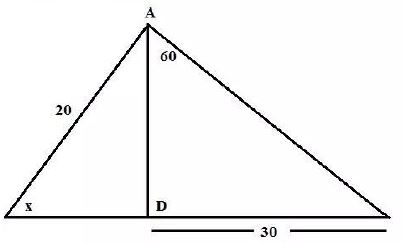
Answer:
From the right-angled triangle \( \triangle ACD \), we have:
\( \tan 60^\circ = \frac{30}{AD} \)
\( \implies \sqrt{3} = \frac{30}{AD} \)
\( \implies AD = \frac{30}{\sqrt{3}} \)
Next, from the right-angled triangle \( \triangle ABD \), we can write:
\( \sin x = \frac{AD}{20} \)
\( \implies AD = 20 \sin x \)
Equating both expressions for \( AD \):
\( 20 \sin x = \frac{30}{\sqrt{3}} \)
\( \implies \sin x = \frac{30}{20\sqrt{3}} \)
\( \implies \sin x = \frac{\sqrt{3}}{2} \)
\( \implies \sin x = \sin 60^\circ \)
\( \implies x = 60^\circ \)
In simple words: Find the height \( AD \) first using the right side triangle, then use this height in the left side triangle to find the angle \( x \).
Exam Tip: When a diagram consists of two right triangles sharing a common side, always calculate the length of the shared side first, as it links the information from one triangle to the other.
Question 4. Find the length of \( AD \) in each of the following cases:
(i) In the first figure, a right-angled triangle \( ABE \) is placed on top of a rectangle \( BCDE \), with \( \angle AEB = 45^\circ \), \( BE = 50\text{ m} \), and \( DE = 10\text{ m} \).
(ii) In the second figure, in triangle \( ABD \), find \( AD \) given that \( AB = 100\text{ m} \) and \( \angle B = 30^\circ \).
Answer:
(i) In the right-angled triangle \( \triangle ABE \):
\( \tan 45^\circ = \frac{AE}{BE} \)
\( \implies 1 = \frac{AE}{BE} \)
\( \implies AE = BE \)
Since \( BE = 50\text{ m} \), we have \( AE = 50\text{ m} \).
From the rectangle \( BCDE \), opposite sides are equal:
\( DE = BC = 10\text{ m} \)
Therefore, the total length of \( AD \) is:
\( AD = AE + DE = 50 + 10 = 60\text{ m} \)
(ii) In the right-angled triangle \( \triangle ABD \):
\( \sin B = \frac{AD}{AB} \)
\( \implies \sin 30^\circ = \frac{AD}{100} \)
\( \implies \frac{1}{2} = \frac{AD}{100} \)
\( \implies AD = 50\text{ m} \)
In simple words: For the first part, find the two segments \( AE \) and \( DE \) separately and add them together. For the second part, use the sine ratio directly in the right-angled triangle to find \( AD \).
Exam Tip: Be careful with compound figures. Break the total length into distinct parts (like \( AE \) and \( DE \)) and calculate each using the appropriate geometric properties of triangles and rectangles.
Question 5. In the given right-angled triangles \( \triangle ABC \) and \( \triangle BDC \), if \( BC = 40\text{ cm} \), \( \angle ABC = 60^\circ \), and \( \angle DBC = 45^\circ \), find the length of \( AD \).
Answer:
In the right-angled triangle \( \triangle ABC \):
\( \tan 60^\circ = \frac{AC}{BC} \)
\( \implies \sqrt{3} = \frac{AC}{40} \)
\( \implies AC = 40\sqrt{3}\text{ cm} \)
In the right-angled triangle \( \triangle BDC \):
\( \tan 45^\circ = \frac{DC}{BC} \)
\( \implies 1 = \frac{DC}{40} \)
\( \implies DC = 40\text{ cm} \)
By observing the figure, the segment \( AD \) can be found by subtracting \( DC \) from \( AC \):
\( AD = AC - DC \)
\( \implies AD = 40\sqrt{3} - 40 \)
\( \implies AD = 40(\sqrt{3} - 1)\text{ cm} \)
Substituting \( \sqrt{3} \approx 1.732 \):
\( AD \approx 40(1.732 - 1) = 40(0.732) = 29.28\text{ cm} \)
In simple words: Find the height of the larger triangle \( AC \) and the smaller triangle \( DC \) using the base of \( 40\text{ cm} \). Subtract the smaller height from the larger height to find the distance \( AD \).
Exam Tip: Keep the value of \( \sqrt{3} \) as \( 1.732 \) in your calculations only at the very end to prevent rounding errors in intermediate steps.
Question 6. The side of a rhombus is \( 60\text{ cm} \) and one of its angles is \( 60^\circ \). Find the lengths of both its diagonals.
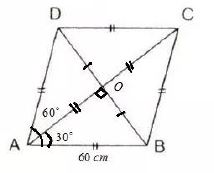
Answer:
The diagonals of a rhombus bisect each other perpendicularly and also bisect the interior angles at the vertices.
Let the rhombus be \( ABCD \) with diagonals \( AC \) and \( BD \) intersecting at point \( O \).
Given that the side \( AB = 60\text{ cm} \) and \( \angle DAB = 60^\circ \).
Therefore, we have:
\( \angle OAB = \frac{60^\circ}{2} = 30^\circ \)
\( \angle AOB = 90^\circ \)
In the right-angled triangle \( \triangle AOB \):
\( \sin 30^\circ = \frac{OB}{AB} \)
\( \implies \frac{1}{2} = \frac{OB}{60} \)
\( \implies OB = 30\text{ cm} \)
Using the cosine function in the same triangle:
\( \cos 30^\circ = \frac{OA}{AB} \)
\( \implies \frac{\sqrt{3}}{2} = \frac{OA}{60} \)
\( \implies OA = 30\sqrt{3}\text{ cm} \)
Substituting \( \sqrt{3} \approx 1.732 \):
\( OA = 30 \times 1.732 = 51.96\text{ cm} \)
Thus, the lengths of the diagonals are:
\( \text{Length of diagonal } AC = 2 \times OA = 2 \times 51.96 = 103.92\text{ cm} \)
\( \text{Length of diagonal } BD = 2 \times OB = 2 \times 30 = 60\text{ cm} \)
In simple words: Since diagonals of a rhombus bisect each other at right angles, we can use a right triangle inside the rhombus to find half of each diagonal's length and then double them.
Exam Tip: Remember the properties of a rhombus: diagonals bisect at \( 90^\circ \) and bisect the corner angles. Stating these properties clearly at the beginning of your solution is essential for earning full steps marks.
Question 7. Find the length of \( AB \) from the given figure, if \( FC = 20\text{ cm} \), \( ED = 30\text{ cm} \), \( \angle FAC = 45^\circ \), \( \angle EBD = 60^\circ \), and \( \angle EFP = 60^\circ \).
Answer:
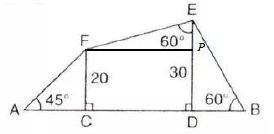
In the right-angled triangle \( \triangle ACF \):
\( \tan 45^\circ = \frac{FC}{AC} \)
\( \implies 1 = \frac{20}{AC} \)
\( \implies AC = 20\text{ cm} \)
In the right-angled triangle \( \triangle DEB \):
\( \tan 60^\circ = \frac{ED}{BD} \)
\( \implies \sqrt{3} = \frac{30}{BD} \)
\( \implies BD = \frac{30}{\sqrt{3}} \approx 17.32\text{ cm} \)
We are given \( FC = 20\text{ cm} \) and \( ED = 30\text{ cm} \). Since \( FP \) is parallel to \( CD \), we have:
\( EP = ED - FC = 30 - 20 = 10\text{ cm} \)
In the right-angled triangle \( \triangle FPE \):
\( \tan 60^\circ = \frac{FP}{EP} \)
\( \implies \sqrt{3} = \frac{FP}{10} \)
\( \implies FP = 10\sqrt{3} \approx 17.32\text{ cm} \)
Since \( CD = FP \), we have \( CD = 17.32\text{ cm} \).
Now, the total length \( AB \) is:
\( AB = AC + CD + BD \)
\( \implies AB = 20 + 17.32 + 17.32 = 54.64\text{ cm} \)
In simple words: Find \( AC \) and \( BD \) using the two outer right-angled triangles. Then, find the middle section \( CD \) by drawing a horizontal line \( FP \) and using trigonometry on the small top triangle \( FPE \). Add all three parts together.
Exam Tip: Drawing auxiliary lines (like the horizontal line \( FP \)) to form a rectangle and a new right-angled triangle is a very useful technique in complex 2D geometric problems.
Question 8. In an isosceles trapezium \( ABCD \), \( AB \parallel CD \), \( AD = BC = 20\text{ cm} \), \( CD = 20\text{ cm} \), and \( \angle A = 60^\circ \). Find:
(i) The length of the base \( AB \).
(ii) The distance between the parallel sides \( AB \) and \( CD \).
Answer:
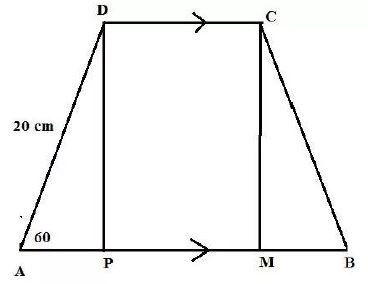
Draw two perpendicular lines from points \( D \) and \( C \) to the base \( AB \), meeting it at points \( P \) and \( M \) respectively. Since \( AB \parallel CD \), the quadrilateral \( PMCD \) forms a rectangle.
(i) In the right-angled triangle \( \triangle ADP \):
\( \cos 60^\circ = \frac{AP}{AD} \)
\( \implies \frac{1}{2} = \frac{AP}{20} \)
\( \implies AP = 10\text{ cm} \)
By symmetry, in the right-angled triangle \( \triangle BMC \ \), we also have:
\( BM = 10\text{ cm} \)
From the rectangle \( PMCD \), the opposite sides are equal:
\( PM = CD = 20\text{ cm} \)
Thus, the total length of the base \( AB \) is:
\( AB = AP + PM + MB = 10 + 20 + 10 = 40\text{ cm} \)
(ii) In the right-angled triangle \( \triangle APD \):
\( \sin 60^\circ = \frac{PD}{AD} \)
\( \implies \frac{\sqrt{3}}{2} = \frac{PD}{20} \)
\( \implies PD = 10\sqrt{3}\text{ cm} \)
Thus, the perpendicular distance between the parallel sides \( AB \) and \( CD \) is \( 10\sqrt{3}\text{ cm} \).
In simple words: Drop perpendiculars from the top corners of the trapezium to the bottom base. This splits the shape into a rectangle in the middle and two identical right triangles on the sides. Solve these triangles to find the total base length and the height.
Exam Tip: In trapezium problems, dropping perpendiculars from the vertices of the shorter parallel side to the longer parallel side is almost always the key first step to solving the problem.
Question 9. In the given figure, find the total length of \( AB \). Given that \( AQ = 10 \), \( BR = 8 \), and the angles are as shown in the right-angled triangles \( \triangle AQP \) and \( \triangle PBR \):
Answer:
In the right-angled triangle \( \triangle AQP \):
\( \tan 30^\circ = \frac{AQ}{AP} \)
\( \implies \frac{1}{\sqrt{3}} = \frac{10}{AP} \)
\( \implies AP = 10\sqrt{3} \)
In the right-angled triangle \( \triangle PBR \):
\( \tan 45^\circ = \frac{PB}{BR} \)
\( \implies 1 = \frac{PB}{8} \)
\( \implies PB = 8 \)
The total length of \( AB \) is the sum of \( AP \) and \( PB \):
\( AB = AP + PB = 10\sqrt{3} + 8 \)
In simple words: Find the length of \( AP \) using the tangent ratio in the left triangle, and find \( PB \) using the tangent ratio in the right triangle. Add them together to get the total length \( AB \).
Exam Tip: Ensure that you do not add \( 10\sqrt{3} \) and \( 8 \) directly into \( 18\sqrt{3} \). These are unlike terms; keep them as \( 10\sqrt{3} + 8 \) or substitute the decimal value of \( \sqrt{3} \).
Question 10. Find the length of \( AB \) if \( DE = 30\text{ cm} \), \( \angle ADE = 45^\circ \), and \( \angle BDE = 60^\circ \) in the given figure:
Answer:
In the right-angled triangle \( \triangle ADE \):
\( \tan 45^\circ = \frac{AE}{DE} \)
\( \implies 1 = \frac{AE}{30} \)
\( \implies AE = 30\text{ cm} \)
In the right-angled triangle \( \triangle DBE \):
\( \tan 60^\circ = \frac{BE}{DE} \)
\( \implies \sqrt{3} = \frac{BE}{30} \)
\( \implies BE = 30\sqrt{3}\text{ cm} \)
The total length of \( AB \) is:
\( AB = AE + BE = 30 + 30\sqrt{3} = 30(1 + \sqrt{3})\text{ cm} \)
In simple words: Find the two parts of the base, \( AE \) and \( BE \), using the tangent ratios of the two triangles sharing the common height \( DE = 30\text{ cm} \). Then add them together.
Exam Tip: Always look for a shared side between adjacent right-angled triangles to quickly find missing values using trigonometry.
Question 11. In the given figure, \( AB \) is parallel to \( DC \), and \( AD \) is perpendicular to both \( AB \) and \( EC \). Given \( AD = 2\text{ cm} \), \( \angle ACD = 45^\circ \), and \( \angle AED = 60^\circ \). Find:
(i) The length of \( AB \).
(ii) The length of \( AC \).
(iii) The length of \( AE \).
Answer:
(i) In the right-angled triangle \( \triangle ADC \):
\( \tan 45^\circ = \frac{AD}{DC} \)
\( \implies 1 = \frac{2}{DC} \)
\( \implies DC = 2\text{ cm} \)
Since \( AB \parallel CD \) and \( AD \perp EC \), the quadrilateral \( ABCD \) is a rectangle, meaning opposite sides are equal:
\( AB = DC = 2\text{ cm} \)
(ii) In the same right-angled triangle \( \triangle ADC \):
\( \sin 45^\circ = \frac{AD}{AC} \)
\( \implies \frac{1}{\sqrt{2}} = \frac{2}{AC} \)
\( \implies AC = 2\sqrt{2}\text{ cm} \)
(iii) In the right-angled triangle \( \triangle ADE \):
\( \sin 60^\circ = \frac{AD}{AE} \)
\( \implies \frac{\sqrt{3}}{2} = \frac{2}{AE} \)
\( \implies AE = \frac{4}{\sqrt{3}}\text{ cm} \)
In simple words: First, find \( DC \) and \( AC \) from the right triangle \( \triangle ADC \). Since \( AB \) is equal to \( DC \), this gives the length of \( AB \). Finally, find \( AE \) by using the sine ratio in the right triangle \( \triangle ADE \).
Exam Tip: Be sure to write down the geometric justification (such as opposite sides of a rectangle being equal) when equating lengths of parallel lines like \( AB \) and \( DC \).
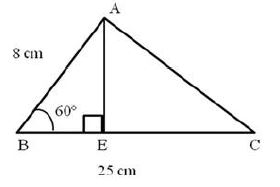
Question 12. In the given figure, \( AB = 8\text{ cm} \), \( BC = 25\text{ cm} \), and \( \angle B = 60^\circ \). \( AE \) is perpendicular to \( BC \). Find:
(i) The length of \( BE \).
(ii) The length of \( AC \).
Answer:
In the right-angled triangle \( \triangle ABE \):
\( \sin 60^\circ = \frac{AE}{AB} \)
\( \implies \frac{\sqrt{3}}{2} = \frac{AE}{8} \)
\( \implies AE = 4\sqrt{3}\text{ cm} \)
(i) To find \( BE \), apply Pythagoras' theorem in \( \triangle ABE \):
\( BE^2 = AB^2 - AE^2 \)
\( \implies BE^2 = 8^2 - (4\sqrt{3})^2 \)
\( \implies BE^2 = 64 - 48 \)
\( \implies BE^2 = 16 \)
\( \implies BE = 4\text{ cm} \)
(ii) Now, we can find \( EC \) since the total length \( BC = 25\text{ cm} \):
\( EC = BC - BE \)
\( \implies EC = 25 - 4 = 21\text{ cm} \)
In the right-angled triangle \( \triangle AEC \), apply Pythagoras' theorem to find \( AC \):
\( AC^2 = AE^2 + EC^2 \)
\( \implies AC^2 = (4\sqrt{3})^2 + 21^2 \)
\( \implies AC^2 = 48 + 441 \)
\( \implies AC^2 = 489 \)
\( \implies AC = \sqrt{489} \approx 22.11\text{ cm} \)
In simple words: Find the vertical height \( AE \) using sine of \( 60^\circ \). Use this height and Pythagoras' theorem on the left side to get \( BE = 4\text{ cm} \). Subtract this from the total base to get the right part \( EC = 21\text{ cm} \), and then use Pythagoras' theorem on the right side to get \( AC \).
Exam Tip: Splitting a non-right-angled triangle into two right-angled triangles using an altitude is a standard technique. Use Pythagoras' theorem to transition from one right-angled triangle to the next.
Question 13. In a right-angled triangle \( \triangle ABC \), \( \angle B = 90^\circ \), \( \angle ACB = 30^\circ \), and \( AB = 12\text{ cm} \). If \( BD \) is perpendicular to \( AC \), find:
(i) The length of \( BC \).
(ii) The length of \( AD \).
(iii) The length of \( AC \).
Answer:
(i) In the right-angled triangle \( \triangle ABC \):
\( \tan 30^\circ = \frac{AB}{BC} \)
\( \implies \frac{1}{\sqrt{3}} = \frac{12}{BC} \)
\( \implies BC = 12\sqrt{3}\text{ cm} \)
(ii) In the right-angled triangle \( \triangle ABC \), we know the sum of angles is \( 180^\circ \):
\( \angle A = 90^\circ - \angle ACB = 90^\circ - 30^\circ = 60^\circ \)
In the right-angled triangle \( \triangle ABD \) (where \( BD \perp AC \)):
\( \cos A = \frac{AD}{AB} \)
\( \implies \cos 60^\circ = \frac{AD}{12} \)
\( \implies \frac{1}{2} = \frac{AD}{12} \)
\( \implies AD = 6\text{ cm} \)
(iii) In the right-angled triangle \( \triangle ABC \):
\( \sin 30^\circ = \frac{AB}{AC} \)
\( \implies \frac{1}{2} = \frac{12}{AC} \)
\( \implies AC = 24\text{ cm} \)
In simple words: Use the basic trigonometric ratios in the large right-angled triangle \( \triangle ABC \) to find \( BC \) and the hypotenuse \( AC \). To find \( AD \), use the smaller right-angled triangle \( \triangle ABD \) with its angle at \( A = 60^\circ \).
Exam Tip: Be sure to calculate the other acute angle in the triangle first (like \( \angle A = 60^\circ \)) when moving from the main right-angled triangle to an internal right-angled triangle created by an altitude.
Question 14. In the given right-angled triangle ABC, which is right-angled at B, find the magnitude of angle A (represented by \( \theta \)) when:
(i) AB is \( \sqrt{3} \) times BC.
(ii) BC is \( \sqrt{3} \) times AB.
Answer:
(i) Given that the side AB is \( \sqrt{3} \) times BC, we can express this relation as:
\( \frac{AB}{BC} = \sqrt{3} \) Since cotangent is the ratio of the adjacent side to the opposite side:
\( \cot\theta = \frac{AB}{BC} \)
\( \implies \cot\theta = \sqrt{3} \) We know that \( \cot 30^\circ = \sqrt{3} \). Therefore:
\( \cot\theta = \cot 30^\circ \)
\( \implies \theta = 30^\circ \) (ii) Similarly, when BC is \( \sqrt{3} \) times AB, we have:
\( \frac{BC}{AB} = \sqrt{3} \) Since tangent is the ratio of the opposite side to the adjacent side:
\( \tan\theta = \frac{BC}{AB} \)
\( \implies \tan\theta = \sqrt{3} \) We know that \( \tan 60^\circ = \sqrt{3} \). Therefore:
\( \tan\theta = \tan 60^\circ \)
\( \implies \theta = 60^\circ \)
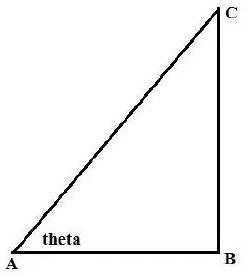
In simple words: Write down the ratio of the sides given in the problem, match it to the correct trigonometric function like tangent or cotangent, and find the corresponding standard angle.
Exam Tip: Be careful to identify which side is the perpendicular (opposite) and which is the base (adjacent) with respect to angle theta so that you do not swap tangent and cotangent.
Question 15. A ladder leaning against a vertical tower makes an angle of \( 30^\circ \) with the ground. If the ladder reaches up to a height of 15 m on the tower, calculate the total length of the ladder.
Answer: Let the length of the ladder be represented by \( x \) meters. From the geometric arrangement, we have a right-angled triangle where: The vertical height is the opposite side (perpendicular) = 15 m. The length of the ladder is the hypotenuse = \( x \). The angle with the ground is \( 30^\circ \). Using the sine ratio:
\( \sin 30^\circ = \frac{\text{Perpendicular}}{\text{Hypotenuse}} \)
\( \sin 30^\circ = \frac{15}{x} \) Since \( \sin 30^\circ = \frac{1}{2} \):
\( \frac{1}{2} = \frac{15}{x} \)
\( \implies x = 30\text{ m} \) Consequently, the length of the ladder is 30 m. In simple words: Since we know the height of the tower and the angle of the ladder, we can use the sine formula to easily calculate the ladder's length.
Exam Tip: Labeling the diagram with the unknown variable and known measurements helps you select the correct trigonometric ratio directly.
Question 16. A kite is flying at the end of a string of length 100 m. If the string is inclined at an angle of \( 60^\circ \) to the horizontal ground, determine the maximum height reached by the kite.
Answer: Let the maximum vertical height of the kite be \( x \) meters. In the right-angled triangle ABC representing this scenario: The hypotenuse represents the string length = 100 m. The angle of elevation of the string is \( 60^\circ \). The perpendicular represents the vertical height = \( x \). Applying the sine formula:
\( \sin 60^\circ = \frac{\text{Perpendicular}}{\text{Hypotenuse}} \)
\( \sin 60^\circ = \frac{x}{100} \) Since \( \sin 60^\circ = \frac{\sqrt{3}}{2} \):
\( \frac{\sqrt{3}}{2} = \frac{x}{100} \)
\( \implies x = 100 \times \frac{\sqrt{3}}{2} \)
\( \implies x = 50\sqrt{3} \) Substituting the standard value \( \sqrt{3} \approx 1.732 \):
\( \implies x = 50 \times 1.732 = 86.6\text{ m} \) Therefore, the maximum height attained by the kite is 86.6 m. In simple words: The height of the kite is found by multiplying the length of the string by the sine of the angle it makes with the ground.
Exam Tip: When the final answer is a decimal, remember to show the intermediate step using the surd form before substituting the value of the square root.
Question 17. A vertical tower AB stands on horizontal ground. From two points C and D on the ground, which are on the same side of the tower and spaced 20 cm apart, the angles of elevation of the top of the tower A are measured. Find the height of the tower AB and the distance BC when the angles of elevation from C and D are:
(i) \( 45^\circ \) and \( 30^\circ \) respectively.
(ii) \( 60^\circ \) and \( 30^\circ \) respectively.
(iii) \( 60^\circ \) and \( 45^\circ \) respectively.
Answer:
(i) Let the distance \( BC = x\text{ cm} \). The total distance is \( BD = BC + CD = (x + 20)\text{ cm} \). In the right-angled triangle ABD:
\( \tan 30^\circ = \frac{AB}{BD} \)
\( \frac{1}{\sqrt{3}} = \frac{AB}{x + 20} \)
\( \implies x + 20 = \sqrt{3} AB \) - (1) In the right-angled triangle ABC:
\( \tan 45^\circ = \frac{AB}{BC} \)
\( 1 = \frac{AB}{x} \)
\( \implies AB = x \) - (2) Substituting the value of \( x \) from (2) into (1):
\( AB + 20 = \sqrt{3} AB \)
\( \implies AB(\sqrt{3} - 1) = 20 \)
\( \implies AB = \frac{20}{\sqrt{3} - 1} \) Multiplying the numerator and denominator by the conjugate \( (\sqrt{3} + 1) \):
\( \implies AB = \frac{20(\sqrt{3} + 1)}{(\sqrt{3} - 1)(\sqrt{3} + 1)} = \frac{20(\sqrt{3} + 1)}{3 - 1} \)
\( \implies AB = \frac{20(\sqrt{3} + 1)}{2} = 10(\sqrt{3} + 1) \) Using \( \sqrt{3} \approx 1.732 \):
\( \implies AB = 10(1.732 + 1) = 10 \times 2.732 = 27.32\text{ cm} \) Since \( BC = x = AB \):
\( \implies BC = 27.32\text{ cm} \) Hence, \( AB = 27.32\text{ cm} \) and \( BC = 27.32\text{ cm} \). (ii) Let \( BC = x\text{ cm} \). The total distance is \( BD = BC + CD = (x + 20)\text{ cm} \). In the right-angled triangle ABD:
\( \tan 30^\circ = \frac{AB}{BD} \)
\( \frac{1}{\sqrt{3}} = \frac{AB}{x + 20} \)
\( \implies x + 20 = \sqrt{3} AB \) - (1) In the right-angled triangle ABC:
\( \tan 60^\circ = \frac{AB}{BC} \)
\( \sqrt{3} = \frac{AB}{x} \)
\( \implies x = \frac{AB}{\sqrt{3}} \) - (2) Substituting the value of \( x \) from (2) into (1):
\( \frac{AB}{\sqrt{3}} + 20 = \sqrt{3} AB \) Multiplying the entire equation by \( \sqrt{3} \):
\( \implies AB + 20\sqrt{3} = 3 AB \)
\( \implies 2 AB = 20\sqrt{3} \)
\( \implies AB = 10\sqrt{3} = 10 \times 1.732 = 17.32\text{ cm} \) Using this value in (2):
\( \implies x = \frac{17.32}{\sqrt{3}} \approx 10\text{ cm} \) Hence, \( AB = 17.32\text{ cm} \) and \( BC = 10\text{ cm} \). (iii) Let \( BC = x\text{ cm} \). The total distance is \( BD = BC + CD = (x + 20)\text{ cm} \). In the right-angled triangle ABD:
\( \tan 45^\circ = \frac{AB}{BD} \)
\( 1 = \frac{AB}{x + 20} \)
\( \implies x + 20 = AB \) - (1) In the right-angled triangle ABC:
\( \tan 60^\circ = \frac{AB}{BC} \)
\( \sqrt{3} = \frac{AB}{x} \)
\( \implies x = \frac{AB}{\sqrt{3}} \) - (2) Substituting the value of \( x \) from (2) into (1):
\( \frac{AB}{\sqrt{3}} + 20 = AB \) Multiplying by \( \sqrt{3} \):
\( \implies AB + 20\sqrt{3} = \sqrt{3} AB \)
\( \implies AB(\sqrt{3} - 1) = 20\sqrt{3} \)
\( \implies AB = \frac{20\sqrt{3}}{\sqrt{3} - 1} \) Multiplying the numerator and denominator by \( (\sqrt{3} + 1) \):
\( \implies AB = \frac{20\sqrt{3}(\sqrt{3} + 1)}{(\sqrt{3} - 1)(\sqrt{3} + 1)} = \frac{20(3 + \sqrt{3})}{2} \)
\( \implies AB = 10(3 + 1.732) = 10 \times 4.732 = 47.32\text{ cm} \) Using this in (2):
\( \implies x = \frac{47.32}{\sqrt{3}} \approx 27.32\text{ cm} \) Hence, \( AB = 47.32\text{ cm} \) and \( BC = 27.32\text{ cm} \).
In simple words: Write separate tangent equations for both right-angled triangles, substitute the distance variable of one into the other, and solve step-by-step.
Exam Tip: Rationalizing denominators is a critical step in trigonometry. Clearly show the conjugate multiplication to secure step marks.
Question 18. A vertical cliff AB of height 150 m stands on a horizontal plane. From the top of the cliff A, the angles of depression of two boats P and Q are observed to be \( 30^\circ \) and \( 45^\circ \) respectively. Calculate the distance between the two boats if:
(i) the boats are on opposite sides of the cliff.
(ii) the boats are on the same side of the cliff.
Answer: Let the cliff be represented by the vertical segment AB of height 150 m. Let P and Q denote the locations of the two boats. (i) When the boats lie on opposite sides of the cliff: In the right-angled triangle APB:
\( \tan 30^\circ = \frac{AB}{PB} \)
\( \frac{1}{\sqrt{3}} = \frac{150}{PB} \)
\( \implies PB = 150\sqrt{3} \) Using \( \sqrt{3} \approx 1.732 \):
\( \implies PB = 150 \times 1.732 = 259.80\text{ m} \) In the right-angled triangle ABQ:
\( \tan 45^\circ = \frac{AB}{BQ} \)
\( 1 = \frac{150}{BQ} \)
\( \implies BQ = 150\text{ m} \) The total distance between the boats is:
\( PQ = PB + BQ \)
\( \implies PQ = 259.80 + 150 = 409.80\text{ m} \) Thus, the distance between the boats is 409.80 m. (ii) When the boats lie on the same side of the cliff: From the individual distances calculated in part (i):
\( PB = 259.80\text{ m} \) and \( BQ = 150\text{ m} \). The horizontal distance between them is the difference:
\( PQ = PB - BQ \)
\( \implies PQ = 259.80 - 150 = 109.80\text{ m} \) Thus, the distance between the boats is 109.80 m.
In simple words: Calculate the individual horizontal distances from the cliff's base to each boat. Add these distances if the boats are on opposite sides, and subtract them if they are on the same side.
Exam Tip: Alternate angles are equal - use this property to transition from angles of depression at the top to angles of elevation at the bottom for easier calculations.
Question 19. A vertical tower CD stands on a horizontal plane. Two points A and B lie on the same straight line with the base of the tower C. If AB = 48 m and the angles of elevation of the top of the tower D from A and B are \( x^\circ \) and \( y^\circ \) respectively, determine the height of the tower CD. Given that \( \tan x^\circ = \frac{5}{12} \) and \( \tan y^\circ = \frac{3}{4} \).
Answer: Let the distance \( BC = x\text{ m} \) and let \( CD \) be the height of the tower. The total distance from A to C is \( AC = AB + BC = (48 + x)\text{ m} \). In the right-angled triangle ADC:
\( \tan x^\circ = \frac{DC}{AC} \)
\( \frac{5}{12} = \frac{DC}{48 + x} \)
\( \implies 5(48 + x) = 12 CD \)
\( \implies 240 + 5x = 12 CD \) - (1) In the right-angled triangle BDC:
\( \tan y^\circ = \frac{CD}{BC} \)
\( \frac{3}{4} = \frac{CD}{x} \)
\( \implies x = \frac{4 CD}{3} \) - (2) Substituting the value of \( x \) from (2) into (1):
\( 240 + 5\left(\frac{4 CD}{3}\right) = 12 CD \)
\( \implies 240 + \frac{20 CD}{3} = 12 CD \) Multiply the entire equation by 3 to clear the fraction:
\( \implies 720 + 20 CD = 36 CD \)
\( \implies 16 CD = 720 \)
\( \implies CD = \frac{720}{16} = 45\text{ m} \) Consequently, the height of the tower CD is 45 m. In simple words: Create two equations using the tangent ratios of both angles, express the horizontal ground distance in terms of the vertical tower's height, and solve the system.
Exam Tip: Substituting variables to convert a multi-variable trigonometric system into a single-variable algebraic equation is the safest way to avoid mistakes.
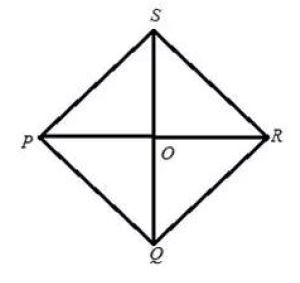
Question 20. The perimeter of a rhombus is 96 cm and one of its interior angles is \( 120^\circ \). Calculate the lengths of both of its diagonals.
Answer: In a rhombus, all four sides have equal length. Since the perimeter is 96 cm, the length of each side is:
\( PQ = \frac{96}{4} = 24\text{ cm} \). Let PQRS be the rhombus where \( \angle PQR = 120^\circ \) and the diagonals PR and SQ intersect at point O. We know that the diagonals of a rhombus bisect each other at right angles (\( 90^\circ \)) and also bisect the interior angles at the vertices. Therefore, in the right-angled triangle POQ (with the right angle at O):
\( \angle PQO = \frac{1}{2} \angle PQR = \frac{1}{2} (120^\circ) = 60^\circ \). Using the sine ratio in triangle POQ:
\( \sin 60^\circ = \frac{\text{Perpendicular}}{\text{Hypotenuse}} = \frac{PO}{PQ} \)
\( \sin 60^\circ = \frac{PO}{24} \) Since \( \sin 60^\circ = \frac{\sqrt{3}}{2} \):
\( \frac{\sqrt{3}}{2} = \frac{PO}{24} \)
\( \implies PO = 12\sqrt{3} \approx 12 \times 1.732 = 20.784\text{ cm} \) Since the diagonal PR is twice the length of PO:
\( \implies PR = 2 \times PO = 2 \times 20.784 = 41.568\text{ cm} \). Next, using the cosine ratio in triangle POQ:
\( \cos 60^\circ = \frac{\text{Base}}{\text{Hypotenuse}} = \frac{OQ}{PQ} \)
\( \cos 60^\circ = \frac{OQ}{24} \) Since \( \cos 60^\circ = \frac{1}{2} \):
\( \frac{1}{2} = \frac{OQ}{24} \)
\( \implies OQ = 12\text{ cm} \) Since the diagonal SQ is twice the length of OQ:
\( \implies SQ = 2 \times OQ = 2 \times 12 = 24\text{ cm} \). Therefore, the lengths of the diagonals are 41.568 cm and 24 cm.
In simple words: Find the side of the rhombus from its perimeter, use the property that diagonals bisect vertex angles, and apply trigonometry to calculate half the lengths of the diagonals.
Exam Tip: Remember to write down the geometric properties of the rhombus (such as diagonal bisectors meeting at 90 degrees) in the beginning of your steps to secure full reasoning marks.
ICSE Textbook Solutions for Class 9 Mathematics Chapter 24 Solution Of Right Triangles
Verified Problem Answers for Class 9 Mathematics Chapter 24 Solution Of Right Triangles
Find reliable chapter-wise explanations for Class 9 Mathematics Chapter 24 Solution Of Right Triangles. Curated to follow standard ICSE guidelines, these problem solutions assist students in building strong conceptual foundations.
How to Use These Class 9 Mathematics Solutions
Tackle complex theorems and numerical problems easily by cross-referencing your working steps with our structured solution guides.
Complete Your ICSE Chapter Revision
Pair your solution review with additional practice papers to test your execution speed and ensure total preparedness for school exams.
FAQs
You can download the verified Selina Concise solutions for Chapter 24 Solution Of Right Triangles on StudiesToday.com. Our teachers have prepared answers for Class 9 Mathematics as per 2026-27 ICSE academic session.
Yes, our solutions for Chapter 24 Solution Of Right Triangles are designed as per new 2026 ICSE standards. 40% competency-based questions required for Class 9, are included to help students understand application-based logic behind every Mathematics answer.
Yes, every exercise in Chapter 24 Solution Of Right Triangles from the Selina Concise textbook has been solved step-by-step. Class 9 students will learn Mathematics conceots before their ICSE exams.
Yes, follow structured format of these Selina Concise solutions for Chapter 24 Solution Of Right Triangles to get full 20% internal assessment marks and use Class 9 Mathematics projects and viva preparation as per ICSE 2026 guidelines.