

Class 8 Mathematics Chapter 19 Representing 3 D in 2 D: Selina Concise Study Material
Access the official Selina Concise textbook solutions for Class 8 Mathematics, updated for the 2026-27 academic year. This digital resource is structured to help students build strong conceptual clarity and prepare effectively for school examinations.
Chapter 19 Representing 3 D in 2 D Answer Guide
View or download the dedicated Chapter 19 Representing 3 D in 2 D resource below. This chapter-by-chapter structuring ensures easy navigation for daily study routines and immediate access to core academic concepts.
Question 1. If a polyhedron has 8 faces and 8 vertices, find the number of edges in it.
Answer:
We are given:
Faces \( (F) = 8 \)
Vertices \( (V) = 8 \)
We use Euler's formula to find the edges \( (E) \):
\( F + V - E = 2 \)
Substitute the values:
\( 8 + 8 - E = 2 \)
\( \implies 16 - E = 2 \)
\( \implies -E = 2 - 16 \)
\( \implies -E = -14 \)
\( \implies E = 14 \)
Therefore, the shape has 14 edges.
In simple words: We can find the number of edges using Euler's rule. If we add faces and vertices and then subtract 2, we get the total number of edges.
Exam Tip: Make sure to memorize the formula \( F + V - E = 2 \). It is a very easy way to get full marks on these questions.
Question 2. If a polyhedron has 10 vertices and 7 faces, find the number of edges in it.
Answer:
Here, we have:
Vertices \( (V) = 10 \)
Faces \( (F) = 7 \)
Using Euler's formula:
\( F + V - E = 2 \)
Placing our numbers in this formula:
\( 7 + 10 - E = 2 \)
\( \implies 17 - E = 2 \)
\( \implies -E = 2 - 17 \)
\( \implies -E = -15 \)
\( \implies E = 15 \)
This means the polyhedron has 15 edges.
In simple words: Add the faces and vertices together to get 17, then subtract 2 to find the 15 edges.
Exam Tip: Always state what \( F \), \( V \), and \( E \) stand for before solving to show clear steps.
Question 3. State, the number of faces, number of vertices and number of edges of:
(i) a pentagonal pyramid
(ii) a hexagonal prism
Answer:
(i) For a pentagonal pyramid:
- Faces = 6
- Vertices = 6
- Edges = 10
(ii) For a hexagonal prism:
- Faces = 8
- Vertices = 12
- Edges = 18
In simple words: A pentagonal pyramid has a five-sided base with five triangle faces on top, giving 6 faces, 6 corners, and 10 edges. A hexagonal prism has two hexagon ends and six side rectangles, giving 8 faces, 12 corners, and 18 edges.
Exam Tip: Drawing a quick sketch of these 3D shapes can help you count their corners, sides, and flat faces correctly.
Question 4. Verily Euler’s formula for the following three dimensional figures:
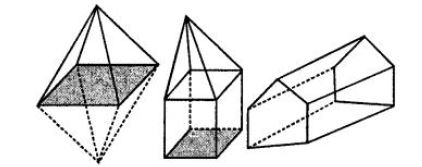
Answer:
(i) For the first figure (octahedron)
- Vertices \( (V) = 6 \)
- Faces \( (F) = 8 \)
- Edges \( (E) = 12 \)
Using Euler's formula:
\( F + V - E = 2 \)
\( \implies 8 + 6 - 12 = 2 \)
\( \implies 2 = 2 \)
Thus, the formula is verified.
(ii) For the second figure (pentagonal composite shape)
- Vertices \( (V) = 9 \)
- Faces \( (F) = 8 \)
- Edges \( (E) = 15 \)
Using Euler's formula:
\( F + V - E = 2 \)
\( \implies 8 + 9 - 15 = 2 \)
\( \implies 17 - 15 = 2 \)
\( \implies 2 = 2 \)
This verifies the formula.
(iii) For the third figure (prism-like shape)
- Vertices \( (V) = 9 \)
- Faces \( (F) = 5 \)
- Edges \( (E) = 12 \)
Using Euler's formula:
\( F + V - E = 2 \)
\( \implies 5 + 9 - 12 = 2 \)
\( \implies 14 - 12 = 2 \)
\( \implies 2 = 2 \)
This confirms Euler's formula is true.
In simple words: For each shape, we count its corners, flat sides, and straight lines. When we add faces and corners, then subtract the lines, we always get 2.
Exam Tip: Carefully count hidden edges and vertices shown by dashed lines so you do not miss any.
Question 5. Can a polyhedron have 8 faces, 26 edges and 16 vertices?
Answer:
Let us check using Euler's formula:
\( F + V - E = 2 \)
Here, we have:
- Faces \( (F) = 8 \)
- Vertices \( (V) = 16 \)
- Edges \( (E) = 26 \)
Put these values into the left side of the formula:
\( F + V - E = 8 + 16 - 26 \)
\( \implies F + V - E = 24 - 26 \)
\( \implies F + V - E = -2 \)
Since \( -2 \neq 2 \), Euler's formula is not satisfied.
Therefore, a polyhedron cannot have 8 faces, 26 edges, and 16 vertices.
In simple words: If we add the 8 faces and 16 corners, we get 24. Subtracting 26 edges gives -2. Since this is not equal to 2, such a solid cannot exist.
Exam Tip: If the left-hand side of Euler's formula does not equal 2, the shape cannot exist. Always state this conclusion clearly.
Question 6. Can a polyhedron have:
(i) 3 triangles only ?
(ii) 4 triangles only ?
(iii) a square and four triangles ?
Answer:
(i) No. A solid shape must have at least 4 faces, so 3 triangles cannot form a polyhedron.
(ii) Yes. A triangular pyramid (also called a tetrahedron) is made of exactly 4 triangles.
(iii) Yes. A square pyramid is made using one square base and four triangular sides.
In simple words: You need at least 4 flat surfaces to close up a 3D shape. So, 3 triangles cannot make a shape, but 4 triangles or a square with 4 triangles can.
Exam Tip: Try to remember real-world examples of these shapes, like a pyramid, to quickly answer these questions.
Question 7. Using Euler’s formula, find the values of x, y, z.
| S.No. | Faces | Vertices | Edges |
|---|---|---|---|
| (i) | \( x \) | 15 | 20 |
| (ii) | 6 | \( y \) | 8 |
| (iii) | 14 | 26 | \( z \) |
Answer:
Euler's formula states:
\( F + V - E = 2 \)
(i) For the first row:
Here, \( F = x \), \( V = 15 \), and \( E = 20 \).
Using the formula:
\( x + 15 - 20 = 2 \)
\( \implies x - 5 = 2 \)
\( \implies x = 2 + 5 \)
\( \implies x = 7 \)
(ii) For the second row:
Here, \( F = 6 \), \( V = y \), and \( E = 8 \).
Using the formula:
\( 6 + y - 8 = 2 \)
\( \implies y - 2 = 2 \)
\( \implies y = 2 + 2 \)
\( \implies y = 4 \)
(iii) For the third row:
Here, \( F = 14 \), \( V = 26 \), and \( E = z \).
Using the formula:
\( 14 + 26 - z = 2 \)
\( \implies 40 - z = 2 \)
\( \implies -z = 2 - 40 \)
\( \implies -z = -38 \)
\( \implies z = 38 \)
In simple words: We can use Euler's rule for each row to find the missing number. By filling in the two known values, we can solve for the unknown letter.
Exam Tip: Set up your equation carefully for each variable and pay attention to negative signs during calculation.
Question 8. What is the least number of planes that can enclose a solid? What is the name of the solid.
Answer:
We need at least four flat faces to enclose any solid shape. This solid is known as a tetrahedron.
In simple words: You cannot make a 3D closed shape with fewer than four flat faces. A shape with four faces is called a tetrahedron.
Exam Tip: Always write "tetrahedron" or "triangular pyramid" clearly, as these are the key terms that earn marks.
Question 9. Is a square prism same as a cube?
Answer:
Yes, a square prism can be the same as a cube. This is because a cube is a special square prism where all the faces are equal squares.
In simple words: A cube is a type of square prism where every side has the exact same length.
Exam Tip: Mention that a cube is a special case of a square prism where the height equals the base side length.
Question 10. A cubical box is 6 cm x 4 cm x 2 cm. Draw two different nets of it.
Answer:
Here are two different nets for a box measuring \( 6\text{ cm} \times 4\text{ cm} \times 2\text{ cm} \):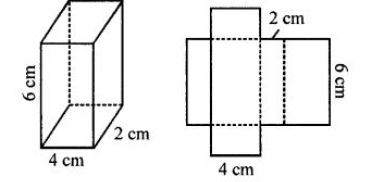 In simple words: A net is a flat pattern that folds up to make a 3D box. We can arrange the six faces in different ways to build the exact same cuboid.
Exam Tip: Label the dimensions on your nets so the examiner can see that the sides will fit together perfectly when folded.
Question 11. Dice are cubes where the sum of the numbers on the opposite faces is 7. Find the missing numbers a, b and c.
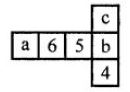
Answer:
In a standard die net, opposite faces always add up to 7. Let's find each opposite pair:
- The face opposite to \( a \) is 5. So, \( a + 5 = 7 \implies a = 2 \).
- The face opposite to \( b \) is 6. So, \( b + 6 = 7 \implies b = 1 \).
- The face opposite to \( c \) is 4. So, \( c + 4 = 7 \implies c = 3 \).
Therefore, the missing numbers are \( a = 2 \), \( b = 1 \), and \( c = 3 \).
The completed net is:
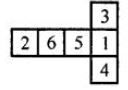
In simple words: Since opposite sides of a die always equal 7, we subtract the given side's number from 7 to find its opposite partner.
Exam Tip: When folding a net mentally, remember that alternate squares in a row are always opposite to each other.
Question 12. Name the polyhedron that can be made by folding each of the following nets:
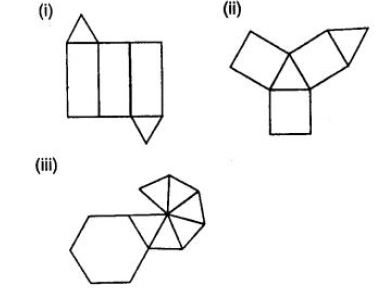
Answer:
(i) Triangular prism. This shape has 3 rectangular faces and 2 triangular bases.
(ii) Triangular prism. This is also a triangular prism as it is made of 3 rectangles and 2 triangles.
(iii) Hexagonal pyramid. This is because it has a hexagon as its base and 6 triangles as its side faces.
In simple words: The first two nets fold into a triangular prism (like a tent). The third net folds into a pyramid with a six-sided base.
Exam Tip: Identify the flat base first and count the number of sides. This tells you what kind of prism or pyramid the net will make.
Question 13. Draw nets for the following polyhedrons:
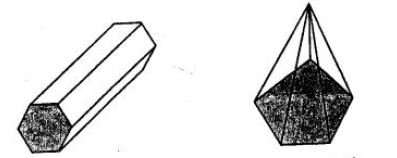
Answer:
Net of hexagonal prism:
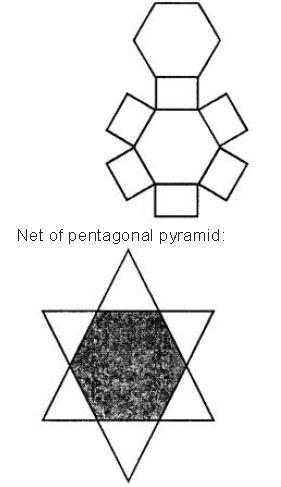
In simple words: The hexagonal prism net has six rectangular panels in a line with two hexagons on opposite sides. The pentagonal pyramid net has a pentagon in the center with five triangles around it.
Exam Tip: Always make sure the number of side shapes in your net matches the number of edges on the base of the polyhedron.
Verified Textbook Solutions for Class 8 Mathematics Chapter 19 Representing 3 D in 2 D
Detailed Textbook Solutions: Chapter 19 Representing 3 D in 2 D (Class 8 Mathematics)
Review accurate ICSE solutions for Chapter 19 Representing 3 D in 2 D tailored for Class 8 Mathematics students. Use these step-by-step notes to simplify difficult textbook exercises and improve exam readiness.
Concept Clarification for Chapter 19 Representing 3 D in 2 D
Tackle complex theorems and numerical problems easily by cross-referencing your working steps with our structured solution guides.
Effective Revision Strategies for Chapter 19 Representing 3 D in 2 D
Pair your solution review with additional practice papers to test your execution speed and ensure total preparedness for school exams.
FAQs
You can download the verified Selina Concise solutions for Chapter 19 Representing 3 D in 2 D on StudiesToday.com. Our teachers have prepared answers for Class 8 Mathematics as per 2026-27 ICSE academic session.
Yes, our solutions for Chapter 19 Representing 3 D in 2 D are designed as per new 2026 ICSE standards. 40% competency-based questions required for Class 8, are included to help students understand application-based logic behind every Mathematics answer.
Yes, every exercise in Chapter 19 Representing 3 D in 2 D from the Selina Concise textbook has been solved step-by-step. Class 8 students will learn Mathematics conceots before their ICSE exams.
Yes, follow structured format of these Selina Concise solutions for Chapter 19 Representing 3 D in 2 D to get full 20% internal assessment marks and use Class 8 Mathematics projects and viva preparation as per ICSE 2026 guidelines.