

Class 6 Mathematics Chapter 31 Recognition of Solids: Selina Concise Study Material
Explore the complete Selina Concise textbook solutions for Class 6 Mathematics. Tailored for the 2026-27 curriculum, this resource breaks down complex topics to support daily study and targeted revision.
Chapter 31 Recognition of Solids Answer Guide
Navigate directly to the Chapter 31 Recognition of Solids solutions using the digital viewer below. Organizing your study sessions chapter-by-chapter allows for seamless offline study and quick reference during revision.
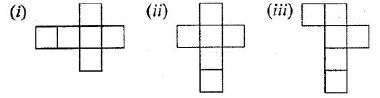
Question 1. Identify the nets which can be used to form cubes :

Answer: Out of the given nets, only (ii), (iii), and (iv) can fold to make a cube.
In simple words: The patterns in (ii), (iii), and (iv) can be folded to form a perfect box.
Exam Tip: Remember that a valid net for a cube must have exactly six square faces and no overlapping parts when folded.
Question 2. Draw at least three different nets for making cube.
Answer:
Three different patterns that can fold into a cube are shown above.
In simple words: Here are three different flat shapes that you can fold to build a cube.
Exam Tip: When drawing nets, make sure all six squares are of equal size so they fit together perfectly.
Question 3. The dimensions of a cuboid are 6 cm, 4 cm and 3 cm. Draw two different types of oblique sketches for this cuboid.
Answer:
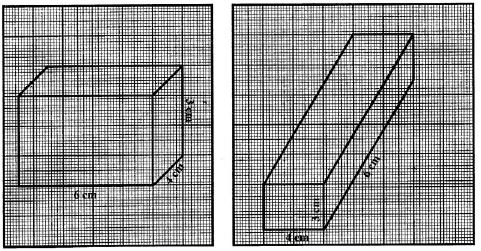
The two drawings above represent the same cuboid drawn from different angles.
In simple words: These are two ways to draw a box of size 6 cm by 4 cm by 3 cm on grid paper.
Exam Tip: In oblique sketches, keep the front face to its true scale while drawing the depth lines at a 45-degree angle.
Question 4. Two cubes, each with 3 cm edge, are placed side by side to form a cuboid. For this cuboid, draw :
(i) an oblique sketch
(ii) an isometric sketch.
Answer: When two identical 3 cm cubes are joined, they form a cuboid with length 6 cm, width 3 cm, and height 3 cm.
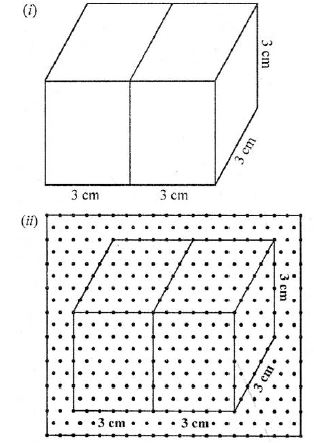
In simple words: Putting two cubes side by side makes a longer box. These drawings show how it looks on different types of paper.
Exam Tip: Be sure to draw the line where the two cubes meet to clearly show they are placed side by side.
Question 5. The figure, given below, shows shadows of some 3D objects, when seen under the lamp of an overhead projector :
In each case, name the object.
Answer:
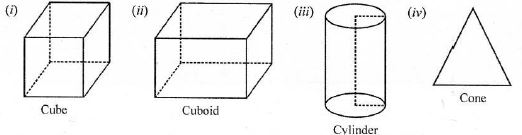
(i) A cube (or a sphere) casts a square shadow.
(ii) A cuboid casts a rectangular shadow.
(iii) A cylinder casts a circular shadow when viewed from the top.
(iv) A cone casts a triangular shadow when light shines from the side.
In simple words: Different solid shapes make different shadows when you shine a light on them.
Exam Tip: Think about which 3D objects can project flat shapes like circles, squares, or triangles when light hits them from different directions.
Question 6. Look at the solids, drawn below, and fill the given chart.
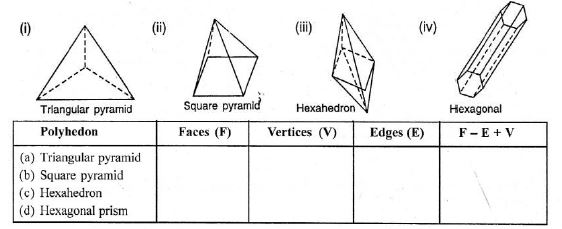
Answer: We can find the number of faces, vertices, and edges for each shape, then verify Euler's formula \( F - E + V = 2 \):
| Polyhedron | Faces (F) | Vertices (V) | Edges (E) | \( F - E + V \) |
|---|---|---|---|---|
| (a) Triangular pyramid | 4 | 4 | 6 | 2 |
| (b) Square pyramid | 5 | 5 | 8 | 2 |
| (c) Hexahedron | 8 | 6 | 12 | 2 |
| (d) Hexagonal prism | 8 | 12 | 18 | 2 |
In simple words: This table shows how many flat sides, corners, and straight lines each shape has. When you calculate Faces - Edges + Vertices, the answer is always 2.
Exam Tip: Euler's formula \( F + V - E = 2 \) is a useful tool to verify your count of faces, vertices, and edges for any simple polyhedron.
Question P.Q. Using Euler’s formula, find the values of a, b, c and d.
| Faces | \( a \) | 5 | 20 | 6 |
|---|---|---|---|---|
| Vertices | 6 | \( b \) | 12 | \( d \) |
| Edges | 12 | 9 | \( c \) | 12 |
Answer: We can use Euler's relation \( F + V - E = 2 \) to calculate the missing values:
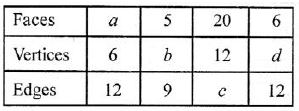
(i) For the first solid, we have \( a + 6 - 12 = 2 \). This simplifies to \( a - 6 = 2 \), which gives \( a = 8 \).
(ii) For the second solid, we have \( 5 + b - 9 = 2 \). This simplifies to \( b - 4 = 2 \), which gives \( b = 6 \).
(iii) For the third solid, we have \( 20 + 12 - c = 2 \). This simplifies to \( 32 - c = 2 \), which gives \( c = 30 \).
(iv) For the fourth solid, we have \( 6 + d - 12 = 2 \). This simplifies to \( d - 6 = 2 \), which gives \( d = 8 \).
In simple words: Use the rule Faces + Corners - Lines = 2 to find the blank values in each column.
Exam Tip: Be careful with basic addition and subtraction when rearranging Euler's formula to solve for the unknown variable.
Question P.Q. Using an isometric dot paper, draw :
(i) a cube with each edge 3 cm.
(ii) a cuboid measuring 5 cm x 4 cm x 3 cm.
Answer:
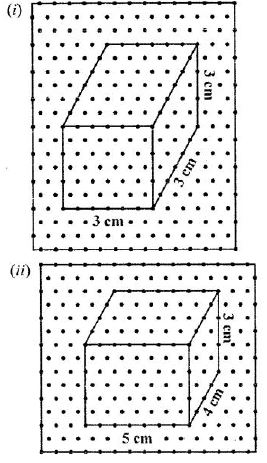
In simple words: This shows how to draw a cube and a box on a grid made of dots.
Exam Tip: On isometric paper, all three axes of the 3D drawing are scaled equally, meaning vertical edges remain vertical while horizontal edges are drawn at 30-degree angles.
Question 7. Dice are cubes with dot or dots on each face. Opposite faces of a die always have a total of seven on them.
Below are given two nets to make dice (cube), the numbers inserted in each square indicate the number of dots in it.
Insert suitable numbers in each blank so that numbers in opposite faces of the die have a total of seven dots.

Answer: Since opposite faces on a standard die must sum to 7, we can fill in the blank squares so that each pair of opposite faces satisfies this rule:
(i)- The face opposite to 1 is 6 (since \( 1 + 6 = 7 \)).
- The face opposite to 2 is 5 (since \( 2 + 5 = 7 \)).
- The face opposite to 3 is 4 (since \( 3 + 4 = 7 \)).
(ii)- The face opposite to 1 is 6 (since \( 1 + 6 = 7 \)).
- The face opposite to 2 is 5 (since \( 2 + 5 = 7 \)).
- The face opposite to 3 is 4 (since \( 3 + 4 = 7 \)).

In simple words: On any standard die, opposite sides always add up to 7. We can use this rule to find the missing numbers.
Exam Tip: Try mentally folding the net to clearly see which faces will end up on opposite sides of each other.
Question 8. The following figure represents mets of some solids. Name the solids.
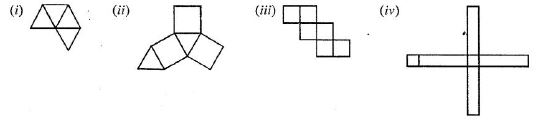
Answer: The 3D shapes formed by folding these flat patterns are:
(i) Tetrahedron (a triangular-based pyramid)
(ii) Triangular prism
(iii) Cube
(iv) Cuboid
In simple words: When you fold up these paper designs, they make a pyramid, a triangular box, a square block, and a rectangular box.
Exam Tip: Pay close attention to the 2D shapes making up the net; triangular faces fold into pyramids or prisms, whereas rectangular faces form cuboids.
Step-by-Step Solutions for Class 6 Mathematics Chapter 31 Recognition of Solids
About ICSE Solutions for Class 6 Mathematics Chapter 31 Recognition of Solids
Access structured ICSE solutions for Class 6 Mathematics Chapter 31 Recognition of Solids designed to match CISCE curriculum standards. These verified answers help clarify complex numericals and support daily homework revision.
Step-by-Step Explanations and Breakdown
Every exercise question in this chapter includes step-by-step working steps, allowing you to self-evaluate, catch mistakes early, and understand the underlying logic.
More Study Resources for Class 6 Mathematics
Pair your solution review with additional practice papers to test your execution speed and ensure total preparedness for school exams.
FAQs
You can download the verified Selina Concise solutions for Chapter 31 Recognition of Solids on StudiesToday.com. Our teachers have prepared answers for Class 6 Mathematics as per 2026-27 ICSE academic session.
Yes, our solutions for Chapter 31 Recognition of Solids are designed as per new 2026 ICSE standards. 40% competency-based questions required for Class 6, are included to help students understand application-based logic behind every Mathematics answer.
Yes, every exercise in Chapter 31 Recognition of Solids from the Selina Concise textbook has been solved step-by-step. Class 6 students will learn Mathematics conceots before their ICSE exams.
Yes, follow structured format of these Selina Concise solutions for Chapter 31 Recognition of Solids to get full 20% internal assessment marks and use Class 6 Mathematics projects and viva preparation as per ICSE 2026 guidelines.