

Class 6 Mathematics Chapter 27 Quadrilateral: Selina Concise Study Material
Access the official Selina Concise textbook solutions for Class 6 Mathematics, updated for the 2026-27 academic year. This digital resource is structured to help students build strong conceptual clarity and prepare effectively for school examinations.
Chapter 27 Quadrilateral Answer Guide
Navigate directly to the Chapter 27 Quadrilateral solutions using the digital viewer below. Organizing your study sessions chapter-by-chapter allows for seamless offline study and quick reference during revision.
Important Points
4. Quadrilateral
A quadrilateral is a flat, two-dimensional shape bounded by four straight sides. It contains four sides, four interior angles, and four vertices.
For the quadrilateral ABCD shown below:
- The four sides are: AB, BC, CD, and DA.
- The four interior angles are: \( \angle ABC \), \( \angle BCD \), \( \angle CDA \), and \( \angle DAB \) (which can also be represented as \( \angle 1 \), \( \angle 2 \), \( \angle 3 \), and \( \angle 4 \) respectively).
- The four vertices are: A, B, C, and D.
5. Diagonals of a Quadrilateral
The line segments that connect the opposite vertices of a quadrilateral are known as its diagonals.
The figure below depicts a quadrilateral PQRS with its diagonals, PR and QS.
6. Types of Quadrilaterals
1. Trapezium
A trapezium is a quadrilateral that has exactly one pair of parallel opposite sides.
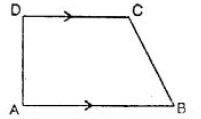
The diagram below displays a trapezium ABCD where the sides AB and DC are parallel (written as \( AB \parallel DC \)).
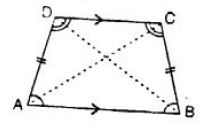
If the non-parallel sides of a trapezium are equal in length, it is referred to as an isosceles trapezium.
The subsequent illustration shows an isosceles trapezium ABCD where the non-parallel sides AD and BC have equal lengths (meaning \( AD = BC \)).
Additionally, in any isosceles trapezium:
- The base angles are equal: \( \angle A = \angle B \) and \( \angle D = \angle C \).
- The diagonals are equal: \( AC = BD \).
2. Parallelogram
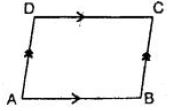
A parallelogram is a quadrilateral with both pairs of opposite sides parallel to each other.
The figure ABCD shown below represents a parallelogram because \( AB \parallel DC \) and \( AD \parallel BC \).
In any parallelogram ABCD:
- The opposite sides have equal lengths: \( AB = DC \) and \( AD = BC \).
- The opposite angles are equal in measure: \( \angle ABC = \angle ADC \) and \( \angle BCD = \angle BAD \).
- The diagonals bisect each other at their intersection point \( O \): \( OA = OC = \frac{1}{2} AC \) and \( OB = OD = \frac{1}{2} BD \).
7. Some Special Types of Parallelograms
(a) Rhombus
A rhombus is a parallelogram that has all four sides of equal length.
Thus, in a rhombus ABCD:
- The opposite sides are parallel to each other: \( AB \parallel DC \) and \( AD \parallel BC \).
- All four sides are equal in length: \( AB = BC = CD = DA \).
- The opposite angles have equal measures: \( \angle A = \angle C \) and \( \angle B = \angle D \).
- The diagonals bisect each other at right angles: \( OA = OC = \frac{1}{2} AC \), \( OB = OD = \frac{1}{2} BD \), and \( \angle AOB = \angle BOC = \angle COD = \angle AOD = 90^\circ \).
- The diagonals bisect the interior angles at the vertices: \( \angle 1 = \angle 2 \), \( \angle 3 = \angle 4 \), \( \angle 5 = \angle 6 \), and \( \angle 7 = \angle 8 \).
(b) Rectangle
A rectangle is a parallelogram in which at least one angle measures \( 90^\circ \). Alternatively, it can be defined as a quadrilateral where all four angles are \( 90^\circ \).
Note: If a parallelogram contains one right angle, then all of its angles are automatically right angles. This is because opposite angles in a parallelogram are equal, and adjacent angles are supplementary.
The properties of a rectangle include:
- The opposite sides are parallel.
- The opposite sides are equal in length.
- Every interior angle is a right angle (\( 90^\circ \)).
- The diagonals have equal lengths.
- The diagonals bisect each other.
(c) Square
A square is a parallelogram where all four sides are of equal length and every angle is a right angle (\( 90^\circ \)).
Alternatively, a square can be defined as:
- A rhombus with one right angle.
- A rectangle with all sides equal.
- A quadrilateral with all four sides equal and all four angles equal to \( 90^\circ \).
Thus, if ABCD is a square:
- All sides are equal: \( AB = BC = CD = DA \).
- Each interior angle is a right angle: \( \angle A = \angle B = \angle C = \angle D = 90^\circ \).
- The diagonals are equal: \( AC = BD \).
- The diagonals bisect each other at right angles: \( OA = OC = \frac{1}{2} AC \), \( OB = OD = \frac{1}{2} BD \), and \( \angle AOB = \angle BOC = \angle COD = \angle DOA = 90^\circ \). Since the diagonals are equal, it follows that \( OA = OC = OB = OD \).
- The diagonals bisect the angles at the vertices, dividing each into two \( 45^\circ \) angles: \( \angle 1 = \angle 2 = 45^\circ \) (since \( \angle 1 + \angle 2 = 90^\circ \)). Similarly, \( \angle 3 = \angle 4 = 45^\circ \), \( \angle 5 = \angle 6 = 45^\circ \), and \( \angle 7 = \angle 8 = 45^\circ \).
Question 1. Two angles of a quadrilateral are 89° and 113°. If the other two angles are equal; find the equal angles.
Answer:
Let the other two equal angles each measure \( x^\circ \).
Since the sum of the four interior angles of any quadrilateral is \( 360^\circ \), we can set up the following equation:
\( 89^\circ + 113^\circ + x^\circ + x^\circ = 360^\circ \)
Adding the known values and combining the variable terms gives:
\( 202^\circ + 2x^\circ = 360^\circ \)
Now, subtract \( 202^\circ \) from both sides:
\( 2x^\circ = 360^\circ - 202^\circ \)
\( 2x^\circ = 158^\circ \)
Divide both sides by 2 to solve for \( x \):
\( x^\circ = \frac{158^\circ}{2} = 79^\circ \)
Therefore, each of the other two angles measures \( 79^\circ \).
In simple words: The four angles in any quadrilateral must add up to \( 360^\circ \). We subtract the two known angles from \( 360^\circ \) and then split the remaining amount equally to get \( 79^\circ \) for each of the two unknown angles.
Exam Tip: Always state the angle sum property of quadrilaterals at the beginning of your solution to secure full steps marks.
Question 2. Two angles of a quadrilateral are 68° and 76°. If the other two angles are in the ratio 5 : 7; find the measure of each of them.
Answer:
Let the other two angles be represented as \( 5x^\circ \) and \( 7x^\circ \) based on the given ratio of \( 5 : 7 \).
We know that the sum of all interior angles of a quadrilateral is \( 360^\circ \).
So, we write the equation:
\( 68^\circ + 76^\circ + 5x^\circ + 7x^\circ = 360^\circ \)
Combine the constant values and the variable terms:
\( 144^\circ + 12x^\circ = 360^\circ \)
Subtract \( 144^\circ \) from both sides:
\( 12x^\circ = 360^\circ - 144^\circ \)
\( 12x^\circ = 216^\circ \)
Divide both sides by 12:
\( x = \frac{216^\circ}{12} = 18^\circ \)
Now, we calculate the measure of each angle using the value of \( x \):
First unknown angle = \( 5 \times 18^\circ = 90^\circ \)
Second unknown angle = \( 7 \times 18^\circ = 126^\circ \)
Thus, the two required angles measure \( 90^\circ \) and \( 126^\circ \).
In simple words: When given a ratio for the angles, we attach a variable like \( x \) to make them \( 5x \) and \( 7x \). We add them to the other angles to equal \( 360^\circ \), solve for \( x \), and find the final angles.
Exam Tip: When a ratio is provided, always introduce a common variable like \( x \) to represent the parts before constructing your algebraic equation.
Question 3. Angles of a quadrilateral are (4x)°, 5(x+2)°, (7x-20)° and 6(x+3)°. Find
(i) the value of x.
(ii) each angle of the quadrilateral.
Answer:
(i) The sum of the interior angles of a quadrilateral is \( 360^\circ \).
Therefore, we sum the four given expressions:
\( 4x + 5(x+2) + (7x-20) + 6(x+3) = 360^\circ \)
Expand the parentheses:
\( 4x + 5x + 10 + 7x - 20 + 6x + 18 = 360^\circ \)
Group and combine like terms:
\( 22x + 8 = 360^\circ \)
Subtract 8 from both sides:
\( 22x = 360^\circ - 8^\circ \)
\( 22x = 352^\circ \)
Divide by 22:
\( x = \frac{352^\circ}{22} = 16^\circ \)
So, the value of \( x \) is 16.
(ii) We substitute the value \( x = 16 \) back into each expression to determine the individual angles:
First angle = \( (4 \times 16)^\circ = 64^\circ \)
Second angle = \( 5(16 + 2)^\circ = 5 \times 18^\circ = 90^\circ \)
Third angle = \( (7 \times 16 - 20)^\circ = (112 - 20)^\circ = 92^\circ \)
Fourth angle = \( 6(16 + 3)^\circ = 6 \times 19^\circ = 114^\circ \)
The measures of the angles are \( 64^\circ \), \( 90^\circ \), \( 92^\circ \), and \( 114^\circ \).
In simple words: We add up all the expressions representing the four angles to equal \( 360^\circ \). Solving this equation gives us the value of \( x \), which we then use to find each angle's exact degree.
Exam Tip: Be careful when distributing numbers outside the brackets - for example, \( 5(x+2) \) must become \( 5x + 10 \), not \( 5x + 2 \).
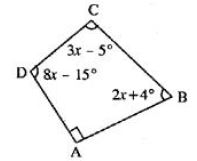
Question 4. Use the information given in the following figure to find :
(i) x
(ii) ∠B and ∠C
Answer:
(i) From the diagram, the angles are:
\( \angle A = 90^\circ \) (indicated by the right-angle square mark)
\( \angle B = (2x + 4)^\circ \)
\( \angle C = (3x - 5)^\circ \)
\( \angle D = (8x - 15)^\circ \)
Adding all the interior angles to equal \( 360^\circ \):
\( \angle A + \angle B + \angle C + \angle D = 360^\circ \)
\( 90^\circ + (2x + 4)^\circ + (3x - 5)^\circ + (8x - 15)^\circ = 360^\circ \)
Combine the \( x \) variables and constant terms:
\( (2x + 3x + 8x) + (90 + 4 - 5 - 15) = 360^\circ \)
\( 13x + 74 = 360^\circ \)
Subtract 74 from both sides:
\( 13x = 360^\circ - 74^\circ \)
\( 13x = 286^\circ \)
Divide by 13:
\( x = 22^\circ \)
(ii) We can now substitute \( x = 22 \) to find the measures of \( \angle B \) and \( \angle C \):
\( \angle B = (2 \times 22 + 4)^\circ = (44 + 4)^\circ = 48^\circ \)
\( \angle C = (3 \times 22 - 5)^\circ = (66 - 5)^\circ = 61^\circ \)
In simple words: The corner marked with a square is \( 90^\circ \). We add this value and the other three expressions together to get \( 360^\circ \). After finding \( x = 22 \), we insert it back to calculate the angles for B and C.
Exam Tip: Be sure to identify the square symbol on any angle as a given \( 90^\circ \) angle, even if it is not explicitly written in text.
Question 5. In quadrilateral ABCD, side AB is parallel to side DC. If ∠A : ∠D = 1 : 2 and ∠C : ∠B = 4:5
(i) Calculate each angle of the quadrilateral.
(ii) Assign a special name to quadrilateral ABCD.
Answer:
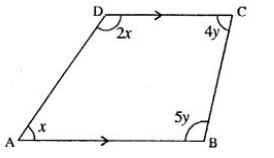
(i) Since the sides \( AB \) and \( DC \) are parallel (\( AB \parallel DC \)), the consecutive interior angles on the same side of each transversal line are supplementary (they sum up to \( 180^\circ \)).
Therefore, we have:
\( \angle A + \angle D = 180^\circ \)
and
\( \angle B + \angle C = 180^\circ \)
Given the ratio \( \angle A : \angle D = 1 : 2 \):
Let \( \angle A = x \) and \( \angle D = 2x \).
So,
\( x + 2x = 180^\circ \)
\( 3x = 180^\circ \)
\( x = 60^\circ \)
Using this, we find:
\( \angle A = 60^\circ \)
\( \angle D = 2 \times 60^\circ = 120^\circ \)
Given the ratio \( \angle C : \angle B = 4 : 5 \):
Let \( \angle C = 4y \) and \( \angle B = 5y \).
So,
\( 4y + 5y = 180^\circ \)
\( 9y = 180^\circ \)
\( y = 20^\circ \)
Using this, we find:
\( \angle C = 4 \times 20^\circ = 80^\circ \)
\( \angle B = 5 \times 20^\circ = 100^\circ \)
Therefore, the angles of the quadrilateral are \( \angle A = 60^\circ \), \( \angle B = 100^\circ \), \( \angle C = 80^\circ \), and \( \angle D = 120^\circ \).
(ii) Because the quadrilateral \( ABCD \) has exactly one pair of parallel opposite sides (\( AB \parallel DC \)), it is a **trapezium**.
In simple words: Parallel lines mean the left angles add to \( 180^\circ \) and the right angles add to \( 180^\circ \). Solving these equations gives us all four angles, and because only one pair of opposite sides is parallel, the shape is called a trapezium.
Exam Tip: Do not confuse the co-interior angle rule by trying to sum angles across the non-parallel sides. Always check which pair of lines is marked parallel.
Question 6. From the following figure find ;
(i) x,
(ii) ∠ABC,
(iii) ∠ACD.
Answer:
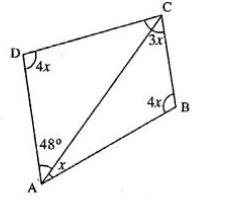
(i) The sum of the interior angles of quadrilateral \( ABCD \) is equal to \( 360^\circ \).
Based on the diagram, the angles are:
\( \angle DAB = 48^\circ + x \)
\( \angle ADC = 4x \)
\( \angle BCD = 3x \)
\( \angle ABC = 4x \)
Adding these together:
\( (48^\circ + x) + 4x + 3x + 4x = 360^\circ \)
Combine all the variable terms and constants:
\( 12x + 48^\circ = 360^\circ \)
Subtract \( 48^\circ \) from both sides:
\( 12x = 312^\circ \)
Divide by 12:
\( x = 26^\circ \)
(ii) Calculate \( \angle ABC \):
\( \angle ABC = 4x = 4 \times 26^\circ = 104^\circ \)
(iii) Calculate \( \angle ACD \):
In triangle \( ACD \), the sum of the three interior angles is \( 180^\circ \):
\( \angle DAC + \angle ADC + \angle ACD = 180^\circ \)
\( 48^\circ + 4x + \angle ACD = 180^\circ \)
Substitute \( x = 26^\circ \) into the equation:
\( 48^\circ + 4(26^\circ) + \angle ACD = 180^\circ \)
\( 48^\circ + 104^\circ + \angle ACD = 180^\circ \)
\( 152^\circ + \angle ACD = 180^\circ \)
\( \angle ACD = 180^\circ - 152^\circ = 28^\circ \)
In simple words: First, we add all the angles of the full quadrilateral to solve for \( x = 26^\circ \). After finding \( x \), we use the top triangle \( ACD \) where the angles must add up to \( 180^\circ \), letting us calculate the remaining angle at corner C.
Exam Tip: A diagonal divides a quadrilateral into two triangles. You can use the properties of triangles (angles sum to \( 180^\circ \)) to find missing segment angles.
Question 7. Given : In quadrilateral ABCD ; ∠C = 64°, ∠D = ∠C – 8° ; ∠A = 5(a+2)° and ∠B = 2(2a+7)°. Calculate ∠A.
Answer:
First, find the measure of \( \angle D \):
\( \angle D = \angle C - 8^\circ = 64^\circ - 8^\circ = 56^\circ \)
The total sum of all interior angles of quadrilateral \( ABCD \) is \( 360^\circ \):
\( \angle A + \angle B + \angle C + \angle D = 360^\circ \)
Substitute the known values and algebraic expressions:
\( 5(a + 2)^\circ + 2(2a + 7)^\circ + 64^\circ + 56^\circ = 360^\circ \)
Expand the brackets:
\( 5a + 10 + 4a + 14 + 120 = 360 \)
Combine the like terms:
\( 9a + 144 = 360 \)
Subtract 144 from both sides:
\( 9a = 360 - 144 \)
\( 9a = 216 \)
Divide by 9:
\( a = \frac{216}{9} = 24 \)
Now, calculate \( \angle A \):
\( \angle A = 5(a + 2)^\circ = 5(24 + 2)^\circ = 5 \times 26^\circ = 130^\circ \)
In simple words: We find \( \angle D \) by subtracting \( 8^\circ \) from \( \angle C \). Then we add all four angles together to make \( 360^\circ \), solve for \( a = 24 \), and plug that value back in to find \( \angle A \).
Exam Tip: Ensure that you solve for the actual angle asked in the question (like \( \angle A \)) rather than stopping once you find the value of the variable \( a \).
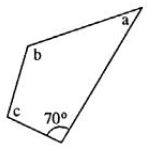
Question 8. In the given figure : ∠b = 2a + 15 and ∠c = 3a + 5; find the values of b and c.
Answer:
The sum of the interior angles of a quadrilateral is \( 360^\circ \).
Based on the given figure, the angles are \( 70^\circ \), \( a^\circ \), \( \angle b \), and \( \angle c \).
So, we have:
\( 70 + a + \angle b + \angle c = 360 \)
Substitute the given expressions for \( \angle b \) and \( \angle c \):
\( 70 + a + (2a + 15) + (3a + 5) = 360 \)
Group and add the variable terms and constants together:
\( (a + 2a + 3a) + (70 + 15 + 5) = 360 \)
\( 6a + 90 = 360 \)
Subtract 90 from both sides:
\( 6a = 270 \)
Divide by 6:
\( a = 45 \)
Now, calculate the values of \( \angle b \) and \( \angle c \) by substituting \( a = 45 \):
\( \angle b = 2(45) + 15 = 90 + 15 = 105^\circ \)
\( \angle c = 3(45) + 5 = 135 + 5 = 140^\circ \)
Therefore, the values of \( b \) and \( c \) are \( 105^\circ \) and \( 140^\circ \) respectively.
In simple words: We write an equation setting the sum of all angles in the shape to \( 360^\circ \) using \( a \) as our single variable. After finding \( a = 45 \), we use it to calculate the exact degrees of the other angles.
Exam Tip: Always double check your calculations by summing the four final angles to make sure they add up to exactly \( 360^\circ \).
Question 9. Three angles of a quadrilateral are equal. If the fourth angle is 69°; find the measure of equal angles.
Answer:
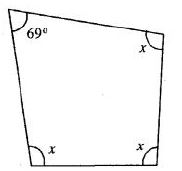
Let the measure of each of the three equal angles be \( x^\circ \).
Since the sum of the angles of a quadrilateral is \( 360^\circ \), we can write:
\( x^\circ + x^\circ + x^\circ + 69^\circ = 360^\circ \)
\( 3x^\circ + 69^\circ = 360^\circ \)
Subtract \( 69^\circ \) from both sides:
\( 3x^\circ = 360^\circ - 69^\circ \)
\( 3x^\circ = 291^\circ \)
Divide both sides by 3:
\( x^\circ = 97^\circ \)
Hence, the measure of each equal angle is \( 97^\circ \).
In simple words: Since three angles are the same, we call them all \( x \). Together with the \( 69^\circ \) angle, they must add up to \( 360^\circ \). Solving this shows that each equal angle is \( 97^\circ \).
Exam Tip: Clearly define the variable you use for equal values at the beginning of your calculation to maintain a neat and well-structured answer sheet.
Question 10. In quadrilateral PQRS, ∠P : ∠Q : ∠R : ∠S = 3 : 4 : 6 : 7. Calculate each angle of the quadrilateral and then prove that PQ and SR are parallel to each other. Is PS also parallel to QR ?
Answer:
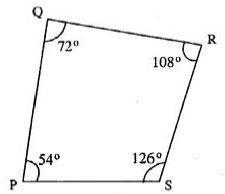
Let the measures of the angles be \( \angle P = 3x \), \( \angle Q = 4x \), \( \angle R = 6x \), and \( \angle S = 7x \).
Since the sum of the angles of a quadrilateral is \( 360^\circ \):
\( \angle P + \angle Q + \angle R + \angle S = 360^\circ \)
\( 3x + 4x + 6x + 7x = 360^\circ \)
\( 20x = 360^\circ \)
Divide by 20:
\( x = 18^\circ \)
Now, calculate each individual angle:
\( \angle P = 3 \times 18^\circ = 54^\circ \)
\( \angle Q = 4 \times 18^\circ = 72^\circ \)
\( \angle R = 6 \times 18^\circ = 108^\circ \)
\( \angle S = 7 \times 18^\circ = 126^\circ \)
To prove whether \( PQ \parallel SR \), let's check the co-interior angle sums:
\( \angle Q + \angle R = 72^\circ + 108^\circ = 180^\circ \)
and
\( \angle P + \angle S = 54^\circ + 126^\circ = 180^\circ \)
Since the sum of consecutive interior angles on the same side is \( 180^\circ \), the lines \( PQ \) and \( SR \) are parallel (\( PQ \parallel SR \)).
Now, let's test whether \( PS \) and \( QR \) are parallel by checking their co-interior angle sum:
\( \angle P + \angle Q = 54^\circ + 72^\circ = 126^\circ \neq 180^\circ \)
Because this sum is not equal to \( 180^\circ \), the lines \( PS \) and \( QR \) are not parallel.
In simple words: We find the angles using the ratio, getting \( 54^\circ \), \( 72^\circ \), \( 108^\circ \), and \( 126^\circ \). The top and bottom angles add to \( 180^\circ \), proving those lines are parallel. The left and right side angles do not add to \( 180^\circ \), so they are not parallel.
Exam Tip: Remember that two lines are parallel if and only if their interior consecutive angles add up to exactly \( 180^\circ \). State this definition clearly in your proofs.
Question 11. Use the information given in the following figure to find the value of x.
Answer:
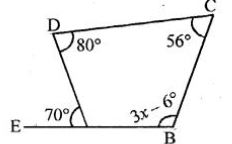
Let the vertices of the quadrilateral be labeled \( A \), \( B \), \( C \), and \( D \). Let the line \( BA \) be extended to a point \( E \).
Since \( EAB \) is a straight line, the angles \( \angle EAD \) and \( \angle DAB \) form a linear pair:
\( \angle EAD + \angle DAB = 180^\circ \)
Given \( \angle EAD = 70^\circ \):
\( 70^\circ + \angle DAB = 180^\circ \)
\( \angle DAB = 180^\circ - 70^\circ = 110^\circ \)
The sum of all interior angles of the quadrilateral is \( 360^\circ \):
\( \angle DAB + \angle ADC + \angle DCB + \angle ABC = 360^\circ \)
Substitute the known angles and expressions:
\( 110^\circ + 80^\circ + 56^\circ + (3x - 6)^\circ = 360^\circ \)
Combine the constant numbers:
\( 246^\circ + 3x - 6^\circ = 360^\circ \)
\( 240^\circ + 3x = 360^\circ \)
Subtract \( 240^\circ \) from both sides:
\( 3x = 360^\circ - 240^\circ \)
\( 3x = 120^\circ \)
Divide by 3:
\( x = \frac{120^\circ}{3} = 40^\circ \)
So, the value of \( x \) is 40.
In simple words: First, we find the inner angle at A by subtracting the outside angle \( 70^\circ \) from \( 180^\circ \) (since they are on a straight line). Then we make all the inner angles add up to \( 360^\circ \), helping us find \( x = 40 \).
Exam Tip: Be sure to write down the reasoning "angles on a straight line" or "linear pair" when calculating the interior angle to explain your steps clearly.
Question 12. The following figure shows a quadrilateral in which sides AB and DC are parallel. If ∠A : ∠D = 4 : 5, ∠B = (3x – 15)° and ∠C = (4x + 20)°, find each angle of the quadrilateral ABCD.
Answer:
Since \( AB \parallel DC \), the co-interior angles between the parallel lines are supplementary:
\( \angle A + \angle D = 180^\circ \)
and
\( \angle B + \angle C = 180^\circ \)
Given \( \angle A : \angle D = 4 : 5 \), let \( \angle A = 4y \) and \( \angle D = 5y \).
So,
\( 4y + 5y = 180^\circ \)
\( 9y = 180^\circ \)
\( y = 20^\circ \)
Substituting this back gives:
\( \angle A = 4 \times 20^\circ = 80^\circ \)
\( \angle D = 5 \times 20^\circ = 100^\circ \)
Now, solve for \( x \) using the relation for \( \angle B \) and \( \angle C \):
\( \angle B + \angle C = 180^\circ \)
\( (3x - 15)^\circ + (4x + 20)^\circ = 180^\circ \)
Combine the terms:
\( 7x + 5 = 180 \)
Subtract 5 from both sides:
\( 7x = 175 \)
Divide by 7:
\( x = 25^\circ \)
Substitute \( x = 25 \) to find the measures of \( \angle B \) and \( \angle C \):
\( \angle B = 3(25) - 15 = 75 - 15 = 60^\circ \)
\( \angle C = 4(25) + 20 = 100 + 20 = 120^\circ \)
The angles of the quadrilateral are \( \angle A = 80^\circ \), \( \angle B = 60^\circ \), \( \angle C = 120^\circ \), and \( \angle D = 100^\circ \).
In simple words: The parallel top and bottom lines mean we can solve for the left and right angles separately since each pair adds up to \( 180^\circ \). Solving these two separate parts gives us the values for all four corners.
Exam Tip: Since this problem contains two independent sets of variables, use a different variable letter (like \( y \)) for the ratio and \( x \) for the algebra expressions to keep the equations clean.
Exercise 27(B)
Question 1. In a trapezium ABCD, side AB is parallel to side DC. If ∠A = 78° and ∠C = 120°, find angles B and D.
Answer:
In trapezium \( ABCD \), \( AB \parallel DC \). The angles along each transversal side are co-interior angles and add up to \( 180^\circ \).
Therefore, we have:
\( \angle A + \angle D = 180^\circ \)
and
\( \angle B + \angle C = 180^\circ \)
Substitute the known value \( \angle A = 78^\circ \):
\( 78^\circ + \angle D = 180^\circ \)
\( \angle D = 180^\circ - 78^\circ = 102^\circ \)
Substitute the known value \( \angle C = 120^\circ \):
\( \angle B + 120^\circ = 180^\circ \)
\( \angle B = 180^\circ - 120^\circ = 60^\circ \)
Therefore, \( \angle B = 60^\circ \) and \( \angle D = 102^\circ \).
In simple words: For a trapezium with parallel top and bottom lines, the angles on the left add to \( 180^\circ \) and the angles on the right add to \( 180^\circ \). We subtract each given angle from \( 180^\circ \) to find the other two.
Exam Tip: Remember that in a trapezium, the angles that add up to \( 180^\circ \) are adjacent to the non-parallel sides.
Question 2. In a trapezium ABCD, side AB is parallel to side DC. If ∠A = x° and ∠D = (3x – 20)°; find the value of x.
Answer:
Since \( AB \parallel DC \), the angles \( \angle A \) and \( \angle D \) are co-interior angles on the transversal line \( AD \).
Their sum must equal \( 180^\circ \):
\( \angle A + \angle D = 180^\circ \)
\( x^\circ + (3x - 20)^\circ = 180^\circ \)
Combine the like terms:
\( 4x - 20 = 180 \)
Add 20 to both sides:
\( 4x = 200 \)
Divide by 4:
\( x = \frac{200}{4} = 50^\circ \)
So, the value of \( x \) is 50.
In simple words: Since the top and bottom lines of this trapezium are parallel, the two angles on the left side add up to \( 180^\circ \). Solving this equation shows that \( x \) is 50.
Exam Tip: Avoid the mistake of equating adjacent angles in a trapezium - they are supplementary (sum to \( 180^\circ \)), not equal.
Question 3. The angles A, B, C and D of a trapezium ABCD are in the ratio 3 : 4 : 5 : 6. Le. ∠A : ∠B : ∠C : ∠D = 3:4: 5 : 6. Find all the angles of the trapezium. Also, name the two sides of this trapezium which are parallel to each other. Give reason for your answer
Answer:
Let the angles of the trapezium be \( \angle A = 3x \), \( \angle B = 4x \), \( \angle C = 5x \), and \( \angle D = 6x \).
The sum of the interior angles of a quadrilateral is \( 360^\circ \):
\( \angle A + \angle B + \angle C + \angle D = 360^\circ \)
\( 3x + 4x + 5x + 6x = 360^\circ \)
\( 18x = 360^\circ \)
Divide by 18:
\( x = 20^\circ \)
Now, find each angle:
\( \angle A = 3 \times 20^\circ = 60^\circ \)
\( \angle B = 4 \times 20^\circ = 80^\circ \)
\( \angle C = 5 \times 20^\circ = 100^\circ \)
\( \angle D = 6 \times 20^\circ = 120^\circ \)
To find which sides are parallel, we calculate the sum of adjacent angles:
\( \angle A + \angle D = 60^\circ + 120^\circ = 180^\circ \)
\( \angle B + \angle C = 80^\circ + 100^\circ = 180^\circ \)
Since the co-interior angles on the transversal lines \( AD \) and \( BC \) add up to \( 180^\circ \), the sides \( AB \) and \( DC \) must be parallel to each other (\( AB \parallel DC \)).
In simple words: First we find the angles from their ratios, which gives us \( 60^\circ \), \( 80^\circ \), \( 100^\circ \), and \( 120^\circ \). Since the left side angles and the right side angles each add up to \( 180^\circ \), the top and bottom sides must be the parallel pair.
Exam Tip: In a trapezium, the parallel sides are those that connect the pairs of supplementary consecutive angles.
Question 4. In an isosceles trapezium one pair of opposite sides are ….. to each Other and the other pair of opposite sides are ….. to each other.
Answer:
In an isosceles trapezium, one pair of opposite sides is **parallel** to each other and the other pair of opposite sides is **equal** to each other.
In simple words: An isosceles trapezium is a symmetric shape where the top and bottom lines are parallel, and the two slanting sides are exactly the same length.
Exam Tip: Be sure to memorize the properties of specialized quadrilaterals like isosceles trapeziums, as they are often tested in fill-in-the-blank questions.
Question 5. Two diagonals of an isosceles trapezium are x cm and (3x – 8) cm. Find the value of x.
Answer:
By definition, the diagonals of any isosceles trapezium are of equal length.
Therefore, we can write:
\( 3x - 8 = x \)
Subtract \( x \) from both sides:
\( 3x - x = 8 \)
\( 2x = 8 \)
Divide both sides by 2:
\( x = 4 \)
Thus, the value of \( x \) is \( 4 \text{ cm} \).
In simple words: The two diagonals (crisscross lines) of a symmetric trapezium are always the same length. So, we set the two given expressions equal to each other and solve to find \( x = 4 \).
Exam Tip: Always state the geometric property you are using - in this case, "the diagonals of an isosceles trapezium are equal" - to justify your algebraic step.
Question 6. Angle A of an isosceles trapezium is 115° ; find the angles B, C and D.
Answer: For an isosceles trapezium, the base angles are always equal to each other.
\(\therefore \angle B = \angle A = 115^\circ\)
Since the parallel sides are horizontal, the interior angles on the same side, \(\angle A\) and \(\angle D\), must add up to \(180^\circ\):
\(\angle A + \angle D = 180^\circ\)
\(\implies 115^\circ + \angle D = 180^\circ\)
\(\implies \angle D = 180^\circ - 115^\circ\)
\(\implies \angle D = 65^\circ\)
Because the other set of base angles is also equal:
\(\angle C = \angle D = 65^\circ\)
Thus, the remaining angles are \(\angle B = 115^\circ\), \(\angle C = 65^\circ\), and \(\angle D = 65^\circ\).
In simple words: In a trapezium with equal sides, the bottom angles are the same and the top angles are the same. Angles that are next to each other on a side line add up to 180 degrees.
Exam Tip: Remember to state the reason "base angles of an isosceles trapezium are equal" clearly to secure full marks.
Question 7. Two opposite angles of a parallelogram are 100° each. Find each of the other two opposite angles.
Answer: Let the given opposite angles be \(\angle A = 100^\circ\) and \(\angle C = 100^\circ\).
Since adjacent angles in a parallelogram are supplementary, we can find \(\angle B\):
\(\angle A + \angle B = 180^\circ\)
\(\implies 100^\circ + \angle B = 180^\circ\)
\(\implies \angle B = 180^\circ - 100^\circ\)
\(\implies \angle B = 80^\circ\)
In a parallelogram, opposite angles are always equal to one another:
\(\angle D = \angle B = 80^\circ\)
Therefore, the remaining two opposite angles are both \(80^\circ\).
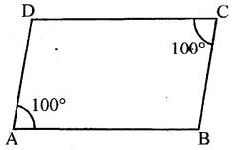
In simple words: Angles opposite to each other in a parallelogram are equal, and angles next to each other add up to 180 degrees. Using this, we find the remaining angles are 80 degrees each.
Exam Tip: Show the steps using the property of adjacent angles being supplementary first, and then apply the opposite angles property to verify.
Question 8. Two adjacent angles of a parallelogram are 70° and 110° respectively. Find the other two angles of it.
Answer: Let the two given adjacent angles be \(\angle A = 70^\circ\) and \(\angle B = 110^\circ\).
Since opposite angles in a parallelogram are equal, we can directly find the other two angles:
\(\angle C = \angle A = 70^\circ\)
\(\angle D = \angle B = 110^\circ\)
Thus, the other two angles of the parallelogram are \(70^\circ\) and \(110^\circ\).
In simple words: The opposite corners of a parallelogram always have the exact same angle. Since we know two side-by-side corners, the other two corners must match them.
Exam Tip: Write down the specific geometric property "opposite angles of a parallelogram are equal" to support your solution steps.
Question 9. The angles A, B, C and D of a quadrilateral are in the ratio 2:3: 2 : 3. Show this quadrilateral is a parallelogram.
Answer: Let the ratio of the angles be \(2x : 3x : 2x : 3x\).
So, the four angles can be written as:
\(\angle A = 2x\)
\(\angle B = 3x\)
\(\angle C = 2x\)
\(\angle D = 3x\)
The sum of the interior angles in any quadrilateral is \(360^\circ\):
\(\angle A + \angle B + \angle C + \angle D = 360^\circ\)
\(\implies 2x + 3x + 2x + 3x = 360^\circ\)
\(\implies 10x = 360^\circ\)
\(\implies x = 36^\circ\)
Now, we calculate the individual angles:
\(\angle A = 2 \times 36^\circ = 72^\circ\)
\(\angle B = 3 \times 36^\circ = 108^\circ\)
\(\angle C = 2 \times 36^\circ = 72^\circ\)
\(\angle D = 3 \times 36^\circ = 108^\circ\)
To prove ABCD is a parallelogram, we check the necessary conditions:
(i) Opposite angles are equal: \(\angle A = \angle C = 72^\circ\) and \(\angle B = \angle D = 108^\circ\).
(ii) Consecutive adjacent angles are supplementary:
\(\angle A + \angle B = 72^\circ + 108^\circ = 180^\circ\)
\(\angle C + \angle D = 72^\circ + 108^\circ = 180^\circ\)
Since these conditions are fully satisfied, quadrilateral ABCD is a parallelogram.
In simple words: We find the exact angles by dividing 360 degrees into 10 parts. The opposite angles turn out to be equal to each other, and side-by-side angles add up to 180 degrees, which proves it is a parallelogram.
Exam Tip: To get full marks, prove both conditions: that opposite angles are equal and adjacent angles are supplementary.
Question 10. In a parallelogram ABCD, its diagonals AC and BD intersect each other at point O. If AC = 12 cm and BD = 9 cm ; find; lengths of OA and OD.
Answer: In any parallelogram, the diagonals bisect each other at the point of intersection.
This means:
\(OA = OC = \frac{1}{2} AC\)
And:
\(OB = OD = \frac{1}{2} BD\)
Now, we calculate the values:
\(OA = \frac{1}{2} \times 12\text{ cm} = 6\text{ cm}\)
\(OD = \frac{1}{2} \times 9\text{ cm} = 4.5\text{ cm}\)
Thus, the lengths are \(OA = 6\text{ cm}\) and \(OD = 4.5\text{ cm}\).
In simple words: The two crossing lines in a parallelogram cut each other exactly in half. So, we just divide the total length of each diagonal by 2 to find the answers.
Exam Tip: Clearly mention the theorem "diagonals of a parallelogram bisect each other" before dividing the values by 2.
Question 11. In parallelogram ABCD, its diagonals intersect at point O. If OA = 6 cm and OB = 7.5 cm, find the length of AC and BD.
Answer: Since the diagonals of a parallelogram bisect each other, each diagonal is twice the length of its segment:
\(OA = \frac{1}{2} AC\)
\(\implies AC = 2 \times OA\)
And:
\(OB = \frac{1}{2} BD\)
\(\implies BD = 2 \times OB\)
Now, we calculate the lengths:
\(AC = 2 \times 6\text{ cm} = 12\text{ cm}\)
\(BD = 2 \times 7.5\text{ cm} = 15\text{ cm}\)
Thus, the total lengths are \(AC = 12\text{ cm}\) and \(BD = 15\text{ cm}\).
In simple words: The crossing point splits the diagonals in half. To find the full length of each line, we multiply the half-lengths by 2.
Exam Tip: Be careful not to swap the letters when calculating; associate OA with diagonal AC, and OB with diagonal BD.
Question 12. In parallelogram ABCD, ∠A = 90°
(i) What is the measure of angle B.
(ii) Write the special name of the parallelogram.
Answer:
(i) In a parallelogram, consecutive adjacent angles are supplementary, so they add up to \(180^\circ\):
\(\angle A + \angle B = 180^\circ\)
\(\implies 90^\circ + \angle B = 180^\circ\)
\(\implies \angle B = 180^\circ - 90^\circ\)
\(\implies \angle B = 90^\circ\)
(ii) Since all angles of this parallelogram are \(90^\circ\), its special name is a rectangle. In simple words: Side-by-side corners add up to 180 degrees. Since one is 90 degrees, the other must also be 90 degrees, which makes this shape a rectangle.
Exam Tip: Remember that if just one angle of a parallelogram is \(90^\circ\), all of its angles automatically become \(90^\circ\), defining it as a rectangle.
Question 13. One diagonal of a rectangle is 18 cm. What is the length of its other diagonal?
Answer: In a rectangle, the two diagonals are always equal in length.
Given that one diagonal measures \(18\text{ cm}\), the other diagonal must also measure \(18\text{ cm}\).
Therefore, the length of the other diagonal is \(18\text{ cm}\).
In simple words: The two corner-to-corner lines in a rectangle are always the exact same length. So, if one is 18 cm, the other is 18 cm too.
Exam Tip: State the property "diagonals of a rectangle are equal in length" clearly to score full marks for this one-mark question.
Question 14. Each angle of a quadrilateral is x + 5°. Find:
(i) the value of x
(ii) each angle of the quadrilateral.
Give the special name of the quadrilateral taken.
Answer:
(i) Since the sum of all four interior angles of a quadrilateral is \(360^\circ\):
\(\angle A + \angle B + \angle C + \angle D = 360^\circ\)
\((x + 5^\circ) + (x + 5^\circ) + (x + 5^\circ) + (x + 5^\circ) = 360^\circ\)
\(\implies 4(x + 5^\circ) = 360^\circ\)
\(\implies 4x + 20^\circ = 360^\circ\)
\(\implies 4x = 340^\circ\)
\(\implies x = 85^\circ\)
(ii) Now, we substitute \(x = 85^\circ\) to find the measure of each angle:
\(\text{Each angle} = x + 5^\circ = 85^\circ + 5^\circ = 90^\circ\)
Since all four angles are right angles (\(90^\circ\)), the special name of this quadrilateral is a rectangle.
In simple words: All four angles add up to 360 degrees. Since they are all equal, each one must be 90 degrees. This helps us find that x is 85, and the shape is a rectangle.
Exam Tip: Be sure to write down the steps for solving the equation for x carefully, and state the name 'rectangle' to answer all parts of the question.
Question 15. If three angles of a quadrilateral are 90° each, show that the given quadrilateral is a rectangle.
Answer: Let the angles of the quadrilateral ABCD be \(\angle A = 90^\circ\), \(\angle B = 90^\circ\), and \(\angle C = 90^\circ\).
The total sum of all four angles in any quadrilateral is \(360^\circ\):
\(\angle A + \angle B + \angle C + \angle D = 360^\circ\)
\(\implies 90^\circ + 90^\circ + 90^\circ + \angle D = 360^\circ\)
\(\implies 270^\circ + \angle D = 360^\circ\)
\(\implies \angle D = 360^\circ - 270^\circ = 90^\circ\)
Since all four angles are equal to \(90^\circ\), the given quadrilateral is a rectangle.
In simple words: The four angles must add up to 360 degrees. Subtracting the three 90-degree angles leaves 90 degrees for the fourth one. Since all corners are 90 degrees, the shape is a rectangle.
Exam Tip: Prove that the fourth angle is also \(90^\circ\) using the angle sum property before concluding that the shape is a rectangle.
Question 16. The diagnols of a rhombus are 6 .cm and 8 cm. State the angle at which these diagnols intersect.
Answer: The diagonals of a rhombus always intersect each other at right angles.
Therefore, the angle of intersection of the diagonals is \(90^\circ\).
In simple words: No matter what the lengths of the diagonals are, they always cross each other at exactly 90 degrees in any rhombus.
Exam Tip: Do not get distracted by the numerical lengths given in the question; the angle of intersection of rhombus diagonals is always \(90^\circ\).
Question 17. Write, giving reason, the name of the figure drawn alongside. Under what condition will this figure be a square.
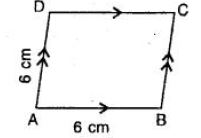
Answer: Since all four sides of the given quadrilateral are equal in length:
\(AB = BC = CD = DA = 6\text{ cm}\)
The figure is a rhombus.
This figure will become a square if any one of its interior angles is a right angle (\(90^\circ\)).
In simple words: Because all sides are equal to 6 cm, the shape is a rhombus. It will turn into a square if we make its corners 90 degrees.
Exam Tip: Clearly state that equal sides define a rhombus, and adding a right angle makes that rhombus a square.
Question 18. Write two conditions that will make the adjoining figure a square.
Answer: The two conditions required to make the given parallelogram a square are:
(i) All four sides must be equal in length.
(ii) Any one of its interior angles must measure \(90^\circ\).
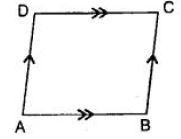
In simple words: To change a parallelogram into a square, we need to make sure all its sides are equal and its angles are 90 degrees.
Exam Tip: Memorize the two key conditions that distinguish a parallelogram from a square: equal sides (rhombus property) and right angles (rectangle property).
ICSE Textbook Solutions for Class 6 Mathematics Chapter 27 Quadrilateral
About ICSE Solutions for Class 6 Mathematics Chapter 27 Quadrilateral
Find reliable chapter-wise explanations for Class 6 Mathematics Chapter 27 Quadrilateral. Curated to follow standard ICSE guidelines, these problem solutions assist students in building strong conceptual foundations.
Step-by-Step Explanations and Breakdown
Tackle complex theorems and numerical problems easily by cross-referencing your working steps with our structured solution guides.
More Study Resources for Class 6 Mathematics
Wrap up your chapter revision by verifying core concepts against standard ICSE question formats. All resources on our platform are free to access.
FAQs
You can download the verified Selina Concise solutions for Chapter 27 Quadrilateral on StudiesToday.com. Our teachers have prepared answers for Class 6 Mathematics as per 2026-27 ICSE academic session.
Yes, our solutions for Chapter 27 Quadrilateral are designed as per new 2026 ICSE standards. 40% competency-based questions required for Class 6, are included to help students understand application-based logic behind every Mathematics answer.
Yes, every exercise in Chapter 27 Quadrilateral from the Selina Concise textbook has been solved step-by-step. Class 6 students will learn Mathematics conceots before their ICSE exams.
Yes, follow structured format of these Selina Concise solutions for Chapter 27 Quadrilateral to get full 20% internal assessment marks and use Class 6 Mathematics projects and viva preparation as per ICSE 2026 guidelines.