

Download ICSE Class 8 History Civics Solutions by Selina Concise
Access the official Selina Concise textbook solutions for Class 8 History Civics, updated for the 2026-27 academic year. This digital resource is structured to help students build strong conceptual clarity and prepare effectively for school examinations.
Access Chapter 02 The Union Executive Solutions for Class 8 History Civics
View or download the dedicated Chapter 02 The Union Executive resource below. This chapter-by-chapter structuring ensures easy navigation for daily study routines and immediate access to core academic concepts.
I. Fill in the blanks:
Question 1. A person to be appointed a minister must be a member of either House of __________.
Answer: Parliament
In simple words: To become a minister, a person has to belong to either the Lok Sabha or the Rajya Sabha.
Exam Tip: Remember that if a non-member is made a minister, they must secure a seat in either house within six months.
Question 2. The Prime Minister __________ the business to be carried on by the Cabinet.
Answer: decides
In simple words: The Prime Minister is the one who plans and guides what the Cabinet will work on.
Exam Tip: Highlighting the Prime Minister's role as the head of the Cabinet shows a strong grasp of executive leadership.
Question 3. The Vice President is elected for a period of __________.
Answer: five years
In simple words: The Vice President holds their official position for a five-year term.
Exam Tip: Be sure to distinguish between the terms of office for the Vice President (5 years) and Rajya Sabha members (6 years).
Question 4. The Prime Minister __________ among the ministers.
Answer: distributes portfolios
In simple words: The Prime Minister assigns different departments and duties to each minister.
Exam Tip: "Portfolios" is a key technical term; make sure to use it when describing how ministries are assigned.
Question 5. The public servants constitute the __________.
Answer: permanent executives
In simple words: Government officers and civil servants make up the permanent part of the executive branch.
Exam Tip: Clearly contrast the "permanent executive" (civil servants) with the "political executive" (ministers) for better marks.
Question. Match the contents of Column A with that of Column B:
| Column A | Column B |
|---|---|
| 1. The Prime Minister | (a) takes all important decisions. |
| 2. The President | (b) consisted of all the Ministers. |
| 3. The Cabinet | (c) under the control of a Minister is called portfolio. |
| 4. The Council of Minister | (d) appoints the Prime Ministers. |
| 5. A Department | (e) heads the Coucil of Ministers. |
Answer:
| Column A | Column B |
|---|---|
| 1. The Prime Minister | (e) heads the Council of Ministers. |
| 2. The President | (d) appoints the Prime Minister. |
| 3. The Cabinet | (a) takes all important decisions. |
| 4. The Council of Ministers | (b) consisted of all the Ministers. |
| 5. A Department | (c) under the control of a Minister is called portfolio. |
In simple words: This table links central government terms with their exact roles, like the President appointing the Prime Minister and the Cabinet making key choices.
Exam Tip: When matching, ensure that you associate the Cabinet specifically with "important decisions" and the Council of Ministers with "all ministers."
III. Tick mark (✓) the correct statements and cross mark (X) the wrong ones :
Question 1. The Prime Minister is the vital link between the President and the Cabinet.
Answer: Correct (✓)
In simple words: The Prime Minister acts as a bridge, sharing Cabinet decisions with the President.
Exam Tip: Remember that the Prime Minister is the primary channel of communication between the head of state and the council.
Question 2. The Prime Minister acts on the advice of the President.
Answer: Incorrect (X)
In simple words: It is actually the other way around; the President must act on the advice of the Prime Minister and Cabinet.
Exam Tip: In a parliamentary setup, the real power lies with the Prime Minister, making the President's actions dependent on ministerial advice.
Question 3. A money bill cannot be introduced without the President’s authority.
Answer: Correct (✓)
In simple words: Any law dealing with money needs the President's permission before it can be brought to Parliament.
Exam Tip: Always specify that money bills originate only in the Lok Sabha and require prior presidential recommendation.
Question 4. The President can appoint anyone as the Prime Minister.
Answer: Incorrect (X)
In simple words: The President can only select the leader who has the support of the majority party in the Lok Sabha.
Exam Tip: Point out that the President's choice is restricted by the democratic majority in the Lok Sabha.
Question 5. Most of the Civil Servants at the Centre are selected by the Union Public Service Commission.
Answer: Correct (✓)
In simple words: The UPSC is the official board that recruits most central government officers.
Exam Tip: Mentioning the UPSC (Union Public Service Commission) as an independent body highlights your understanding of civil services.
IV. Answer the following:
Question 1. Who is the Chief Executive of the Indian Union? Who votes for him?
Answer: The President holds the position of Chief Executive for the Indian Union. This leader is chosen by an electoral college. It includes the voting members from the two houses of Parliament as well as those from the state assemblies.
In simple words: The President is the official head of India. They are elected by elected lawmakers, not directly by citizens.
Exam Tip: Clearly state that only "elected" members of Parliament and State Assemblies can vote, as nominated members do not participate in this election.
Question 2. State two executive and two judicial powers of the President. Under what circumstances can the President proclaim a state of emergency?
Answer: Two executive powers of the President are:
1. The President selects and appoints the Prime Minister along with other central ministers.
2. The President is responsible for appointing state Governors, Supreme Court and High Court judges, the Comptroller and Auditor General, the Attorney General, and members of the UPSC.
Two judicial powers of the President are:
1. The President has the authority to reduce, put on hold, or completely forgive sentences, including those given by military courts or death penalties.
2. The President cannot be held answerable in any court of law for how they use their official powers, unless they face impeachment in Parliament.
The President can announce a state of emergency if:
1. The safety and security of the nation are in danger.
2. The government structure in any state fails to work according to the Constitution.
3. The financial health of the country is in jeopardy.
In simple words: The President appoints top leaders and has the power to pardon court punishments. They can also take special control of the country if there is a major threat, a state government collapse, or economic crisis.
Exam Tip: Use clear, separate subheadings for executive, judicial, and emergency powers to ensure your answer is well-structured and easy to read.
Question 3. What are the two main functions of the Cabinet?
Answer: The main roles of the Cabinet include:
1. They make all the crucial decisions for the country.
2. They design and plan the key policies and programs of the government.
In simple words: The Cabinet is the main group of ministers that makes important choices and plans how the government runs.
Exam Tip: Focus on the words "decision-making" and "policy formulation" as they are key terms that examiners look for.
Question 4. Name the three categories of the union ministers.
Answer: The union ministry is divided into three levels:
1. Cabinet Ministers
2. Ministers of State
3. Deputy Ministers
In simple words: Ministers are ranked in three levels, with Cabinet Ministers at the top, followed by Ministers of State and Deputy Ministers.
Exam Tip: Presenting these three ranks in a clear, numbered descending list helps secure quick marks.
Question 5. What is the position of the Prime Minister? Mention his powers.
Answer: The Prime Minister is the leader of the party or coalition that wins a clear majority in the Lok Sabha.
The key powers of the Prime Minister are:
1. Acting as the leader of the Lok Sabha.
2. Managing both the domestic and foreign affairs of the nation.
3. Serving as the primary voice and spokesperson of the administration.
4. Choosing the members who will join the council of ministers.
5. Allocating different departments or portfolios to ministers.
6. Having the authority to ask any minister to resign.
7. Recommending candidates to the President for high-level government appointments.
8. Chairing and guiding cabinet meetings.
In simple words: The Prime Minister is the actual head of the government. They lead the Lok Sabha, select other ministers, assign their jobs, and guide all major actions.
Exam Tip: State clearly that the Prime Minister is the "real head of government" before listing their executive, legislative, and coordinative powers.
Question 6. Do you think the President of India should be directly elected by the people? Why/why not?
Answer: In India's parliamentary setup, the Prime Minister serves as the active head of the government, while the President plays a symbolic role as the nominal head. If the President were directly voted in by the citizens, they would also hold immense democratic authority and power. This could lead to a major conflict of power between the Prime Minister and the President. Therefore, an indirect election is better to ensure smooth governance without any leadership clashes.
In simple words: If both the President and Prime Minister were directly chosen by the public, they might fight over who has more power. Keeping the President's election indirect avoids this confusion.
Exam Tip: Support your opinion by explaining the potential deadlock or "clash of power" that a directly elected President could cause in a parliamentary system.
V. Explain the following statements:
Question 1. “The President is a nominal head.”
Answer: This statement signifies that under our parliamentary system, the administration is practically run by the Prime Minister. The President acts as the official constitutional head of the nation but does not wield actual administrative power. Instead, the real executive authority lies with the Council of Ministers, which is guided by the Prime Minister.
In simple words: Even though the President is the official head of the country, they do not run the daily government. That job belongs to the Prime Minister and their ministers.
Exam Tip: Use the constitutional terms "de jure" (by law) for the President and "de facto" (in practice) for the Prime Minister to make your answer stand out.
Question 2. “All the ministers, including the Prime Minister, swim and sink together.”
Answer: This phrase means that the Prime Minister and their entire team of ministers share collective responsibility to the Lok Sabha. If the house passes a vote of no confidence against even a single minister, the entire team, including the Prime Minister, is forced to step down.
In simple words: Ministers work as a single team. If Parliament loses trust in one minister, the whole group must resign together.
Exam Tip: Explicitly mention "collective responsibility" and the effect of a "vote of no confidence" to show your understanding of parliamentary rules.
Additional Questions
A. Fill in the blanks:
Question 1. The President can be removed from office by a procedure known as __________.
Answer: Impeachment
In simple words: Impeachment is the official process used by Parliament to remove a President.
Exam Tip: Spell the term "Impeachment" correctly, as technical term spelling is closely observed by examiners.
Question 2. The President appoints the judges of the __________ Court and the __________ Court.
Answer: Supreme, High
In simple words: The President officially chooses the judges for India's top courts.
Exam Tip: Keep in mind that these appointments are made in consultation with the Chief Justice of India.
Question 3. The President can call a __________ session of the Parliament if there is a deadlock regarding a bill.
Answer: joint
In simple words: If the two houses cannot agree on a new law, the President can bring them together to vote.
Exam Tip: Remember that a joint session is presided over by the Speaker of the Lok Sabha, not the President.
Question 4. The Cabinet is the __________ of the Council of Ministers. The Cabinet Ministers hold important __________.
Answer: inner core, portfolios
In simple words: The Cabinet is the main decision-making group inside the ministry, holding key government duties.
Exam Tip: Be ready to define "portfolios" as specific departments like Defence, Finance, or Home Affairs.
Question 5. The Prime Minister is the link between the __________, the people and the __________.
Answer: President, Parliament
In simple words: The Prime Minister connects the citizens and lawmakers with the nation's head.
Exam Tip: Memorize the Prime Minister's role as the central channel connecting the executive head, the legislature, and the general public.
B. Name the following:
Question 1. The current Prime Minister of India
Answer: Narendra Modi
In simple words: Narendra Modi is the chief leader of the Indian government.
Exam Tip: Be sure to write the full name and check current political updates, as these names depend on the active government of the time.
Question 2. The current Chairperson of the Rajya Sabha
Answer: Mohammad Hamid Ansari
In simple words: At the time of this text, Mohammad Hamid Ansari served as the head of the Rajya Sabha.
Exam Tip: Remember that the Vice President of India automatically serves as the ex-officio Chairperson of the Rajya Sabha.
Question 3. The current Supreme Commander of the Defence Forces
Answer: Pranab Mukherjee
In simple words: When this was recorded, President Pranab Mukherjee was the top commander of the Indian military.
Exam Tip: The President always holds the supreme command of all three wings of the armed forces.
Question 4. The current ministers in charge of:
(a) Defence
(b) External Affairs
(c) Finance
(d) Health
Answer:
(a) Defence Minister - Manohar Parrikar
(b) External Affairs - Sushma Swaraj
(c) Finance Minister - Arun Jaitley
(d) Health Minister - Jagat Prakash Nadda
In simple words: This list shows the names of the leaders who ran these key government ministries during the period of this lesson.
Exam Tip: For current affairs questions, keep an eye on cabinet reshuffles to ensure your answers match current appointments.
C. Choose the correct answer:
Question 1. Who is the nominal head of the government of India?
(a) The President
(b) The Prime Minister
(c) The Vice President
(d) None of the options
Answer: (a) The President
In simple words: The President acts as the official head but does not run daily affairs.
Exam Tip: Pay attention to the difference between "head of the state" (President) and "head of the government" (Prime Minister).
Question 2. The President is the Supreme Commander of the:
(a) Indian Administrative Service
(b) Defense Forces
(c) Indian Foreign Service
(d) None of the options
Answer: (b) Defense Forces
In simple words: The President of India is the topmost leader of all military wings.
Exam Tip: This question often appears in exams to test your understanding of the President's military powers.
Question 3. The Vice-President is the Chairperson of the:
(a) Lok Sabha
(b) Rajya Sabha
(c) Vidhan Sabha
(d) None of the options
Answer: (b) Rajya Sabha
In simple words: By virtue of holding office, India's Vice-President leads meetings of the Rajya Sabha.
Exam Tip: Use the term "ex-officio" when describing how the Vice President gets the role of leading the Rajya Sabha.
Question 4. After the elections, the President appoints the leader of the majority party as the:
(a) Vice President
(b) Speaker
(c) Prime Minister
(d) None of the options
Answer: (c) Prime Minister
In simple words: Once general elections are done, the leader of the winning party is made the Prime Minister.
Exam Tip: Remember that the President must invite the leader of the majority party first, and can only use discretion if there is a hung parliament.
Question 5. The Council of Ministers is the real executive but the administration is carried on in the name of the:
(a) Prime Minister
(b) President
(c) Vice-President
(d) None of the options
Answer: (a) Prime Minister
In simple words: The Cabinet holds the actual power, but decisions are taken in the name of the Prime Minister's leadership.
Exam Tip: Understand that even though the Prime Minister leads the administration, all official executive decisions are made in the name of the President.
D. State whether the following are true or false:
Question 1. The President is elected for a term of 4 years.
Answer: False. The actual term for which a President is elected is 5 years.
In simple words: The President serves for five years, not four.
Exam Tip: If a statement is false, always write the correct factual correction alongside your answer to earn full marks.
Question 2. The President can pardon a death sentence.
Answer: True
In simple words: Yes, the President has the special power to forgive a person sentenced to death.
Exam Tip: This is a unique judicial power that belongs only to the President of India, not to state Governors.
Question 3. The President can declare war or conclude peace.
Answer: True
In simple words: The President can officially start a war or sign a peace agreement.
Exam Tip: Remember that while the President makes these declarations, they must be approved by Parliament.
Question 4. The Prime Minister choose the Cabinet Ministers.
Answer: True
In simple words: The Prime Minister selects the members who will join the Cabinet.
Exam Tip: Although the President officially appoints the Cabinet, they can only do so based on the Prime Minister's choice.
Question 5. Civil servants belong to the majority party in Parliament.
Answer: False. Civil servants do not belong to any political party; they remain politically neutral.
In simple words: Civil servants are neutral officers who work for the country, not for any political group.
Exam Tip: Highlight "political neutrality" as the core principle of the permanent civil services.
E. Answer the following questions in one or two words/ sentences:
Question 1. Who is the real executive head in a parliamentary form of government?
Answer: The Prime Minister functions as the actual executive head under a parliamentary system of governance.
In simple words: The Prime Minister is the person who holds real power and runs the government.
Exam Tip: A one-sentence answer should get straight to the point; identify the Prime Minister immediately.
Question 2. Name the body that elects the President of India.
Answer: The President is chosen by a group of electors known as the Electoral College.
In simple words: A special group of elected lawmakers called the Electoral College votes for the President.
Exam Tip: Always capitalize "Electoral College" as it is a specific constitutional term.
Question 3. Name any two officials appointed by the President?
Answer: Among the officials appointed by the President are State Governors and the Attorney General.
In simple words: The President appoints high officers like Governors of states and the Attorney General.
Exam Tip: Providing well-known offices like "Governors" and "Chief Justice" makes your answer strong and easy to recall.
Question 4. What is an ordinance?
Answer: An ordinance is a temporary law issued by the executive branch when Parliament is not currently meeting.
In simple words: It is a special quick law made by the President when Parliament is on a break.
Exam Tip: Mention that an ordinance has the same force as an ordinary act of Parliament, but is only temporary.
Question 5. What can the President do when the security of the country is threatened by external aggression or armed rebellion?
Answer: Under such threats, the President has the authority to declare a National Emergency.
In simple words: The President can call a National Emergency if the country is attacked or faces a rebellion.
Exam Tip: Mention "National Emergency" clearly to match the standard textbook terminology.
Question 6. Whose advice is the President bound to follow in carrying out his/her functions?
Answer: The President must act according to the guidance given by the Prime Minister and the Council of Ministers.
In simple words: The President must follow recommendations made by the Prime Minister and their team of ministers.
Exam Tip: Point out that this advice is legally binding on the President as per constitutional amendments.
Question 7. Who is the head of the Council of Ministers?
Answer: This council is led by the Prime Minister.
In simple words: The Prime Minister is the leader of all the other ministers.
Exam Tip: Remember that the Council of Ministers cannot exist or function without the Prime Minister at its head.
Question 8. When two or more political parties form the government, what is it called?
Answer: When multiple political groups partner together to run the administration, it is referred to as a Coalition Government.
In simple words: A coalition government is formed when different political parties join hands to run the country.
Exam Tip: Be sure to spell "Coalition Government" correctly, as it is a fundamental term in modern civics.
Question 9. What is meant by allotment of portfolios?
Answer: This term refers to the Prime Minister assigning specific ministries or departments to different members of the council. For example, assigning ministers to oversee sectors like communication, agriculture, or foreign affairs.
In simple words: This means giving each minister a specific department to look after, such as farming or foreign relations.
Exam Tip: Use an example (like the Minister of Agriculture or Finance) to explain what a "portfolio" means in practice.
Question 10. What happens when a vote of no-confidence is passed against any one Cabinet Minister?
Answer: If Parliament passes a vote of no confidence against any single minister, the entire Council of Ministers is required to resign at once.
In simple words: If one Cabinet Minister loses the support of Parliament, the entire government team must step down.
Exam Tip: This rule highlights the concept of "collective responsibility," where the cabinet stands or falls as one unit.
F. Answer the following questions briefly:
Question 1. In the context of the President of India, answer the following questions:
(a) Mention the qualifications required for the post of the President.
(b) How is the President elected ?
(c) How can the services of the President be terminated ?
Answer:
(a) The requirements for a person to stand for the presidential election are:
1. Being a citizen of India.
2. Reaching a minimum age of 35.
3. Meeting the eligibility criteria required to become a member of the Lok Sabha.
4. Keeping free of any profit-yielding office under local, state, or central authorities.
(b) The election process is indirect, handled by an electoral college. This group consists of:
1. Elected representatives from the two houses of Parliament.
2. Elected representatives from the legislative assemblies of the states.
(c) Parliament can remove a President through a formal impeachment process. This step is taken if the leader is found guilty of constitutional violations, treason, or corruption.
In simple words: To be President, a person must be a 35-year-old citizen eligible for the Lok Sabha. They are elected by a team of state and national lawmakers, and can only be removed by Parliament if they break the Constitution.
Exam Tip: Underline "35 years of age," "Electoral College," and "Impeachment" to draw the examiner's eye to these key points.
Question 2. With reference to the powers of the President, discuss:
(a) Any four executive powers
(b) Military powers
(c) Any four legislative powers
Answer:
(a) Executive powers: The President is responsible for selecting the Prime Minister, who leads the dominant party or coalition in the Lok Sabha. Other federal ministers are appointed based on the Prime Minister's recommendations.
(b) Military powers: Holding the role of Supreme Commander of the armed forces, the President holds the power to initiate war or establish peace. Furthermore, all international pacts and agreements are formally entered into in the name of the President.
(c) Legislative powers:
1. The President can call or end a session of Parliament and delivers the opening address each year, highlighting national policies.
2. The President can dissolve the Lok Sabha to initiate new general elections.
3. The President can call for a joint meeting of both legislative houses to resolve a voting deadlock on a bill.
4. Every passed bill needs the President's signature to become law. The President can return a bill once, but if passed again, they must sign it.
5. The President nominates 12 representatives to the Rajya Sabha and can select two Anglo-Indian representatives for the Lok Sabha.
6. The President can issue temporary laws, or ordinances, when Parliament is on break, which remain valid for six weeks once Parliament reconvenes.
In simple words: The President has key duties like choosing the Prime Minister, commanding the military, and signing new bills into laws. They can also call joint meetings of Parliament or declare a recess.
Exam Tip: Be prepared to list at least four legislative powers clearly, as this is a frequent essay-type question.
Question 3. The President is an integral part of the Parliament. In this context explain the following:
(a) The financial powers of the President
(b) The judicial powers of the President
(c) The emergency powers of the President.
Answer:
(a) Financial powers:
1. The annual budget is introduced in Parliament on behalf of the President.
2. Money bills require the President's prior consent before they can be introduced.
(b) Judicial powers:
1. The President can forgive, reduce, or put on hold any legal punishment, and has the unique authority to pardon death row cases.
2. The President cannot be brought before any court of law for their official duties, except through impeachment proceedings in Parliament.
(c) Emergency powers:
1. The President can declare a national emergency if the country is threatened by war or domestic uprisings.
2. The President can declare President's Rule in a state where local constitutional machinery fails.
3. The President can declare a financial emergency if the economic stability of India is at risk.
In simple words: The President has financial control over money bills, the judicial authority to pardon crimes, and the power to declare emergencies when the nation's security, state governance, or economy is in danger.
Exam Tip: Group your points logically under the three specified subheadings to ensure you address all parts of the question.
Question 4. With reference to the functions of the Parliament, explain the following:
(a) Law-making functions
(b) Control over the executive
(c) Judicial functions
Answer:
(a) Law-making roles:
1. Parliament has the authority to make or update laws covering matters on the Union and Concurrent lists.
2. Under specific situations, it can also pass legislation regarding subjects on the State list.
3. Parliament holds the exclusive power to start bills aimed at amending the Constitution.
(b) Control over the executive:
1. Parliament monitors the executive closely, as the Council of Ministers is answerable to the Lok Sabha for its choices.
2. If a vote of no confidence succeeds in the Lok Sabha, the entire ministry must resign immediately.
3. Members can review government plans and question ministers directly to keep them accountable.
4. Lawmakers can table adjournment motions to bring focus to sudden public crises like natural disasters or security issues.
(c) Judicial roles:
Parliament has the power to run impeachment trials and remove the President, Vice-President, or Supreme Court and High Court judges if they abuse power or violate constitutional rules.
In simple words: Parliament makes national laws, keeps the Prime Minister's team accountable, and has the authority to remove high officials if they violate the law.
Exam Tip: Explain how tools like "question hour," "adjournment motions," and "no-confidence motions" are used to keep check on the executive branch.
Question 5. Discuss the powers and position of the Prime Minister with reference to his relationship with the following:
(a) Parliament
(b) The President
(c) The Council of Ministers.
Answer:
(a) Relationship with Parliament:
As the elected head of the country and the leader of the majority party or coalition, the Prime Minister exercises actual power. This position makes them the real head of government, directing key legislative business in Parliament.
(b) Relationship with the President:
The Prime Minister acts as the chief advisor to the President on all official matters. They keep the President updated on Cabinet decisions, and this advice is legally binding.
(c) Relationship with the Council of Ministers:
1. The Prime Minister chooses the members who serve in the council.
2. They allocate department duties and chair all Cabinet discussions.
3. They oversee various departments and serve as the main link between the Cabinet and the President.
4. They can reorganize the Cabinet and ask any minister to resign.
In simple words: The Prime Minister is the primary leader in Parliament, guides the President's actions, and has full authority over choosing and directing other ministers.
Exam Tip: Emphasize that the Prime Minister is the "keystone of the cabinet arch" to highlight their central role in the administration.
Question 6. In the context of the Prime Minister and the Council of Ministers, explain the following:
(a) Appointment of the Prime Minister
(b) Formation of the Council of Ministers
(c) The Cabinet
Answer:
(a) Appointment of the Prime Minister:
The President officially appoints the Prime Minister. Practically, the President must choose the leader of the party or coalition holding a majority in the Lok Sabha. If there is no clear majority, the President uses discretion to select someone capable of running a stable government. The appointee must be a member of either house of Parliament.
(b) Formation of the Council of Ministers:
The Prime Minister drafts a list of selected ministers and presents it to the President for official appointment. This council consists of three categories: Cabinet Ministers, Ministers of State, and Deputy Ministers.
(c) The Cabinet:
All ministers must belong to one of the houses of Parliament or get elected within six months of appointment. The Cabinet represents the inner circle of the Council of Ministers, holding key portfolios and making critical policy choices. They hold the highest ranks and are collectively responsible to the Lok Sabha. If they lose a vote of confidence, the entire ministry must resign together.
In simple words: The President appoints the Prime Minister, who then builds their team of ministers. The Cabinet is the inner, most powerful group that leads key decisions and must resign if Parliament loses faith in them.
Exam Tip: Be sure to clarify that although the Cabinet is part of the Council of Ministers, it is a smaller, more powerful, and elite group of senior ministers.
G Picture study:
Until 1950, the building in the picture was known as ‘Viceroy’s House’, and served as the residence of the Governor General of India.
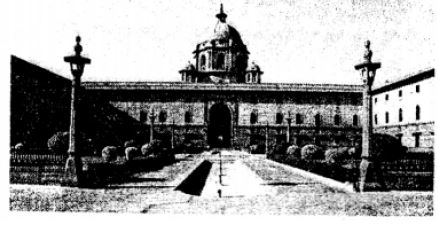
Question 1. Identify the building. Whose official residence is it now?
Answer: This building is the Rashtrapati Bhavan, which serves as the official residence of the President of India.
In simple words: The building is called Rashtrapati Bhavan, and it is where India's President lives.
Exam Tip: Connect the historic transition of the building from the British "Viceroy's House" to "Rashtrapati Bhavan" in 1950.
Question 2. How is he or she elected?
Answer: The President is chosen through an indirect election since they act as a nominal rather than a real head of state. An Electoral College carries out this election, which is made up of:
1. Elected members from both the Lok Sabha and Rajya Sabha.
2. Elected members from all State Legislative Assemblies.
In simple words: The President is elected indirectly by state and national lawmakers rather than directly by the public.
Exam Tip: Mentioning that citizens do not directly participate in this election helps clarify the term "indirect election."
Question 3. What is his/her term of office?
Answer: The President's term lasts for five years, and they are eligible to stand for re-election once their term ends.
In simple words: The President is elected for five years and can be chosen again for another term.
Exam Tip: State the exact duration (5 years) clearly and mention the possibility of re-election to earn full marks.
Question 4. Mention two powers each held by this person of with reference to the following:
(a) Financial power
(b) Judicial Power
Answer:
(a) Financial power:
1. The budget of the country is brought before Parliament in the President's name.
2. Money bills can only be introduced in Parliament with the President's prior consent.
(b) Judicial Power:
1. The President can pardon, reduce, or put on hold sentences, including death row cases.
2. The President is not answerable to any court of law for their official actions, unless facing impeachment by Parliament.
In simple words: The President controls when money bills are introduced and can pardon criminal sentences. They are also protected from being sued in court while in office.
Exam Tip: Provide one clear example for each type of power (such as pardoning death sentences or presenting the national budget) to secure high scores.
Free study material for History Civics
Step-by-Step Solutions for Class 8 History Civics Chapter 02 The Union Executive
ICSE Chapter Solutions: Class 8 History Civics Chapter 02 The Union Executive
Find reliable chapter-wise explanations for Class 8 History Civics Chapter 02 The Union Executive. Curated to follow standard ICSE guidelines, these problem solutions assist students in building strong conceptual foundations.
Step-by-Step Explanations and Breakdown
Every exercise question in this chapter includes step-by-step working steps, allowing you to self-evaluate, catch mistakes early, and understand the underlying logic.
More Study Resources for Class 8 History Civics
Pair your solution review with additional practice papers to test your execution speed and ensure total preparedness for school exams.
FAQs
You can download the verified Selina Concise solutions for Chapter 02 The Union Executive on StudiesToday.com. Our teachers have prepared answers for Class 8 History Civics as per 2026-27 ICSE academic session.
Yes, our solutions for Chapter 02 The Union Executive are designed as per new 2026 ICSE standards. 40% competency-based questions required for Class 8, are included to help students understand application-based logic behind every History Civics answer.
Yes, every exercise in Chapter 02 The Union Executive from the Selina Concise textbook has been solved step-by-step. Class 8 students will learn History Civics conceots before their ICSE exams.
Yes, follow structured format of these Selina Concise solutions for Chapter 02 The Union Executive to get full 20% internal assessment marks and use Class 8 History Civics projects and viva preparation as per ICSE 2026 guidelines.