

Selina Concise Solutions for Class 8 Biology: Chapter 03 Reproduction in Humans
Review the Selina Concise Solutions for ICSE Class 8 Biology Chapter 3 Reproduction in Humans designed for Class 8 Biology students. Published under the latest ICSE guidelines for 2026-27, these chapter-wise solutions provide the foundational knowledge required for exam success.
Chapter-wise Solutions: Chapter 03 Reproduction in Humans
Access the complete PDF for Chapter 03 Reproduction in Humans below. This focused excerpt allows students to isolate specific topics for thorough review and uninterrupted reading, complementing standard ICSE textbooks.
Question 1(a). The testes are located within the:
(a) Penis
(b) Scrotum
(c) Ureter
(d) Urinary bladder
Answer: (b) Scrotum
In simple words: The scrotum is a small pouch of skin that hangs outside the body to hold and protect the testes.
Exam Tip: Remember that the scrotum keeps the testes at a temperature lower than that of the rest of the body, which is required to make sperm.
Question 1(b). Amoeba is most commonly reproduced by:
(a) Budding
(b) Regeneration
(c) Binary fission
(d) Multiple fission
Answer: (c) Binary fission
In simple words: An amoeba reproduces by splitting its single-cell body into two equal, identical halves.
Exam Tip: "Binary" means two and "fission" means splitting, which is the most basic form of asexual reproduction in single-celled organisms.
Question 1(c). Identify the stage which is formed after the fertilisation of the egg by the sperm?
(a) Ovule
(b) Foetus
(c) Embryo
(d) Zygote
Answer: (d) Zygote
In simple words: The very first cell created when a sperm joins with an egg is called a zygote.
Exam Tip: Be clear on the developmental sequence: Zygote - Embryo - Foetus - Baby.
Question 1(d). Internally, the uterus opens into:
(a) Urethra
(b) Vagina
(c) Oviduct
(d) Vulva
Answer: (b) Vagina
In simple words: The uterus, or womb, connects to the vagina at its lower end through the cervix.
Exam Tip: The narrow neck-like passage connecting the uterus to the vagina is specifically called the cervix.
Question 1(e). Which one of the following represents the correct sequence in the life history of a butterfly ?
(a) Egg -> Larva -> Adult -> Pupa
(b) Egg -> Pupa -> Adult -> Larva
(c) Egg -> Larva -> Pupa -> Adult
(d) Egg -> Pupa -> Larva -> Adult
Answer: (c) Egg -> Larva -> Pupa -> Adult
In simple words: A butterfly starts as an egg, hatches into a caterpillar (larva), forms a resting chrysalis (pupa), and then turns into a flying adult.
Exam Tip: Larva is the active feeding stage (caterpillar), and pupa is the resting/transformation stage (chrysalis).
Short Answer Questions:
Question 1(a). Distinguish between: Egg and sperm.
Answer:
| Feature | Egg (Ovum) | Sperm |
|---|---|---|
| Production Site | Formed within the ovaries. | Produced inside the testes. |
| Physical Shape | Spherical cell containing a distinct nucleus. | Composed of a head with a nucleus, a midpiece, and a long tail. |
In simple words: Eggs are round female reproductive cells made in the ovaries, whereas sperms are male reproductive cells with tails made in the testes.
Exam Tip: Always highlight the structural difference - eggs are large and static, while sperms are microscopic and motile with a tail.
Question 1(b). Distinguish between: Sexual reproduction and asexual reproduction.
Answer:
| Feature | Sexual Reproduction | Asexual Reproduction |
|---|---|---|
| Number of Parents | Requires two parents of different sexes. | Involves only one parent. |
| Gametes & Fusion | Involves the creation and union of male and female gametes. | Occurs without gamete formation or union of cells. |
| Speed of Process | A relatively slow method of generating offspring. | A rapid way to multiply and grow in population. |
| Examples | Humans, birds, and reptiles. | Amoeba, yeast, and simple plants. |
In simple words: Sexual reproduction requires two parents and the joining of their reproductive cells, while asexual reproduction only needs one parent to split or make a copy.
Exam Tip: In difference tables, always align the contrasting features directly across from each other for clarity.
Question 1(c). Distinguish between: Budding and Regeneration.
Answer:
| Feature | Budding | Regeneration |
|---|---|---|
| Mechanism | An outgrowth or bud develops on the parent's body and later detaches to form a new organism. | The ability to regrow damaged or lost body parts using cell division. |
| Examples | Hydra, Yeast. | Starfish, Planaria, Sponges. |
In simple words: Budding is growing a new baby like a bump on the parent's side, while regeneration is growing back a lost limb or part.
Exam Tip: Clearly state that budding is primarily a reproductive method, while regeneration is often for healing but can lead to reproduction in simple organisms.
Question 2. Define the following terms: (a) Fetilization (b) Implantation (c) Puberty
Answer:
(a) Fertilization: The process where a male sperm cell merges with a female egg cell to form a single-celled zygote.
(b) Implantation: The process where the early-stage embryo (a ball of dividing cells) travels to the uterus and attaches securely to its muscular wall, starting pregnancy.
(c) Puberty: The developmental stage during which reproductive systems mature in boys and girls, making them capable of reproduction. It is marked by breast development in girls and testicular enlargement and growth spurts in boys.
In simple words: Fertilization is when egg and sperm meet, implantation is when the growing egg settles in the womb to start pregnancy, and puberty is the transition into physical maturity.
Exam Tip: Be sure to use the exact biological terms "zygote" for fertilization and "embryo" for implantation to score full marks.
Question 3. State the reason why testes lie outside the abdomen in a scrotum?
Answer: The testes are located outside the abdominal cavity in the scrotum because normal body temperature is too high for healthy sperm production. The scrotum maintains a climate that is approximately 2°C to 3°C lower than the core body temperature, which is the ideal range for sperm to develop.
In simple words: The scrotum acts as a cooling sac, keeping the testes 2 to 3 degrees cooler than the rest of the body so they can make healthy sperm.
Exam Tip: Always specify the ideal temperature difference (2°C to 3°C lower than core body temperature) in your written explanations.
Question 4. Why is it important that a very large number of sperms should be present in the semen ?
Answer: Although a single ejaculation contains millions of sperms, the journey through the female reproductive tract is highly hazardous. A vast majority of sperms die along the way, and only a tiny number manage to reach the upper oviduct. Because only one single sperm is needed to fertilize the egg, a massive initial quantity is necessary to guarantee that at least one viable sperm reaches the egg successfully.
In simple words: Most sperms die on their long journey to the egg, so millions are needed to ensure at least one makes it to achieve fertilization.
Exam Tip: State clearly that despite millions of sperms being released, only a single sperm fuses with the egg nucleus to form a zygote.
Question 5. List the structures, in their correct sequence, through which the sperms must pass from the time they are produced in the testes to the time they leave the urethra.
Answer: Once produced, sperms move through these structures in order:
1. Testes (specifically, the sperm-producing tubules)
2. Epididymis (where they are stored and mature)
3. Sperm Ducts / Vas Deferens (muscular tubes leading upwards)
4. Urethra (the final passage through which they exit the body)
In simple words: Sperm travels from the testes, stores in the epididymis, moves up the sperm duct, and leaves through the urethra.
Exam Tip: Memorize this flow: Testes -> Epididymis -> Vas Deferens -> Urethra. This sequence is a common short-answer question in exams.
Question 6. State the functions of the following: (a) Ovary (b) Testes (c) Fallopian tubes (d) Seminal vesicle (e) Uterus
Answer:
(a) Ovary: Generates female eggs (ova) and secretes key female sex hormones (estrogen and progesterone).
(b) Testes: Produce male gametes (sperms) and synthesize the male sex hormone (testosterone).
(c) Fallopian tubes: Act as the site of fertilization and carry the fertilized egg toward the uterus.
(d) Seminal vesicle: Secretes nutrient-rich seminal fluid that nourishes and aids in the transport of sperm cells.
(e) Uterus: Receives, protects, and nourishes the developing embryo during pregnancy, and contracts to assist in childbirth.
In simple words: Ovaries make eggs, testes make sperm, fallopian tubes are where they meet, seminal vesicles produce fluid, and the uterus holds the baby.
Exam Tip: When writing the function of ovaries, make sure to name both hormones: estrogen and progesterone.
Question 7. Given here is a section of the female reproductive system of human beings. (a) Name the parts labelled 1 to 4 (b) Name the part where fertilisation occurs in human beings.
Answer:
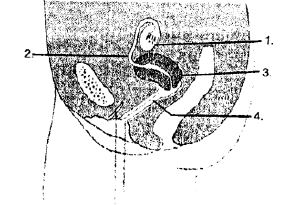
(a) The labeled parts are:
1. Ovary
2. Fallopian tube (Oviduct)
3. Uterus (Inner lining or muscular wall)
4. Vagina
(b) Fertilization takes place in the upper portion of the fallopian tube (oviduct).
In simple words: Part 1 is the ovary, 2 is the fallopian tube, 3 is the uterus, and 4 is the vagina. Sperm meets egg inside the fallopian tube.
Exam Tip: Practice sketching this simple diagram as it is frequently asked in anatomy and biology exams.
Question 8. Given alongside is a diagram of male reproductive system in humans. Label the parts indicated by numbers 1 to 5, and state their functions.
Answer:
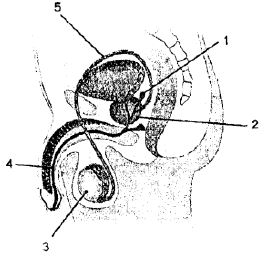
1. Seminal vesicle: Produces a specialized fluid that serves as a nourishing medium to help transport sperm cells.
2. Prostate gland: Releases an alkaline fluid into the urethra to help neutralize acids and keep sperm active.
3. Testes: The primary male reproductive organs where sperm cells and male sex hormones are produced.
4. Urethra: A tube that runs through the penis to carry both urine and semen out of the body.
5. Sperm duct (Vas deferens): The tube that conducts sperms from the testes up to the urethra.
In simple words: 1 is the seminal vesicle, 2 is the prostate, 3 is the testis, 4 is the urethra, and 5 is the sperm duct. They work together to produce and deliver semen.
Exam Tip: Be sure to write both common names "Sperm duct" and "Vas deferens" when labeling part 5.
Long Answer Questions:
Question PQ. Define the term metamorphosis. Briefly describe the various stages occurring in the life-cycle of a butterfly.
Answer: Metamorphosis is a biological process in which an animal undergoes rapid and complete physical changes to transition from its immature form to its mature adult form.
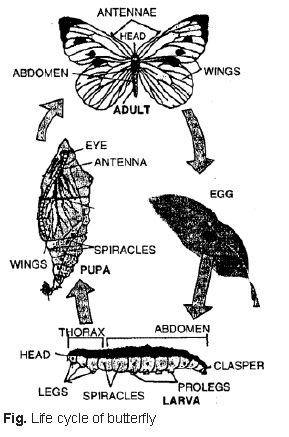
The life cycle of a butterfly features four major stages:
1. Egg: The adult female butterfly lays eggs on the leaves of a plant.
2. Larva (Caterpillar): The hatched individual, or caterpillar, is highly active and voracious. It spends this stage feeding on leaves and growing rapidly in size.
3. Pupa (Chrysalis): The caterpillar stops eating and moving, entering a resting phase. It spins a protective silk cocoon around itself where it begins forming adult structures.
4. Adult: Once fully mature, the pupa breaks out of the cocoon as a winged adult. Its wings dry out and expand, enabling it to fly.
In simple words: Metamorphosis is the big body change an insect goes through. A butterfly starts as an egg, grows as a caterpillar, rests in a cocoon, and emerges as a flying adult.
Exam Tip: Be ready to name and describe all four developmental stages in their correct sequence: Egg - Larva - Pupa - Adult.
Question PQ. What is fertilization? Describe the process in human beings.
Answer: Fertilization is defined as the fusion of a haploid male gamete (sperm) with a haploid female gamete (ovum) to produce a diploid zygote.
The Process in Humans:
1. Semen deposition: Millions of sperm cells are deposited into the vagina during sexual intercourse.
2. Travel: The sperm swim upward through the cervix and uterus to reach the upper sections of the fallopian tubes.
3. Fusion: If a mature egg is present in the fallopian tube, a single sperm makes contact with it. Only the head of the sperm (containing the nucleus) penetrates and enters the egg, leaving its tail outside.
4. Zygote formation: The male and female nuclei fuse, forming a zygote. This single cell begins dividing to form an embryo, which moves down to implant in the uterine wall to grow as a fetus over a gestation period of around 280 days.
In simple words: Fertilization is when a sperm cell fuses with an egg cell. The sperm swims to the fallopian tube, its head enters the egg, and their cores combine to begin a new life.
Exam Tip: Always emphasize that during human fertilization, only the sperm head enters the egg, leaving the tail behind.
Question 1. How does a single called fertilized egg grows into an adult in human beings?
Answer: After fertilization, the single-celled zygote grows through these specific stages:
1. Cellular Division: The zygote divides repeatedly to form a multicellular sphere called an embryo.
2. Implantation: This embryo travels to the uterus and attaches itself to its rich muscular lining.
3. Cell Differentiation: The generic cells of the embryo begin to specialize and take on particular structures and functions.
4. Organ Development: These specialized cells form tissues, organs, and complete organ systems, turning the embryo into a fetus.
5. Growth to Adulthood: After a 280-day development period, a baby is born, which continues to grow in size and complexity until reaching adulthood.
In simple words: The single cell splits many times to become a ball of cells, implants in the womb, and its cells specialize to make different organs until a baby is born and grows up.
Exam Tip: Make sure to mention the term "differentiation" to explain how generic cells transform into specialized tissues and organs.
Question PQ. Tabulate the important physical changes in the boys and girls that take place during puberty.
Answer: Puberty begins around age 10 in girls and age 11 in boys, bringing about major bodily changes:
| Feature | Boys | Girls |
|---|---|---|
| Reproductive Organs | Testes and penis enlarge; sperm production begins. | Ovaries, uterus, and vagina enlarge; egg release and menstruation begin. |
| Secondary Sex Characteristics | Development of broader shoulders and a muscular frame. | Development of larger breasts and widening of hips. |
| Body Hair | Hair grows on the face, chest, armpits, and pubic area. | Hair grows in armpits and pubic area; chest and face remain hairless. |
| Voice Changes | Voice becomes significantly deeper and hoarse. | Voice remains high-pitched. |
| Skin | Acne outbursts are common due to active sweat/oil glands. | Skin changes occur, but facial hair does not grow. |
In simple words: During puberty, boys get a deeper voice, facial hair, and wider shoulders, while girls start their periods, develop breasts, and get wider hips.
Exam Tip: Tabulating differences like this is highly recommended because it shows structured thinking and makes grading easier for the examiner.
Question 2. Describe the human female reproductive system with a labelled diagram.
Answer: The human female reproductive system comprises several essential components:
- Ovaries: Two oval organs located on each side of the lower abdomen that produce eggs (ova) and female hormones.
- Oviducts (Fallopian Tubes): Funnel-shaped structures that receive released eggs and serve as the site where fertilization occurs.
- Uterus (Womb): A hollow, muscular organ where the fertilized embryo attaches and develops into a baby, nourished by the placenta.
- Vagina: A muscular canal that receives semen during sexual intercourse and serves as the birth canal.
- Vulva: The external genital structures surrounding the opening of the vagina.
In simple words: The female system has ovaries to make eggs, fallopian tubes where they are fertilized, a uterus (womb) to grow a baby, and a vagina that connects the womb to the outside.
Exam Tip: Learn the path of the egg cell: Ovary -> Oviduct -> Uterus -> Vagina, as this helps you remember the system's structure.
Question PQ. ‘Adolescence is a crucial stage’. Justify this statement.
Answer: Adolescence, which occurs between the ages of 10 and 19, is a critical transitional phase because it involves massive biological, emotional, and social changes:
- Biological changes: Rapid physical growth spurts and sexual maturation (puberty) take place as sex organs become functional, altering body shape, voice, and appearance.
- Emotional and mental shifts: Surging hormone levels directly influence brain chemistry, leading to sudden mood swings, restlessness, and increased self-consciousness.
- Social changes: Teenagers start seeking independence, focusing heavily on peer groups, and experiencing natural attraction toward the opposite sex.
Adjusting to these rapid biological and emotional changes makes this stage highly sensitive and critical in human development.
In simple words: Adolescence is crucial because your body is maturing quickly while your brain is adjusting to new hormones, emotions, and social relationships.
Exam Tip: To get full marks, balance your answer by discussing both physical transformations and emotional/psychological challenges.
ADDITIONAL QUESTIONS
I. Multiple choice questions. Tick (✓) the correct choice:
Question 1. Testis are present in a sac called
(a) scrotum
(b) oviduct
(c) epididymis
(d) none of the options
Answer: (a) scrotum
In simple words: The scrotum is the external pouch of skin that holds and protects the testes.
Exam Tip: The scrotum keeps the testes slightly cooler than core body temperature, which is essential for healthy sperm production.
Question 2. Butterfly in its development from larva to an adult shows
(a) multiplication
(b) metamorphosis
(c) fertilisation
(d) none of the options
Answer: (b) metamorphosis
In simple words: Metamorphosis is the set of dramatic physical changes an insect undergoes as it matures from a larva to an adult.
Exam Tip: Butterflies undergo "complete" metamorphosis because their larval stage looks entirely different from their adult stage.
Question 3. Which of the following glands is responsible for bringing about changes during adolescence in boys and girls?
(a) pituitary
(b) adrenal
(c) thyroid
(d) testis
Answer: (a) pituitary
In simple words: The pituitary gland in the brain releases hormones that trigger other sex organs to grow and mature.
Exam Tip: The pituitary gland is considered the "master gland" because it secretes the gonadotropins that stimulate the testes and ovaries during puberty.
II. Fill in the blanks:
Question 1. Lower part of uterus is called _______.
Answer: cervix
In simple words: The cervix is the narrow lower end of the uterus that connects to the vagina.
Exam Tip: The cervix dilates during labor to allow the baby to pass into the birth canal.
Question 2. The sac-like structure present outside the body and which contains testes is called _______.
Answer: scrotum
In simple words: The scrotum is the bag of skin hanging outside the body containing the testes.
Exam Tip: Remember that keeping the testes outside the core body cavity is a physiological necessity for sperm survival.
Question 3. Male gametes are produced inside _______.
Answer: testes
In simple words: The testes are the organs where male reproductive cells (sperms) are made.
Exam Tip: Testes produce both the male gametes (sperm) and the primary male sex hormone (testosterone).
Question 4. Development of baby (foetus) takes place inside _______.
Answer: uterus
In simple words: The uterus, or womb, is the muscular space where a baby grows during pregnancy.
Exam Tip: The uterus is highly muscular, allowing it to expand significantly during pregnancy and contract strongly during birth.
Question 5. The time between fertilisation and birth is called _______.
Answer: pregnancy
In simple words: Pregnancy (or gestation) is the period when a baby is developing inside the mother's womb before being born.
Exam Tip: In humans, the gestation or pregnancy period is typically around 280 days (or 9 months).
III. Find the odd one out, giving reason: Testes, epididymis, uterus, vas deferens
Answer: Uterus is the odd one out. It is an organ of the female reproductive system, while the other three (testes, epididymis, and vas deferens) are all parts of the male reproductive system.
In simple words: Uterus belongs to females, while the other three organs belong to males.
Exam Tip: When answering "odd one out" questions, always name the odd item first, and then explicitly state the shared category of the remaining items.
IV. Differentiate between the following:
Question 1. Sperm and Ovum
Answer:
| Feature | Sperm | Ovum (Egg) |
|---|---|---|
| Type of Gamete | Male reproductive cell. | Female reproductive cell. |
| Production Site | Produced in the testes. | Produced in the ovaries. |
| Relative Size | Extremely small and microscopic. | Much larger compared to sperm. |
| Motility | Highly active and motile using its tail. | Non-motile / stationary. |
| Nutrient Reserve | Contains no stored food. | Contains stored food reserves (yolk). |
| Production Volume | Released in millions at a time. | Typically, only one is released per month in humans. |
In simple words: Sperm is the tiny, swimming male cell made in millions, while the ovum is the large, stationary female cell made once a month.
Exam Tip: Note that only the sperm carries a specialized tail for movement, which is essential to swim up the female reproductive tract.
Question 2. External fertilisation and Internal fertilisation.
Answer:
| Feature | External Fertilisation | Internal Fertilisation |
|---|---|---|
| Location of Fusion | Sperm and egg fuse outside the female's body. | Sperm and egg fuse inside the female's body. |
| Environmental Medium | Requires water to prevent the gametes from drying out and to allow sperm to swim. | Does not require water as gametes are protected inside the female tract. |
| Wastage of Gametes | High wastage because gametes are exposed to the open environment and predators. | Lower wastage as the process occurs in a safe, controlled internal environment. |
| Examples | Frogs (amphibians) and most fish. | Mammals, birds, reptiles, and insects. |
In simple words: External fertilization occurs in water outside the animal's body, while internal fertilization happens safely inside the female body.
Exam Tip: Aquatic organisms generally practice external fertilization, utilizing the surrounding water to facilitate the meeting of gametes.
V. Define the following:
Question 1. Growth
Answer: Growth is an irreversible, permanent increase in the physical size, volume, and weight of an organism. It involves structural changes like cell division and an increase in cell numbers. (e.g., a baby growing into an adult).
In simple words: Growth is getting permanently larger and heavier as you age.
Exam Tip: Always include the word "permanent" or "irreversible" in your definition of growth to obtain full marks.
Question 2. Development
Answer: Development refers to the gradual increase in the physical and functional complexity of an organism's body. During development, basic cells undergo differentiation to take up specific, specialized functions.
In simple words: Development is how your body parts become more complex and mature, learning to do specialized tasks.
Exam Tip: Differentiate between growth (increase in size/mass) and development (increase in structural complexity/specialization).
Question 3. Adolescence
Answer: Adolescence is the transitional stage of human development between puberty and complete adult maturity. It typically spans from age 11 to 18, during which a young person's reproductive organs become active and they develop physically and mentally into an adult.
In simple words: Adolescence is the teenage transition phase when your body and mind mature into adulthood.
Exam Tip: Be sure to state the general age range (11 to 18 years) when defining human adolescence.
Question 4. Puberty
Answer: Puberty is the specific time during adolescence (usually between ages 11 and 14) when an individual's reproductive systems mature and become functionally capable of producing active gametes (eggs in ovaries and sperm in testes).
In simple words: Puberty is the developmental window when your sex organs start working and producing reproductive cells.
Exam Tip: Highlight the starting of gamete production (eggs/sperm) as the defining biological feature of puberty.
Question 5. Metamorphosis
Answer: Metamorphosis is the biological process of transformation from an immature, larval form (like a caterpillar or tadpole) into a completely different adult form through distinct structural changes.
In simple words: Metamorphosis is the drastic change in body shape that turns a caterpillar into a butterfly or a tadpole into a frog.
Exam Tip: Frogs and butterflies are the standard textbook examples to mention when explaining metamorphosis.
VI. Mention the common method of reproduction in the following organisms:
Question 1. Amoeba
Answer: Binary fission
In simple words: Amoeba splits its single-celled body down the middle to form two new individuals.
Exam Tip: Binary fission is a form of asexual reproduction where the parent cell divides into two equal parts.
Question 2. Hydra
Answer: Budding
In simple words: Hydra grows a tiny bud on its body that eventually detaches to live on its own.
Exam Tip: During budding in Hydra, the cells divide rapidly at one specific site to form an outgrowth.
Question 3. Flatworm
Answer: Fragmentation
In simple words: A flatworm can break into smaller pieces, and each piece grows into a full new flatworm.
Exam Tip: Fragmentation is different from simple regeneration; it is a dedicated method of producing offspring from broken body parts.
Question 4. Start fish
Answer: Regeneration
In simple words: A starfish can grow back its lost arms, or even grow an entire new body from a single broken arm.
Exam Tip: Simple organisms like starfish rely on cell division to restore complete limbs or bodies through regeneration.
VII. Mention the functions of the following:
Question 1. Testis
Answer: The primary functions of the testes are to produce male gametes (sperm cells) and to act as an endocrine gland that secretes the male sex hormone, testosterone.
In simple words: Testes produce male sperm cells and release the hormone testosterone.
Exam Tip: Mention both biological roles: gamete production (reproductive) and hormone secretion (endocrine).
Question 2. Ovary
Answer: The major roles of the ovary are to produce female gametes (ova or eggs) and to secrete crucial reproductive hormones (estrogen and progesterone) that manage the menstrual cycle and support pregnancy.
In simple words: Ovaries produce eggs and release hormones to regulate the female menstrual cycle.
Exam Tip: Always specify the two key female hormones: oestrogen (estrogen) and progesterone.
Question 3. Uterus
Answer: Also referred to as the womb, the uterus is the site where a fertilized egg implants and grows. It delivers critical oxygen and nourishment to the developing embryo during pregnancy.
In simple words: The uterus is the womb where a fertilized egg settles and grows into a baby.
Exam Tip: Mention both its primary roles: acting as the site of implantation and protecting/feeding the growing fetus.
Question 4. Oviduct
Answer: The oviduct, or fallopian tube, provides a channel for eggs to travel from the ovary to the uterus and serves as the exact chamber where sperm fertilizes the egg.
In simple words: The oviduct is the tube through which the egg travels and where it meets the sperm to be fertilized.
Exam Tip: Remember that fertilization occurs specifically in the upper part of the fallopian tube/oviduct, not in the uterus.
VIII. Answer the following questions:
Question 1. Which part of the human body produces (1) Sperms (2) Ova?
Answer:
1. Sperms are produced in the **testes**.
2. Ova (eggs) are produced in the **ovaries**.
In simple words: Males produce sperm in the testes, and females produce eggs in the ovaries.
Exam Tip: Testes and ovaries are the primary sex organs (gonads) in humans.
Question 2. Name the organ involved in the following: 1. Fertilisation of ovum by tile sperm. 2. Passing of sperms from a man to a woman.
Answer:
1. **Oviduct** (or fallopian tube)
2. **Penis**
In simple words: Fertilization happens inside the fallopian tubes, and sperm is introduced using the penis.
Exam Tip: In exam answers, provide both terms "oviduct" and "fallopian tube" to show a comprehensive understanding.
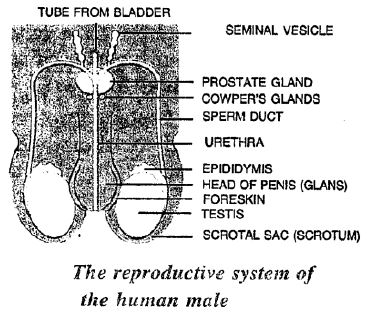
Question 3. Describe the male and female reproductive systems in humans.
Answer: The human reproductive systems consist of highly specialized organs:
Male Reproductive System:
- **Testes:** Located in the scrotum outside the body, they produce sperm cells and testosterone.
- **Epididymis:** A coiled structure behind each testis that stores and matures sperm.
- **Sperm Ducts (Vas Deferens):** Tubes through which sperm cells travel toward the urethra.
- **Penis:** The muscular organ that delivers sperm into the female body.
Female Reproductive System:
- **Ovaries:** A pair of oval structures that produce eggs and female sex hormones.
- **Oviducts (Fallopian Tubes):** Tubes where eggs travel and fertilization takes place.
- **Uterus (Womb):** The muscular organ where the embryo implants and develops.
- **Vagina:** The canal that connects the cervix to the outside, receiving sperm and serving as the birth canal.
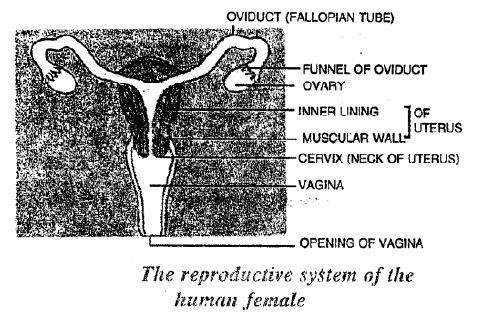
In simple words: The male system produces sperm using the testes and delivers it via the penis. The female system produces eggs in the ovaries, fertilizes them in the fallopian tubes, and grows the baby inside the uterus.
Exam Tip: Be ready to list the main organs of both systems and outline the path of reproductive cells (gametes) through them.
Question 4. What happens in a boy’s body under the influence of hormones?
Answer: Under the influence of male hormones (chiefly testosterone), the reproductive organs become fully active, causing several physical changes between ages 14 and 16:
1. The voice deepens and becomes hoarse.
2. Facial, body, and pubic hair begin to grow.
3. The body becomes more muscular as skeletal muscle develops.
4. Oil glands become active, often causing acne outbreaks.
In simple words: Hormones activate a boy's reproductive organs, which deepens his voice, grows facial hair, builds muscle, and sometimes causes pimples.
Exam Tip: Testosterone is the primary hormone driving these changes (secondary sexual characteristics) during puberty in boys.
Question 5. What happens in a girl’s body under the influence of hormones?
Answer: Driven by female hormones (estrogen and progesterone), the female reproductive organs mature, bringing about several changes around ages 11 to 12:
1. Breasts begin to develop and enlarge.
2. Hips broaden and become wider.
3. The voice maintains a high pitch.
4. The menstrual cycle (menstruation) begins.
In simple words: Hormones activate a girl's reproductive system, starting breast growth, widening her hips, and beginning her monthly periods.
Exam Tip: Estrogen is the primary hormone responsible for initiating these secondary sexual characteristics in girls during puberty.
Question 6. Mention the changes which occur during adolescence in humans.
Answer: During adolescence, both growth hormones and sex hormones drive major physical, emotional, and social changes:
- **Physical development:** Rapid growth spurts occur in both sexes. Girls experience breast growth, hip widening, and the onset of menstruation. Boys experience voice deepening, muscle development, and facial hair growth.
- **Emotional & Mental shifts:** Surging hormone levels affect brain chemistry, causing mood swings, restlessness, self-consciousness, and developing romantic attractions.
- **Social dynamics:** Teenagers seek independence, focus heavily on peer groups, and form their personal identities.
In simple words: Adolescence brings major growth spurts, sexual maturity, emotional mood swings, and a desire to be independent.
Exam Tip: Cover both physical changes (like growth spurts) and emotional/social adjustments to write a complete answer.
Question 7. Describe the different methods of asexual reproduction in animals.
Answer: Animals reproduce asexually through several mechanisms:
1. **Binary Fission:** A single-celled organism (like *Amoeba*) splits its parent body into two identical halves, each growing into a new individual.
2. **Multiple Fission:** Under harsh environmental conditions, an organism (like *Plasmodium*) forms a protective cyst. Its nucleus divides repeatedly into multiple daughter nuclei, which later break free to become new individuals once conditions improve.
3. **Budding:** A tiny outgrowth, or bud, develops on the parent's outer wall (like in *Hydra*). This bud grows, matures, and eventually detaches to lead an independent life.
4. **Fragmentation:** The parent's body breaks into separate segments (such as in flatworms or sponges), and each fragment regenerates missing tissues to grow into a complete new organism.
5. **Regeneration:** Simple organisms can restore missing body segments through rapid cell division. For instance, a starfish can grow an entire new body from a single severed arm, though complex mammals can only regenerate simple structures like skin and nails.
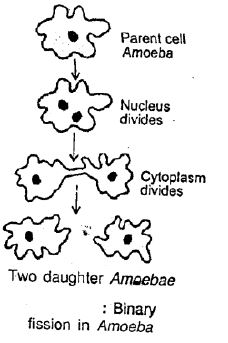
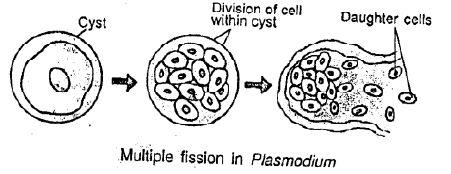
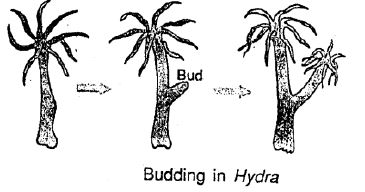
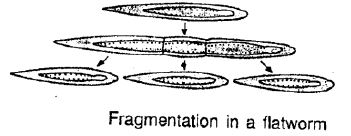
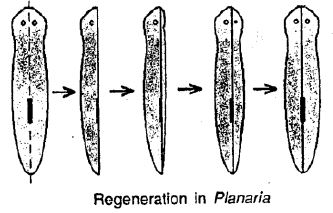
In simple words: Asexual methods include splitting in half (binary fission), splitting into many pieces (multiple fission), growing a bud that drops off (budding), breaking into parts that grow back (fragmentation), and rebuilding lost limbs (regeneration).
Exam Tip: Always provide a specific example (such as Amoeba for binary fission and Hydra for budding) for each reproductive method you list.
Question 8. Adolesecence is considered a critical stage in the life of boys and girls. Explain this statement.
Answer: Adolescence is a highly critical stage because it involves intense biological and psychological adjustments:
- **Physical Transitions:** Sex and growth hormones trigger rapid physical changes (breast growth, hip widening, and menstruation in girls; facial/body hair, muscular growth, voice deepening, and acne in boys).
- **Sexual Maturity:** Reaching puberty requires young people to physically and mentally adjust to their developing reproductive systems and emerging sexual feelings.
- **Emotional Swings & Independence:** Fluctuating hormones cause emotional instability, restlessness, and a strong desire to be independent, which can sometimes lead to psychological stress or rebellious behavior.
In simple words: Adolescence is a critical stage because kids must deal with rapid physical changes while adjusting to new emotions, mood swings, and a desire for independence.
Exam Tip: Balance your answer by addressing both the physiological aspects (hormonal activity) and the psychological adjustments (independence and mood swings).
Question 9. Describe the various stages in the life cycle of a butterfly.
Answer: The life cycle of a butterfly features a process of complete metamorphosis consisting of four distinct stages:
1. **Egg:** The cycle begins when an adult female butterfly deposits eggs onto plant leaves.
2. **Larva (Caterpillar):** The hatched larva is an active, voracious caterpillar that feeds continuously on leaves to grow rapidly in size.
3. **Pupa (Chrysalis):** The caterpillar stops moving and eating, spinning a protective silk cocoon around itself. Inside this resting stage, it undergoes intense restructuring to form adult characteristics.
4. **Adult:** Once fully formed, a winged adult butterfly breaks out of the cocoon, expands its wings, and takes flight to begin the cycle anew.
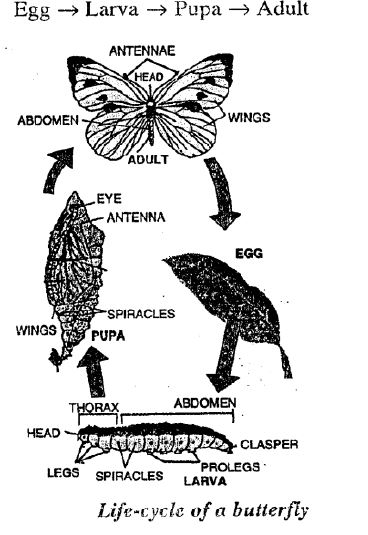
In simple words: A butterfly goes through four stages: egg, active feeding caterpillar, resting pupa inside a cocoon, and finally emerging as a flying adult.
Exam Tip: Use a simple cyclic flowchart to represent these four stages to clearly illustrate complete metamorphosis in exams.
Free study material for Biology
ICSE Study Resources for Class 8 Biology Chapter 03 Reproduction in Humans
About ICSE Solutions for Class 8 Biology Chapter 03 Reproduction in Humans
Strengthen your preparation with comprehensive answers for Class 8 Biology Chapter 03 Reproduction in Humans. These expert-reviewed solutions make tracking your academic progress straightforward and efficient.
How to Use These Class 8 Biology Solutions
Tackle complex theorems and numerical problems easily by cross-referencing your working steps with our structured solution guides.
Complete Your ICSE Chapter Revision
Explore our broader library of study materials and chapter notes to support your continuous revision and secure higher marks.
FAQs
You can download the verified Selina Concise solutions for Chapter 03 Reproduction in Humans on StudiesToday.com. Our teachers have prepared answers for Class 8 Biology as per 2026-27 ICSE academic session.
Yes, our solutions for Chapter 03 Reproduction in Humans are designed as per new 2026 ICSE standards. 40% competency-based questions required for Class 8, are included to help students understand application-based logic behind every Biology answer.
Yes, every exercise in Chapter 03 Reproduction in Humans from the Selina Concise textbook has been solved step-by-step. Class 8 students will learn Biology conceots before their ICSE exams.
Yes, follow structured format of these Selina Concise solutions for Chapter 03 Reproduction in Humans to get full 20% internal assessment marks and use Class 8 Biology projects and viva preparation as per ICSE 2026 guidelines.