

Download Class 10 All Subjects Practice Worksheets
Access comprehensive chapter-wise worksheets for All Chapters using the CBSE Class 10 All Subjects Revision Worksheet Set 10. Designed to align with the 2026-27 academic syllabus for Class 10 All Subjects, these printable practice sets help students reinforce key concepts and improve their overall exam readiness.
Access All Chapters Practice Papers and Solutions
Navigate directly to the solved All Subjects worksheets using the digital viewer below. Each practice set includes detailed step-by-step solutions, allowing students to instantly cross-check their work and identify areas requiring further revision.
ENGLISH HOLIDAY HOMEWORK
Question 1. Make books your best friends during the summer break. Read any two books and write their book review for a presentation in the class.
- The Winner Stands Alone - Paulo Coelho
- To Kill a Mocking Bird - Harper Lee
- Open - Andre Agassi
- Wings of Fire - Abdul Kalam
- Discovery of India - Jawaharlal Nehru
- The White Tiger - Aravind Adiga
In your presentation you will talk about the plot, the main characters and if the main character had any interesting adventure. Could you relate to any of the characters in the story? If you could change something in the book, what would it be? Also consider if you would recommend this to another person and why. Design an attractive book cover which can be displayed.
Answer: To complete this assignment successfully, select any two books from the provided list (for example, Wings of Fire by A.P.J. Abdul Kalam and The Discovery of India by Jawaharlal Nehru).
1. Book Review Structure:
- Introduction: State the title, author, genre, and overall theme of the book.
- Plot Summary: Provide a brief outline of the narrative arc without giving away major spoilers.
- Character Analysis: Discuss the protagonist, their motivations, key adventures, and how you relate to them personally.
- Critique and Alternative: Reflect on what part of the storyline you would change if given the opportunity and explain your reasoning.
- Recommendation: Conclude with a clear recommendation stating who should read the book and why.
2. Book Cover Design: Create a visually engaging illustration on a chart paper incorporating key symbols, thematic colors, and striking typography representing the core message of the chosen books.
In simple words: Read two books from the list, write down their summaries, analyze the characters, suggest changes if any, and design a creative book cover for a class presentation.
Exam Tip: Structure your review with clear headings and maintain a balance between personal reflection and objective literary analysis.
Question 2. Another habit to inculcate during the summer break is to read the NEWSPAPER everyday. Choose live news items from the newspaper based on the news, complete any of the three following tasks:
- Diary entry reporting the event as one of the characters.
- Letters formal (to the editor/concerned person) and informal (from one person to another).
- E-mail (from one person to another).
- Telephone conversation (from one person to another).
- Conventional first and/or third person narrative.
- A dialogue between the people involved (scripted like a play).
- Converting the news into a radio/television broadcast.
- Poetry: Write a poem about some memorable event, perhaps in the style of a real poet you have read.
Answer: Select three distinct current news items over your summer break and apply three different creative writing formats from the given list.
1. Task 1 (Diary Entry): Adopt the persona of someone directly affected by a major news event and write a reflective, emotional account in first-person perspective with a date and time stamp.
2. Task 2 (Formal/Informal Letter or E-mail): Address a civic issue highlighted in the news by writing a formal letter to the editor of a newspaper proposing actionable solutions, or write an informal letter discussing the event with a friend.
3. Task 3 (Scripted Dialogue or Broadcast): Write a realistic telephonic conversation or television news script capturing multiple viewpoints on the reported issue.
In simple words: Pick three news items and write about them using three creative formats like a diary entry, a formal letter, or a news broadcast script.
Exam Tip: Ensure that the tone of your writing matches the chosen format (e.g., formal and polite for letters to the editor, emotional and subjective for diary entries).
MATHEMATICS
Question 1. By drawing two straight lines, divide the clock into three parts so that the sum of all the numbers on each part is the same.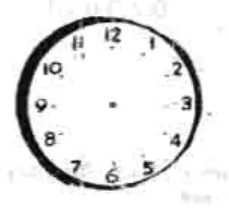
Answer: First, find the sum of all numbers on a standard clock face:
Total sum = \(1 + 2 + 3 + 4 + 5 + 6 + 7 + 8 + 9 + 10 + 11 + 12 = 78\)
Since we need to divide the clock into 3 equal parts, the sum of numbers in each part must be:
\(\frac{78}{3} = 26\)
By drawing two intersecting straight lines across the clock face, we can group the numbers as follows:
- Part 1: \(11 + 12 + 1 + 2 = 26\)
- Part 2: \(10 + 9 + 3 + 4 = 26\)
- Part 3: \(8 + 7 + 6 + 5 = 26\)
In simple words: Add all clock numbers to get 78, divide by 3 to get 26 per section, and group numbers so each section adds up to 26.
Exam Tip: Always calculate the total sum first in partitioning puzzles to determine the target sum per group.
Question 2. Two friends Rajat and Rajesh are 12.5 km apart. If they travel in opposite directions, they meet each other after half an hour and if they travel in the same direction, they meet after 2.5 hours. If Rajesh travels faster, what is his speed?
Answer: Let the speed of Rajat be \(x\) km/h and the speed of Rajesh be \(y\) km/h, with \(y > x\).
Distance between them = \(12.5\) km.
Case 1: Traveling in opposite directions, relative speed = \(x + y\).
Time taken = \(0.5\) hours (half an hour).
\((x + y) \times 0.5 = 12.5\)
\(x + y = \frac{12.5}{0.5} = 25\) km/h --- (Equation 1)
Case 2: Traveling in the same direction, relative speed = \(y - x\).
Time taken = \(2.5\) hours.
\((y - x) \times 2.5 = 12.5\)
\(y - x = \frac{12.5}{2.5} = 5\) km/h --- (Equation 2)
Adding Equation 1 and Equation 2:
\((x + y) + (y - x) = 25 + 5\)
\(2y = 30\)
\(y = 15\) km/h
Substituting \(y = 15\) into Equation 1:
\(x + 15 = 25 \implies x = 10\) km/h.
Therefore, Rajesh's speed is 15 km/h.
In simple words: Use relative speed formulas for opposite and same direction travel to form two linear equations, then solve them simultaneously to find Rajesh's speed as 15 km/h.
Exam Tip: In relative speed problems, opposite directions add speeds (\(x + y\)) while same direction subtracts speeds (\(y - x\)).
Question 3. Replace each letter with 1, 2, 3, 4, 5, 6 or 7 so that the sum of the numbers in each circle is 15.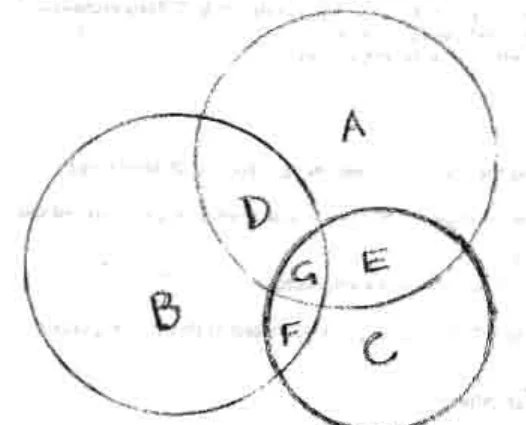
Answer: Assign A = 6, B = 4, C = 2, D = 3, E = 5, F = 7, G = 1. Check: circle A (A, D, E, G) = 6 + 3 + 5 + 1 = 15; circle B (B, D, F, G) = 4 + 3 + 7 + 1 = 15; circle C (C, E, F, G) = 2 + 5 + 7 + 1 = 15. Every number 1 to 7 is used once.
In simple words: Assign numbers 1 through 7 to the circles and overlapping regions so that every circle adds up to 15.
Exam Tip: Start by placing larger numbers in intersecting regions since they contribute to multiple circles simultaneously.
Question 4. Most shopkeepers make use of several weights of 1kg, 2kg, 5kg, 10kg, 20kg and 40kg, But in Ramgarh there is an intelligent shopkeeper who uses only four weights for weighing 1kg to 40kg. Can you figure out the four weights which the shopkeeper uses?
Answer: The shopkeeper uses weights based on powers of 3, allowing weights to be placed on either the pan with the object or the pan with the weights (using subtraction as well as addition).
The four weights are: 1 kg, 3 kg, 9 kg, and 27 kg.
Verification:
- Maximum weight measurable = \(1 + 3 + 9 + 27 = 40\) kg.
- Any integer weight from 1 to 40 can be weighed using combinations of adding and subtracting these four weights (e.g., to weigh 2 kg, put 3 kg on one side and 1 kg on the object side: \(3 - 1 = 2\)).
In simple words: The shopkeeper uses 1 kg, 3 kg, 9 kg, and 27 kg weights, which can be added or subtracted to weigh any amount from 1 kg to 40 kg.
Exam Tip: Remember that weighing puzzles involving arbitrary ranges often rely on ternary (powers of 3) number systems.
Question 5. On repeated requests, Chandrani mam decides to disclose her year of birth to her students in the form of a riddle. She says "if you write my year of birth on a piece of paper, it will appear the same when read in the conventional manner or by turning the page upside down". In which year was she born?
Answer: Digits that look valid when turned upside down are 0, 1, 8 (unchanged) and 6, 9 (which swap). The year 1961 works: turned upside down it reads 1961 again (1 stays 1, 9 becomes 6, 6 becomes 9, 1 stays 1, and the order reverses).
In simple words: The birth year is 1961 because the digits 1, 9, 6, 1 read the same even when turned upside down.
Exam Tip: Look for numbers composed of rotationally symmetric digits like 0, 1, and 8, or complementary pairs like 6 and 9.
Question 6. If there are 12 one-rupee stamps in a dozen, how many two rupee stamps are there in a dozen?
Answer: A dozen always means 12 items, regardless of the denomination or type of item.
Therefore, there are 12 two-rupee stamps in a dozen.
In simple words: A dozen is always 12, so there are 12 two-rupee stamps in a dozen.
Exam Tip: Watch out for trick questions where monetary value is confused with physical quantity.
Question 8. Insert the symbols + or - (as many times) so that each of the following equations is correct?
i) 293571 = 9
ii) 445728 = 8
iii) 843521 = 7
iv) 365244 = 0
Answer:
i) For 293571 = 9: \(2 - 9 + 3 + 5 + 7 + 1 = 9\)
ii) For 445728 = 8: \(4 - 4 + 5 - 7 + 2 + 8 = 8\)
iii) For 843521 = 7: \(8 - 4 - 3 + 5 + 2 - 1 = 7\)
iv) For 365244 = 0: \(3 - 6 + 5 - 2 - 4 + 4 = 0\)
In simple words: Insert plus and minus signs between the digits so that the arithmetic result matches the target number.
Exam Tip: Test small adjustments to positive and negative terms until the running sum matches the target.
Question 9. How do you place 7 small circles into 3 big circles so that each big circle contains 4 small circles?
Answer: Draw 3 overlapping big circles (like a Venn diagram with a central intersection and two side intersections).
- Place 1 small circle in the central intersection of all three big circles.
- Place 1 small circle in each of the three pairwise intersections between two big circles (total 3 small circles in pairwise overlaps).
- Place 1 small circle in the non-overlapping outer region of each of the three big circles (total 3 small circles in outer regions).
Total small circles = \(1 \text{ (center)} + 3 \text{ (pairwise)} + 3 \text{ (outer)} = 7\).
Each big circle contains: \(1 \text{ (center)} + 2 \text{ (pairwise)} + 1 \text{ (outer)} = 4\) small circles.
In simple words: Place 1 circle in the middle, 1 in each overlap, and 1 in each outer section so every big circle ends up with 4 small circles.
Exam Tip: Use Venn diagram overlapping regions to share items among multiple groups.
Activity
Many patterns can be created with geometrical shapes. E.g. curves can be drawn from a set of straight lines by using a circle. The circle is marked with a set of equally spaced points. Here there are 36. This can be done by drawing a circle and marking a point every 10 degrees. These points are first numbered from 1 to 36 and then again from 37 to 72 as shown below. Each point is joined to its double. Point 1 is joined to 2, 2 to 4, 3 to 6, 4 to 8 and so on.
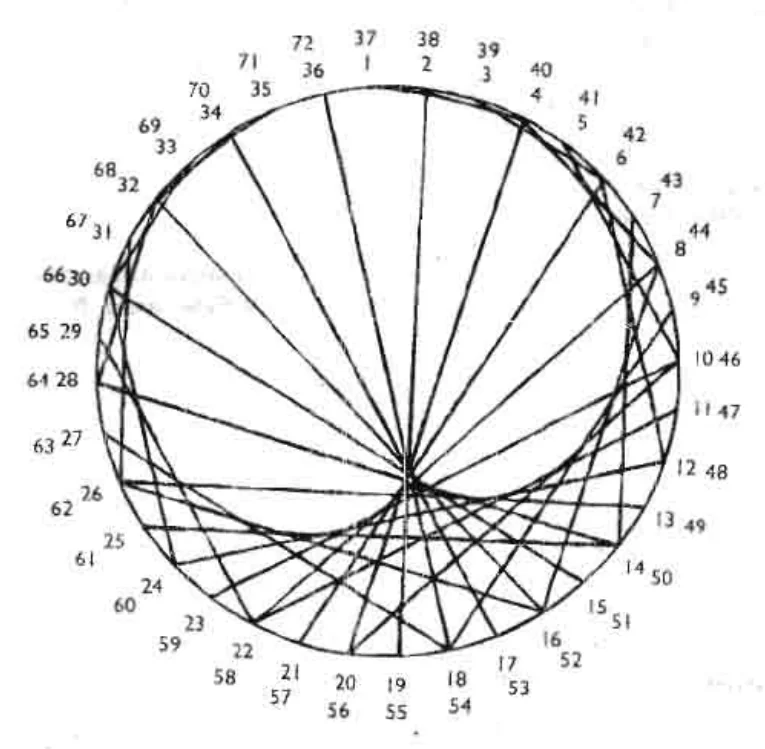
The result is a beautiful pattern known as a 'cardoid' as shown above. Let your creative side take over and draw the above and at least four other such patterns using coloured pens and threads on cards made out of chart papers.
Sample outline: Draw a circle, mark 36 equally spaced points, number them 1 to 36 and then 37 to 72, join each point to its double, and repeat with different numbers of points and colours.
GEOGRAPHY HOLIDAY HOME WORK
Question 1. Collect information on any one of the following disasters: 1. Earthquakes 2. Tsunami 3. Avalanches/Landslides 4. Fire 5. Leakage of chemicals or Harmful gases. Form a group of 8 students. Each member of the group will collect information on any one disaster with reference to the following aspects: 1. Introduction - 1 member, 2. Causes of the disaster - 2 members, 3. Consequences - 2 members, 4. Mitigation strategies - 2 members, 5. Bibliography/acknowledgment/photographs - 1 member.
Answer: This is a collaborative group project. Form a group of 8 students and select one disaster (e.g., Earthquakes). Divide the sub-topics as follows:
1. Introduction (Member 1): Definition, magnitude scale, and historical context of major earthquakes.
2. Causes (Members 2 & 3): Tectonic plate movements, fault lines, and seismic waves.
3. Consequences (Members 4 & 5): Loss of life, structural collapse, economic disruption, and secondary hazards like fires or landslides.
4. Mitigation Strategies (Members 6 & 7): Earthquake-resistant building construction, early warning systems, and community drills.
5. Documentation (Member 8): Compiling photographs, maps, references, and the bibliography from the prescribed book "Together Towards A Safer India - II".
In simple words: Work in a group of 8 to research an earthquake by dividing the tasks into introduction, causes, effects, safety measures, and bibliography.
Exam Tip: Ensure all sections of the project are formatted uniformly with clear headings and relevant case studies.
The project on disaster management will be assessed on the following basis:
- Originality of the project - 2 marks
- Research Work - 3 marks
- Creativity - 2 marks
- Interaction/Presentation - 3 marks
Please note:
- The marks/grades scored will be included in the Formative Assessment.
- Refer to the prescribed book - "Together Towards A Safer India - II".
SOCIAL SCIENCE HOLIDAY HOMEWORK - ECONOMICS
Question 1. Collect data for the following countries: 1) India 2) France 3) United States 4) China 5) Pakistan 6) Norway. The information should be based on the following HDI indicators: a) Per Capita Income b) Literacy rate c) Life expectancy d) Access to safe drinking water e) IMR. Compare and analyse the performance of different countries based on the above mentioned indicators.
Answer: Collect recent statistical data from reliable sources (such as UNDP Human Development Reports or World Bank databases) for the specified countries across all five indicators.
1. Data Compilation: Construct a comparative table listing India, France, United States, China, Pakistan, and Norway against Per Capita Income, Literacy Rate, Life Expectancy, Safe Drinking Water Access, and Infant Mortality Rate (IMR).
2. Comparative Analysis:
- Developed nations like Norway and the United States show very high per capita incomes, near-zero IMR, and high literacy rates.
- Emerging economies like China and India show rapid growth in per capita income and literacy, though challenges remain in healthcare and IMR.
- Compare Pakistan's indicators with India and analyze the socio-economic factors influencing human development.
In simple words: Gather HDI statistics for the six countries, put them in a table, and compare how developed nations rank higher than developing ones across health and education metrics.
Exam Tip: Always cite your data sources and highlight how education and health indicators directly correlate with overall economic development.
PHYSICS HOLIDAY HOMEWORK
Question 1. What is the net resistance between A and B in the given network?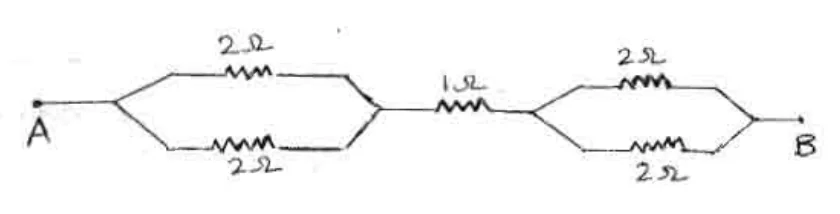
Answer: Analyzing the circuit diagram:
- The left section has two \(2\,\Omega\) resistors in parallel. Let their equivalent resistance be \(R_1\):
\(\frac{1}{R_1} = \frac{1}{2} + \frac{1}{2} = 1 \implies R_1 = 1\,\Omega\)
- The middle section has a single \(1\,\Omega\) resistor in series: \(R_2 = 1\,\Omega\)
- The right section has two \(2\,\Omega\) resistors in parallel. Let their equivalent resistance be \(R_3\):
\(\frac{1}{R_3} = \frac{1}{2} + \frac{1}{2} = 1 \implies R_3 = 1\,\Omega\)
- All three sections (\(R_1, R_2, R_3\)) are connected in series between terminals A and B.
Total net resistance \(R_{AB} = R_1 + R_2 + R_3 = 1 + 1 + 1 = 3\,\Omega\).
In simple words: Calculate the parallel resistance of the left pair (1 ohm), add the middle 1 ohm resistor, and add the parallel resistance of the right pair (1 ohm) to get a total of 3 ohms.
Exam Tip: Break complex circuits down into simpler series and parallel blocks from left to right.
Question 2. Given three 30 ohm resistances, how can they be connected to give the net resistance of 90 ohms, 10 ohms and 45 ohms?
Answer: Given three resistors of \(R = 30\,\Omega\) each:
1. For net resistance of \(90\,\Omega\): Connect all three resistors in series.
\(R_{net} = R + R + R = 30 + 30 + 30 = 90\,\Omega\).
2. For net resistance of \(10\,\Omega\): Connect all three resistors in parallel.
\(\frac{1}{R_{net}} = \frac{1}{30} + \frac{1}{30} + \frac{1}{30} = \frac{3}{30} = \frac{1}{10} \implies R_{net} = 10\,\Omega\).
3. For net resistance of \(45\,\Omega\): Connect two resistors in parallel, and connect that parallel combination in series with the third resistor.
Resistance of the parallel pair = \(\frac{30 \times 30}{30 + 30} = 15\,\Omega\).
Adding the third resistor in series: \(R_{net} = 15 + 30 = 45\,\Omega\).
In simple words: Connect them all in series for 90 ohms, all in parallel for 10 ohms, and two in parallel combined with one in series for 45 ohms.
Exam Tip: Series connection increases resistance while parallel connection decreases it below the value of the smallest individual resistor.
Question 3. The resistance of two conductors in series is 50 ohms and in parallel is 12 ohms. Find the resistance of each conductor.
Answer: Let the resistances of the two conductors be \(R_1\) and \(R_2\).
Given in series: \(R_1 + R_2 = 50\) --- (Equation 1)
Given in parallel: \(\frac{R_1 R_2}{R_1 + R_2} = 12\)
Substitute Equation 1 into the parallel equation:
\(\frac{R_1 R_2}{50} = 12 \implies R_1 R_2 = 50 \times 12 = 600\) --- (Equation 2)
We know the algebraic identity: \((R_1 - R_2)^2 = (R_1 + R_2)^2 - 4 R_1 R_2\)
\((R_1 - R_2)^2 = (50)^2 - 4(600) = 2500 - 2400 = 100\)
\(R_1 - R_2 = \sqrt{100} = 10\) --- (Equation 3)
Adding Equation 1 and Equation 3:
\(2 R_1 = 60 \implies R_1 = 30\,\Omega\)
Substituting \(R_1 = 30\) into Equation 1:
\(30 + R_2 = 50 \implies R_2 = 20\,\Omega\)
Therefore, the resistances are \(30\,\Omega\) and \(20\,\Omega\).
In simple words: Use the sum and product formulas for series and parallel resistances to set up simultaneous equations, yielding 30 ohms and 20 ohms.
Exam Tip: Memorize the algebraic identity connecting sum, difference, and product of two variables for quick solutions in resistor network problems.
Question 4. Two wires of 10 ohms and 5 ohms are in parallel and the arrangement is in series with 20 ohms wire. If the current in 5 ohms wire is 2 A, calculate the current in 10 ohms wire and the potential difference V across the whole circuit?
Answer:
1. Current in \(10\,\Omega\) wire:
The \(10\,\Omega\) and \(5\,\Omega\) wires are connected in parallel, so the potential difference \(V_p\) across both is the same.
\(V_p = I_1 \times R_1 = I_2 \times R_2\)
Given current in \(5\,\Omega\) wire (\(I_2\)) = \(2\) A.
\(V_p = 2 \times 5 = 10\) V.
Current in \(10\,\Omega\) wire (\(I_1\)) = \(\frac{V_p}{10} = \frac{10}{10} = 1\) A.
2. Total current and potential difference across the whole circuit:
Total current entering the parallel combination \(I_{total} = I_1 + I_2 = 1 + 2 = 3\) A.
This total current of 3 A flows through the series \(20\,\Omega\) wire as well.
Equivalent resistance of the parallel combination \(R_p = \frac{10 \times 5}{10 + 5} = \frac{50}{15} = \frac{10}{3}\,\Omega\).
Total circuit resistance \(R_{total} = R_p + 20 = \frac{10}{3} + 20 = \frac{70}{3}\,\Omega\).
Total potential difference across the whole circuit \(V = I_{total} \times R_{total} = 3 \times \frac{70}{3} = 70\) V.
In simple words: Find the voltage across the parallel wires to get 1 A in the 10 ohm wire, calculate the total current of 3 A, and multiply by the total circuit resistance to find 70 V.
Exam Tip: In parallel branches, voltage is constant; use Ohm's law to find branch currents before calculating total circuit voltage.
Question 5. Six equal resistances of 1 ohm each are connected to form the sides of a hexagon ABCDEF. Calculate the resistance offered by the combination if the current enters at A and leaves at D.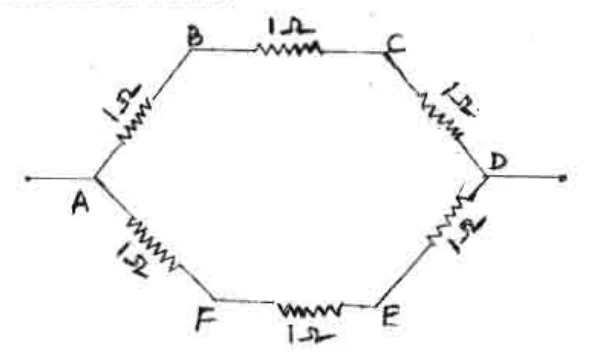
Answer: Consider a regular hexagon ABCDEF with each side equal to \(1\,\Omega\). Current enters at vertex A and leaves at vertex D.
- The vertices A and D divide the hexagon into two symmetrical paths:
- Path 1 (upper half): A to B to C to D, consisting of three \(1\,\Omega\) resistors in series: \(R_{upper} = 1 + 1 + 1 = 3\,\Omega\).
- Path 2 (lower half): A to F to E to D, consisting of three \(1\,\Omega\) resistors in series: \(R_{lower} = 1 + 1 + 1 = 3\,\Omega\).
- These two paths are connected in parallel between A and D.
Equivalent resistance \(R_{AD}\):
\(\frac{1}{R_{AD}} = \frac{1}{R_{upper}} + \frac{1}{R_{lower}} = \frac{1}{3} + \frac{1}{3} = \frac{2}{3}\)
\(R_{AD} = \frac{3}{2} = 1.5\,\Omega\).
In simple words: The hexagon splits into two equal 3-ohm branches between A and D, giving a total parallel resistance of 1.5 ohms.
Exam Tip: Exploit symmetry in closed geometric circuits to simplify resistor networks into parallel branches.
CHEMISTRY HOLIDAY HOMEWORK
Question 1. Research on any leading scientist in the field of chemistry. The information researched has to be submitted in the form of a project/power point presentation. The project should not exceed 5-6 pages. It has to be supported with pictures and experiments. The project will be assessed as part of CCE activity. No oral presentation. The project carries 5 marks. Students are required to work under the following heads: Scientist: Early life and turning point in his/her life, Contribution/experiment, Research used in daily life / its application in the field of chemistry, Work of recognition / Any significant achievement / Any prize awarded.
Answer: Select a prominent chemist (e.g., Marie Curie, Dmitri Mendeleev, or Robert Boyle) and structure your 5-6 page project report under the required headings:
1. Introduction & Early Life: Birth, education, and the pivotal turning point that sparked their interest in science.
2. Major Contribution & Experiments: Key scientific breakthroughs (such as the periodic table or discovery of radioactivity) explained with experimental details and diagrams.
3. Real-World Applications: How their research impacts modern chemistry, industry, and daily life.
4. Awards & Recognition: Honors received, including Nobel Prizes, fellowships, and enduring scientific legacy.
In simple words: Create a 5-6 page illustrated report on a famous chemist covering their life, experiments, daily life uses of their work, and awards.
Exam Tip: Include labeled diagrams of apparatus and clear timelines to make your chemistry project stand out.
BIOLOGY HOLIDAY HOMEWORK
Question 1. Prepare an investigatory project on Hypertension. The project should include the following sub-topics: (a) Structure of the Human Heart. (b) Blood flow through the Heart. (c) What is Hypertension. (d) A Survey of your locality - Make a door to door survey of your locality and contact people of different age groups (at least 10). Record their answers in relation to queries put down in the questionnaire. (e) Analyse the recorded observations. The analysis should include issues like age, gender, profession, lifestyles and attitudes of the people surveyed.
Answer: Follow these steps to complete the biology investigatory project on hypertension:
1. Cardiovascular Anatomy & Physiology: Describe the four chambers of the human heart, valves, and the double circulation of oxygenated and deoxygenated blood.
2. Hypertension Overview: Define high blood pressure, its normal vs. hypertensive thresholds, and risk factors.
3. Survey Implementation: Conduct a door-to-door survey of at least 10 individuals using the provided questionnaire (recording age, profession, lifestyle habits, blood pressure checking habits, and awareness).
4. Data Analysis: Analyze responses by correlating age groups, stress levels in professions, and dietary habits with hypertension prevalence.
In simple words: Write about heart structure and blood flow, define hypertension, survey 10 people using the questionnaire, and analyze how lifestyle affects blood pressure.
Sample Questionnaire
Name: ............................ Age: .............. Male / Female Weight: ........ kg
Address: ..........................................................................
| 1. Do you get your blood pressure checked at regular intervals? | (Yes / No) |
| 2. Are you aware about Hypertension (High Blood Pressure)? | (Yes / No) |
| 3. Do you suffer from this disorder? | (Yes / No) |
| 4. Do you know the causes of this disorder? | (Yes / No) |
| 5. Do you take any medicine related to this disorder regularly? | (Yes / No) |
| 6. Do you include oily foods in your meals? | (Yes / No) |
| 7. Do you think your diet is balanced? | (Yes / No) |
| 8. Do you prefer junk foods over routine food? | (Yes / No) |
| 9. Do you exercise or go for a walk regularly? | (Yes / No) |
| 10. What is your profession? | ............................ |
| 11. Do you think your profession is a hurdle in maintaining a healthy lifestyle? | (Yes / No) |
Exam Tip: Present survey data using clear bar graphs and pie charts to earn high marks for data presentation.
हिन्दी ग्रीष्म अवकाश कार्य कक्षा X
Question 1. अपनी क्षेत्रीय भाषा की कम से कम दस लोकोक्तियों का संकलन कीजिए।
Answer: अपनी क्षेत्रीय भाषा (जैसे अवधी, भोजपुरी, मैथिली, राजस्थानी आदि) की दस प्रसिद्ध लोकोक्तियों को उनके अर्थ और प्रयोग सहित लिखिए। उदाहरण के लिए:
1. नाच न जाने आँगन टेढ़ा - काम न जानने पर बहाने बनाना।
2. जैसी करनी वैसी भरनी - कर्म के अनुसार फल मिलना।
3. चोर की दाढ़ी में तिनका - अपराधी व्यक्ति हमेशा डरा रहता है।
In simple words: अपनी क्षेत्रीय भाषा की दस लोकोक्तियाँ उनके अर्थ के साथ लिखिए।
Exam Tip: लोकोक्तियों के साथ उनका सटीक अर्थ और वाक्य प्रयोग अवश्य लिखें।
Question 2. हरिहर काका (संचयन से) कहानी को पढ़कर उस पर आधारित दस प्रश्नों की प्रश्नावली बनाएँ।
Answer: 'हरिहर काका' कहानी को ध्यानपूर्वक पढ़कर उस पर आधारित दस महत्वपूर्ण बोधात्मक प्रश्न और उनके उत्तर तैयार करें, जैसे:
1. हरिहर काका के पास कुल कितनी बीघा जमीन थी?
2. ठाकुरबारी के मंहत और परिवार के लोग हरिहर काका की सेवा क्यों करते थे?
In simple words: कहानी को पढ़कर उस पर आधारित दस प्रश्न और उनके उत्तर लिखिए।
Exam Tip: प्रश्न ऐसे हों जो कहानी की मुख्य थीम और चरित्रों के संघर्ष को स्पष्ट करें।
Question 3. "वर्तमान समाज में वृद्धों की अवस्था" पर अपने विचार लिखें। (लगभग 150 शब्दों में)
Answer: आधुनिक समाज में संयुक्त परिवार टूटने के कारण वृद्धों की स्थिति दयनीय होती जा रही है। उन्हें अकेलापन, उपेक्षा और हीनभावना का सामना करना पड़ता है। युवा पीढ़ी को अपनी व्यस्त जीवनशैली से समय निकालकर बुजुर्गों को आदर और स्नेह देना चाहिए क्योंकि उनका अनुभव समाज की अमूल्य धरोहर है।
In simple words: वृद्धों की स्थिति पर 150 शब्दों में अपने विचार लिखिए कि कैसे उन्हें सम्मान और प्यार मिलना चाहिए।
Exam Tip: अनुच्छेद लेखन में विचारों की स्पष्टता और भाषा की सरलता का विशेष ध्यान रखें।
Question 4. सी.बी.एस.ई. के निदेशक को पत्र लिखकर यह बताएँ कि सी.बी.एस.ई. की गतिविधियों से आपके व्यक्तित्व में क्या सकारात्मक परिवर्तन आए हैं।
Answer:
परीक्षा भवन,
नई दिल्ली।
दिनांक: [तारीख]
श्रीमान निदेशक महोदय,
केंद्रीय माध्यमिक शिक्षा बोर्ड (CBSE), दिल्ली।
विषय: बोर्ड की गतिविधियों से व्यक्तित्व में आए सकारात्मक परिवर्तनों के संबंध में।
महोदय,
सविनय निवेदन है कि मैं आपके बोर्ड के अंतर्गत अध्ययनरत एक छात्र हूँ। CCE और सहगामी गतिविधियों ने मेरे आत्मविश्वास, वक्तृत्व कला, और सामाजिक दायित्व की भावना को अत्यधिक समृद्ध किया है। इन रचनात्मक आयोजनों ने मेरी झिझक दूर की है।
धन्यवाद!
भवदीय,
[आपका नाम]
In simple words: सी.बी.एस.ई. के निदेशक को औपचारिक पत्र लिखकर बताएं कि विभिन्न गतिविधियों से आपके आत्मविश्वास और व्यक्तित्व में क्या सुधार हुआ है।
Exam Tip: औपचारिक पत्र का प्रारूप सही रखें और विषय स्पष्ट रूप से लिखें।
Question 5. निम्न विषयों पर लगभग 150 शब्दों का अनुच्छेद लिखें:
क) "मैं अपनी धरती का रक्षक"
ख) "ऐसा होता मेरा देश"
ग) "धरती का शृंगार - बेटियाँ"
Answer:
ग) "धरती का शृंगार - बेटियाँ"
बेटियाँ इस सृष्टि का आधार और परिवार की शान हैं। जिस प्रकार फूल बगीचे की शोभा बढ़ाते हैं, उसी प्रकार बेटियाँ अपने संस्कारों से समाज को रोशन करती हैं। आज के युग में बेटियाँ शिक्षा, विज्ञान, खेल और रक्षा हर क्षेत्र में अपनी प्रतिभा का लोहा मनवा रही हैं। बेटियों के बिना समाज की कल्पना भी नहीं की जा सकती।
In simple words: दिए गए विषयों में से किसी एक पर लगभग 150 शब्दों का सुंदर अनुच्छेद लिखिए।
Exam Tip: अनुच्छेद की शुरुआत एक आकर्षक पंक्ति से करें और अंत सकारात्मक संदेश के साथ करें।
Question 6. प्रबन्धक, दूरदर्शन को पत्र लिखकर, कार्यक्रमों के स्तर को सुधारने के लिए सुझाव दीजिए।
Answer:
परीक्षा भवन,
नई दिल्ली।
दिनांक: [तारीख]
प्रबंधक महोदय,
दूरदर्शन, नई दिल्ली।
विषय: दूरदर्शन के कार्यक्रमों के स्तर में सुधार हेतु सुझाव।
महोदय,
मैं आपके लोकप्रिय चैनल दूरदर्शन का नियमित दर्शक हूँ। आजकल कई कार्यक्रमों में शालीनता और गुणवत्ता की कमी देखने को मिल रही है। मेरा अनुरोध है कि शैक्षणिक, सांस्कृतिक और ज्ञानवर्धक कार्यक्रमों का प्रसारण बढ़ाया जाए ताकि युवा पीढ़ी को सही दिशा मिल सके।
धन्यवाद!
भवदीय,
[आपका नाम]
In simple words: दूरदर्शन के प्रबंधक को पत्र लिखकर कार्यक्रमों की गुणवत्ता बढ़ाने और शैक्षिक कार्यक्रम दिखाने का अनुरोध करें।
Exam Tip: पत्र में शिष्टाचार और स्पष्ट सुझावों का प्रयोग करें।
संस्कृतम् - कक्षा दशमी
Question 1. 'अ' से 'ज्ञ' तक के प्रत्येक वर्ण से पाँच-पाँच शब्द लिखकर एक शब्दकोश बनाइए।
Answer: अ, आ, इ, ई, उ, ऊ, ऋ, ए, ऐ, ओ, औ, क, ख, ग, घ, ङ, च, छ, ज, झ वर्णों में से प्रत्येक से पाँच-पाँच संस्कृत शब्द उनके अर्थ सहित लिखिए।
- अ: अमर, अश्व, अग्नि, अम्रम्, आकाश
- क: कमलम्, कपोलः, कोकिलः, कृषकः, कन्या
In simple words: 'अ' से 'झ' तक के वर्णों से पाँच-पाँच संस्कृत शब्द लिखकर शब्दकोश तैयार करें।
Exam Tip: शब्दों के अर्थ हिंदी और अंग्रेजी दोनों में लिखकर शब्दकोश को आकर्षक बनाएं।
Question 2. किसी एक फिल्मी गीत का संस्कृत में अनुवाद करो।
Answer: किसी लोकप्रिय हिंदी गीत (जैसे 'इतनी शक्ति हमें देना दाता') का संस्कृत श्लोक या पद में अनुवाद करें:
हिंदी: "इतनी शक्ति हमें देना दाता, मन का विश्वास कमजोर हो ना।"
संस्कृत अनुवाद: "तावत् शक्तिं नो देहि विधाता, मनसः विश्वासः हीनो मा भूत्।"
In simple words: किसी प्रसिद्ध हिंदी गीत का सुंदर संस्कृत अनुवाद लिखिए।
Question 3. एक छोटी-सी कहानी संस्कृत में लिखिए।
Answer: पिपासितः काकः (प्यासा कौआ) की कथा संस्कृत में:
"एकस्मिन् वने एकः काकः पिपासितः आसीत्। सः जलम् अन्वेषितुम् इतोऽस्ततः भ्रमत्। सः एकं जलपात्रम् अपश्यत्। पात्रे जलम् अल्पम् आसीत्। सः पाषाणखण्डान् आनीय पात्रे अक्षिपत्। जलम् उपरि अगच्छत्। काकः जलं पीत्वा प्रसन्ना अभवत्।"
In simple words: संस्कृत में प्यासे कौए की छोटी सी कहानी लिखिए।
Exam Tip: सरल लट्लकार (वर्तमान काल) और लोट्लकार का प्रयोग करके संस्कृत में लघु कथा लिखें।
Question 4. मित्र से फोन पर की गई बातचीत को विस्तारपूर्वक लिखिए। विषय कोई भी चुना जा सकता है।
Answer: ग्रीष्मकालीन अवकाश के विषय पर मित्र से संस्कृत में संवाद:
रमेशः - हरिः ओम् मित्र! कथम् असि?
सुरेशः - ओम् नमः! अहम् कुशलः अस्मि। त्वं कथम् असि?
रमेशः - अहम् अपि कुशलः। ग्रीष्मअवकाशे त्वं किं करिष्यसि?
सुरेशः - अहम् पित्रा सह भ्रमणाय गमिष्यामि।
In simple words: मित्र के साथ फोन पर हुई बातचीत को संस्कृत संवाद के रूप में लिखिए।
Exam Tip: संवाद में संबोधन (मित्र!, भो!) और उचित प्रश्नों का प्रयोग करें।
Question 5. 'अविवेकः परमापदां पदम्' पाठ को संवाद रूप में लिखें।
Answer: 'अविवेकः परमापदां पदम्' (अविवेक सभी आपत्तियों का घर है) पाठ की कथा को दो पात्रों या विद्यार्थियों के बीच संवाद के रूप में रूपांतरित करें जिसमें अविवेकी कार्यों के दुष्परिणामों पर चर्चा की गई हो।
In simple words: पाठ 'अविवेकः परमापदां पदम्' को नाटक या संवाद के रूप में लिखिए।
Exam Tip: संवाद लिखते समय पाठ के नैतिक संदेश को प्रमुखता दें।
FRENCH HOLIDAY HOMEWORK
Question 1. The presence of French words in English has its historical raison d'etre. During the Norman period in England about 10,000 French words were adopted into English. Moreover in the course of time, the English language has picked up a great many number of French words and expressions from French. These words are called transparent words or les mots transparents. Identify at least fifteen such words from the field of fashion, tourism, design, music, language, history, gastronomy etc with both English and French meanings.
Example: Boudoir - French - Petit salon élégant de dame.
English - A woman's bedroom or private sitting room.
Fragrance - French - Odeur agréable.
English- The quality of being fragrant; a sweet or pleasing scent.
Answer: Here are 15 transparent French words commonly used in English across various fields with their French and English meanings:
1. Café:
- French: Petit restaurant où l'on sert du café et des boissons.
- English: A small restaurant selling light meals and drinks.
2. Menu:
- French: Liste des plats servis dans un repas.
- English: A detailed list of food items available in a restaurant.
3. Entrepreneur:
- French: Personne qui dirige une entreprise et prend des risques financiers.
- English: A person who operates a business, taking on financial risks.
4. Cliché:
- French: Expression stéréotypée usée par l'usage.
- English: A phrase or opinion that is overused and lacks original thought.
5. Chauffeur:
- French: Personne employée pour conduire une voiture particulière.
- English: A person employed to drive a private car.
6. Elite:
- French: Ce qu'il y a de meilleur et de plus select dans un groupe.
- English: A select group that is superior in terms of ability or qualities.
7. Fiancé / Fiancée:
- French: Personne qui est fiancée pour se marier.
- English: A person to whom someone is engaged to be married.
8. Genre:
- French: Catégorie artistique ou littéraire.
- English: A category of artistic composition or literary work.
9. Mirage:
- French: Illusion d'optique où l'on croit voir des choses absentes.
- English: An optical illusion caused by atmospheric conditions.
10. Renaissance:
- French: Mouvement culturel et artistique du XVe au XVIe siècle.
- English: The revival of art and literature under the influence of classical models.
11. Résumé:
- French: Document détaillant le parcours professionnel et académique.
- English: A brief summary of a person's education and professional experience.
12. Rouge:
- French: Produit cosmétique de couleur rouge pour les joues.
- English: Red cosmetics used for coloring the cheeks.
13. Sachet:
- French: Petit sac contenant une substance parfumée.
- English: A small perfumed bag used to scent clothes.
14. Salon:
- French: Pièce de réception ou réunion artistique.
- English: A room for entertaining guests or holding gatherings.
15. Souvenir:
- French: Objet que l'on garde pour se rappeler un lieu ou un événement.
- English: A thing kept as a reminder of a person, place, or event.
In simple words: List 15 French words used in English (like café, menu, entrepreneur) along with their French and English definitions.
Exam Tip: Provide clear definitions and maintain accurate French spelling including accents (e.g., Résumé, Cliché).
Question 2. Write a French poem of about 20 lines or 4 stanzas on any topic of your choice.
Answer: Here is a 4-stanza French poem (20 lines total) about nature and spring (Le Printemps):
Stanza 1:
Le soleil luit dans le ciel bleu,
La nature s'éveille peu à peu,
Les oiseaux chantent dans les bois,
Le printemps arrive avec joie,
La terre respire de nouveau.
Stanza 2:
Les fleurs éclosent dans les prés,
Le vent murmure des secrets,
L'herbe verte danse au vent doux,
Un beau sourire sur nous tous,
Le monde est un tableau vivant.
Stanza 3:
Les rivières coulent vers la mer,
L'air pur chasse le grand hiver,
Les enfants jouent dans le jardin,
Chaque matin est un festin,
Le bonheur emplit nos cœurs.
Stanza 4:
O belle saison de lumière,
Tu embellis toute la terre,
Nous chantons ta douce chanson,
Dans la paix et l'unisson,
Vive le printemps éternel!
In simple words: Write a 20-line poem in French divided into 4 stanzas on any theme like nature or spring.
Exam Tip: Pay attention to rhyme schemes (AABB or ABAB) and correct grammatical agreement in French poetry.
Free study material for Class X
CBSE Class 10 All Subjects Worksheets for All Chapters
Practice Exercises for Class 10 All Subjects All Chapters
Access structured practice worksheets for All Chapters aligned with the 2026 CBSE curriculum. These downloadable exercises for Class 10 All Subjects help students build accuracy and reinforce core concepts for upcoming school tests.
Step-by-Step Solutions and Practice Guidelines
Built using official NCERT guidelines for Class 10 All Subjects, these practice sheets provide reliable academic support. Cross-reference your completed work with our detailed solutions to learn standard answer-writing formats for CBSE exams.
Enhance Speed with Online Practice
Wrap up your chapter revision by testing your knowledge against standard objective question formats. Explore our full library of free, up-to-date printable assignments to maximize your academic results in upcoming CBSE evaluations.
FAQs
You can download the latest chapter-wise printable worksheets for Class 10 All Subjects All Chapters for free from StudiesToday.com. These have been made as per the latest CBSE curriculum for this academic year.
Yes, Class 10 All Subjects worksheets for All Chapters focus on activity-based learning and also competency-style questions. This helps students to apply theoretical knowledge to practical scenarios.
Yes, we have provided solved worksheets for Class 10 All Subjects All Chapters to help students verify their answers instantly.
Yes, our Class 10 All Subjects test sheets are mobile-friendly PDFs and can be printed by teachers for classroom.
For All Chapters, regular practice with our worksheets will improve question-handling speed and help students understand all technical terms and diagrams.