

Multiple Choice Questions (MCQs) for NEET Chemistry: Aldehydes, Ketones and Carboxylic Acids
Explore reliable objective questions for Aldehydes, Ketones and Carboxylic Acids tailored for NEET learners. Utilizing these Chemistry multiple-choice formats ensures thorough preparation and strengthens problem-solving speed for upcoming school assessments.
Practice Aldehydes, Ketones and Carboxylic Acids MCQs for NEET Chemistry
Navigate directly to the 50 objective questions for Aldehydes, Ketones and Carboxylic Acids using the digital viewer below. Each practice set includes verified answer keys, allowing students to instantly cross-check their work and identify areas requiring further revision.
This set has 36 multiple choice questions on Aldehydes, Ketones and Carboxylic Acids for NEET Chemistry (set 2 of 4). Each question has four options, with the answer and the explanation as given in the source where one is printed. It covers the reactions of aldehydes and ketones, including aldol, Cannizzaro, Grignard and reduction reactions, and the occurrence, preparation and acidity of carboxylic acids.
Multiple Choice Questions
(a) primary alcohol
(b) secondary alcohol
(c) tertiary alcohol
(d) aldehyde
Show Answer & Explanation
Answer: (c) tertiary alcohol
Explanation:
R2C=O + R′MgX → R2C(OMgX)R′ → R2C(OH)R′ + Mg(OH)X (3° alcohol)
(a) Acetal
(b) Ketal
(c) Acetone
(d) None
Show Answer & Explanation
Answer: (a) Acetal
Explanation:
When acetaldehyde is treated with alcohol in the presence of dry HCl, then acetal is formed (through the hemiacetal).
(a) a beta-hydroxy aldehyde or a beta-hydroxy ketone
(b) an alpha-hydroxy aldehyde or ketone
(c) an alpha, beta unsaturated ester
(d) a beta-hydroxy acid
Show Answer & Explanation
Answer: (a) a beta-hydroxy aldehyde or a beta-hydroxy ketone
Explanation:
Aldehydes and ketones having at least one α-hydrogen atom in presence of dilute alkali give β-hydroxy aldehyde or β-hydroxy ketone.
CH3CHO + CH3CHO → CH3CH(OH)CH2CHO (aldol) → CH3CH=CHCHO (crotonaldehyde, on heating, -H2O)
(a) Glycol with KOH
(b) Zn-Hg with HCl
(c) LiAlH4
(d) H2 and Pt as catalyst
Show Answer & Explanation
Answer: (b) Zn-Hg with HCl
Explanation:
Clemmensen reduction: >C=O → >CH2 (Zn-Hg/HCl).
(a) R–CH=N–NH2
(b) R–C≡N
(c) R–C(=O)–NH2
(d) R–CH=NH
Show Answer & Explanation
Answer: (a) R–CH=N–NH2
Explanation:
R–CHO + NH2–NH2 → R–CH=N–NH2 (aldehyde hydrazone).
(a) hydrazone
(b) aldoxime
(c) primary amine
(d) alcohol
Show Answer & Explanation
Answer: (b) aldoxime
(a) (CH3)2CHCH2OH
(b) C6H5–OH
(c) CH3–CH2–CH(OH)–CH2–CH3
(d) CH3CH2OH
Show Answer & Explanation
Answer: (d) CH3CH2OH
Explanation:
Iodoform test is given by compounds having CH3CO– group or secondary alcohols having CH3– as one of alkyl groups, i.e., CH3CHOHR or CH3CH2OH because it is readily oxidised by halogen (present in reagent) to CH3CHO which has CH3–C(=O)– group.
(a) acetaldehyde
(b) acetone
(c) acetic acid
(d) methyl acetate
Show Answer & Explanation
Answer: (a) acetaldehyde
Explanation:
Aldehydes (e.g. CH3CHO) restore the pink colour of Schiff's reagent.
(a) HSO3−
(b) SO3Na
(c) SO32−
(d) None of the above
Show Answer & Explanation
Answer: (c) SO32−
Explanation:
The nucleophile is SO32−, not HSO3−, SO3Na.
(a) reduction of carbonyl compound into alcohol
(b) reduction of carbonyl compound into alkene
(c) reduction of carboxyl compound into alkane
(d) reduction of nitro compound into aniline
Show Answer & Explanation
Answer: (c) reduction of carboxyl compound into alkane
Explanation:
Wolf-Kishner reduction is reduction of carboxyl compound into alkane.
(a) ammonical CuSO4
(b) ammonical AgNO3
(c) alkaline solution containing complex of copper nitrate
(d) none of these
Show Answer & Explanation
Answer: (b) ammonical AgNO3
Explanation:
Ammonical AgNO3 is Tollen's reagent.
(a) diester
(b) acid anhydride
(c) hemiacetal
(d) acetal
Show Answer & Explanation
Answer: (d) acetal
(a) Schiff's reagent
(b) Fehling's reagent
(c) Schiff's base
(d) Schiff's acid
Show Answer & Explanation
Answer: (c) Schiff's base
(a) Reaction with hydrazine
(b) Reaction with phenyl hydrazine
(c) Reaction with hydroxylamine
(d) All of the above
Show Answer & Explanation
Answer: (d) All of the above
Explanation:
These reactions lead to replacement of oxygen atom of carbonyl group to form hydrazones and oximes.
(a) the former takes place in the presence of α-H-atom.
(b) the former takes place in the absence of α-H-atom.
(c) the former takes place in the presence of β-H-atom.
(d) none of the above
Show Answer & Explanation
Answer: (a) the former takes place in the presence of α-H-atom.
Explanation:
Cannizzaro's reaction is shown by aldehydes lacking α-H-atom. Aldol condensation reactions are shown by aldehydes having α-H-atoms.
(i) acetone; benzaldehyde
(ii) acetaldehyde; butan-2-one
(iii) propanone; formaldehyde.
(iv) cyclopentanone, benzaldehyde
(a) (i), (ii) and (iii)
(b) (ii) and (iii)
(c) (ii), (iii) and (iv)
(d) (iii) and (iv)
Show Answer & Explanation
Answer: (a) (i), (ii) and (iii)
Explanation:
All ketones in (i), (ii) and (iii) contain abstractable alpha-proton while all aldehydes do not contain alpha-hydrogen.
(a) Benzaldehyde
(b) Benzylalcohol
(c) Acetophenone
(d) Benzophenone
Show Answer & Explanation
Answer: (a) Benzaldehyde
Explanation:
Benzaldehyde undergoes Cannizzaro reaction, which forms benzoic acid and benzyl alcohol as the product.
(a) Sodium hydrogensulphite
(b) Phenyl hydrazine
(c) Fehling's solution
(d) Grignard reagent
Show Answer & Explanation
Answer: (c) Fehling's solution
(a) Butan-1-ol
(b) Butan-2-ol
(c) Both of these
(d) None of these
Show Answer & Explanation
Answer: (b) Butan-2-ol
(a) Formic acid : Red ant
(b) Acetic acid : Vinegar
(c) Butyric acid : Rancid butter
(d) Isobutyric acid : Automobile exhausts
Show Answer & Explanation
Answer: (d) Isobutyric acid : Automobile exhausts
Explanation:
Automobile exhausts are artificial source of isobutyric acid.
(a) 15-20%
(b) 20-25%
(c) 6-8%
(d) 2-4%
Show Answer & Explanation
Answer: (c) 6-8%
Explanation:
Vinegar is 6-8% solution of acetic acid.
(a) Reduction
(b) Hydrolysis
(c) Electrolysis
(d) Decarboxylation
Show Answer & Explanation
Answer: (b) Hydrolysis
Explanation:
The overall reaction involved is
CH3CN → CH3CONH2 (H2O) → CH3COO−NH4+ → CH3COOH + NH4Cl (HCl)
On reduction cyanides yield 1° amines. They do not undergo decarboxylation or electrolysis.
(a) KMnO4 (alk.)
(b) K2Cr2O7 (alk.)
(c) Both (a) and (b)
(d) Neither (a) nor (b)
Show Answer & Explanation
Answer: (a) KMnO4 (alk.)
Explanation:
Toluene (any alkyl benzene) → benzoic acid (KMnO4/OH−, K2Cr2O7 or dil. HNO3).
(a) R–C(=O)O with δ− on the carbonyl O and δ+ on the other O
(b) R–C(=O)O with δ− on both O atoms
(c) R–C(=O)O with δ+ on both O atoms
(d) None of these
Show Answer & Explanation
Answer: (b) R–C(=O)O with δ− on both O atoms
Explanation:
Both C–O bonds are identical and each O possesses partial negative charge.
(a) Acetic acid
(b) Succinic acid
(c) Formic acid
(d) All of the above
Show Answer & Explanation
Answer: (c) Formic acid
Explanation:
Formic acid cannot be prepared by Grignard reagent.
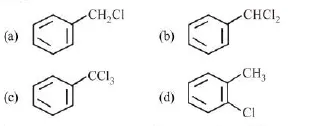
Show Answer & Explanation
Answer: (b)
Explanation:
Toluene → benzal chloride (C6H5CHCl2) (Cl2/hν) → benzaldehyde (H2O, 373 K).
(a) CH3OH
(b) CH3COOH
(c) HOOC–CH2–CH2–COOH
(d) HO–CH2–CH2–OH
Show Answer & Explanation
Answer: (d) HO–CH2–CH2–OH
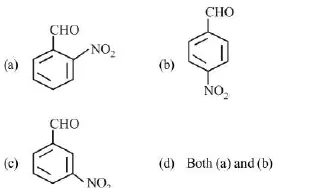
Show Answer & Explanation
Answer: (c)
Explanation:
–CHO group acts as a deactivating and meta-directing group.
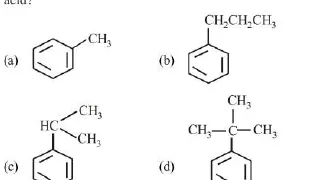
Show Answer & Explanation
Answer: (d)
Explanation:
Primary and secondary alkyl groups are oxidised to give carboxylic acid while tertiary alkyl group remain unaffected.
(a) ionic bond
(b) covalent bond
(c) coordinate bond
(d) intermolecular hydrogen bond
Show Answer & Explanation
Answer: (d) intermolecular hydrogen bond
(a) lower than corresponding alcohols
(b) higher than corresponding alcohols
(c) equal to that of corresponding alcohols
(d) None of the above
Show Answer & Explanation
Answer: (b) higher than corresponding alcohols
Explanation:
Due to H-bonding.
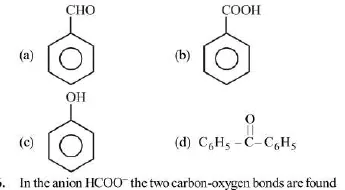
Show Answer & Explanation
Answer: (b)
Explanation:
Grignard reagent forms addition product with bubbled carbon dioxide which on hydrolysis with HCl yields benzoic acid.
C6H5MgBr + CO2 → C6H5COOMgBr → C6H5COOH + Mg(OH)Br
(a) o-nitrobenzoic acid
(b) m-nitrobenzoic acid
(c) p-nitrobenzoic acid
(d) p-nitrophenol
Show Answer & Explanation
Answer: (a) o-nitrobenzoic acid
(a) (CH3)2CHCOOCH3
(b) CH3COOCH2CH3
(c) CH3COOCH(CH3)2
(d) (CH3)2CHCOOCH2CH3
Show Answer & Explanation
Answer: (c) CH3COOCH(CH3)2
Explanation:
CH3COOH + HO–CH(CH3)2 → CH3COOCH(CH3)2 (ethanoic acid + propan-2-ol)
(a) 3-Nitrobenzoic acid
(b) 4-Nitrobenzoic acid
(c) 2-Nitrobenzoic acid
(d) 2,4-dinitrobenzoic acid
Show Answer & Explanation
Answer: (a) 3-Nitrobenzoic acid
(a) Phenol < Ethanol < Chloroacetic acid < Acetic acid
(b) Ethanol < Phenol < Chloroacetic acid < Acetic acid
(c) Ethanol < Phenol < Acetic acid < Chloroacetic acid
(d) Chloroacetic acid < Acetic acid < Phenol < Ethanol
Show Answer & Explanation
Answer: (c) Ethanol < Phenol < Acetic acid < Chloroacetic acid
Aldehydes, Ketones and Carboxylic Acids Objective Questions & Solutions for NEET Chemistry
Download Multiple Choice Questions: Aldehydes, Ketones and Carboxylic Acids (NEET Chemistry)
Explore reliable practice questions for Aldehydes, Ketones and Carboxylic Acids tailored for NEET Chemistry learners. Use these multiple-choice formats to evaluate preparedness and strengthen problem-solving skills.
Concept Clarification for Aldehydes, Ketones and Carboxylic Acids
Cross-reference your completed choices with comprehensive NCERT solutions for NEET Chemistry to ensure absolute clarity across all sub-topics in this chapter.
Additional Study Resources for NEET Chemistry
Follow up your worksheet practice by attempting the interactive online Chemistry MCQ test for this chapter to evaluate your execution speed. All platform resources are free to access.
FAQs
You can get most exhaustive NEET Chemistry Aldehydes Ketones and Carboxylic Acids Important Questions MCQs with Answers Set 02 for free on StudiesToday.com. These MCQs for NEET Chemistry are updated for the 2026-27 academic session as per NEET examination standards.
Yes, our NEET Chemistry Aldehydes Ketones and Carboxylic Acids Important Questions MCQs with Answers Set 02 include the latest type of questions, such as Assertion-Reasoning and Case-based MCQs. 50% of the NEET paper is now competency-based.
By solving our NEET Chemistry Aldehydes Ketones and Carboxylic Acids Important Questions MCQs with Answers Set 02, NEET students can improve their accuracy and speed which is important as objective questions provide a chance to secure 100% marks in the Chemistry.
Yes, Chemistry MCQs for NEET have answer key and brief explanations to help students understand logic behind the correct option as its important for 2026 competency-focused NEET exams.
Yes, you can also access online interactive tests for NEET Chemistry Aldehydes Ketones and Carboxylic Acids Important Questions MCQs with Answers Set 02 on StudiesToday.com as they provide instant answers and score to help you track your progress in Chemistry.