

Download NEET MCQs for NEET Chemistry: Aldehydes, Ketones and Carboxylic Acids
Review structured MCQ sets for NEET Chemistry Aldehydes, Ketones and Carboxylic Acids. Built according to official NEET guidelines, these downloadable questions support daily revision and core concept reinforcement.
Chapter-wise Objective Questions: Aldehydes, Ketones and Carboxylic Acids
Access the complete set of multiple-choice questions for Aldehydes, Ketones and Carboxylic Acids below. This focused format allows students to isolate specific topics for thorough review and uninterrupted practice alongside official NEET textbooks.
This set has 36 multiple choice questions on Aldehydes, Ketones and Carboxylic Acids for NEET Chemistry (set 1 of 4). Each question has four options, with the answer and the explanation as given in the source where one is printed. It covers the nomenclature and structure of aldehydes and ketones, their preparation, physical properties, and the tests and basic reactions used to identify them.
Multiple Choice Questions
CH3–CH(CHO)–CH2–CH3
(a) Butan-2-aldehyde
(b) 2-methylbutanal
(c) 3-methylisobutyraldehyde
(d) 2-ethylpropanal
Show Answer & Explanation
Answer: (b) 2-methylbutanal
(a) 4-methyl pent-3-one
(b) 2-methyl pent-3-one
(c) 4-methylpent-2-one
(d) 2-methyl pent-2-one
Show Answer & Explanation
Answer: (b) 2-methyl pent-3-one
(a) sp2-p-overlapping
(b) sp3-p-overlapping
(c) sp-p-overlapping
(d) s-p-overlapping
Show Answer & Explanation
Answer: (a) sp2-p-overlapping
(a) s-s-overlapping
(b) p-p-overlapping
(c) s-p-overlapping
(d) p-d-overlapping
Show Answer & Explanation
Answer: (b) p-p-overlapping
(a) R and R′ on carbon; C(δ−)=O(δ+)
(b) R and R′ on carbon; C(δ+)=O(δ−)
(c) R–C=O with R′ below the carbon; δ+ and δ− marked above the C and O atoms (δ+ over the carbon, δ− over the oxygen)
(d) R–C=O with R′ below the carbon; δ+ marked over the R–C bond side and δ− over the oxygen
Show Answer & Explanation
Answer: (b) R and R′ on carbon; C(δ+)=O(δ−)
Explanation:
O is more electronegative than C.
(a) Methanal
(b) Propanal
(c) Ethanal
(d) Hexanal
Show Answer & Explanation
Answer: (d) Hexanal
Explanation:
The lower aldehydes have sharp pungent odours. As the size of the molecule increases, the odour becomes less pungent and more fragrant.
(a) Aldehyde
(b) Ketone
(c) Alkene
(d) Acid
Show Answer & Explanation
Answer: (a) Aldehyde
Explanation:
1° alcohols on catalytic dehydrogenation give aldehydes.
RCH2OH → RCHO + H2 (Cu, 300°C)
(a) Aldehydes and ketones respectively
(b) Ketones and aldehydes respectively
(c) Only aldehydes
(d) Only ketones
Show Answer & Explanation
Answer: (a) Aldehydes and ketones respectively
Explanation:
Alcohols are oxidized by removal of H2 in presence of a heated metal catalyst (Cu).
CH3CH2OH → CH3CHO + H2 (1° alcohol gives aldehyde)
(CH3)2CHOH → CH3COCH3 + H2 (2° alcohol gives ketone)
(a) HgSO4
(b) Pd/BaSO4
(c) anhydrous AlCl3
(d) anhydrous ZnCl2
Show Answer & Explanation
Answer: (b) Pd/BaSO4
Explanation:
Catalyst used in Rosenmund reduction is Pd/BaSO4. Rosenmund reduction is used for reduction of acid chloride: R–COCl → R–CHO (H2, Pd/BaSO4).
(a) Mendius reaction
(b) Sandmeyer's reaction
(c) Rosenmund's reaction
(d) Stephen's reaction
Show Answer & Explanation
Answer: (d) Stephen's reaction
Explanation:
Phenyl cyanide is reduced into benzaldehyde in the presence of SnCl2/HCl reagent. This reaction is known as Stephen's reaction.
C6H5C≡N + 2[H] → C6H5CH=NH → C6H5CHO + NH3 (SnCl2, HCl; then H2O/H+)
(a) in between carbon chain
(b) at any position in carbon atom
(c) only at the end of carbon chain
(d) at the second carbon atom of the carbon chain
Show Answer & Explanation
Answer: (c) only at the end of carbon chain
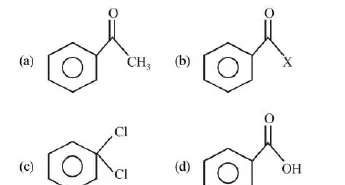
Show Answer & Explanation
Answer: (b)
(a) Oxidation of secondary alcohols
(b) Dehydrogenation of 2° alcohol
(c) Pyrolysis of calcium acetate
(d) Acid hydrolysis of alkyl cyanide
Show Answer & Explanation
Answer: (d) Acid hydrolysis of alkyl cyanide
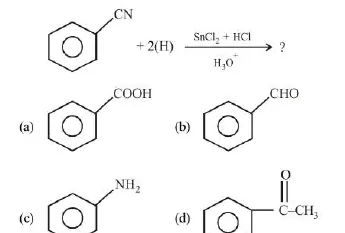
Show Answer & Explanation
Answer: (b)
(a) Rosenmund's reaction
(b) Stephen's reaction
(c) Cannizzaro's reaction
(d) Gatterman-Koch reaction
Show Answer & Explanation
Answer: (d) Gatterman-Koch reaction
(a) CH3CHO
(b) HCHO
(c) CH3CH2CHO
(d) All of these
Show Answer & Explanation
Answer: (b) HCHO
Explanation:
Formyl chloride is unstable at room temperature.
(a) CH3MgBr followed by hydrolysis
(b) I2–NaOH, CH3I
(c) Dil. H2SO4 followed by reaction with CH2N2
(d) LiAlH4 followed by reaction with CH3I
Show Answer & Explanation
Answer: (a) CH3MgBr followed by hydrolysis
Explanation:
Alkanenitriles (other than methanenitrile) and benzonitrile give ketones with Grignard reagents.
(a) R–MgX
(b) R2Cd
(c) CO + HCl
(d) CrO3
Show Answer & Explanation
Answer: (b) R2Cd
(a) Hydrogen bonding
(b) van der Waal's forces
(c) Dipole-dipole attraction
(d) None of these
Show Answer & Explanation
Answer: (c) Dipole-dipole attraction
Explanation:
>C=O ↔ >C+–O−; the polarity exists in carbonyl group due to resonance.
(a) Methanal
(b) Propanal
(c) Propanone
(d) Butanone
Show Answer & Explanation
Answer: (a) Methanal
Explanation:
Solubility decreases with increase in mol. wt.
(a) Both have same boiling point
(b) Boiling point of propanal is higher than the boiling point of propanone.
(c) Boiling point of propanal is lower than the boiling point of propanone
(d) Nothing can be predicted
Show Answer & Explanation
Answer: (c) Boiling point of propanal is lower than the boiling point of propanone
Explanation:
Propanone has symmetrical structure.
(a) +I inductive effect decrease positive charge on carbonyl carbon atom
(b) steric effect of two bulky alkyl groups
(c) sp2 hybridised carbon atom of carbonyl carbon atom
(d) Both (a) and (b)
Show Answer & Explanation
Answer: (d) Both (a) and (b)
(a) electronegativity difference of carbon and oxygen atoms
(b) electromeric effect
(c) more stable anion with negative charge on oxygen atom and less stable carbonium ion
(d) None of the above
Show Answer & Explanation
Answer: (c) more stable anion with negative charge on oxygen atom and less stable carbonium ion
(a) Cannizzaro reaction is given by aldehydes in presence of alkali
(b) Aldol condensation is given by aldehydes in presence of alkali
(c) Aldol condensation is given by aldehydes and ketones in presence of acids
(d) None of the above
Show Answer & Explanation
Answer: (d) None of the above
Explanation:
Cannizzaro reaction is given by aldehydes having no α-hydrogen atom in the presence of conc. alkali, aldol condensation is given by aldehydes and ketones having at least one α-atom in presence of alkali or in presence of acids.
(a) three electron donating methyl groups
(b) cleavage taking place between –C–CHO bond
(c) absence of alpha hydrogen atom in the molecule
(d) bulky (CH3)3C– group
Show Answer & Explanation
Answer: (c) absence of alpha hydrogen atom in the molecule
Explanation:
Aldol condensation is given by the compounds which contain α hydrogen atom. As the given compound does not contain α hydrogen atom, hence it does not undergo aldol condensation.
(a) CH3CH=NNHCON=CHCH3
(b) CH3CH=NNHCONH2
(c) CH3CH=N–N(OH)–CONH2
(d) CH3CH=N–CONHNH2
Show Answer & Explanation
Answer: (b) CH3CH=NNHCONH2
Explanation:
CH3CHO + H2N–NH–CO–NH2 → CH3CH=N–NH–CO–NH2 + H2O (acetaldehyde semicarbazone)
(a) 2-Pentanone
(b) Ethanol
(c) Ethanal
(d) 3-Pentanone
Show Answer & Explanation
Answer: (d) 3-Pentanone
Explanation:
Iodoform test is exhibited by ethyl alcohol, acetaldehyde, acetone, methyl ketone and those alcohols which possess CH3CH(OH)– group. As 3-pentanone does not contain CH3CO– group therefore it does not give iodoform test.
(a) CH3COCH3
(b) CH3CH2CHO
(c) HCHO
(d) CH3CHO
Show Answer & Explanation
Answer: (c) HCHO
Explanation:
Aldol condensation is given by carbonyl compounds which have α-hydrogen atoms. HCHO does not have any α-hydrogen atom, so it does not give aldol condensation.
(a) CH3–CH2OH
(b) C6H5CHO
(c) CH3CHO
(d) CH3–CO–CH3
Show Answer & Explanation
Answer: (b) C6H5CHO
Explanation:
Cannizzaro reaction is given by aldehydes which do not have α-hydrogen atom. Benzaldehyde (C6H5CHO) does not have α-H atom and hence gives Cannizzaro reaction.
(a) HCOOH
(b) CH3(CHOH)3CHO
(c) CH3CO(CHOH)CH3
(d) Both (a) and (b)
Show Answer & Explanation
Answer: (d) Both (a) and (b)
Explanation:
Compounds having –CHO group reduce Tollen's reagent to silver mirror. It is called silver mirror test. Both (a) HCOOH and (b) CH3(CHOH)3CHO have the –CHO group (HCOOH has H–C(=O)– group), so both of them give positive silver mirror test.
(a) Lucas test
(b) Tollen's test
(c) KMnO4 solution (Baeyer's test)
(d) None of these
Show Answer & Explanation
Answer: (b) Tollen's test
Explanation:
Tollen's reagent is ammonical AgNO3. Aldehydes form silver mirror with it and ketones do not show any change. So Tollen's reagent is used to distinguish between aldehydes and ketones.
(a) Clemmensen reduction
(b) H2S
(c) H2/Ni
(d) None of these
Show Answer & Explanation
Answer: (a) Clemmensen reduction
Explanation:
Aldehydes and ketones are reduced to alkanes by Clemmensen reduction.
>C=O → >CH2 + H2O (Zn-Hg/HCl)
(a) Wolf-Kishner reaction
(b) Reimer-Tiemann reaction
(c) Wurtz reaction
(d) None of these
Show Answer & Explanation
Answer: (a) Wolf-Kishner reaction
Explanation:
Wolf-Kishner reduction: >C=O → >CH2 ((i) NH2–NH2, (ii) KOH).
(a) Acetone
(b) Acetaldehyde
(c) CH3OH
(d) CH3CH2COCH3
Show Answer & Explanation
Answer: (c) CH3OH
Explanation:
Only aldehydes and ketones react with 2,4-dinitrophenylhydrazine.
(a) Cannizaro's reaction
(b) Aldol condensation
(c) Iodoform reaction
(d) Clemmensen's reduction
Show Answer & Explanation
Answer: (c) Iodoform reaction
Explanation:
Iodoform test is given by compounds which have CH3CO group. 2-pentanone (CH3CH2CH2COCH3) has CH3CO group, so it gives iodoform test, while 3-pentanone (CH3CH2COCH2CH3) does not have CH3CO group, so it does not give iodoform test.
(a) two same aldehydes
(b) two same ketones
(c) two different aldehydes and ketones
(d) None of these
Show Answer & Explanation
Answer: (c) two different aldehydes and ketones
Explanation:
In cross aldol condensation aromatic aldehydes or ketones (with or without α-hydrogen) react with aldehydes, ketones or esters having α-hydrogen atoms in the presence of dilute alkali to form an α,β-unsaturated carbonyl compound.
Example: C6H5CHO + CH3CHO → C6H5CHOHCH2CHO → C6H5CH=CHCHO (cinnamaldehyde)
Multiple Choice Questions (MCQs) for NEET Chemistry Aldehydes, Ketones and Carboxylic Acids
Download Multiple Choice Questions: Aldehydes, Ketones and Carboxylic Acids (NEET Chemistry)
Review structured objective questions for NEET Chemistry Aldehydes, Ketones and Carboxylic Acids. Built according to official NEET guidelines, these MCQ sets support daily revision and core concept reinforcement.
Concept Clarification for Aldehydes, Ketones and Carboxylic Acids
Each question includes structured solution keys mapped directly to standard NEET textbooks, helping students evaluate their reasoning and correct mistakes early in their revision.
Additional Study Resources for NEET Chemistry
Wrap up your chapter revision by testing your knowledge against standard question formats. Everything on our platform is provided free of charge.
FAQs
You can get most exhaustive NEET Chemistry Aldehydes Ketones and Carboxylic Acids Important Questions MCQs with Answers Set 01 for free on StudiesToday.com. These MCQs for NEET Chemistry are updated for the 2026-27 academic session as per NEET examination standards.
Yes, our NEET Chemistry Aldehydes Ketones and Carboxylic Acids Important Questions MCQs with Answers Set 01 include the latest type of questions, such as Assertion-Reasoning and Case-based MCQs. 50% of the NEET paper is now competency-based.
By solving our NEET Chemistry Aldehydes Ketones and Carboxylic Acids Important Questions MCQs with Answers Set 01, NEET students can improve their accuracy and speed which is important as objective questions provide a chance to secure 100% marks in the Chemistry.
Yes, Chemistry MCQs for NEET have answer key and brief explanations to help students understand logic behind the correct option as its important for 2026 competency-focused NEET exams.
Yes, you can also access online interactive tests for NEET Chemistry Aldehydes Ketones and Carboxylic Acids Important Questions MCQs with Answers Set 01 on StudiesToday.com as they provide instant answers and score to help you track your progress in Chemistry.