

Multiple Choice Questions (MCQs) for Class 9 Mathematics: IMO Olympiad
Review structured MCQ sets for Class 9 Mathematics IMO Olympiad. Built according to official CBSE guidelines, these downloadable questions support daily revision and core concept reinforcement.
Practice IMO Olympiad MCQs for Class 9 Mathematics
View or download the dedicated IMO Olympiad MCQ resource below. Practicing these 50 objective questions regularly builds familiarity with standard exam patterns and helps secure higher marks in final Mathematics evaluations.
MATHEMATICS
Question. Fill in the blanks.
A non-terminating and non-recurring decimal expansion is a/an ________ number.
The decimal expansion of 1/125 is in ______ form.
A. Rational, terminating
B. Irrational, terminating
C. Rational, non-terminating recurring
D. Rational, recurring
Answer : B
Question. A pair of dice is thrown. The probability of getting even number on first die & odd number on the second die is
A. 1/5
B. 1/2
C. 1/4
D. 1/3
Answer : C
Question. A point whose abscissa and ordinate are 2 and –5 respectively, lies in
A. First quadrant
B. Second quadrant
C. Third quadrant
D. Fourth quadrant
Answer : D
Question. Which of the following statements is INCORRECT?
A. A solid has 3 dimensions.
B. A surface has 2 dimensions.
C. A line has 0 dimension.
D. None of these
Answer : C
Question. The dimensions of a rectangular piece of paper are 22 cm × 14 cm. It is rolled once across the breadth and once across the length to form right circular cylinders of biggest possible surface areas. Find the difference in volumes of the two cylinders that will be formed.
A. 196 cm3
B. 308 cm3
C. 49 cm3
D. 105 cm3
Answer : A
Question. It is not possible to construct a triangle whose sides are
A. 3 cm, 3 cm and 6 cm
B. 5 cm, 12 cm and 13 cm
C. 15 cm, 8 cm and 17 cm
D. 3 cm, 4 cm and 5 cm
Answer : A
Question. The mean of the data x1, x2, ...., xn is 102, then mean of the data 5x1, 5x2, ....., 5xn is
A. 102
B. 204
C. 606
D. 510
Answer : D
Question. A triangle and a parallelogram have same base and same area. If the sides of the triangle are 20 cm, 25 cm and 35 cm, and the base side is 25 cm for the triangle as well as the parallelogram, find the vertical height of the parallelogram.
A. 2√6 cm
B. 4√6 cm
C. √6 cm
D. None of these
Answer : B
Question. How many linear equations are satisfied by x = 2 and y = –3?
A. Only one
B. Two
C. Three
D. Infinitely many
Answer : D
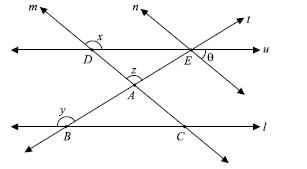
Question. In the figure given below, l || u and m || n. If ∠ACB = 55° and ∠AED = 30°, find x, y, z and q respectively.
A. 95°, 125°, 150°, 55°
B. 150°, 95°, 125°, 55°
C. 125°, 150°, 95°, 55°
D. 55°, 95°, 150°, 125°
Answer : C
Question. How many statements are INCORRECT?
(i) If a circle is divided into four equal arcs, each is a minor arc.
(ii) A sector of a circle can have area more than the area of the whole circle.
(iii) The area of each quadrant of a circle is one-third of the area of the whole circle.
(iv) One and only one chord of a circle can be the diameter of the circle.
A. 1
B. 2
C. 3
D. 0
Answer : C
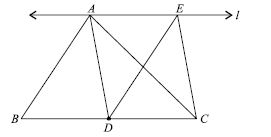
Question. In the given figure, l || BC and D is mid-point of BC.
If area (ΔABC) = x × area (ΔEDC), find the value of x.
A. 1/2
B. 1
C. 4
D. 2
Answer : D
Question. It is not possible to construct a triangle ABC with BC = 5 cm, ∠B = 75° and AB + AC equal to
A. 7.5 cm
B. 8 cm
C. 9 cm
D. 4.5 cm
Answer : D
Question. Select the INCORRECT statement.
A. The difference of a rational number and an irrational number is an irrational number.
B. The product of a non-zero rational number with an irrational number is an irrational number.
C. The quotient of an irrational number with a nonzero rational number is an irrational number.
D. None of these
Answer : D
Question. If we multiply or divide both sides of a linear equation in two variables with a non-zero number, then the solution of the linear equation
A. Changes
B. Changes in case of multiplication only
C. Changes in case of division only
D. Remains unaltered
Answer : D
Question. If (2x+1) is a factor of the polynomial p(x) = kx3+23x2+71x+30, then find the value of (k −1)/8
A. –2
B. 5/8
C. 1/8
D. 2
Answer : C
Question. A field is 15 m long and 12 m broad. At one corner of this field a rectangular well of dimensions 8 m × 2.5 m × 2 m is dug, and the dug-out soil is spread evenly over the rest of the field. Find the rise in the level of the rest of the field.
A. 25 cm
B. 15 cm
C. 125 cm
D. 200 cm
Answer : A
Question. The abscissa of a point is positive in the
A. First and Second quadrant
B. Second and Third quadrant
C. Third and Fourth quadrant
D. Fourth and First quadrant
Answer : D
Question. Find the area of the quadrilateral ABCD in which AB = 7 cm, BC = 6 cm, CD = 12 cm, DA = 15 cm and AC = 9 cm. (Take √110 = 10.5 approx.)
A. 57 cm2
B. 45 cm2
C. 75 cm2
D. 72 cm2
Answer : C
Question. Let l be the lower class limit of a class-interval in a frequency distribution and m be the mid-point of the class. Then, the upper class limit of the class is
A. m + l+m/2
B. l + m+l/2
C. 2m – l
D. m – 2l
Answer : C
Question. If (2k – 1, k) is a solution of the equation 10x – 9y = 12, then k =
A. 1
B. 2
C. 3
D. 4
Answer : B
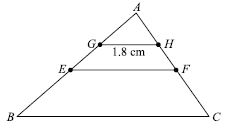
Question. In the given figure, E and F are mid-points of the sides AB and AC respectively of the DABC; G and H are mid-points of the sides AE and AF respectively of the DAEF. If GH = 1.8 cm, find BC.
A. 7.2 cm
B. 10 cm
C. 15 cm
D. 72 cm
Answer : A
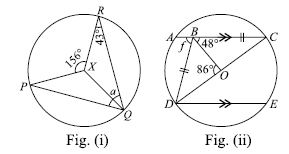
Question. In Fig. (i), X is the centre of the circle and in Fig. (ii), O is the centre of the circle. Find a and f respectively.
A. 78°, 76°
B. 38°, 43°
C. 48°, 76°
D. 76°, 78°
Answer : A
Question. In ΔABC, AB = 7.2 cm, BC = 4.8 cm, AM ⊥ BC and CL ⊥ AB. If CL = 4 cm, find AM.
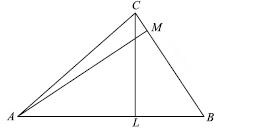
A. 4 cm
B. 10 cm
C. 5 cm
D. 6 cm
Answer : D
Question. If ΔABC ≅ ΔPQR and DABC is not congruent to ΔRPQ, then which of the following is not true?
A. BC = PQ
B. AC = PR
C. QR = BC
D. AB = PQ
Answer : A
Question. Whi ch of the fol lowing i s not t rue for a parallelogram?
A. Opposite sides are equal
B. Opposite angles are equal
C. Opposite angles are bisected by the diagonals
D. Diagonals bisect each other
Answer : C
Question. If bisectors of ∠A and ∠B of a parallelogram ABCD intersect each other at P, bisectors of ∠B and ∠C at Q, bisectors of ∠C and ∠D at R and bisectors of ∠D and ∠A at S, then PQRS is a
A. Rectangle
B. Rhombus
C. Square
D. None of these
Answer : A
Question. The construction of a triangle ABC, given that BC = 3 cm, ∠C = 60°, is possible when the difference of AB and AC is equal to
A. 3.2 cm
B. 3.1 cm
C. 3 cm
D. 2.8 cm
Answer : D
Question. Which of the following polynomials has (x + 1) as a factor?
(i) x3 + x2 + x + 1
(ii) x4 + x3 + x2 + x + 1
(iii) x4 + 3x3 + 3x2 + x + 2
(iv) x3 – x2 – (2 + 2) x − 2
A. (i), (ii)
B. (iii), (iv)
C. (ii), (iii)
D. (i), (iv)
Answer : D
Question. A die is thrown 300 times and the outcomes 1, 2, 3, 4, 5, 6 have frequencies as below :
| Outcome | 1 | 2 | 3 | 4 | 5 | 6 |
| Frequency | 55 | 53 | 58 | 49 | 48 | 37 |
Find the probability of getting a prime number.
A. 0.395
B. 0.53
C. 0.355
D. 0.215
Answer : B
Question. In figure, ABCD is a parallelogram and E is mid-point of the side CD, then area (ABED) = k × area (ΔBEC), then k =
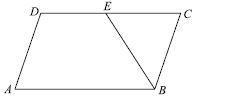
A. 2
B. 1/2
C. 3
D. 1/3
Answer : C
Question. If x = 4/8+√60, then 1/2 [√x + 2/√x] =
A. √5
B. √3
C. 2√5
D. 2√3
Answer : A
Question. In the given figure, ABCD is a rhombus. Find y.
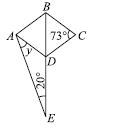
A. 56°
B. 107°
C. 33.5°
D. None of these
Answer : C
Question. Factorise : y2 −12√3y +105.
A. ( y + 7√3)( y + 5√3)
B. ( y − 7√3)( y + 5√3)
C. ( y − 7√3)( y − 5√3)
D. ( y + 7√3)( y − 5√3)
Answer : C
Question. In the given figure, AC = BC and ∠ACY = 140°.
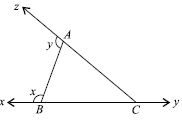
Find x and y respectively.
A. 110°, 100°
B. 40°, 110°
C. 110°, 110°
D. 140°, 100°
Answer : C
Question. Euclid’s Postulate 1 is
A. A straight line may be drawn from any one point to any other point.
B. A terminated line can be produced indefinitely.
C. All right angles are equal to one another.
D. None of these
Answer : A
Question. The weights (in kg) of 15 students are : 31, 35, 27, 29, 32, 43, 37, 41, 34, 28, 36, 44, 45, 42, 30. Find the median. If the weight 44 kg is replaced by 46 kg and 27 kg by 25 kg, find the new median.
A. 41 kg, 35 kg
B. 35 kg, 41 kg
C. 35 kg, 35 kg
D. 37 kg, 36 kg
Answer : C
Question. If l = 1+ √2 + √3 and m = 1 + √2 − √3, then
l2 + m2 - 2l - 2m/8 =
A. 1
B. 0
C. –1
D. 5
Answer : A
Question. The distance of the point P(4, 3) from the origin is
A. 4 units
B. 3 units
C. 5 units
D. 7 units
Answer : C
Question. A circular piece of paper of radius 20 cm is trimmed into the shape of the biggest possible square. Find the area of the paper cut off. (Use π = 22/7)
A. 457(1/7)cm2
B. 800 cm2
C. 157(1/7)cm2
D. (8800/7)cm2
Answer : A
Question. If E is an event associated with an experiment, then
A. P (E) > 1
B. –1 < P (E) < 1
C. 0 ≤ P (E) < 1
D. None of these
Answer : C
Question. A triangle and a parallelogram have a common side and are of equal areas. The triangle having sides 26 cm, 28 cm and 30 cm stands on the parallelogram. The common side of the triangle and the parallelogram is 28 cm. Find the vertical height of the triangle and that of the parallelogram respectively.
A. 26 cm, 24 cm
B. 20 cm, 24 cm
C. 12 cm, 24 cm
D. 24 cm, 12 cm
Answer : D
Question. If l and m be two positive real numbers such that l > 3m, l2 + 9m2 = 369 and lm = 60, then find the value of l−3m/12 .
A. 1/12
B. 1/4
C. 9
D. 5/4
Answer : B
Question. The distance between the graph of the equations
x = –3 and x = 2 is
A. 1 unit
B. 2 units
C. 3 units
D. 5 units
Answer : D
Question. Which of the following is not possible in case of a triangle ABC?
A. AB = 3 cm, BC = 4 cm and CA = 5 cm
B. AB = 5 cm, BC = 8 cm and CA = 7 cm
C. ∠A = 50°, ∠B = 60° and ∠C = 70°
D. AB = 2 cm, BC = 4 cm and CA = 7 cm
Answer : D
ACHIEVERS SECTION
Question. If (x3 + ax2 + bx + 6) has (x – 2) as a factor and leaves a remainder 3 when divided by (x – 3), find the value of 2a + 3b.
A. –9
B. 9
C. –11
D. 11
Answer : A
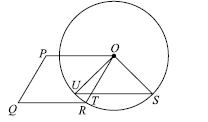
Question. If O is centre of circle as shown in figure, ∠SOP = 102° and ∠ROP = ∠SOU = 72°, then find ∠OSU and ∠RTU respectively.
A. 54°, 93°
B. 45°, 110°
C. 54°, 96°
D. 45°, 94°
Answer : C
Question. If h, s, V be the height, curved surface area and volume of a cone respectively, then (3pVh3 + 9V2 – s2h2) is equal to
A. 0
B. π
C. V/sh
D. 36/V
Answer : A
Question. The given bar-graph shows the percentage distribution of the total production of a car manufacturing company into various models over two years. Study the graph carefully and answer the question. Percentage of six different types of cars manufactured by a company over two years
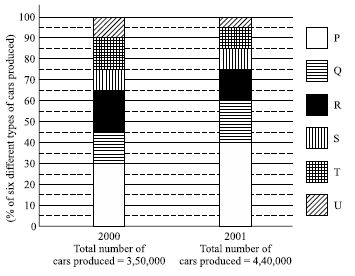
Difference between total number of cars of models P, Q and T manufactured in 2000 and 2001 is ______.
A. 2,45,000
B. 2,27,500
C. 2,10,000
D. 98,000
Answer : D
Question. While constructing a triangle ABC, in which
BC = 3.8 cm, ∠B = 45° and AB + AC = 6.8 cm we follow the following steps :
Step 1 : Draw the perpendicular bisector of CD meeting BD at A.
Step 2 : From ray BX, cut-off line segment BD equal to AB + AC i.e., 6.8 cm.
Step 3 : Join CA to obtain the required triangle ABC.
Step 4 : Draw BC = 3.8 cm.
Step 5 : Draw ∠CBX = 45°
Step 6 : Join CD.
Arrange the above steps in correct order.
A. 4, 5, 6, 1, 2, 3
B. 5, 4, 6, 2, 3, 1
C. 4, 5, 2, 6, 1, 3
D. None of these
Answer : C
Free study material for Mathematics Olympiad IMO
Download Chapter MCQs: Class 9 Mathematics IMO Olympiad
About IMO Olympiad MCQs for Class 9 Mathematics
Review structured objective questions for Class 9 Mathematics IMO Olympiad. Built according to official CBSE guidelines, these MCQ sets support daily revision and core concept reinforcement.
How to Verify Your MCQ Answers
Cross-reference your completed choices with comprehensive NCERT solutions for Class 9 Mathematics to ensure absolute clarity across all sub-topics in this chapter.
Enhance Speed with Online MCQ Tests
Explore our broader library of printable assignments, chapter notes, and mock tests designed to support continuous revision and secure higher marks in CBSE assessments.
FAQs
You can get most exhaustive CBSE Class 9 Mathematics IMO Olympiad MCQs with Answers Set 15 for free on StudiesToday.com. These MCQs for Class 9 Mathematics are updated for the 2026-27 academic session as per CBSE examination standards.
Yes, our CBSE Class 9 Mathematics IMO Olympiad MCQs with Answers Set 15 include the latest type of questions, such as Assertion-Reasoning and Case-based MCQs. 50% of the CBSE paper is now competency-based.
By solving our CBSE Class 9 Mathematics IMO Olympiad MCQs with Answers Set 15, Class 9 students can improve their accuracy and speed which is important as objective questions provide a chance to secure 100% marks in the Mathematics.
Yes, Mathematics MCQs for Class 9 have answer key and brief explanations to help students understand logic behind the correct option as its important for 2026 competency-focused CBSE exams.
Yes, you can also access online interactive tests for CBSE Class 9 Mathematics IMO Olympiad MCQs with Answers Set 15 on StudiesToday.com as they provide instant answers and score to help you track your progress in Mathematics.