

Business Statistics Objective Questions and Answers: Random Variables and Distribution Functions
Explore reliable objective questions for Random Variables and Distribution Functions tailored for learners. Utilizing these Business Statistics multiple-choice formats ensures thorough preparation and strengthens problem-solving speed for upcoming school assessments.
Download Random Variables and Distribution Functions MCQs with Answers
Access the complete PDF for Random Variables and Distribution Functions multiple-choice questions below. This focused format allows students to isolate specific topics for thorough review and uninterrupted practice alongside official textbooks.
Question. For what values of k can f(x) = (1-k) kx
a) 0<k<1
b) k=0
c) k>1
d) None of the options
Answer: A
Question. In a business venture a man can make a profit of Rs 2,000 with probability of 0.4 or have a loss of Rs 1,000 with a probability of 0.6. His expected profit is
a) 100
b) 200
c) 400
d) 300
Answer: B
Question. Obtain the probability distribution of the number of sixes in 2 tosses of dice
a) x/p(x), 0/(4/9), 1/(4/9), 2/(1/9)
b) x/p(x), 0/(4/72), 1/(1/9), 2/(1/9)
c) x/p(x), 0/(4/9), 1/(4/36), 2/(8/9)
d) x/p(x), 0/(25/36), 1/(10/36), 2/(1/36)
Answer: D
Question. Three cards are drawn at random successively, with replacement, from a well shuffled pack of cards. Getting a card of ‘diamonds’ is termed as success. Obtain the probability distribution of the number of successes.
a) x/p(x), 0/(27/64), 1/(27/64), 2/(9/64), 3/(1/64)
b) x/p(x), 0/(1/9), 1/(4/9), 2/(1/9), 3/(6/9)
c) x/p(x), 0/(4/9), 1/(4/9), 2/(1/9), 3/(5/9)
d) x/p(x), 0/(4/64), 1/(7/64), 2/(1/64), 3/(8/64)
Answer: A
Question. A contractor spends Rs. 3,000 to prepare for a bid on a construction project which, after deducting manufacturing expenses and the cost of bidding, will yield a profit of Rs. 25,000 if the bid is not won. If the chance of winning the bid is 10%, compute his expected profit?
a) 100
b) 607
c) 35
d) 200
Answer: D
Question. Determine which of the following given values can serve as the values of a probability distribution of a random variable with the range x = 1, 2, 3 and 4
a) f(1) = 0.25 , f(2) = 0.75 , f(3) = 0.25 , f(4) = -0.25
b) f(1) = 0.15 , f(2) = 0.27 , f(3) = 0.29 , f(4) = 0.29
c) f(1) = 1/19 , f(2) = 10/19 , f(3) = 2/19 , f(4) = 5/19
d) None of the options
Answer: B
Question. Two dices are thrown simultaneously and ‘getting a number less than 3’ on a die is termed as a success. Obtain the probability distribution of the number of successes
a) x/p(x), 0/(4/9), 1/(5/9), 2/(1/9)
b) x/p(x), 0/(1/9), 1/(4/9), 2/(1/9)
c) x/p(x), 0/(4/9), 1/(4/9), 2/(1/9)
d) x/p(x), 0/(4/9), 1/(7/9), 2/(1/9)
Answer: C
Question. Find variance for the random variable x that has the probability density
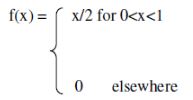
a) 1/9
b) 2/9
c) 4/9
d) 5/9
Answer: B
Question. Suppose an insurance company offers a 45 year old man a Rs1,000. 1 year term insurance policy for an annual premium of Rs12 . Assuming that the number of deaths per 1000 is 5 for persons in this age this group. The expected gain for the insurance company on a policy of this type is
a) 7
b) 8
c) 9
d) 10
Answer: A
Question. In a random throw of n dice, the expectation of the sum of points on them is
a) n/2
b) 3n/2
c) 7n/2
d) 9n/2
Answer: C
Question. If X has the probability density
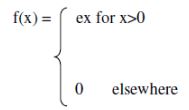
Find the expected value of g(X) = e3x/4
a) 1
b) 2
c) 3
d) 4
Answer: D
Question. Given that X has the probability distribution f(x) = 1/8(3/x) for x = 0, 1, 2 and 3, find the moment-generating function of this random variable and use it to determine μ1`and μ2 `
a) 0
b) 3/2
c) 1/2
d) 1
Answer: B
Question. If X1 and X2 are independent random variables having exponential densities with the parameters a and b the probability density of Y = X1+ X2 when a ≠ b
a) f(y) = 1/a+b. (e-y/a – e-y/b ) for y > 0 and f(y) = 0 elsewhere
b) f(y) = 1/a-b. (e-y/a – e-y/b ) for y < 0 and f(y) = 1 elsewhere
c) f(y) = 1/a-b. (e-y/a – e-y/b ) for y > 0 and f(y) = 0 elsewhere
d) None of the options
Answer: C
Question. If X has a hypergeometric distribution with M = 3, N = 6 and n = 2, find the probability distribution of Y, the number of successes minus the number of failures
a) h(0) = 1/5 , h(1) = 3/5 , h(2) = 1/5
b) h(0) = 2/5 , h(1) = 3/8 , h(2) = 1/5
c) h(0) = 9/5 , h(1) = 3/5 , h(2) = 1/5
d) h(0) = 1/5 , h(1) = 4/5 , h(2) = 1/5
Answer: A
Question. If X has the uniform density with the parameters α = 0 and β = 1. Find the probability density of the random variable Y = √X
a) g(y) = y for 0 < y < 1 and g(y) = 0 elsewhere
b) g(y) = 2y for 0 < y < 1 and g(y) = 0 elsewhere
c) g(y) = 2y for 0 > y > 1 and g(y) = 0 elsewhere
d) None of the options
Answer: B
Question. A lot of 12 television sets include 2 with white chords. If 3 of the sets are chosen at random for shipment to the hotel, how many sets with white chords can the shipper expect to send to the hotel
a) 0
b) 1
c) 1/2
d) All of the above
Answer: C
Question. If X is the number of head obtained in 4 tosses of a balanced coin then find the probability distribution of the random variable Z = (X-2)2
a) z/h(z), 0/(3/8), 1/(4/8), 4/(1/8)
b) z/h(z), 0/(1/8), 1/(4/8), 4/(1/8)
c) z/h(z), 0/(3/8), 1/(2/8), 4/(1/8)
d) z/h(z), 0/(3/8), 1/(7/8), 4/(1/8)
Answer: A
Question. If the joint density of X1 and X2 is given by
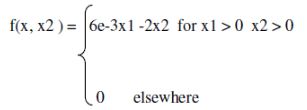
Find the probability density of Y = X1+ X2
a) f(y) = 6(ey – e-3y ) for y < 0 elsewhere f(y) = 0
b) f(y) = 6(e-2y – e-3y ) for y > 0 elsewhere f(y) = 0
c) f(y) = 6(e-2y – e-y ) for y > 0 elsewhere f(y) = 1
d) f(y) = 6(e-2y – e-y/2 ) for y > 0 elsewhere f(y) = 0
Answer: B
Question. A dice is tossed twice ‘getting a number less than 3’ is termed as success. Hence the mean of the number of successes is
a) 1
b) 3/2
c) 1/4
d) 2/3
Answer: D
Question. The moment-generating function of a random variable which has probability density f(x) = 1/2e-|x| for – ∞ < x < ∞ is
a) Mx (t) = 1/2t+1
b) Mx (t) = 1/1-t2
c) Mx (t) = 1/-2t
d) Mx (t) = 1/t2
Answer: B
Question. Find μ1`of the discrete random variable x that has the probability distribution f(x) = 2(1/3x) for x = 1, 2, 3 – – –
a) 1/2
b) 0
c) 1
d) 3/2
Answer: D
Question. If the joint probability density of X and Y is given by
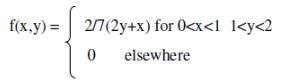
Find the expected value of g(X,Y) = X/Y3
a) 13/84
b) 15/84
c) 84/13
d) 84/15
Answer: B
Question. From a bag containing 4 white and 6 red balls, three balls are drawn at random and if each white ball drawn carries a reward of Rs4 and each red ball Rs6, find the expected reward of the draw
a) Rs14.8
b) Rs15.6
c) Rs31
d) Rs16
Answer: B
Question. A number is chosen at random from the set 10.11,12- – -109; and another number is chosen at random from the set 12,13 ,14- – – 61. The expected value of their sum is
a) 95
b) 96
c) 97
d) 98
Answer: B
Question. If the probability density of X is given by
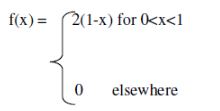
To evaluate E[(2X+1)2]
a) 2
b) 1
c) 4
d) 3
Answer: D
Question. A and B throw with one die for a prize of Rs199 which is to be won by the player who first throws 6. If A has the first throw their respective expectation are
a) Rs 64, Rs 46
b) Rs 54, Rs 45
c) Rs 87, Rs 78
d) Rs 35, Rs 53
Answer: B
Question. The joint probability density function
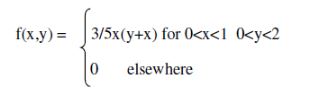
Of 2 random variables X and Y, find P[(X,Y)€A] where A is the region (x,y)/0 < x, ½, 1<y<2
a) 11/65
b) 11/80
c) 10/76
d) 67/80
Answer: B
Question. E(x2) = 91/6. Find the value of E(2 x2+1) is
a) 92/3
b) 91/3
c) 90/3
d) 94/3
Answer: D
Question. Three coins whose faces are marked 1 and 2 are tossed. Their expectations of the total values of numbers on their faces is
a) 9.5
b) 4.5
c) 3
d) 4
Answer: B
Question. A die is thrown at random. What is the expectation of the number on it:
a) 3.7
b) 3.1
c) 3.5
d) 3.8
Answer: C
Question. If the probability density of Xs given by
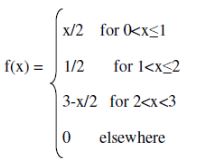
Find the expected value of g(X) = X2-5X+3
a) 11/3
b) -11/3
c) -11/6
d) 11/6
Answer: C
Question. The expected value of X is usually written as:
a) E(X) or Σ
b) E(X) or μ
c) E(X) or φ
d) E(X) or λ
Answer: B
Question. What is the expected number of heads appearing when a fair coin is tossed three times?
a) 2.1
b) 1.5
c) 3.2
d) 4.1
Answer: B
Question. If the probability density of X is given by
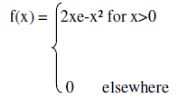
and Y = X2
The probability density of Y is
a) g(y) = e-y for y > 0 and g(y) elsewhere
b) g(y) = ey for y > 0 and g(y) = 0
c) g(y) = e-y for y< 0 and g(y) > 0
d) None of the options
Answer: A
Question. If the probability density is given by Where k is appropriate constant the probability density of the random variable Y = 2X / 1 + 2X
a) g(y) = k/16y3 .(1-y) for 0 > y > 1 and g(y) = 0 elsewhere
b) g(y) = k/16y3 .(1-y) for 0 < y < 1 and g(y) = 0 elsewhere
c) g(y) = k/16y2 .(1-y) for 0 < y < 1 and g(y) = 0 elsewhere
d) g(y) = k/16y9 .(1-y) for 0 < y < 1 and g(y) = 1 elsewhere
Answer: B
Question. The probability distribution for

The variance of the random variable x is
a) 20
b) 21
c) 22
d) 23
Answer: A
Question. When 2 unbiased coins are tossed once, the variance of the number of head is
a) 1
b) 3/2
c) 1/4
d) None of the options
Answer: D
Question. For any random variable for which E(x) exists find the value of μ0
a) 0
b) -1
c) 2
d) 1
Answer: D
Chapter Random Variables and Distribution Functions Practice Tests for Business Statistics
Test your conceptual understanding of Random Variables and Distribution Functions with these targeted Business Statistics multiple-choice questions. Designed to build accuracy, these sets cover essential exam topics.
Concept Clarification for Business Statistics Random Variables and Distribution Functions
Every question includes detailed answer keys and explanations to help you understand the underlying concepts and fix mistakes early in your Business Statistics revision.
More Study Resources for Business Statistics Random Variables and Distribution Functions
After completing these exercises, challenge yourself with an online Business Statistics quiz to check your speed and precision. All learning resources on our platform are free to access.
FAQs
You can download the MCQs for Business Statistics Random Variables and Distribution Functions for latest session from StudiesToday.com
Yes, the MCQs issued for Business Statistics Random Variables and Distribution Functions have been made available here for latest academic session
Learning Random Variables and Distribution Functions based MCQs will help students improve their overall understanding of important concepts and topics and help to score well in Business Statistics exams.
You can practice Random Variables and Distribution Functions through worksheets, textbooks and online quizzes provided by studiestoday.com.
You can find Business Statistics Random Variables and Distribution Functions MCQs on educational websites like studiestoday.com, online tutoring platforms, and in sample question papers provided on this website.
To prepare for Random Variables and Distribution Functions MCQs, refer to the concepts links provided by our teachers and download sample papers for free.
Yes, there are many online resources that we have provided on studiestoday.com available such as practice worksheets, question papers, and online tests for learning MCQs for Business Statistics Random Variables and Distribution Functions
Yes, you can find printable Random Variables and Distribution Functions worksheets for Business Statistics on studiestoday.com.
We have provided full database of free multiple choice questions with answers on studiestoday.com for Business Statistics Random Variables and Distribution Functions