

Frank Brothers Solutions for Class 9 Mathematics: Chapter 13 Inequalities In Triangles
Access the official Frank Brothers textbook solutions for Class 9 Mathematics, updated for the 2026-27 academic year. This digital resource is structured to help students build strong conceptual clarity and prepare effectively for school examinations.
Chapter-wise Solutions: Chapter 13 Inequalities In Triangles
Navigate directly to the Chapter 13 Inequalities In Triangles solutions using the digital viewer below. Organizing your study sessions chapter-by-chapter allows for seamless offline study and quick reference during revision.
Question 1. Determine the longest and shortest sides in each of the following triangles based on the given angles:
(i) In \(\Delta ABC\), the largest angle is \(\angle B\) and the smallest angle is \(\angle A\).
(ii) In \(\Delta DEF\), the greatest angle is \(\angle F\) and the smallest is \(\angle D\).
(iii) In \(\Delta XYZ\), \(\angle X = 76^\circ\) and \(\angle Y = 84^\circ\).
Answer:
(i) Within the provided triangle ABC, the largest angle is \(\angle B\). The side directly opposite to this angle is AC, which makes AC the longest side. Similarly, the smallest angle is \(\angle A\). Its opposite side is BC, so BC is the shortest side.
(ii) For the triangle DEF, the greatest angle is \(\angle F\). Its opposite side is DE, meaning DE is the longest side. The smallest angle is \(\angle D\). Since EF lies opposite to \(\angle D\), EF is the shortest side.
(iii) In \(\Delta XYZ\), we know the sum of angles in a triangle is \(180^\circ\).
\(\implies \angle X + \angle Y + \angle Z = 180^\circ\)
\(\implies 76^\circ + 84^\circ + \angle Z = 180^\circ\)
\(\implies 160^\circ + \angle Z = 180^\circ\)
\(\implies \angle Z = 20^\circ\)
This means \(\angle Y = 84^\circ\) is the largest angle, and its opposite side is XZ, making XZ the longest side. The smallest angle is \(\angle Z = 20^\circ\). Its opposite side is XY, which is therefore the shortest side.
In simple words: The side opposite to the largest angle is always the longest, and the side opposite to the smallest angle is always the shortest.
Exam Tip: Always calculate the third angle using the angle sum property of a triangle before concluding which sides are the longest or shortest.
Question 2. Find the ascending order of the sides in each of the following triangles:
(i) In \(\Delta ABC\), \(\angle A = 45^\circ\) and \(\angle B = 65^\circ\).
(ii) In \(\Delta DEF\), \(\angle D = 38^\circ\) and \(\angle E = 58^\circ\).
Answer:
(i) For \(\Delta ABC\), the angles add up to \(180^\circ\):
\(\angle A + \angle B + \angle C = 180^\circ\)
\(\implies 45^\circ + 65^\circ + \angle C = 180^\circ\)
\(\implies 110^\circ + \angle C = 180^\circ\)
\(\implies \angle C = 70^\circ\)
Comparing the angles, we get \(\angle A = 45^\circ, \angle B = 65^\circ, \angle C = 70^\circ\), which gives the order: \(\angle A < \angle B < \angle C\). Since longer sides are opposite to larger angles, the ascending order of the sides is BC, AC, AB.
(ii) For \(\Delta DEF\):
\(\angle D + \angle E + \angle F = 180^\circ\)
\(\implies 38^\circ + 58^\circ + \angle F = 180^\circ\)
\(\implies 96^\circ + \angle F = 180^\circ\)
\(\implies \angle F = 84^\circ\)
The angles in order of size are \(\angle D < \angle E < \angle F\). Thus, the sides in ascending order of length are EF, DF, DE.
In simple words: Find all three angles first. Then, list the sides in order from shortest to longest matching the smallest to largest angles.
Exam Tip: Clearly write the angle values in an inequality chain (e.g., \(\angle A < \angle B < \angle C\)) before stating the side lengths to make your proof easy to follow.
Question 3. Determine the smallest angle in each of the following triangles based on the given side lengths:
(i) In \(\Delta ABC\), AC = 4.2 cm is the shortest side.
(ii) In \(\Delta PQR\), QR = 5.4 cm is the shortest side.
(iii) In \(\Delta XYZ\), YZ = 5 cm is the shortest side.
Answer:
(i) In \(\Delta ABC\), AC is the smallest side. Since the angle opposite to the shortest side is always the smallest, \(\angle B\) is the smallest angle.
(ii) In \(\Delta PQR\), QR is the shortest side. Therefore, the angle opposite to it, \(\angle P\), is the smallest.
(iii) In \(\Delta XYZ\), YZ is the shortest side. Consequently, the angle opposite to it, \(\angle X\), is the smallest.
In simple words: The smallest angle of any triangle is always located directly opposite to its shortest side.
Exam Tip: State the geometric theorem: "The angle opposite to the shorter side is smaller" to secure full marks for your reasoning.
Question 4. In \(\Delta ABC\), BC = AC and \(\angle A = 35^\circ\). Find \(\angle C\) and identify the shortest and longest sides of the triangle.
Answer: Since BC = AC, the angles opposite to these equal sides must also be equal.
\(\implies \angle A = \angle B = 35^\circ\)
Let the third angle \(\angle C = x^\circ\).
Using the angle sum property of a triangle:
\(\angle A + \angle B + \angle C = 180^\circ\)
\(\implies 35^\circ + 35^\circ + x^\circ = 180^\circ\)
\(\implies 70^\circ + x^\circ = 180^\circ\)
\(\implies x^\circ = 110^\circ\)
So, \(\angle C = 110^\circ\).
In this triangle, the largest angle is \(\angle C\), so the longest side is AB. The smaller angles are \(\angle A\) and \(\angle B\) (both \(35^\circ\)), making BC and AC the shortest sides.
In simple words: Equal sides have equal opposite angles. After finding all angles, use them to find which sides are the longest and shortest.
Exam Tip: Since two angles are equal, don't forget to list both opposite sides as the shortest sides.
Question 5. In the given figure, if \(\angle PBC > \angle QCB\), prove that \(AB > AC\).
Answer: We are given that:
\(\angle PBC > \angle QCB\) - - - (1)
The angles on a straight line form a linear pair:
\(\angle PBC + \angle ABC = 180^\circ\)
\(\implies \angle PBC = 180^\circ - \angle ABC\)
Similarly, we have:
\(\angle QCB = 180^\circ - \angle ACB\)
Substituting these values back into our original inequality (1):
\(180^\circ - \angle ABC > 180^\circ - \angle ACB\)
Subtracting \(180^\circ\) from both sides:
\(-\angle ABC > -\angle ACB\)
Multiplying by -1 reverses the inequality sign:
\(\implies \angle ABC < \angle ACB\)
\(\implies \angle ACB > \angle ABC\)
Since the side opposite to a larger angle is always longer, we conclude that:
\(AB > AC\)
In simple words: Since the exterior angle on one side is larger, the interior angle on that side must be smaller. This shows that the interior angle opposite to AB is larger than the one opposite to AC, making AB longer.
Exam Tip: Be careful when multiplying or dividing inequalities by a negative sign — always reverse the inequality direction.
Question 6. In \(\Delta ACD\) with point B on the extension of CD such that AB = AC, prove that \(AD > AB\).
Answer: By applying the exterior angle property to \(\Delta ACD\), we get:
\(\angle ACB = \angle CDA + \angle CAD\)
This means that:
\(\implies \angle ACB > \angle CDA\) - - - (1)
Since we are given AB = AC, the base angles of this isosceles triangle are equal:
\(\implies \angle ACB = \angle ABC\) - - - (2)
From equations (1) and (2), we can write:
\(\angle ABC > \angle CDA\)
Now considering \(\Delta ABD\), since \(\angle ABD\) (which is \(\angle ABC\)) is greater than \(\angle ADB\) (which is \(\angle CDA\)), the side opposite to \(\angle ABD\) must be longer than the side opposite to \(\angle ADB\):
\(\implies AD > AB\)
In simple words: An exterior angle is always larger than any of its interior opposite angles. Since two sides are equal, we can relate the angles to show that AD is longer than AB.
Exam Tip: Always identify which triangle you are applying the exterior angle property to, and write down the angle equalities clearly.
Question 7. Prove that the perimeter of a triangle is greater than the sum of its three medians.
Answer: Let \(\Delta ABC\) have medians AD, BE, and CF.
It is a standard rule that adding any two sides of a triangle yields a value larger than double the median that bisects the remaining side.
For median AD bisecting BC:
\(\implies AB + AC > 2AD\) - - - (i)
For median BE bisecting AC:
\(\implies AB + BC > 2BE\) - - - (ii)
For median CF bisecting AB:
\(\implies BC + AC > 2CF\) - - - (iii)
Adding inequalities (i), (ii), and (iii) together:
\((AB + AC) + (AB + BC) + (BC + AC) > 2AD + 2BE + 2CF\)
\(\implies 2(AB + BC + AC) > 2(AD + BE + CF)\)
Dividing both sides by 2:
\(\implies AB + BC + AC > AD + BE + CF\)
Thus, the sum of the sides of the triangle is greater than the sum of its medians.
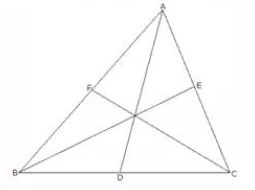
In simple words: The sum of any two sides of a triangle is always greater than twice the median drawn between them. Adding this relationship for all three medians proves the statement.
Exam Tip: Clearly show the addition of all three inequalities and how the factor of 2 is factored out and canceled.
Question 8. Prove that in a right-angled triangle, the hypotenuse is the longest side.
Answer: Let us analyze \(\Delta ABC\), which has a right angle at B (\(\angle B = 90^\circ\)).
Using the angle sum property of triangles:
\(\angle A + \angle B + \angle C = 180^\circ\)
\(\implies \angle A + 90^\circ + \angle C = 180^\circ\)
\(\implies \angle A + \angle C = 90^\circ\)
Because the sum of \(\angle A\) and \(\angle C\) is \(90^\circ\), both must be acute angles (less than \(90^\circ\)).
Thus, \(\angle B\) is the largest angle in the triangle.
Since AC represents the hypotenuse of \(\Delta ABC\), we can confirm that the hypotenuse remains the longest side within any right-angled triangle.
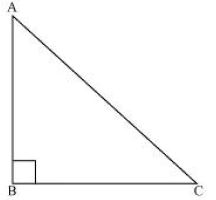
In simple words: Since the right angle is \(90^\circ\) and the other two angles must add up to \(90^\circ\), the right angle is the biggest. This makes the side opposite to it - the hypotenuse - the longest side.
Exam Tip: Always specify that the sum of the other two angles is \(90^\circ\), which makes them strictly less than the right angle.
Question 9. In \(\Delta ABC\), D is any point on the side BC. Prove that \(AB + BC + AC > 2AD\).
Answer: Let us draw a line segment connecting A to D.
In \(\Delta ACD\), the sum of any two sides is greater than the third side:
\(\implies AC + CD > AD\) - - - (i)
Similarly, in \(\Delta ADB\):
\(\implies AB + BD > AD\) - - - (ii)
Adding these two inequalities together:
\(AC + CD + AB + BD > AD + AD\)
Combining the segments on the base side, we have \(CD + BD = BC\):
\(\implies AB + BC + AC > 2AD\)
This completes the proof.
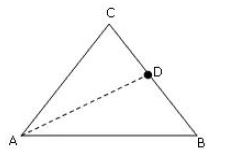
In simple words: By splitting the large triangle into two smaller ones sharing the line AD, we can apply the triangle inequality to both and add them together.
Exam Tip: Remember to use the line addition property (\(CD + BD = BC\)) to simplify your expression after adding the inequalities.
Question 10. Prove that in a quadrilateral PQRS, the sum of its four sides is greater than the sum of its diagonals (i.e., \(PQ + QR + RS + SP > PR + QS\)).
Answer: Let PQRS be a quadrilateral with diagonals PR and QS.
By applying the triangle inequality theorem (as the sum of any two sides must exceed the length of the remaining side) to different triangles:
In \(\Delta PQR\):
\(\implies PQ + QR > PR\) - - - (i)
In \(\Delta PSR\):
\(\implies PS + SR > PR\) - - - (ii)
In \(\Delta PQS\):
\(\implies PS + PQ > QS\) - - - (iii)
In \(\Delta QRS\):
\(\implies QR + SR > QS\) - - - (iv)
Adding these four inequalities:
\(2(PQ + QR + RS + PS) > 2(PR + QS)\)
Dividing both sides by 2:
\(\implies PQ + QR + RS + PS > PR + QS\)
Hence, the sum of the quadrilateral's sides is greater than the sum of its diagonals.
In simple words: We can use the triangle inequality rule on the four triangles formed by the sides and diagonals, then combine them to prove the inequality.
Exam Tip: Be sure to write down the triangle inequality statement for all four triangles to show the complete step-by-step logic.
Question 11. In a quadrilateral ABCD, the diagonals AC and BD intersect at O. Prove that the perimeter of the quadrilateral is less than twice the sum of its diagonals (i.e., \(AB + BC + CD + DA < 2(AC + BD)\)).
Answer: Let us consider the four triangles formed around the intersection point O.
In \(\Delta AOB\):
\(\implies OA + OB > AB\) - - - (i)
In \(\Delta BOC\):
\(\implies OB + OC > BC\) - - - (ii)
In \(\Delta COD\):
\(\implies OC + OD > CD\) - - - (iii)
In \(\Delta AOD\):
\(\implies OA + OD > AD\) - - - (iv)
Adding these four inequalities:
\(2(OA + OB + OC + OD) > AB + BC + CD + AD\)
We can regroup the terms using the diagonals:
\(2[(OA + OC) + (OB + OD)] > AB + BC + CD + AD\)
Since \(OA + OC = AC\) and \(OB + OD = BD\):
\(\implies 2(AC + BD) > AB + BC + CD + AD\)
Which can be written as:
\(\implies AB + BC + CD + AD < 2(AC + BD)\)
In simple words: The sum of the distances from the intersection point to the corners is greater than the outer sides. Grouping these distances into full diagonals proves the rule.
Exam Tip: Group the segment terms (e.g., \(OA + OC\) into \(AC\)) carefully to show how the diagonals are constructed.
Question 12. If P, Q, and R are points on the sides BC, CA, and AB of \(\Delta ABC\) respectively, prove that \(AB + BC + AC > PQ + QR + PR\).
Answer: Applying the triangle inequality to the corner triangles:
In \(\Delta APR\):
\(\implies AP + AR > PR\) - - - (i)
In \(\Delta BPQ\):
\(\implies BP + BQ > PQ\) - - - (ii)
In \(\Delta CQR\):
\(\implies CQ + CR > QR\) - - - (iii)
Adding these three inequalities:
\(AP + AR + BP + BQ + CQ + CR > PR + PQ + QR\)
Regrouping the segments of the sides of \(\Delta ABC\):
\((AP + BP) + (BQ + CQ) + (AR + CR) > PQ + QR + PR\)
Since \(AP + BP = AB\), \(BQ + CQ = BC\), and \(AR + CR = AC\):
\(\implies AB + BC + AC > PQ + QR + PR\)
In simple words: By applying the triangle inequality to the three outer corner triangles and summing them, we show that the original perimeter is larger than the inner one.
Exam Tip: Be precise when adding the segments together so that you reconstruct the full side lengths of the original triangle.
Question 13. In \(\Delta PQR\), T is a point on the side PR such that PT = PQ. Prove that \(QR > TR\).
Answer: In \(\Delta PQR\), the triangle inequality states:
\(PQ + QR > PR\)
Since \(PR = PT + TR\), we can substitute this:
\(PQ + QR > PT + TR\)
We are given that \(PT = PQ\). Substituting this into the inequality:
\(PQ + QR > PQ + TR\)
Subtracting PQ from both sides:
\(\implies QR > TR\)
This completes the proof.
In simple words: The total length of two sides of a triangle must be greater than the third. Since PT is equal to PQ, the remaining part of the side (TR) must be shorter than QR.
Exam Tip: Use algebraic substitution directly to simplify the expression once you replace PT with PQ.
Question 14. In a quadrilateral ABCD, prove that:
(i) \(AB + BC + CD + DA > 2AC\)
(ii) \(CD + DA + AB > BC\)
Answer:
(i) Let us apply the triangle inequality to the triangles formed by diagonal AC:
In \(\Delta ABC\):
\(\implies AB + BC > AC\) - - - (i)
In \(\Delta ACD\):
\(\implies AD + CD > AC\) - - - (ii)
Adding these two inequalities:
\(\implies AB + BC + AD + CD > 2AC\)
(ii) In \(\Delta ACD\):
\(\implies CD + DA > CA\)
Adding AB to both sides:
\(\implies CD + DA + AB > CA + AB\)
We know from \(\Delta ABC\) that \(CA + AB > BC\). Thus:
\(\implies CD + DA + AB > BC\)
In simple words: We can use the triangle inequality on the sub-triangles of the quadrilateral to build both inequalities.
Exam Tip: For part (ii), use the transitive property of inequalities to connect your intermediate steps to the final result.
Question 15. In the given figures:
(i) If PN is perpendicular to line segment QR, and PS is a line segment such that S lies beyond N, prove that \(PN < RN\).
(ii) In \(\Delta RTQ\), \(\angle RTQ = 90^\circ\) and \(\angle TQR = 60^\circ\). In \(\Delta NSR\), \(\angle RNS = 90^\circ\). Prove that \(SN < SR\).
Answer:
(i) Since PN is perpendicular to QR, PN represents the shortest distance from point P to the line QR.
Therefore, \(PN < PS\).
Using a similar property for RT and RN, we can establish:
\(RN < RT\)
By dividing these, we obtain:
\(\frac{PN}{RN} < 1 \implies PN < RN\)
(ii) In \(\Delta RTQ\):
\(\angle RTQ + \angle TQR + \angle TRQ = 180^\circ\)
\(\implies 90^\circ + 60^\circ + \angle TRQ = 180^\circ\)
\(\implies 150^\circ + \angle TRQ = 180^\circ\)
\(\implies \angle TRQ = 30^\circ\)
Therefore, \(\angle TRQ = \angle SRN = 30^\circ\).
In \(\Delta NSR\):
\(\angle RNS + \angle SRN + \angle NSR = 180^\circ\)
\(\implies 90^\circ + 30^\circ + \angle NSR = 180^\circ\)
\(\implies 120^\circ + \angle NSR = 180^\circ\)
\(\implies \angle NSR = 60^\circ\)
Since \(\angle SRN = 30^\circ\) and \(\angle NSR = 60^\circ\), we have \(\angle SRN < \angle NSR\).
The side opposite to the smaller angle is shorter, so we conclude:
\(\implies SN < SR\)
In simple words: For the first part, the straight perpendicular line is always the shortest distance. For the second, we find the angles in both triangles to show that SN is opposite to a smaller angle than SR.
Exam Tip: Be sure to quote the theorem: "The side opposite to the smaller angle is shorter" when solving the second part.
Question 16. In \(\Delta ABC\), D is a point on BC such that AC = CD. If \(\angle DAB = 125^\circ\) and \(\angle ADC = 105^\circ\), prove that \(BC > CD\).
Answer: In \(\Delta ACD\), we are given AC = CD, meaning it is an isosceles triangle.
Thus, \(\angle CDA = \angle DAC\).
Let \(\angle CDA = \angle DAC = x^\circ\).
The sum of angles in \(\Delta ACD\) is \(180^\circ\):
\(\angle CDA + \angle DAC + \angle ACD = 180^\circ\)
We are given \(\angle ACD = 105^\circ\).
\(\implies x^\circ + x^\circ + 105^\circ = 180^\circ\)
\(\implies 2x^\circ = 75^\circ \implies x = 37.5^\circ\)
So, \(\angle C = \angle DAC = 37.5^\circ\) - - - (1)
We also know:
\(\angle DAB = \angle DAC + \angle BAC\)
\(\implies 125^\circ = 37.5^\circ + \angle BAC\)
\(\implies \angle BAC = 87.5^\circ\)
For the entire triangle ABC:
\(\angle ACB + \angle BAC + \angle ABC = 180^\circ\)
\(\implies 75^\circ + 87.5^\circ + \angle ABC = 180^\circ\)
\(\implies \angle ABC = 17.5^\circ\)
Comparing the angles, \(\angle BAC = 87.5^\circ\) is greater than \(\angle ABC = 17.5^\circ\).
Since the side opposite to a larger angle is longer:
\(\implies BC > AC\)
Since AC = CD, we substitute to get:
\(\implies BC > CD\)
In simple words: We find the angles of the triangles step-by-step. Since angle BAC is larger than angle ABC, side BC must be longer than AC, which is equal to CD.
Exam Tip: Make sure you state that AC = CD is given, which justifies substituting CD for AC in the final inequality.
Question 17. In \(\Delta PQR\), S is a point on QR.
(i) Prove that the perpendicular from P to QR is the shortest segment.
(ii) If PS is perpendicular to QR, prove that \(PR > PS\).
(iii) Prove that \(PQ + QR + PR > 2PS\).
Answer:
(i) The shortest distance from an external point to a straight line is always the perpendicular line segment. Thus, for any point S on QR, if PS is not perpendicular, then \(PS > \text{perpendicular}\).
(ii) If PS is perpendicular to QR, then \(\angle PSR = 90^\circ\) is the largest angle in \(\Delta PSR\). The side opposite to it is the hypotenuse, PR. Therefore, \(PR > PS\).
(iii) Applying the triangle inequality to \(\Delta PQR\), \(\Delta PQS\), and \(\Delta PRS\):
In \(\Delta PQR\): \(PQ + PR > QR\)
In \(\Delta PQS\): \(PQ + QS > PS\) - - - (i)
In \(\Delta PRS\): \(PR + SR > PS\) - - - (ii)
Adding inequalities (i) and (ii):
\(PQ + QS + PR + SR > 2PS\)
Since \(QS + SR = QR\):
\(\implies PQ + QR + PR > 2PS\)
In simple words: The perpendicular line is always the shortest way to reach a line. Adding the inequalities of the two smaller triangles shows that the perimeter is greater than twice this line.
Exam Tip: For part (iii), don't forget to combine \(QS\) and \(SR\) into \(QR\) to finalize the perimeter sum.
Question 18. T is a point on the side PR of an equilateral triangle PQR. Prove that:
(i) \(PT < QT\)
(ii) \(RT < QT\)
Answer:
Since \(\Delta PQR\) is equilateral, all its angles are equal to \(60^\circ\).
\(\implies \angle P = \angle Q = \angle R = 60^\circ\)
In \(\Delta PQT\), since T is on PR, \(\angle PQT\) must be less than the full angle \(\angle Q\).
\(\implies \angle PQT < 60^\circ\)
This means \(\angle PQT < \angle P\).
Since the side opposite to a smaller angle is shorter:
\(\implies PT < QT\)
Similarly, in \(\Delta TQR\), the angle \(\angle TQR\) is less than \(\angle Q = 60^\circ\).
\(\implies \angle TQR < \angle R\)
Thus, the side opposite to \(\angle TQR\) is shorter than the side opposite to \(\angle R\):
\(\implies RT < QT\)
In simple words: Since the triangle is equilateral, its main angles are all \(60^\circ\). The angles inside the split triangles are smaller than \(60^\circ\), which helps us prove the inequalities.
Exam Tip: State clearly that a point T on PR divides the angle \(\angle PQR\) into two parts, which is why both parts are strictly less than \(60^\circ\).
Question 19. If S is any point in the interior of \(\Delta PQR\), prove that \(PQ + PR > SQ + SR\).
Answer: Using the triangle inequality theorem:
In \(\Delta PQR\):
\(\implies PQ + PR > QR\) - - - (i)
In \(\Delta SQR\):
\(\implies SQ + SR > QR\) - - - (ii)
Dividing the two inequalities:
\(\frac{PQ + PR}{SQ + SR} > 1\)
\(\implies PQ + PR > SQ + SR\)
In simple words: The sum of the outer two sides of a triangle is always greater than the sum of the inner two lines connecting to any point inside.
Exam Tip: Dividing both equations by the common base \(QR\) is a very elegant way to establish this comparison.
Question 20. In \(\Delta PQR\), PS is perpendicular to QR, and T is a point on QR. Prove that \(PQ > PT\) and \(PR > PT\).
Answer: Using Pythagoras theorem in right-angled triangles:
In \(\Delta PSQ\):
\(PS^2 + SQ^2 = PQ^2 \implies PS^2 = PQ^2 - SQ^2\) - - - (i)
In \(\Delta PST\):
\(PS^2 + ST^2 = PT^2 \implies PS^2 = PT^2 - ST^2\) - - - (ii)
Equating equations (i) and (ii):
\(PQ^2 - SQ^2 = PT^2 - ST^2\)
Since \(SQ = ST + TQ\):
\(PQ^2 - (ST + TQ)^2 = PT^2 - ST^2\)
\(\implies PQ^2 - (ST^2 + 2ST \cdot TQ + TQ^2) = PT^2 - ST^2\)
\(\implies PQ^2 - ST^2 - 2ST \cdot TQ - TQ^2 = PT^2 - ST^2\)
\(\implies PQ^2 - PT^2 = TQ^2 + 2ST \cdot TQ\)
Since \(TQ^2 + 2ST \cdot TQ\) is always positive:
\(PQ^2 - PT^2 > 0\)
\(\implies PQ^2 > PT^2 \implies PQ > PT\)
By symmetry, we can also prove \(PR > PT\).
In simple words: We can use the Pythagorean theorem on both right-angled triangles to relate their hypotenuses and prove that PQ and PR are both longer than PT.
Exam Tip: Expanding the squared binomial correctly is crucial here to show why the difference is strictly positive.
Question 21. In the given figure, prove that \(AF > AE\).
Answer: Using the exterior angle property:
\(\angle AEF > \angle ABC\)
And we have:
\(\angle AFE = \angle DFC\)
By exterior angle property again:
\(\angle ACB > \angle DFC \implies \angle ACB > \angle AFE\)
Given that AB = AC, the base angles are equal:
\(\angle ACB = \angle ABC\)
Thus, we have:
\(\angle AEF > \angle ABC > \angle AFE\)
Which simplifies to:
\(\angle AEF > \angle AFE\)
Since the side opposite to a larger angle is longer:
\(\implies AF > AE\)
In simple words: Exterior angles are larger than interior angles. Combining this with the fact that AB = AC lets us show that angle AEF is larger than angle AFE, making AF longer.
Exam Tip: Be sure to write the full names of the angles and link them using transitive inequalities.
Question 22. In \(\Delta ABC\), AD is the bisector of \(\angle BAC\) and AB = AD. Prove that \(\angle ABD > \angle C\).
Answer: Comparing \(\Delta ABE\) and \(\Delta ADE\):
AB = AD (Given)
\(\angle BAE = \angle DAE\) (Since AE bisects \(\angle BAC\))
AE = AE (Common side)
By SAS congruence criteria:
\(\Delta ABE \cong \Delta ADE\)
This gives:
\(\implies BE = DE\) (by CPCT)
Now in \(\Delta ABD\), since AB = AD, the angles opposite to them are equal:
\(\implies \angle ABD = \angle ADB\)
By applying the exterior angle property to \(\Delta ADC\):
\(\angle ADB > \angle C\)
Substituting \(\angle ABD\) for \(\angle ADB\):
\(\implies \angle ABD > \angle C\)
This completes the proof.
In simple words: We show that two triangles are congruent using SAS. Then, we use the property that an exterior angle is always greater than the opposite interior angle to prove the inequality.
Exam Tip: Remember to state CPCT (Corresponding Parts of Congruent Triangles) to justify your congruence steps.
Question 23. If D is an interior point of \(\Delta ABC\), prove that \(BD + DC < AB + AC\).
Answer: Applying the triangle inequality to \(\Delta ABC\):
\(\implies AB + AC > BC\) - - - (i)
And in \(\Delta BDC\):
\(\implies BD + DC > BC\) - - - (ii)
Dividing inequality (i) by (ii):
\(\frac{AB + AC}{BD + DC} > 1\)
\(\implies AB + AC > BD + DC\)
Which is equivalent to:
\(\implies BD + DC < AB + AC\)
In simple words: The path around the outside of the triangle (AB + AC) is longer than the path inside (BD + DC) when compared to the base line.
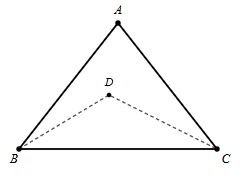
Exam Tip: State the standard inequality rule "Sum of two sides of a triangle is greater than the third side" as your main reason for equations (i) and (ii).
ICSE Textbook Solutions for Class 9 Mathematics Chapter 13 Inequalities In Triangles
ICSE Chapter Solutions: Class 9 Mathematics Chapter 13 Inequalities In Triangles
Access structured ICSE solutions for Class 9 Mathematics Chapter 13 Inequalities In Triangles designed to match CISCE curriculum standards. These verified answers help clarify complex numericals and support daily homework revision.
Step-by-Step Explanations and Breakdown
Tackle complex theorems and numerical problems easily by cross-referencing your working steps with our structured solution guides.
More Study Resources for Class 9 Mathematics
Explore our broader library of study materials and chapter notes to support your continuous revision and secure higher marks.
FAQs
You can download the verified Frank Brothers solutions for Chapter 13 Inequalities In Triangles on StudiesToday.com. Our teachers have prepared answers for Class 9 Mathematics as per 2026-27 ICSE academic session.
Yes, our solutions for Chapter 13 Inequalities In Triangles are designed as per new 2026 ICSE standards. 40% competency-based questions required for Class 9, are included to help students understand application-based logic behind every Mathematics answer.
Yes, every exercise in Chapter 13 Inequalities In Triangles from the Frank Brothers textbook has been solved step-by-step. Class 9 students will learn Mathematics conceots before their ICSE exams.
Yes, follow structured format of these Frank Brothers solutions for Chapter 13 Inequalities In Triangles to get full 20% internal assessment marks and use Class 9 Mathematics projects and viva preparation as per ICSE 2026 guidelines.