

Download CBSE Class 6 Mathematics Assignments
Review targeted academic assignments with the CBSE Class 6 Mathematics Decimals Assignment Set 01. Built according to official CBSE standards for the 2026-27 term, these downloadable Class 6 Mathematics worksheets support effective daily practice for Chapter 08 Decimals.
Access CBSE School Assignments and Answers
View or download the dedicated CBSE Class 6 Mathematics Decimals Assignment Set 01 resource below. Engaging with these assignments under focused study conditions ensures continuous academic progress and mastery of the 2026-27 curriculum.
Question. This is a part of the map of “Magic Town” showing some of the main landmarks.
The distances here are measured in “Giant Leaps” which is written in short as Gl
A smaller unit of length in Magic Town is 'broom length' written in short as bl.
1 Gl = 500 bl
Which of the following distances would be around 4000 bl?

(a) Hotel Greenwich Meridian to Wizard World Superstore (by direct route)
(b) Monster's Marsh to Wizard World Superstore (via Hotel Greenwich)
(c) Vanishing Hall to Hotel Greenwich Meridian
(d) Monster's Marsh to Wizard World Superstore (via Vanishing Hall)
Answer : D
Question. How many hundredths make 1.64?
(a) 4
(b) 16.4
(c) 164
(d) 0.64
Answer : C
Question. In which city was the variation in temperature (difference between the maximum and minimum) the LEAST that day?
The maximum and minimum temperatures recorded in 4 cities on a given day were as below
| Maximum Temperature (oC) | Minimum Temperature (oC) | |
| Chennal | 31.0 | 20.0 |
| Kolkata | 28.5 | 16.5 |
| Mumbai | 32.1 | 23.5 |
| New Delhi | 19.2 | 8.0 |
(a) Chennai
(b) Kolkata
(c) Mumbai
(d) New Delhi
Answer : C
Question. Which of the following is MOST LIKELY TO HAVE BEEN the temperature at 12:30pm in Kolkata that day?
The maximum and minimum temperatures recorded in 4 cities on a given day were as below
| Maximum Temperature (oC) | Minimum Temperature (oC) | |
| Chennal | 31.0 | 20.0 |
| Kolkata | 28.5 | 16.5 |
| Mumbai | 32.1 | 23.5 |
| New Delhi | 19.2 | 8.0 |
(a) 16.5 oC
(b) 17 oC
(c) 26.5 oC
(d) 31 oC
Answer : C
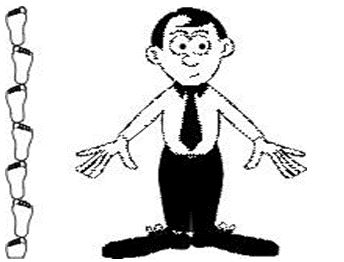
Question. Shyam's height when measured in terms of his own footsteps is shown here:
However, Shyam knows that his height is 120 cm. The length of his footstep must then be about
(a) 12 cm
(b) 18 cm
(c) 20 cm
(d) 21 cm
Answer : C
Question. How many tenths make 3?
(a) 3
(b) 50
(c) 30
(d) 10
Answer : C
Question. How many HUNDREDTHS need to be taken away from 1 to leave 4 TENTHS?
(a) 0.6
(b) 6
(c) 4
(d) 60
Answer : D
Question. Which of the following decimals has the least value?
(a) 4 tenths
(b) 6 hundredths
(c) 8 thousandths
(d) 2 tenths and 5 hundredths
Answer : C
Question. Which of these numbers is the greatest?
(a) 75.08
(b) 7.508
(c) 7.058
(d) 75.8
Answer : D
Question. Mrs. Seth buys a melon weighing 1.2 kg. She keeps a quarter of it in the fridge and the REMAINING part is shared equally by 4 persons in their family. What did each person's share weigh?
(a) 225 g
(b) 240 g
(c) 300 g
(d) 450 g
Answer : A
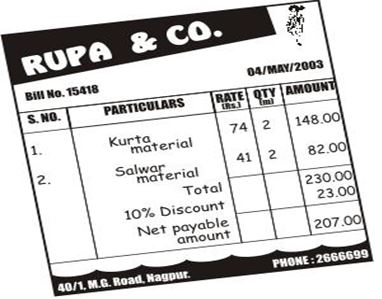
Question. Madhu buys some dress material at a shop. A copy of the bill she gets is shown below. All other things remaining the same, how much would Madhu have paid TOTALLY if the kurta material had cost Rs 79 per metre?
(a) 24
(b) 216
(c) 217
(d) 325
Answer : B
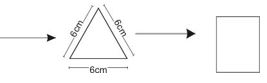
Question. Rose had a triangular wire frame with each side 6 cm long. She opens it out and bends the wire to form a square frame. The length of each side (in cm) of the square frame would be
(a) 3.5
(b) 4.5
(c) 5
(d) 6
Answer : B
Question. The timings of Jyoti Public School are 8:10 AM to 1:35 PM. The day starts with the first period and there are 7 periods of equal duration plus a 45 minute break at the end of the fifth period.
At what time does the sixth period begin in Jyoti Public School?
(a) 12:55 PM
(b) 1:00 PM
(c) 12:25 PM
(d) 12:15 PM
Answer : D
Question. How much more is 1 than 0.06?
(a) 0.4
(b) 0.04
(c) 0.05
(d) 0.94
Answer : D
Question. Ratna buys 15 metres of lace at Rs. 3.85 per metre. Which of the following will give her the BEST estimate of the total amount that she has to pay?
(a) 15 x 3
(b) 15 x 4
(c) 16 x 3
(d) 17 x 2
Answer : B
Question. Which of the numbers given below can go into the empty space to make the statement true?
3.0407 <……………. < 3.36
(a) 3.4
(b) 3.05
(c) 3.007
(d) 3.0398
Answer : B
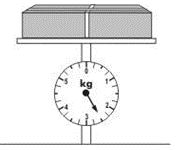
Question. How much does the box weigh?
(a) 2 kg 5 g
(b) 2 kg 50 g
(c) 2 kg 500 g
(d) 3 kg 500 g
Answer : C
Question. What must be added to 5 hundredth to get 1?
(a) 0.5
(b) 0.05
(c) 0.09
(d) 0.95
Answer : D
CHAPTER- 8 (DECIMALS)
Q.1 Write as decimals: i) Three ones and 2-tenths
Answer: 3.2
In simple words: Three ones make 3, and 2-tenths make \(\frac{2}{10}\) or 0.2, so the sum is 3.2.
Exam Tip: Place the decimal point immediately after the ones place.
Q.1 Write as decimals: ii) Sixty and 3-tenths
Answer: 60.3
In simple words: Sixty is written as 60, and 3-tenths is 0.3.
Exam Tip: Ensure the tens place for sixty is filled correctly as 60.
Q.1 Write as decimals: iii) Nineteen and 9-tenths
Answer: 19.9
In simple words: Nineteen is 19, and 9-tenths is 0.9.
Exam Tip: Combine whole number 19 with decimal part 0.9.
Q.1 Write as decimals: iv) One hundred six and 5-tenths
Answer: 106.5
In simple words: One hundred six is 106, and 5-tenths is 0.5.
Exam Tip: Place a zero in the tens place since there are no tens mentioned in one hundred six.
Q.2. Write each of the following as decimals: i) \(\frac{6}{10}\)
Answer: 0.6
In simple words: Dividing 6 by 10 shifts the decimal point one place to the left.
Exam Tip: A single zero in the denominator means one digit after the decimal point.
Q.2. Write each of the following as decimals: ii) \(300 + 50 + 3 + \frac{1}{10} + \frac{3}{100}\)
Answer: 353.13
In simple words: Add the whole numbers to get 353, and convert the fractions into 0.13.
Exam Tip: Align place values properly: hundreds, tens, ones, tenths, and hundredths.
Q.2. Write each of the following as decimals: iii) \(6\frac{2}{5}\)
Answer: 6.4
In simple words: Convert the fraction \(\frac{2}{5}\) to an equivalent fraction with denominator 10 by multiplying numerator and denominator by 2, giving \(\frac{4}{10}\), which is 0.4. Thus, \(6 + 0.4 = 6.4\).
Exam Tip: Alternatively, convert the mixed fraction to improper fraction \(\frac{32}{5}\) and divide by 5.
Q.3. Express as fraction: i) 61.2
Answer: \(\frac{306}{5}\) (or \(\frac{612}{10}\))
In simple words: Remove the decimal point to write 612 over 10, then simplify by dividing by 2.
Exam Tip: Always reduce fractions to their simplest form unless specified otherwise.
Q.3. Express as fraction: ii) 6.4
Answer: \(\frac{32}{5}\) (or \(\frac{64}{10}\))
In simple words: Write as \(\frac{64}{10}\) and divide numerator and denominator by 2.
Exam Tip: One decimal place corresponds to a denominator of 10.
Q.3. Express as fraction: iii) 0.05
Answer: \(\frac{1}{20}\) (or \(\frac{5}{100}\))
In simple words: Two decimal places mean a denominator of 100, so \(\frac{5}{100}\) simplifies to \(\frac{1}{20}\).
Q.3. Express as fraction: iv) 2.4
Answer: \(\frac{12}{5}\) (or \(\frac{24}{10}\))
In simple words: Write as \(\frac{24}{10}\) and simplify by dividing by 2.
Exam Tip: Improper fractions are completely acceptable unless mixed fractions are requested.
Q.3. Express as fraction: v) 2.56
Answer: \(\frac{64}{25}\) (or \(\frac{256}{100}\))
In simple words: Write as \(\frac{256}{100}\) and divide numerator and denominator by their HCF, which is 4.
Exam Tip: Check divisibility by 4 if the last two digits form a multiple of 4.
Q.4. Express the following as kilometers (km) using decimals: i) 2m
Answer: 0.002 km
In simple words: Since 1 km = 1000 m, divide 2 by 1000 to convert meters to kilometers.
Exam Tip: Moving from a smaller unit to a larger unit requires division by 1000.
Q.4. Express the following as kilometers (km) using decimals: ii) 16m
Answer: 0.016 km
In simple words: Divide 16 by 1000 to get 0.016 km.
Exam Tip: Ensure there are three decimal places for meters to kilometers conversion.
Q.4. Express the following as kilometers (km) using decimals: iii) 530m
Answer: 0.530 km (or 0.53 km)
In simple words: Divide 530 by 1000.
Exam Tip: Trailing zeros at the end of a decimal can be omitted.
Q.4. Express the following as kilometers (km) using decimals: iv) 915m
Answer: 0.915 km
In simple words: Divide 915 by 1000.
Exam Tip: Keep track of all three decimal places.
Q.4. Express the following as kilometers (km) using decimals: v) 830m
Answer: 0.830 km (or 0.83 km)
In simple words: Divide 830 by 1000.
Exam Tip: State the final unit clearly as km.
Q.5. Express as Rupees using decimals: i) 120paise
Answer: Rs. 1.20
In simple words: Since 100 paise = 1 Rupee, divide 120 by 100.
Exam Tip: Always include the currency symbol Rs. in front of the answer.
Q.5. Express as Rupees using decimals: ii) 450paise
Answer: Rs. 4.50
In simple words: Divide 450 by 100 to convert paise into Rupees.
Exam Tip: Two decimal places are required for paise to Rupees conversion.
Q.5. Express as Rupees using decimals: iii) 7paise
Answer: Rs. 0.07
In simple words: Divide 7 by 100, which gives 0.07.
Exam Tip: Do not miss the placeholder zero in the tenths place.
Q.5. Express as Rupees using decimals: iv) 500paise
Answer: Rs. 5.00 (or Rs. 5)
In simple words: Divide 500 by 100 to get 5.
Q.5. Express as Rupees using decimals: v) 6 rupees 70 paise
Answer: Rs. 6.70
In simple words: Keep 6 as the whole number and convert 70 paise to 0.70 Rupees.
Exam Tip: Combine rupees and converted paise directly.
Q.6. Express as kilogram (kg) using decimals: i) 5g
Answer: 0.005 kg
In simple words: Since 1 kg = 1000 g, divide 5 by 1000.
Q.6. Express as kilogram (kg) using decimals: ii) 305g
Answer: 0.305 kg
In simple words: Divide 305 by 1000.
Q.6. Express as kilogram (kg) using decimals: iii) 6325g
Answer: 6.325 kg
In simple words: Divide 6325 by 1000 to get 6.325 kg.
Q.6. Express as kilogram (kg) using decimals: iv) 2 kg 65g
Answer: 2.065 kg
In simple words: 65 g is equal to 0.065 kg, which when added to 2 kg gives 2.065 kg.
Q.6. Express as kilogram (kg) using decimals: v) 7 kg 750g
Answer: 7.750 kg (or 7.75 kg)
In simple words: 750 g is 0.750 kg, added to 7 kg gives 7.750 kg.
Q.7. Find the sum of: i) 25.43, 6.735 and 39
Answer: 71.165
In simple words: Write as like decimals (25.430, 6.735, 39.000) and add them vertically.
Exam Tip: Align decimal points vertically before adding.
Q.7. Find the sum of: ii) 0.3, 6.2 and 8.932
Answer: 15.432
In simple words: Convert to like decimals: 0.300 + 6.200 + 8.932 = 15.432.
Q.7. Find the sum of: iii) 4.003, 2.65 and 7.1
Answer: 13.753
In simple words: Add 4.003, 2.650, and 7.100 to get 13.753.
Q.8. Find the value of: i) 8.735 - 6.27
Answer: 2.465
In simple words: Subtract 6.270 from 8.735.
Q.8. Find the value of: ii) 99.009 - 19.9
Answer: 79.109
In simple words: Subtract 19.900 from 99.009.
Q.8. Find the value of: iii) 1000 - 27.35
Answer: 972.65
In simple words: Subtract 27.35 from 1000.00.
Q.9. Simplify: i) \(3.2 \times 2.65 \times 1.05\)
Answer: 8.904
In simple words: Multiply 3.2 by 2.65 to get 8.48, then multiply 8.48 by 1.05 to get 8.904.
Exam Tip: Count total decimal places in the factors to place the decimal correctly in the product (1 + 2 + 2 = 5 decimal places initially, then simplify trailing zeros).
Q.9. Simplify: ii) \(639.5 \times 0.05\)
Answer: 31.975
In simple words: Multiply 6395 by 5 and place the decimal point after three digits.
Q.9. Simplify: iii) \(888.88 \times 80.08\)
Answer: 71175.7904
In simple words: Multiply the numbers to find the product and place the decimal point after four digits.
CHAPTER - 9 (DATA HANDLING)
Q.1 Marks scored by students (out of 50) in a General Knowledge test are as follows:
40, 43, 45, 39, 41, 50, 45, 44, 40, 43, 42, 40, 45, 50, 50, 49, 48, 40, 30, 42, 43, 50, 49, 47, 48, 42, 45, 41
(Draw frequency table)
Answer:
Total
| Marks | Tally Marks | Frequency (Number of Students) |
|---|---|---|
| 30 | | | 1 |
| 39 | | | 1 |
| 40 | |||| | 4 |
| 41 | || | 2 |
| 42 | ||| | 3 |
| 43 | |||| | 3 |
| 44 | | | 1 |
| 45 | |||| | 4 |
| 47 | | | 1 |
| 48 | || | 2 |
| 49 | || | 2 |
| 50 | |||| | 4 |
| 28 |
In simple words: Count how many times each mark appears in the given data and record it using tally marks.
Exam Tip: Always verify that the sum of all frequencies matches the total number of given data points.
Q.2 Smita rolled a dice 35 times and recoded the observation as follows :
3, 6, 1, 2, 6, 3, 4, 5, 4, 4, 3, 1, 2, 1, 2, 6, 5, 2, 6, 5, 3, 1, 2, 3, 4, 6, 5, 4, 1, 6, 5, 5, 3, 2, 3
Make a frequency table using tally marks & answer the following:
Answer:
Total
| Number on Dice | Tally Marks | Frequency |
|---|---|---|
| 1 | |||| | 5 |
| 2 | |||| | | 6 |
| 3 | |||| || | 7 |
| 4 | |||| | 5 |
| 5 | |||| || | 7 |
| 6 | |||| | | 6 |
| 35 |
i.) Which number appeared the maximum number of times?
Answer: 3 and 5 (both appeared 7 times)
ii.) Which number appeared the minimum number of times?
Answer: 1 and 4 (both appeared 5 times)
In simple words: Group and count each dice face occurrence to find frequencies.
Exam Tip: Tally marks are grouped in bunches of five with a slanting line across four vertical lines.
Q.3 Total number of students of a school in different years is given below:
| Year | 2001 | 2002 | 2003 | 2004 | 2005 | 2006 |
|---|---|---|---|---|---|---|
| No of Students | 450 | 600 | 850 | 1050 | 1250 | 1800 |
Prepare a pictograph using symbol = 100 students.
Answer:
In simple words: Divide each year's student count by 100 to determine the number of symbols needed.
Exam Tip: Mention the key clearly indicating what fraction of the symbol represents smaller numbers (like 50).
Q.4 Draw a pictograph to represent the following information:
| Year | 2002 | 2003 | 2004 | 2005 | 2006 |
|---|---|---|---|---|---|
| No of Saplings planted | 70 | 90 | 120 | 150 | 180 |
Answer:
Choose a suitable scale, e.g., 1 symbol = 30 saplings (or 20 saplings). Using 1 symbol = 20 saplings:
- 2002 (70 saplings): 3 full symbols + 1 half symbol (since 60 + 10)
- 2003 (90 saplings): 4 full symbols + 1 half symbol
- 2004 (120 saplings): 6 full symbols
- 2005 (150 saplings): 7 full symbols + 1 half symbol
- 2006 (180 saplings): 9 full symbols
In simple words: Choose a common divisor for the data values as your symbol scale.
Exam Tip: Always state the symbol scale explicitly at the bottom or top of the pictograph.
Q.5. Read the above Bar Graph & answer the following: i) What information does the above bar graph give?
Answer: The bar graph shows the number of tickets sold in five different cities (Chennai, Mumbai, Kolkata, Delhi, Bangalore).
In simple words: The graph displays ticket sales across different cities.
Exam Tip: Read the titles of the X-axis (Cities) and Y-axis (No. of tickets) to describe the graph accurately.
Q.5. Read the above Bar Graph & answer the following: ii) Find the total number of tickets to be sold in five cities.
Answer:
Chennai = 60
Mumbai = 100
Kolkata = 50
Delhi = 80
Bangalore = 70
Total = 60 + 100 + 50 + 80 + 70 = 360 tickets.
In simple words: Add the ticket values of all five city bars together.
Exam Tip: Verify bar heights against the scale (1 unit = 20 tickets).
Q.5. Read the above Bar Graph & answer the following: iii) In which city the maximum numbers of tickets were sold?
Answer: Mumbai (100 tickets)
In simple words: Look for the tallest bar on the graph.
Exam Tip: The city with the highest bar corresponds to the maximum value.
Q.5. Read the above Bar Graph & answer the following: iv) Find the difference of tickets sold in Bangalore & Kolkata.
Answer:
Bangalore = 70
Kolkata = 50
Difference = 70 - 50 = 20 tickets.
In simple words: Subtract the Kolkata ticket count from the Bangalore ticket count.
Exam Tip: Difference always means subtraction of the smaller value from the larger value.
Q.6 The following table shows the number of students of different ages participating in 'environment protection programme' on the world environment day. Draw a bar graph using the given information:
| Age (in years) | 8 | 9 | 10 | 11 | 12 | 13 |
|---|---|---|---|---|---|---|
| Number of Students | 550 | 350 | 400 | 375 | 425 | 575 |
Answer:
To draw the bar graph:
1. Take Age on the X-axis and Number of Students on the Y-axis.
2. Choose an appropriate scale on the Y-axis, such as 1 unit = 50 students.
3. Draw bars of uniform width with equal spacing for each age (8 to 13 years) with heights corresponding to 550, 350, 400, 375, 425, and 575 respectively.
In simple words: Represent each age group as a vertical bar whose height matches the number of students.
Exam Tip: Maintain equal spacing between consecutive bars and uniform thickness for all bars.
CHAPTER - 10 (MENSURATION)
Q.1. Find the perimeter of a rectangle whose length and breadth are 20m and 16.5m respectively.
Answer:
Length (\(l\)) = 20 m
Breadth (\(b\)) = 16.5 m
Perimeter = \(2 \times (l + b)\)
\(= 2 \times (20 + 16.5)\)
\(= 2 \times 36.5 = 73\) m
In simple words: Add length and breadth, then multiply the sum by 2.
Exam Tip: Always write the formula before substituting values.
Q.2. Find the perimeter of a square whose side is 6.5cm.
Answer:
Side (\(s\)) = 6.5 cm
Perimeter of square = \(4 \times s\)
\(= 4 \times 6.5 = 26\) cm
In simple words: Multiply the length of one side by 4.
Exam Tip: Include proper units (cm) in the final answer.
Q.3. Find the cost of fencing a park of length 200m and breadth 150m at the rate of Rs. 33 per meter.
Answer:
Length (\(l\)) = 200 m, Breadth (\(b\)) = 150 m
Perimeter of park = \(2 \times (l + b)\)
\(= 2 \times (200 + 150)\)
\(= 2 \times 350 = 700\) m
Cost of fencing per meter = Rs. 33
Total cost = Perimeter \(\times\) Rate
\(= 700 \times 33 =\) Rs. 23100
In simple words: Find the total perimeter first, then multiply it by the cost per meter.
Exam Tip: Fencing always takes place along the perimeter.
Q.4. How many rectangles can be drawn with perimeter as 28cm, given that the sides are positive integers in cm?
Answer:
Perimeter = \(2 \times (l + b) = 28\)
\(l + b = \frac{28}{2} = 14\)
Since length and breadth are positive integers, the possible pairs for \((l, b)\) are:
1. \(l = 13, b = 1\)
2. \(l = 12, b = 2\)
3. \(l = 11, b = 3\)
4. \(l = 10, b = 4\)
5. \(l = 9, b = 5\)
6. \(l = 8, b = 6\)
7. \(l = 7, b = 7\) (Square is a special rectangle)
Total number of rectangles = 7.
In simple words: Find all pairs of positive integers that add up to half the perimeter (14).
Exam Tip: A square is considered a special type of rectangle where length equals breadth.
Q.5. A marble tile measures 25cm by 20cm. How many tiles will be required to cover a floor of size 5m by 4m?
Answer:
Dimensions of floor: Length = 5 m = 500 cm, Breadth = 4 m = 400 cm
Area of floor = \(500 \times 400 = 200000\) sq. cm
Dimensions of tile: Length = 25 cm, Breadth = 20 cm
Area of one tile = \(25 \times 20 = 500\) sq. cm
Number of tiles required = \(\frac{\text{Area of floor}}{\text{Area of one tile}}\)
\(= \frac{200000}{500} = 400\) tiles.
In simple words: Divide the total area of the floor by the area of one tile. Ensure both are in the same unit.
Exam Tip: Always convert meters to centimeters before calculating areas to maintain unit consistency.
Q.6. Find the perimeter of a rectangle whose area is 500 sq. cm. and breadth is 20cm.
Answer:
Area = 500 sq. cm
Breadth (\(b\)) = 20 cm
Area = \(l \times b\)
\(500 = l \times 20\)
Length (\(l\)) = \(\frac{500}{20} = 25\) cm
Perimeter = \(2 \times (l + b)\)
\(= 2 \times (25 + 20)\)
\(= 2 \times 45 = 90\) cm
In simple words: Find the length by dividing area by breadth, then calculate the perimeter.
Q.7. The area of a square field is 225 sq. m. Find the length of its side.
Answer:
Area of square = \(\text{side}^2 = 225\) sq. m
Side = \(\sqrt{225} = 15\) m
In simple words: Find the number that, when multiplied by itself, gives 225.
Exam Tip: Memorize squares of numbers up to 20 for quick problem solving.
Q.8. The length and breadth of a rectangular park are in the ratio 4:3. Its area is 2352 sq. m. What is the length and breadth of the field?
Answer:
Let length (\(l\)) = \(4x\) and breadth (\(b\)) = \(3x\)
Area = \(l \times b\)
\(2352 = 4x \times 3x\)
\(2352 = 12x^2\)
\(x^2 = \frac{2352}{12} = 196\)
\(x = \sqrt{196} = 14\)
Length = \(4 \times 14 = 56\) m
Breadth = \(3 \times 14 = 42\) m
In simple words: Use a variable \(x\) for the ratio parts, set up the area equation, solve for \(x\), and find the dimensions.
Exam Tip: When dimensions are given in a ratio, always introduce a common multiplier \(x\).
Q.9. The sides of a triangle are in the ratio 3:4:5. If the perimeter of the triangle is 180cm, what are its sides?
Answer:
Let the sides be \(3x\), \(4x\), and \(5x\)
Perimeter = Sum of all sides
\(3x + 4x + 5x = 180\)
\(12x = 180\)
\(x = \frac{180}{12} = 15\)
First side = \(3 \times 15 = 45\) cm
Second side = \(4 \times 15 = 60\) cm
Third side = \(5 \times 15 = 75\) cm
In simple words: Add the ratio parts, equate their sum to the perimeter to find \(x\), then multiply \(x\) by each ratio part.
Exam Tip: Check your answer by adding the sides: 45 + 60 + 75 = 180 cm.
CHAPTER - 11 (ALGEBRA)
Q.1 Write algebraic expression for the following: i) 6 times y to which 2 is added.
Answer: \(6y + 2\)
In simple words: Multiply 6 by \(y\) and add 2 to it.
Exam Tip: "Times" signifies multiplication.
Q.1 Write algebraic expression for the following: ii) -C divided by 9.
Answer: \(\frac{-C}{9}\)
In simple words: Place negative C as numerator and 9 as denominator.
Q.1 Write algebraic expression for the following: iii) 11 subtracted from two times x.
Answer: \(2x - 11\)
In simple words: Start with two times \(x\) (\(2x\)) and subtract 11 from it.
Exam Tip: "Subtracted from" means the second quantity comes first.
Q.1 Write algebraic expression for the following: iv) x multiplied by itself three times.
Answer: \(x^3\)
In simple words: \(x \times x \times x\) equals \(x^3\).
Q.1 Write algebraic expression for the following: v) Three times a number s subtracted from 22.
Answer: \(22 - 3s\)
In simple words: Subtract \(3s\) from 22.
Q.2. Write the next two numbers in each of the following number patterns: i) 5, 11, 23, 47, -----, -----
Answer: 95, 191
In simple words: Each number is multiplied by 2 and 1 is added (\(5 \times 2 + 1 = 11\), \(11 \times 2 + 1 = 23\), etc.). Next: \(47 \times 2 + 1 = 95\), \(95 \times 2 + 1 = 191\).
Exam Tip: Look for patterns involving combinations of multiplication and addition.
Q.2. Write the next two numbers in each of the following number patterns: ii) 243, 81, 27, -----, -----
Answer: 9, 3
In simple words: Each number is divided by 3.
Q.2. Write the next two numbers in each of the following number patterns: iii) 10, 30, 90, 270, -----, -----
Answer: 810, 2430
In simple words: Each number is multiplied by 3.
Q.2. Write the next two numbers in each of the following number patterns: iv) 16, 23, 30, 37, -----, -----
Answer: 44, 51
In simple words: Add 7 to each number.
Q.2. Write the next two numbers in each of the following number patterns: v) 3, 5, 8, 12, -----, -----
Answer: 17, 23
In simple words: The difference increases by 1 each time (+2, +3, +4, +5, +6).
Q.3. Which of the following are equations?
i) \(6x - 7 > 12\)
ii) \(2x + 3 = 9\)
iii) \(\frac{7a}{11} < 19\)
iv) \(\frac{-5b}{8} = 2\)
v) \(3a + 7 < 8\)
vi) \(\frac{m}{3-5} = 9\)
Answer: ii), iv), and vi)
In simple words: An equation must contain an equals sign (=). Inequalities like \(>\) or \(<\) are not equations.
Exam Tip: Look strictly for the '=' symbol to identify equations.
Q.4. Solve the equations by trial & error method: i) \(3x + 7 = 25\)
Answer:
- If \(x = 4\): \(3(4) + 7 = 12 + 7 = 19 \neq 25\)
- If \(x = 5\): \(3(5) + 7 = 15 + 7 = 22 \neq 25\)
- If \(x = 6\): \(3(6) + 7 = 18 + 7 = 25\) (Matches)
Therefore, \(x = 6\).
In simple words: Substitute different values for \(x\) until the Left Hand Side equals the Right Hand Side.
Q.4. Solve the equations by trial & error method: ii) \(7y = 84\)
Answer:
- If \(y = 10\): \(7(10) = 70 \neq 84\)
- If \(y = 11\): \(7(11) = 77 \neq 84\)
- If \(y = 12\): \(7(12) = 84\) (Matches)
Therefore, \(y = 12\).
In simple words: Test values until multiplication by 7 yields 84.
Q.4. Solve the equations by trial & error method: iii) \(3m - 6 = 15\)
Answer:
- If \(m = 5\): \(3(5) - 6 = 15 - 6 = 9 \neq 15\)
- If \(m = 6\): \(3(6) - 6 = 18 - 6 = 12 \neq 15\)
- If \(m = 7\): \(3(7) - 6 = 21 - 6 = 15\) (Matches)
Therefore, \(m = 7\).
In simple words: Test integer values for \(m\) until the expression equals 15.
Q.5. If Vidushi's present age is x years: i) What will be her age 5 years from now?
Answer: \((x + 5)\) years
In simple words: Future age means adding 5 to her present age.
Q.5. If Vidushi's present age is x years: ii) What was her age 2 years ago?
Answer: \((x - 2)\) years
In simple words: Past age means subtracting 2 from her present age.
Q.5. If Vidushi's present age is x years: iii) Her grandmother's age is 7 times her age. What is her grandmother's age?
Answer: \(7x\) years
In simple words: Multiply her present age by 7.
CHAPTER - 12 (RATIO AND PROPORTION)
Q.1. Express as ratios: i) 2km to 6km
Answer: \(1:3\)
In simple words: Ratio = \(\frac{2}{6} = \frac{1}{3}\).
Exam Tip: Always express ratios in their simplest form.
Q.1. Express as ratios: ii) 8g to 120 g
Answer: \(1:15\)
In simple words: Divide both numbers by 8 to get \(\frac{8}{120} = \frac{1}{15}\).
Q.1. Express as ratios: iii) 6hr to 1 day
Answer: \(1:4\)
In simple words: Convert 1 day to 24 hours. Ratio = \(\frac{6}{24} = \frac{1}{4}\).
Exam Tip: Quantities must be in the same units before forming a ratio.
Q.1. Express as ratios: iv) 5m to 650cm
Answer: \(10:13\)
In simple words: Convert 5 m to 500 cm. Ratio = \(\frac{500}{650} = \frac{50}{65} = \frac{10}{13}\).
Q.1. Express as ratios: v) Rs. 3 to 600p
Answer: \(1:2\)
In simple words: Convert Rs. 3 to 300 paise. Ratio = \(\frac{300}{600} = \frac{1}{2}\).
Q.2. In a class there are 25 boys and 35 girls. Find the ratio of: i) number of boys to the number of girls.
Answer: \(5:7\)
In simple words: Ratio = \(\frac{25}{35}\), dividing by 5 gives \(5:7\).
Q.2. In a class there are 25 boys and 35 girls. Find the ratio of: ii) number of girls to the total number of students.
Answer: \(7:12\)
In simple words: Total students = 25 + 35 = 60. Ratio of girls to total = \(\frac{35}{60} = \frac{7}{12}\).
Q.3. Write two equivalent ratio of: i) 3:5
Answer: \(6:10\) and \(9:15\)
In simple words: Multiply both terms of \(\frac{3}{5}\) by 2 and 3 respectively.
Q.3. Write two equivalent ratio of: ii) 11:8
Answer: \(22:16\) and \(33:24\)
In simple words: Multiply both terms by 2 and 3.
Q.3. Write two equivalent ratio of: iii) 6:4
Answer: \(3:2\) and \(12:8\)
In simple words: Divide or multiply both terms by the same number (e.g., divide by 2 or multiply by 2).
Q.3. Write two equivalent ratio of: iv) 2:7
Answer: \(4:14\) and \(6:21\)
In simple words: Multiply both terms by 2 and 3.
Q.4. Divide 20 pens between Samiara and Raima in the ratio 3:2.
Answer:
Sum of ratio terms = 3 + 2 = 5
Samiara's share = \(\frac{3}{5} \times 20 = 12\) pens
Raima's share = \(\frac{2}{5} \times 20 = 8\) pens
In simple words: Divide the total items by the sum of parts, then multiply by each person's ratio share.
Exam Tip: Verify that the sum of individual shares equals the total quantity (12 + 8 = 20).
Q.5. Determine if the following are in proportion: i) 32, 48, 70, 210
Answer:
Product of extremes = \(32 \times 210 = 6720\)
Product of means = \(48 \times 70 = 3360\)
Since \(6720 \neq 3360\), they are not in proportion.
In simple words: Check if the product of the first and last numbers equals the product of the middle two numbers.
Exam Tip: \(a:b :: c:d\) means \(a \times d = b \times c\).
Q.5. Determine if the following are in proportion: ii) 25, 30, 40, 48
Answer:
Product of extremes = \(25 \times 48 = 1200\)
Product of means = \(30 \times 40 = 1200\)
Since \(1200 = 1200\), they are in proportion.
In simple words: Both products are equal, so the numbers form a proportion.
Q.5. Determine if the following are in proportion: iii) 45, 60, 12, 15
Answer:
Product of extremes = \(45 \times 15 = 675\)
Product of means = \(60 \times 12 = 720\)
Since \(675 \neq 720\), they are not in proportion.
In simple words: The cross products are unequal, so they are not in proportion.
Q.6. Find `a' if: i) \( a : 30 :: 7 : 15 \5
Answer:
\(\frac{a}{30} = \frac{7}{15}\)
\(a = \frac{7 \times 30}{15} = 7 \times 2 = 14\)
In simple words: Use cross multiplication to solve for \(a\).
Q.6. Find `a' if: ii) \(12 : a :: 96 : 160\)
Answer:
\(\frac{12}{a} = \frac{96}{160}\)
\(96 \times a = 12 \times 160\)
\(96a = 1920\)
\(a = \frac{1920}{96} = 20\)
In simple words: Equate product of means to product of extremes to find \(a\).
Q.6. Find `a' if: iii) \(72 : 32 :: a : 144\)
Answer:
\(\frac{72}{32} = \frac{a}{144}\)
\(32 \times a = 72 \times 144\)
\(32a = 10368\)
\(a = \frac{10368}{32} = 324\)
In simple words: Multiply extremes and divide by the known mean.
Q.7. A cricket set contains 3 balls and 2 bats. Can 24 balls and 8 bats be made into complete sets?
Answer:
Number of sets possible with 24 balls = \(\frac{24}{3} = 8\) sets.
Number of sets possible with 8 bats = \(\frac{8}{2} = 4\) sets.
Since 8 sets can be made using balls but only 4 sets using bats, they cannot form complete sets (we will run out of bats after 4 sets).
In simple words: Compare how many sets each item can individually make; the smaller number limits the total complete sets.
Exam Tip: Complete sets are limited by the item that finishes first.
Q.8. 6 packets of pens cost Rs. 120. How many packets can be bought in Rs. 360?
Answer:
Cost of 6 packets = Rs. 120
Cost of 1 packet = \(\frac{120}{6} =\) Rs. 20
Number of packets in Rs. 360 = \(\frac{360}{20} = 18\) packets.
In simple words: Find the cost of one packet first, then divide the total money by that cost.
Exam Tip: Unitary method always requires finding the value of a single unit first.
Q.9. A worker is paid Rs. 162.50 for 5 days. What should be paid to him for 29 days.
Answer:
Pay for 5 days = Rs. 162.50
Pay for 1 day = \(\frac{162.50}{5} =\) Rs. 32.50
Pay for 29 days = \(32.50 \times 29 =\) Rs. 942.50
In simple words: Calculate the daily wage, then multiply by 29.
CHAPTER 13 & 14 (SYMMETRY & PRACTICAL GEOMETRY)
1. Which of the digits from 0 to 9 have lines of symmetry? Draw them.
Answer:
- 0: Two lines of symmetry (horizontal and vertical)
- 1: One line of symmetry (vertical)
- 3: One line of symmetry (horizontal)
- 8: Two lines of symmetry (horizontal and vertical)
Digits 2, 4, 5, 6, 7, and 9 have no lines of symmetry.
In simple words: Digits 0, 1, 3, and 8 have lines of symmetry that divide them into identical halves.
Exam Tip: Test symmetry by visualizing folding the digit along vertical and horizontal axes.
2. Write four letters of the English alphabet that have both vertical and horizontal lines of symmetry.
Answer: H, I, O, X
In simple words: These capital letters look identical when reflected horizontally and vertically.
3. Draw a regular polygon that has five lines of symmetry.
Answer: Regular Pentagon.
In simple words: A regular pentagon has 5 equal sides and 5 lines of symmetry passing through each vertex and the midpoint of the opposite side.
4. Draw a kite and draw its line of symmetry.
Answer: A kite has 1 line of symmetry along its main (longer) diagonal.
In simple words: The line of symmetry runs down the middle along the longer diagonal connecting the unequal vertices.
5. Write 'True' or 'False' for the following statements.
a. A circle has infinite number of lines of symmetry. - True
b. A scalene triangle has one line of symmetry. - False
c. A square has two lines of symmetry. - False (A square has 4 lines of symmetry)
d. A kite has one line of symmetry. - True
e. A rhombus has four lines of symmetry. - False (A rhombus has 2 lines of symmetry)
In simple words: Check standard geometrical properties for lines of symmetry.
Exam Tip: A square has 4 lines of symmetry (2 diagonals and 2 perpendicular bisectors of sides).
6. Draw a semicircle of radius 5.8cm.
Answer:
Construction steps:
1. Draw a line segment AB of length \(2 \times 5.8 = 11.6\) cm (diameter).
2. Mark the midpoint O of AB.
3. Using a compass with radius 5.8 cm and center O, draw an arc above (or below) AB to complete the semicircle.
In simple words: Draw the diameter first, find the center, and use a compass to draw the curved boundary.
7. Using a protractor draw an angle of \(75^\circ\). Draw the angle bisector of this angle.
Answer:
Construction steps:
1. Draw a ray OA.
2. Place the protractor center at O and mark a point B at \(75^\circ\). Join OB to form \(\angle AOB = 75^\circ\).
3. With O as center and a convenient radius, draw an arc cutting OA at P and OB at Q.
4. With P and Q as centers and radius more than half of PQ, draw two intersecting arcs inside the angle at point R.
5. Join OR and extend it. OR is the required angle bisector dividing \(75^\circ\) into two angles of \(37.5^\circ\) each.
In simple words: Draw the \(75^\circ\) angle with a protractor, then use a compass to bisect the angle.
8. Draw any line segment AB and take a point P outside it. Construct a perpendicular on AB passing through P.
Answer:
Construction steps:
1. Draw line segment AB and take a point P outside it.
2. With P as center and a convenient radius, draw an arc that intersects AB at two points, say X and Y.
3. With X and Y as centers and radius greater than half of XY, draw two arcs on the other side of AB that intersect at point Q.
4. Join P and Q. PQ is perpendicular to AB passing through P.
In simple words: Create two equidistant points on the line from P, then find the reflection point below to drop a perpendicular.
9. Draw a line segment AB = 9cm. Using compass find a point C on it such that AC = BC.
Answer:
Construction steps:
1. Draw a line segment AB = 9 cm using a ruler.
2. With A as center and radius greater than half of AB (e.g., 6 cm), draw arcs above and below AB.
3. With B as center and the same radius, draw arcs intersecting the previous arcs at points X and Y.
4. Join XY. The point where XY intersects AB is point C.
5. Thus, C is the perpendicular bisector midpoint where AC = BC = 4.5 cm.
In simple words: Construct the perpendicular bisector of AB; the intersection point on the segment is the midpoint C.
10. Draw a line AB and a point C on it. Draw a line CD perpendicular to AB.
Answer:
Construction steps:
1. Draw a line AB and mark a point C on it.
2. With C as center and any convenient radius, draw an arc cutting line AB at points P and Q.
3. With P and Q as centers and radius greater than PC, draw two arcs intersecting each other at point D.
4. Join C and D. CD is perpendicular to AB at point C.
In simple words: Use compass and ruler to erect a 90-degree perpendicular at a specific point on a line.
Exam Tip: Keep the compass width unchanged while drawing intersecting arcs for accuracy.
Free study material for Mathematics
Chapter Assignment & Practice Material for Class 6 Mathematics Chapter 08 Decimals
Chapter Practice Questions for Class 6 Mathematics
Explore reliable practice questions for Chapter 08 Decimals tailored for Class 6 learners. Use these structured worksheets to evaluate preparedness and strengthen core problem-solving skills.
Maximize Exam Scores with Chapter Practice Sets
- Syllabus Compliance: Sets reflect current CBSE evaluation criteria and official marking frameworks.
- Multi-Format Practice: Includes varied problem types designed to deepen comprehension across all sub-topics.
- Time Management: Routine practice optimizes pacing to finish school examinations comfortably within schedule.
Effective Strategy for Class 6 Mathematics Assignments
- Initial Reading: Begin by reading the NCERT book for Class 6 Mathematics to build a baseline understanding.
- Independent Testing: Attempt assignment questions unassisted, then verify work using provided answer keys.
- Supplementary Aids: Leverage revision notes and worksheets whenever you encounter difficult topics.
FAQs
You can download free PDF assignments for Class 6 Mathematics Chapter 08 Decimals from StudiesToday.com. These practice sheets have been updated for the 2026-27 session covering all concepts from latest NCERT textbook.
Yes, our teachers have given solutions for all questions in the Class 6 Mathematics Chapter 08 Decimals assignments. This will help you to understand step-by-step methodology to get full marks in school tests and exams.
Yes. These assignments are designed as per the latest CBSE syllabus for 2026. We have included huge variety of question formats such as MCQs, Case-study based questions and important diagram-based problems found in Chapter 08 Decimals.
Practicing topicw wise assignments will help Class 6 students understand every sub-topic of Chapter 08 Decimals. Daily practice will improve speed, accuracy and answering competency-based questions.
Yes, all printable assignments for Class 6 Mathematics Chapter 08 Decimals are available for free download in mobile-friendly PDF format.