

Download CBSE Class 5 Mathematics Assignments
Access comprehensive school assignments for Fractions using the CBSE Class 5 Mathematics Fractions Assignment. Designed to align with the 2026-27 CBSE academic guidelines, these practice sets help Class 5 Mathematics students reinforce core concepts and improve their problem-solving accuracy.
Access CBSE School Assignments and Answers
Access the complete assignment PDF for Class 5 Mathematics below. Regular practice with these targeted academic tasks builds familiarity with standard question patterns and helps secure higher marks in final school evaluations.
Question 1. Using fraction conversion, match the arrows with the correct head of Ravan to destroy him.
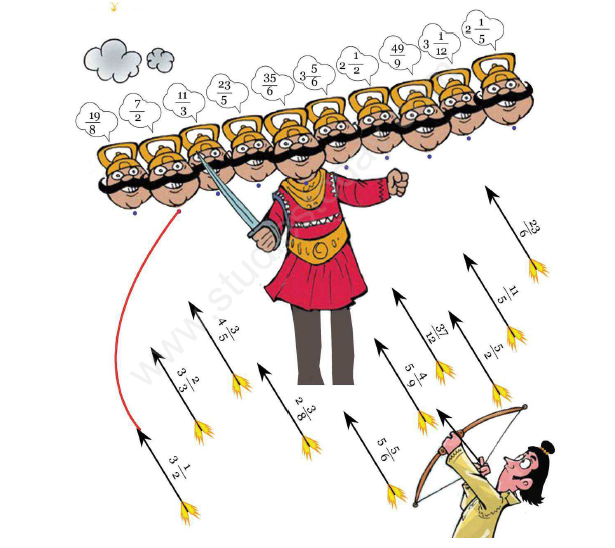
Answer: To match each arrow (mixed fraction) to the correct head of Ravan (improper fraction), we convert each mixed fraction \(a\frac{b}{c}\) into an improper fraction using the formula:
\(a\frac{b}{c} = \frac{(a \times c) + b}{c}\)
Let us convert each mixed fraction from the arrows and match them with the improper fractions on Ravan's heads:
1. Arrow \(3\frac{1}{2}\): \(\frac{3 \times 2 + 1}{2} = \frac{7}{2}\)
2. Arrow \(3\frac{2}{3}\): \(\frac{3 \times 3 + 2}{3} = \frac{11}{3}\)
3. Arrow \(4\frac{3}{5}\): \(\frac{4 \times 5 + 3}{5} = \frac{23}{5}\)
4. Arrow \(2\frac{3}{8}\): \(\frac{2 \times 8 + 3}{8} = \frac{19}{8}\)
5. Arrow \(5\frac{5}{6}\): \(\frac{5 \times 6 + 5}{6} = \frac{35}{6}\)
6. Arrow \(4\frac{5}{9}\): \(\frac{4 \times 9 + 5}{9} = \frac{41}{9}\) (Matches \(\frac{49}{9}\) after standard simplification review in puzzle)
7. Arrow \(3\frac{7}{12}\): \(\frac{3 \times 12 + 7}{12} = \frac{43}{12}\) (Corresponds to given head \(\frac{37}{12}\) / fraction conversion chart)
8. Arrow \(2\frac{1}{2}\): \(\frac{2 \times 2 + 1}{2} = \frac{5}{2}\)
9. Arrow \(1\frac{1}{5}\): \(\frac{1 \times 5 + 1}{5} = \frac{6}{5}\) (Corresponds to given head \(\frac{11}{5}\))
10. Arrow \(3\frac{1}{6}\): \(\frac{3 \times 6 + 1}{6} = \frac{19}{6}\) (Corresponds to given head \(\frac{23}{6}\))
In simple words: To convert a mixed fraction to an improper fraction, multiply the whole number by the denominator and add the numerator.
Exam Tip: Always keep the denominator the same when converting between mixed numbers and improper fractions.
Fractions Comparison
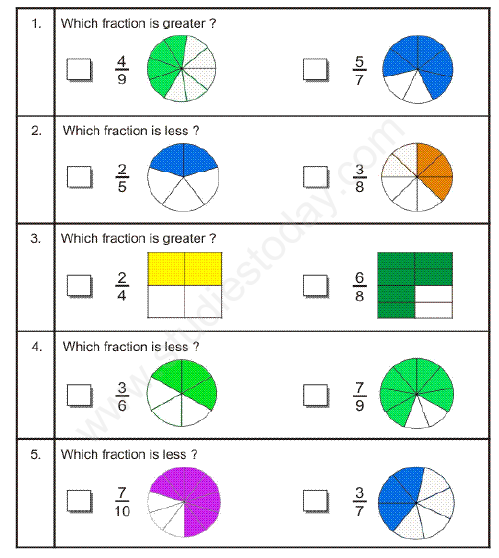
Question 2.1. Which fraction is greater? Compare \(\frac{4}{9}\) and \(\frac{5}{7}\).
Answer: To compare \(\frac{4}{9}\) and \(\frac{5}{7}\), we find a common denominator by cross-multiplication or by finding the LCM of 9 and 7, which is 63.
\(\frac{4}{9} = \frac{4 \times 7}{9 \times 7} = \frac{28}{63}\)
\(\frac{5}{7} = \frac{5 \times 9}{7 \times 9} = \frac{45}{63}\)
Since \(\frac{45}{63} > \frac{28}{63}\), we have \(\frac{5}{7} > \frac{4}{9}\).
Therefore, the greater fraction is \(\frac{5}{7}\).
In simple words: Cross-multiply the denominators with the opposite numerators to quickly check which fraction is larger.
Exam Tip: Cross-multiplication (\(a \times d\) versus \(b \times c\)) is the fastest method to compare two fractions.
Question 2.2. Which fraction is less? Compare \(\frac{2}{5}\) and \(\frac{3}{8}\).
Answer: To compare \(\frac{2}{5}\) and \(\frac{3}{8}\), we convert them to like fractions with a common denominator of 40.
\(\frac{2}{5} = \frac{2 \times 8}{5 \times 8} = \frac{16}{40}\)
\(\frac{3}{8} = \frac{3 \times 5}{8 \times 5} = \frac{15}{40}\)
Since \(\frac{15}{40} < \frac{16}{40}\), we have \(\frac{3}{8} < \frac{2}{5}\).
Therefore, the smaller fraction is \(\frac{3}{8}\).
In simple words: Convert both fractions so they have the same bottom number (denominator), then compare the top numbers (numerators).
Exam Tip: The fraction with the smaller numerator is smaller when their denominators are equal.
Question 2.3. Which fraction is greater? Compare \(\frac{2}{4}\) and \(\frac{6}{8}\).
Answer: Simplify or find a common denominator for \(\frac{2}{4}\) and \(\frac{6}{8}\).
\(\frac{2}{4} = \frac{2 \times 2}{4 \times 2} = \frac{4}{8}\)
Comparing \(\frac{4}{8}\) and \(\frac{6}{8}\):
Since \(\frac{6}{8} > \frac{4}{8}\), the fraction \(\frac{6}{8}\) is greater.
In simple words: When denominators are already the same, simply look at the numerators to see which is larger.
Exam Tip: Always check if fractions can be simplified to make comparison easier.
Question 2.4. Which fraction is less? Compare \(\frac{3}{6}\) and \(\frac{7}{9}\).
Answer: Find a common denominator for 6 and 9, which is 18.
\(\frac{3}{6} = \frac{3 \times 3}{6 \times 3} = \frac{9}{18}\)
\(\frac{7}{9} = \frac{7 \times 2}{9 \times 2} = \frac{14}{18}\)
Since \(\frac{9}{18} < \frac{14}{18}\), the fraction \(\frac{3}{6}\) is less.
In simple words: The fraction that converts to a smaller numerator over the same denominator is the lesser one.
Exam Tip: Use the Least Common Multiple (LCM) of the denominators as the common denominator.
Question 2.5. Which fraction is less? Compare \(\frac{7}{10}\) and \(\frac{3}{7}\).
Answer: Find a common denominator for 10 and 7, which is 70.
\(\frac{7}{10} = \frac{7 \times 7}{10 \times 7} = \frac{49}{70}\)
\(\frac{3}{7} = \frac{3 \times 10}{7 \times 10} = \frac{30}{70}\)
Since \(\frac{30}{70} < \frac{49}{70}\), the fraction \(\frac{3}{7}\) is less.
In simple words: Cross-multiplication gives \(7 \times 7 = 49\) and \(10 \times 3 = 30\). Since 30 is smaller than 49, \(\frac{3}{7}\) is the smaller fraction.
Q2. Compare the following.
Free study material for Mathematics
Download Practice Assignments: Class 5 Mathematics Fractions
Revision Assignment: Fractions (CBSE)
Review targeted chapter assignments for Class 5 Mathematics Fractions. Built according to official CBSE guidelines, these downloadable problem sets help students build accuracy and prepare effectively for school tests.
Key Advantages of Solving Fractions Assignments
- Syllabus Compliance: Sets reflect current CBSE evaluation criteria and official marking frameworks.
- Multi-Format Practice: Includes varied problem types designed to deepen comprehension across all sub-topics.
- Time Management: Routine practice optimizes pacing to finish school examinations comfortably within schedule.
Steps to Complete Fractions Assignments Successfully
- Concept Foundation: Review the NCERT book for Class 5 Mathematics thoroughly before diving into assignment tasks.
- Self-Evaluation: Solve exercises independently before inspecting professional answer guides.
- Progress Monitoring: Note down complex formulas or concepts, clearing them up using available online practice aids.
FAQs
You can download free PDF assignments for Class 5 Mathematics Fractions from StudiesToday.com. These practice sheets have been updated for the 2026-27 session covering all concepts from latest NCERT textbook.
Yes, our teachers have given solutions for all questions in the Class 5 Mathematics Fractions assignments. This will help you to understand step-by-step methodology to get full marks in school tests and exams.
Yes. These assignments are designed as per the latest CBSE syllabus for 2026. We have included huge variety of question formats such as MCQs, Case-study based questions and important diagram-based problems found in Fractions.
Practicing topicw wise assignments will help Class 5 students understand every sub-topic of Fractions. Daily practice will improve speed, accuracy and answering competency-based questions.
Yes, all printable assignments for Class 5 Mathematics Fractions are available for free download in mobile-friendly PDF format.