

Download the latest CBSE Class 12 Chemistry The P Block Elements Notes Set 03 in PDF format. These Class 12 Chemistry revision notes are carefully designed by expert teachers to align with the 2026-27 syllabus. These notes are great daily learning and last minute exam preparation and they simplify complex topics and highlight important definitions for Class 12 students.
Revision Notes for Class 12 Chemistry Unit 07 The p-Block Elements
To secure a higher rank, students should use these Class 12 Chemistry Unit 07 The p-Block Elements notes for quick learning of important concepts. These exam-oriented summaries focus on difficult topics and high-weightage sections helpful in school tests and final examinations.
Unit 07 The p-Block Elements Revision Notes for Class 12 Chemistry
Anomalous behaviour of first member of
p-Block Elements
Anomalous behaviour of first element in the p-block elements is attributed to small size, large (charge/radius) ratio, high ionization enthapy, high electronegativity and unavailability of d-orbitals in its valance shell.
Consequences :
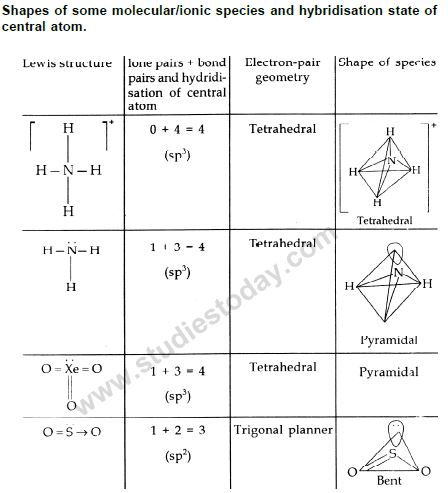
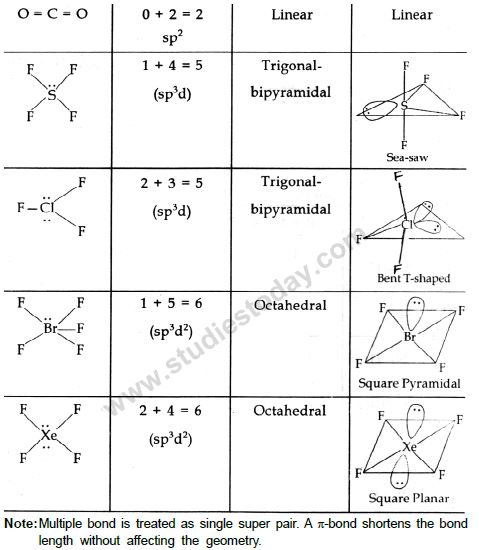
1. The first element in p-block element has four valence orbitals i.e. one 2s and three 2p, Hence maximum covalency of the first element in limited to four. The other elements of the p-block elements have vacant d-orbitals in their valence shell, e.g. elements of the third period have nine (9) one 3s, three 3p and five three 3d orbitals. Hence these show maximum covalence greater than four. Following questions can be answered -
(i) Nitrogen (N) does not from pentahalide while P froms PCl5, PF5, and PF6 –. Why?
(ii) Sulphur (S) forms SF6 but oxygen does not form OF6. Why?
(iii) Though nitrogen forms pentoxide but it does not form pentachloride. Explain. Why?
(iv) Fluorine forms only one oxoacid while other halogens form a number of oxoacids. Why?
(2) The first member of p-block elements displays greater ability to from pπ- pπbond (s) with itself, (e.g., C = C, C ≡C, N = N, N ≡N) and with the other elements of second period (e.g., C = O, C ≡N, N = O) compared to the subsequent members of the group.
This is because p-orbitals of the heavier members are so large and diffuse that they cannot have effective sideways overlapping. Heavier members can form pπ– dπbonds with oxygen.
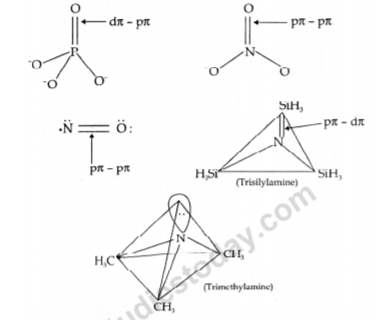
Now, the following questions can be explained using the above reasoning-
(i) Nitrogen forms N2 but phosphorus forms P4 at room temperature. Why?
(ii) Oxygen forms O2 but sulphur exists as S8. Why?
(iii) Explain why (CH3)3 P = O is known but (CH3)3 N = O is not known.
3. Due to small size and high electronegativity and presence of lone pair(s) of electrons, elements N, O, F when bonded to hydrogen atom, forms intermolecular hydrogen bonds which are stronger than other intermolcular forces. This results in exceptionally high m.p. and b.p. of the compounds having N–H/O–H/F–H bonds.
Please click the link below to download pdf file for CBSE Class 12 Chemistry notes and questions for The p block Elements Part D.
Free study material for Chemistry
CBSE Class 12 Chemistry Unit 07 The p-Block Elements Notes
Students can use these Revision Notes for Unit 07 The p-Block Elements to quickly understand all the main concepts. This study material has been prepared as per the latest CBSE syllabus for Class 12. Our teachers always suggest that Class 12 students read these notes regularly as they are focused on the most important topics that usually appear in school tests and final exams.
NCERT Based Unit 07 The p-Block Elements Summary
Our expert team has used the official NCERT book for Class 12 Chemistry to design these notes. These are the notes that definitely you for your current academic year. After reading the chapter summary, you should also refer to our NCERT solutions for Class 12. Always compare your understanding with our teacher prepared answers as they will help you build a very strong base in Chemistry.
Unit 07 The p-Block Elements Complete Revision and Practice
To prepare very well for y our exams, students should also solve the MCQ questions and practice worksheets provided on this page. These extra solved questions will help you to check if you have understood all the concepts of Unit 07 The p-Block Elements. All study material on studiestoday.com is free and updated according to the latest Chemistry exam patterns. Using these revision notes daily will help you feel more confident and get better marks in your exams.
FAQs
You can download the teacher prepared revision notes for CBSE Class 12 Chemistry The P Block Elements Notes Set 03 from StudiesToday.com. These notes are designed as per 2026-27 academic session to help Class 12 students get the best study material for Chemistry.
Yes, our CBSE Class 12 Chemistry The P Block Elements Notes Set 03 include 50% competency-based questions with focus on core logic, keyword definitions, and the practical application of Chemistry principles which is important for getting more marks in 2026 CBSE exams.
Yes, our CBSE Class 12 Chemistry The P Block Elements Notes Set 03 provide a detailed, topic wise breakdown of the chapter. Fundamental definitions, complex numerical formulas and all topics of CBSE syllabus in Class 12 is covered.
These notes for Chemistry are organized into bullet points and easy-to-read charts. By using CBSE Class 12 Chemistry The P Block Elements Notes Set 03, Class 12 students fast revise formulas, key definitions before the exams.
No, all study resources on StudiesToday, including CBSE Class 12 Chemistry The P Block Elements Notes Set 03, are available for immediate free download. Class 12 Chemistry study material is available in PDF and can be downloaded on mobile.