

Download Class 12 Chemistry Concept Summaries: CBSE Class 12 Chemistry Important Formulas All Chapters
Review targeted revision notes for Class 12 Chemistry with the CBSE Class 12 Chemistry Important Formulas All Chapters. Built according to official educational guidelines for the 2026-27 academic year, these downloadable summaries for All topics support daily study and last-minute exam readiness.
Access All topics Notes and Study Material
View or download the dedicated All topics revision resource below. Engaging with these structured concept notes daily ensures continuous academic progress and mastery of the 2026-27 curriculum for Chemistry.
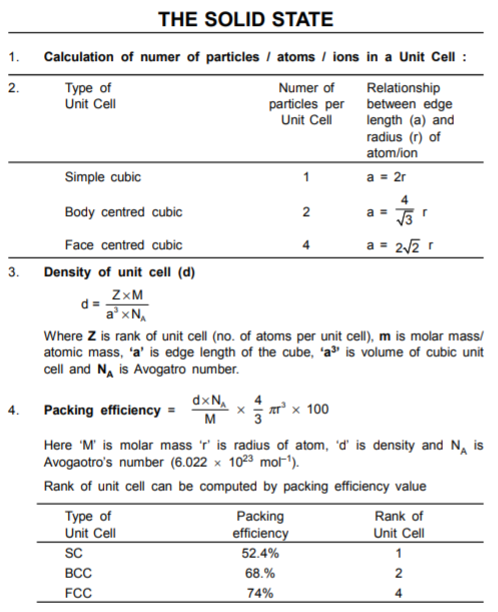
Chapter 1: The Solid State
Number of Atoms per Unit Cell
- Simple Cubic (SC): 1 atom per unit cell, edge length \( a = 2r \)
- Body Centred Cubic (BCC): 2 atoms per unit cell, \( a = \dfrac{4r}{\sqrt{3}} \)
- Face Centred Cubic (FCC): 4 atoms per unit cell, \( a = 2\sqrt{2}\, r \)
Density of Unit Cell
\[ d = \frac{Z \times M}{a^3 \times N_A} \] where \( Z \) = number of atoms per unit cell, \( M \) = molar mass, \( a \) = edge length, \( N_A \) = Avogadro's number.
Packing Efficiency
\[ \text{Packing Efficiency} = \frac{Z \times \dfrac{4}{3}\pi r^3}{a^3} \times 100\% \]
- SC: 52.4% | BCC: 68% | FCC/HCP: 74%
Chapter 2: Solutions
Concentration Terms
\[ \text{Mole Fraction of A: } x_A = \frac{n_A}{n_A + n_B} \] \[ \text{Molarity (M)} = \frac{\text{Moles of solute}}{\text{Volume of solution (L)}} \] \[ \text{Molality (m)} = \frac{\text{Moles of solute}}{\text{Mass of solvent (kg)}} \] \[ \text{ppm} = \frac{\text{Mass of component}}{\text{Total mass of solution}} \times 10^6 \]
Raoult's Law
\[ p_A = p_A^{\circ}\, x_A \qquad p_B = p_B^{\circ}\, x_B \] \[ p_{\text{total}} = p_A^{\circ}\, x_A + p_B^{\circ}\, x_B \]
Colligative Properties
\[ \frac{p^{\circ} - p_s}{p^{\circ}} = x_{\text{solute}} \quad \text{(Relative lowering of vapour pressure)} \] \[ \Delta T_b = i \cdot K_b \cdot m \quad \text{(Elevation of boiling point)} \] \[ \Delta T_f = i \cdot K_f \cdot m \quad \text{(Depression of freezing point)} \] \[ \pi = i\,C\,R\,T \quad \text{(Osmotic pressure)} \]
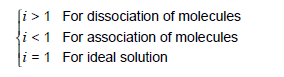
Van't Hoff Factor
\[ i = \frac{\text{Observed colligative property}}{\text{Theoretical colligative property}} = \frac{\text{Normal molar mass}}{\text{Abnormal molar mass}} \]
- \( i > 1 \): dissociation | \( i < 1 \): association | \( i = 1 \): ideal
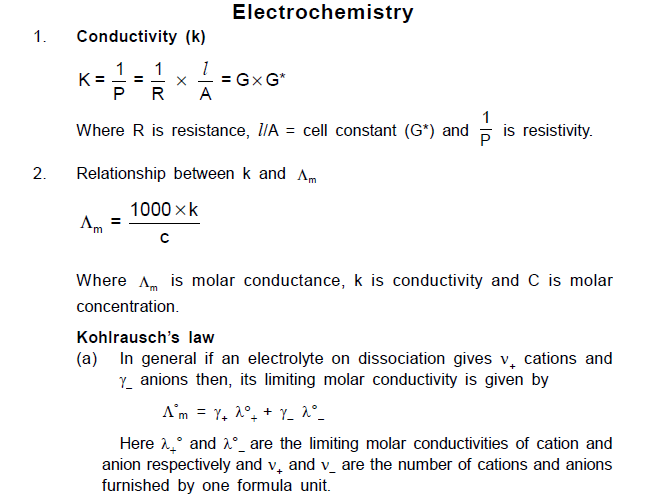
Chapter 3: Electrochemistry
Conductivity
\[ \kappa = \frac{1}{\rho} = G \times G^* \qquad \text{where } G^* = \frac{l}{A} \text{ (cell constant)} \] \[ \Lambda_m = \frac{\kappa \times 1000}{C} \]
Kohlrausch's Law
\[ \Lambda_m^{\circ} = \lambda^{\circ}_{+} + \lambda^{\circ}_{-} \] \[ \Lambda_m = \Lambda_m^{\circ} - K\sqrt{C} \quad \text{(for strong electrolytes)} \]
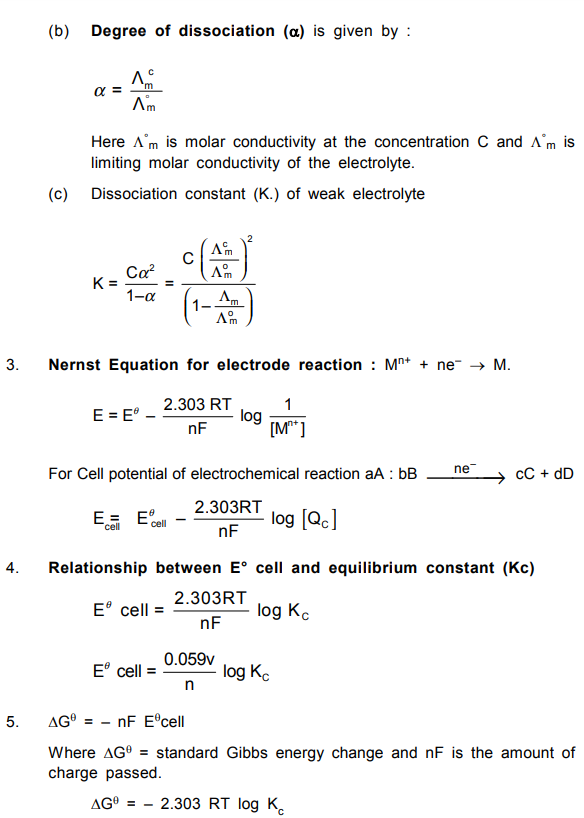
Degree of Dissociation
\[ \alpha = \frac{\Lambda_m}{\Lambda_m^{\circ}} \]
Faraday's Laws
\[ m = Z \cdot I \cdot t \qquad Z = \frac{M}{n \times F} \] where \( F = 96500 \) C/mol, \( n \) = number of electrons.
Nernst Equation
\[ E_{\text{cell}} = E^{\circ}_{\text{cell}} - \frac{RT}{nF} \ln Q = E^{\circ}_{\text{cell}} - \frac{0.0591}{n} \log Q \quad \text{(at 298 K)} \]
Gibbs Energy and EMF
\[ \Delta G^{\circ} = -nFE^{\circ}_{\text{cell}} \] \[ \Delta G^{\circ} = -RT \ln K \qquad \Rightarrow \quad E^{\circ}_{\text{cell}} = \frac{0.0591}{n} \log K \quad \text{(at 298 K)} \]
Chapter 4: Chemical Kinetics
Rate of Reaction
\[ \text{Rate} = -\frac{1}{a}\frac{d[A]}{dt} = -\frac{1}{b}\frac{d[B]}{dt} = \frac{1}{c}\frac{d[C]}{dt} \] \[ \text{Rate} = k[A]^m[B]^n \]
Integrated Rate Laws
Zero order: [ [A]_t = [A]0 - kt \qquad t{1/2} = \frac{[A]_0}{2k} ] First order: [ \ln[A]_t = \ln[A]_0 - kt \qquad k = \frac{2.303}{t}\log\frac{[A]_0}{[A]t} \qquad t{1/2} = \frac{0.693}{k} ]
Arrhenius Equation
\[ k = A\,e^{-E_a/RT} \] \[ \log\frac{k_2}{k_1} = \frac{E_a}{2.303\,R}\left(\frac{T_2 - T_1}{T_1 T_2}\right) \]
Chapter 5: d and f Block Elements
No major numerical formulas - key expressions to remember:
\[ \mu = \sqrt{n(n+2)} \text{ B.M.} \quad \text{(magnetic moment, where } n = \text{unpaired electrons)} \]
Chapter 6: Coordination Compounds
Stability Constant
\[ K_f = \frac{[\text{Complex}]}{[\text{Metal ion}][\text{Ligand}]^n} \]
Higher \( K_f \) = more stable complex. Crystal Field Splitting: \( \Delta_o \) (octahedral) and \( \Delta_t \) (tetrahedral), with \( \Delta_t = \dfrac{4}{9}\Delta_o \).
Chapter 7: Haloalkanes and Haloarenes
No major numerical formulas. Key reaction types for board exams:
- SN1 reaction: rate = \( k[\text{RX}] \) (first order, carbocation intermediate)
- SN2 reaction: rate = \( k[\text{RX}][\text{Nu}^-] \) (second order, backside attack)
- Optical rotation: \( [\alpha] = \dfrac{\alpha}{l \times c} \) where \( l \) = path length (dm), \( c \) = concentration (g/mL)
Chapter 8: Alcohols, Phenols and Ethers
No direct numerical formulas. Key relation for acidic strength:
- Acidic strength order: Phenol > Water > Alcohol
- \( \text{pKa} \): Phenol ≈ 10 | Alcohol ≈ 16–18
- Lucas test distinguishes 1°, 2°, 3° alcohols - reaction rates follow: 3° > 2° > 1°
Chapter 9: Aldehydes, Ketones and Carboxylic Acids
- Acidic strength of carboxylic acids increases with electron-withdrawing groups on the \( \alpha \)-carbon
- \( \text{pKa} \) of acetic acid = 4.74
- Cannizzaro reaction (for aldehydes with no \( \alpha \)-H): disproportionation
- Aldol condensation: requires \( \alpha \)-hydrogen - product is \( \beta \)-hydroxy aldehyde/ketone
Chapter 10: Amines
Basicity
\[ K_b = \frac{[BH^+][OH^-]}{[B]} \qquad \text{pKb} = -\log K_b \]
- Basic strength order (in water): aliphatic amines > NH3 > aromatic amines
- Aniline is a much weaker base than aliphatic amines due to lone pair delocalisation into benzene ring
Diazonium Salt
\[ \text{ArNH}_2 \xrightarrow{\text{NaNO}_2/\text{HCl, 0--5°C}} \text{ArN}_2^+\text{Cl}^- \]
Chapter 11: Biomolecules
No numerical formulas - key structural facts:
- Glucose molecular formula: \( \text{C}_6\text{H}_{12}\text{O}_6 \)
- Sucrose: Glucose + Fructose (non-reducing sugar)
- Peptide bond: \( -\text{CO}-\text{NH}- \) (formed between –COOH and –NH2 groups)
- DNA: deoxyribose sugar + phosphate + nitrogenous bases (A, T, G, C)
- RNA: ribose sugar + phosphate + bases (A, U, G, C)
Solution
1. Mole fraction (x)
if the number of moles of A and B are nA and nB respectrively, the mole fraction of A and B will be
XA= X/nA+nB , AND XB = nB / nA+nB
2. Molarity (M) = Moles of solute/ Volume of solution in litres
3. Moality (m) = Moles of solute / Mass of solvent in kilograms
4. Parts per million (ppm) = Number of parts of the component 106 /Total number of parts of all components of the solution
5. Raoult’s law for a solution of volatile solute in volatile solvent :
pA = pA° xA
pB = pB° xB
Where pA and pB are partial vapour pressures of component ‘A’ and component ‘B’ in solution. pA° and pB° are vapour pressures of pure components ‘A’ and ‘B’ respectively.
6. Raoults law for a solution of non-volatile solute and volatile solvent :
p °A – p °A/ p °A = i nB /nA = i WB* MA / MB* WA (for dilute solution)
Where xB is mole fraction of solute, i is van’t Hoff factor and A A
p °A – p °A / pA ° IS Nrelative lowering of vapour pressure.
Chemical Kinetics
1. Integrated rate law equation for zero order reaction
(a) k = [R]º[R]/t
Where k is rate constant and [R]0 is initial molar concentration.
(b) t1/2 = [R]º/2k
t1/2 is half life period of zero order reaction.
2. Integrated rate law equation for first order reaction
(a) k = 2.303/k log [R]º/[R]
Where k is rate constant, [R]° is initial molar concentration and [R] is final concentration at time ‘t’.
(b) Half life period (t1/2) for first order reaction :
t1/2 = 0.693/k
3. Anhenius epuation
(a) k = Ae –Ea/RT
Where ‘A’ is frequency factor, Ea is the energy of activation, R is universal gas contant and T is absolute temperature.
–Ea/RT gives the fraction of collisions having energy equal to or greater than Ea.
(b) log k1/k2 = Ea/ 2.303 R (T2 - T1/T1 - T2)
Where k1 is rate constant at temperature T1 and k2 is rate constant at temperature T2.
Please click the link below to download pdf file for CBSE Class 12 Chemistry - Important Formulas all chapters.
Free study material for Chemistry
Study Material and Revision Notes for Class 12 Chemistry All topics
About All topics Revision Notes
Explore reliable chapter overviews for All topics tailored for Class 12 learners. Use these structured points to grasp difficult themes and ensure solid preparation for upcoming assessments.
How to Use These Revision Notes
Cross-reference your comprehension with comprehensive NCERT solutions for Class 12 to ensure absolute clarity across all sub-topics in this chapter.
Enhance Practice with MCQs and Worksheets
Wrap up your chapter revision by testing your knowledge against standard question formats. Everything on our platform is provided free of charge.
FAQs
You can download the teacher prepared revision notes for CBSE Class 12 Chemistry Important Formulas All Chapters from StudiesToday.com. These notes are designed as per 2026-27 academic session to help Class 12 students get the best study material for Chemistry.
Yes, our CBSE Class 12 Chemistry Important Formulas All Chapters include 50% competency-based questions with focus on core logic, keyword definitions, and the practical application of Chemistry principles which is important for getting more marks in 2026 CBSE exams.
Yes, our CBSE Class 12 Chemistry Important Formulas All Chapters provide a detailed, topic wise breakdown of the chapter. Fundamental definitions, complex numerical formulas and all topics of CBSE syllabus in Class 12 is covered.
These notes for Chemistry are organized into bullet points and easy-to-read charts. By using CBSE Class 12 Chemistry Important Formulas All Chapters, Class 12 students fast revise formulas, key definitions before the exams.
No, all study resources on StudiesToday, including CBSE Class 12 Chemistry Important Formulas All Chapters, are available for immediate free download. Class 12 Chemistry study material is available in PDF and can be downloaded on mobile.